

By Tang Ziya Rena (27A01B) and Aidan Tan (27A01D)
This article is part of a series of revisions to Raffles Press’ Please Mind the Platform Gap, intended to refresh dated information while retaining the core structure. For our previous feature on H2 Literature, please click here.
All information provided here is accurate as of the time of writing.
This article does not necessarily reflect the views of RI’s academic management and should not be used as a substitute for formal academic counselling.
TLDR: You should take Lit.
“I have as much soul as you, – and full as much heart!”
Charlotte Brontë, Jane Eyre
What does it mean to be human? To rejoice, to love, to suffer.
Perhaps to be recognised as someone worthy of dignity.
In Jane Eyre, the eponymous Jane challenges the societal hierarchies that seek to diminish her. Struggles like this are universal across the literary canon, and make it ever so endearing. Beneath the flowery language and complicated diction, at the very core of it all, lie questions that resonate deeply with us as humans.
What is the H2 Lit syllabus like?
The current H2 Lit syllabus is sectioned into two papers: Paper 1 is titled “Reading Literature”, comprising poetry, prose, and drama sections, and Paper 2 focuses on literature from the English Romantic Period (1785-1832).
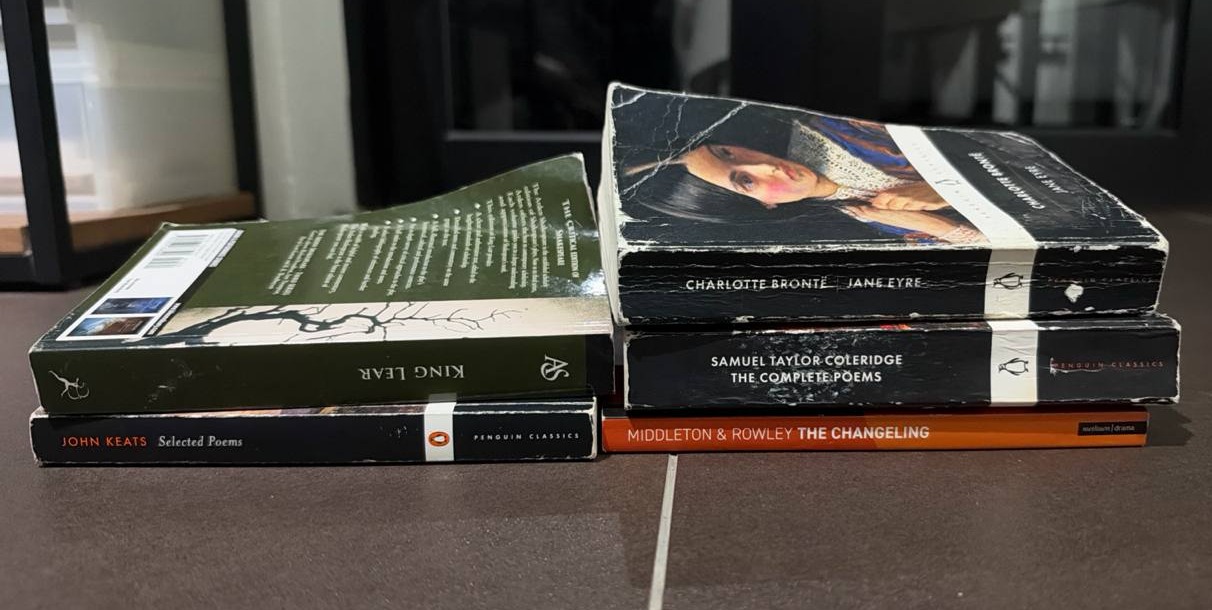
The current Paper 1 and Paper 2 texts in RI’s syllabus consist of Jane Eyre by Charlotte Brontë (Paper 1 prose), The Changeling by Thomas Middleton and William Rowley (Paper 1 drama), King Lear by William Shakespeare (Paper 2 drama) and selected Romantic poems (Paper 2 poetry).
In particular, the selected Romantic poems for Paper 2 poetry comprise around 21 poems by Samuel Taylor Coleridge and 25 poems by John Keats.
In Year 5, students study Jane Eyre, around half of the selected Romantic poems by John Keats and Samuel Taylor Coleridge, and unseen poetry.
In Year 6, students study the remaining texts, namely The Changeling and King Lear, along with the rest of the selected Romantic poems and unseen prose and drama.
What are exams like?
Examinations involve two three-hour-long papers, each contributing equally to your final A-Level grade. Each paper includes three 25-mark questions.
In Paper 1, Section A (Poetry) provides you with two pairs of unseen poems, from which you select one pair to compare and analyse.
Sections B (Prose) and C (Drama) assess Jane Eyre and The Changeling respectively. While essay questions require students to construct broader arguments on themes or characters across the text as a whole, Passage Based Questions (PBQs) demand closer analysis of a specific extract, relating its significance to the work as a whole.
While Paper 1 remains relatively unchanged from 2022, Paper 2 has shifted its focus from Renaissance Literature to Romantic Literature.
Section A now includes an unseen prose passage and an unseen drama passage, and students must analyse one. Section B deals with the works of Keats and Coleridge, and students should reference both works in their essay response. Moving on to Section C, King Lear is to be analysed in response to one of two essay questions.
Zooming in on exam conditions
The Lit exams are open book, but maybe not in the way that you’d expect. Students are permitted to enter the examinations with a clean copy of their set texts. This means that any annotations are strictly prohibited except for underlined, highlighted and vertical lines. In other words, having the entire text with you does not mean having it at your fingertips.
Another recent change to A-Level Literature is the digital examination format. Now, candidates receive their question papers in hard copy but type their responses on a laptop.
“The digital format helps me arrange my ideas more easily and allows me to write later parts of my essay first… exams feel less stressful.”
Anonymous Y5 student
Okay… So what are lessons actually like?
If you think of Literature lessons as an hour of quiet reading, you’re in for a surprise.
While delving into the set texts independently is important, it is a mere prerequisite. Much of the actual learning takes place through rigorous discussions on the works, and students are encouraged to offer their alternative interpretations in lessons.
Unlike other subjects, H2 Literature in particular has more room for discussion. A character’s actions may seem justified to one reader but morally questionable to another. More importantly, we delve into why and how the author achieves their intended effect.
Some lessons, like Unseen, are held in Lecture Theatres. This means there is less room for discussion, and your attention turns to the tutors who go through texts with the class.
How do you study for Lit?
Here are a few of our recommendations:
- Familiarise yourself with the texts. You need to have a good grasp of your texts to be able to pull information about them from your memory in a moment’s notice during exams!
- Contact your seniors for their notes and resources! Materials compiled by other students can give you a good starting point when approaching new texts
- Turn to online resources for additional interpretations (LitCharts, SparkNotes, etc.) (Note that not all online interpretations may be aligned with the Cambridge and RI syllabus)
- Consult your tutors. They can give you the most targeted advice catered to your personal progress in relation to RI’s syllabus.
- Consistently annotate your texts and consolidate important events and themes throughout the year! Don’t let your work pile up, or you’ll surely regret it if you run out of time by the time exams roll around.
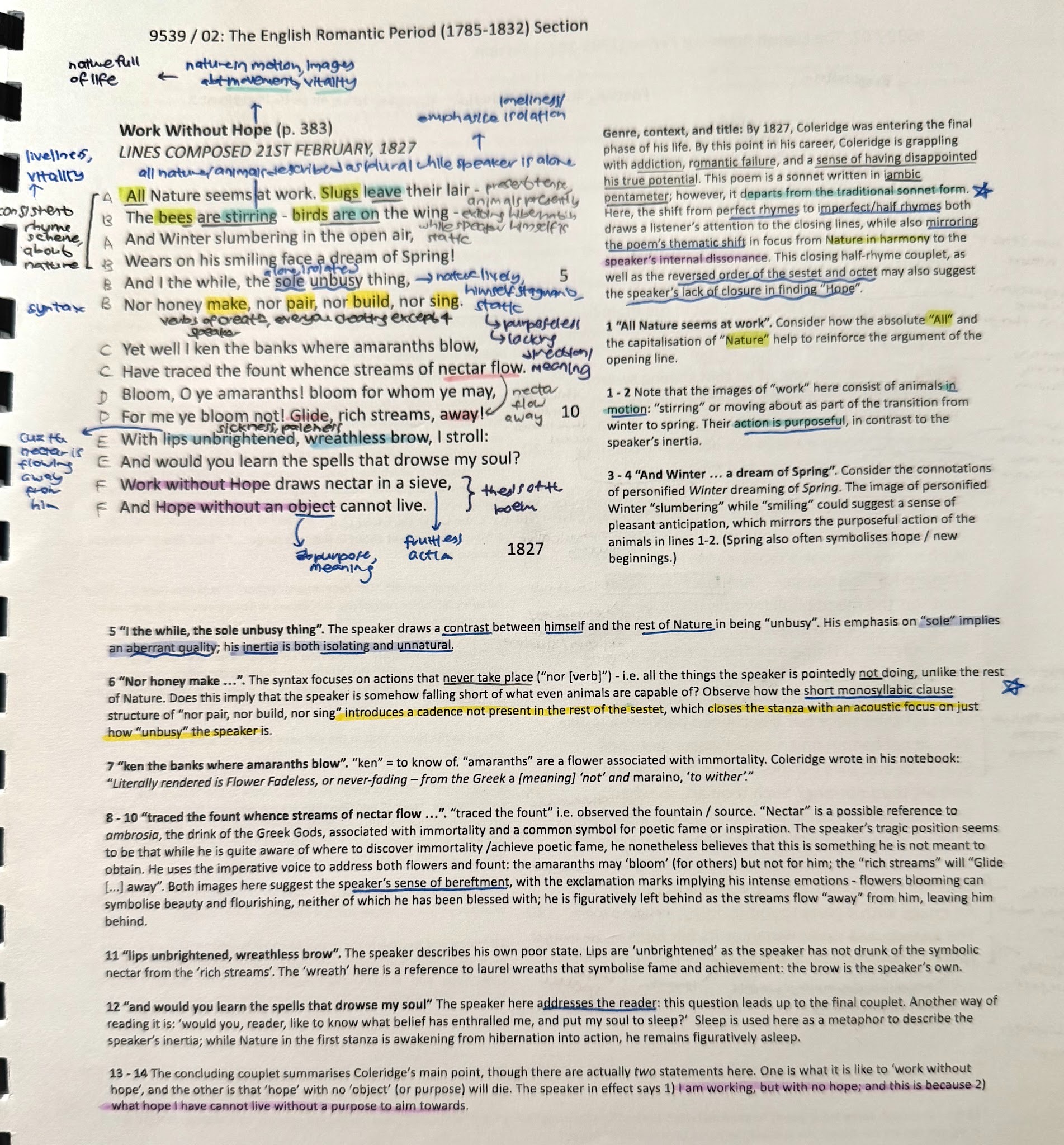
A photo of our poem annotations!
Should you take Lit after not having done so in secondary school?
To that question, we say, why not? The authors of this article are not extremely well-equipped to answer this question, as we both studied Lit in Year 3 and 4, but there are definitely many students who enjoy JC Lit despite not having previously taken it!
After speaking with our peers, they reflect that though the jump is considerable, it is ultimately conquerable! For new Lit takers, the most important thing is not to shy away from reaching out for help and to address any questions or doubts you have at an early stage. Furthermore, teachers are also aware of the jump and will be there to guide you throughout your journey. There’s no shame in experiencing difficulties, and the more proactive you are, the better you will become!
Now, why should you study Lit?
The H2 Literature GCE syllabus document states:

While these statements may seem like lofty goals, after a year of taking JC Lit, we can safely say that they aren’t far from the truth! Literature is famously quoted as “the study of the human condition” and “the mirror of society”, and with good reason!
The love for literature is what keeps us Lit students going. Even when we pull Cs and Ds for our papers, regret isn’t something that crosses our minds.
Literature is deeply riveting and, as the previous Please Mind the Platform Gap article for taking H2 Lit states, it is a timeless art that allows us to contemplate the lives of others and, in turn, the lives of our own.


