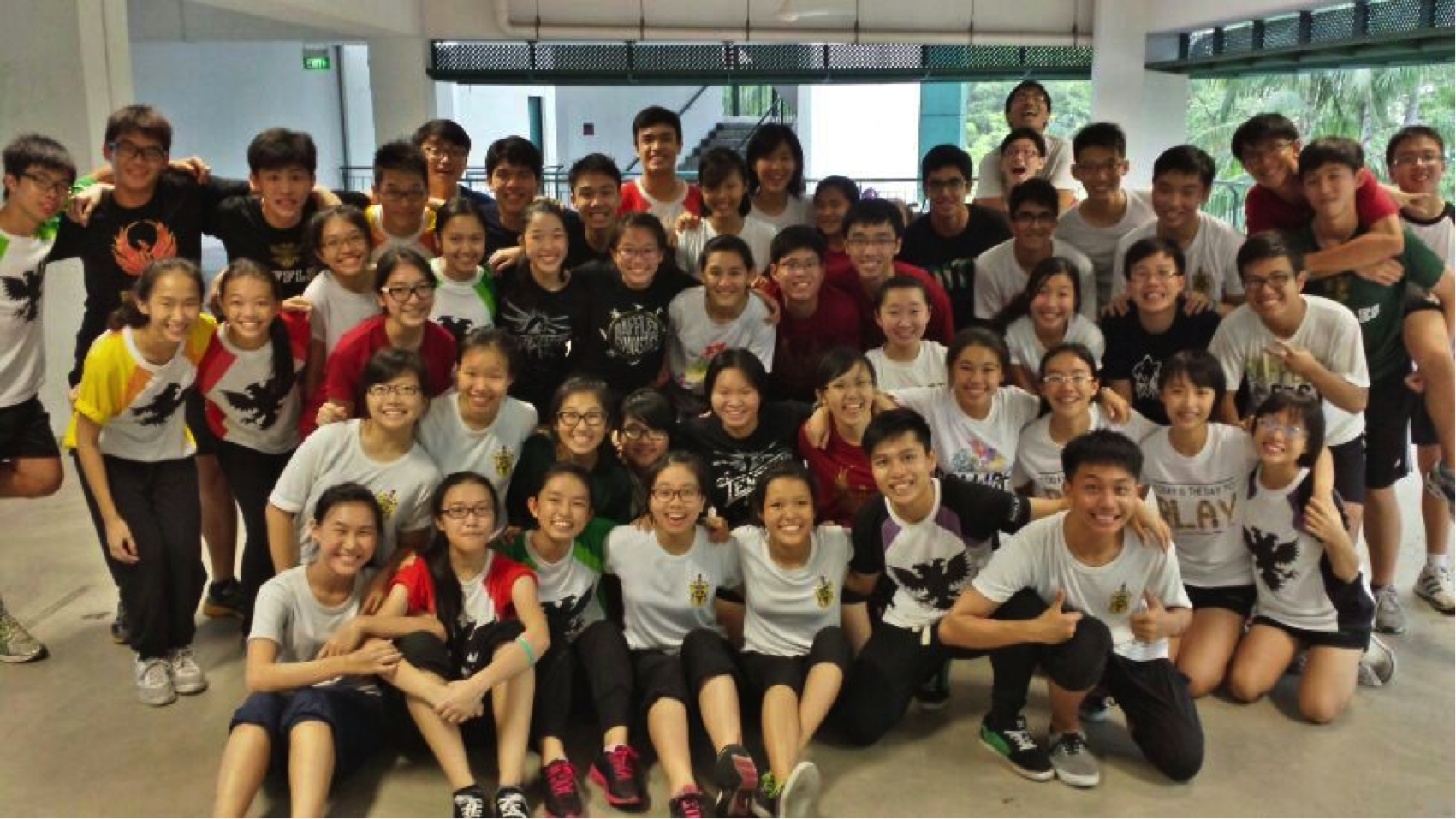
Hustle, hit and never quit: Raffles Hockey Rises To the Top

Reading Time: 6 minutes

By Joshua Tee (15A01D) and Solihin Samsuri (15A01D)
Photos by Gabrielle Jeyaseelan (15S06A)

Boys

hockey1

The last time RI Hockey managed to secure both places in double finals was nearly a decade ago, whereas a double gold had not been attained for over 15 years. Considering the past six to seven seasons of near-misses, dubious decisions and arduous preparations, victory  tasted especially sweet for the Year 6 boys of Raffles Institution (RI) Hockey, who emerged undefeated from this year’s Inter-school National A Division Championships. Bowling over Anglo-Chinese Junior College (ACJC), the imposing score line of 6-0 at the end of 60 minutes was a true reflection of the sheer calibre, discipline and perseverance exemplified by the team as a whole.

Standing strong: RI poised to take a short corner.

Having just ousted the reigning Victoria Junior College, ACJC, whom Raffles previously faced off with in the preliminary round, seemed more inclined to pose a larger threat at such a level of competition. Determined to seize the title after a narrow defeat via penalties last year, morale ran high amongst the players who were “motivated and pumped up” to exhibit the best of their abilities.

Rishi’s resilience: A rock in safeguarding the Raffles goal.

Keeping to a predetermined structure that minimised unnecessary passes, a focused RI side enjoyed comfortable possession of the ball, allowing for early breaks into the D courtesy of left back, Harshvir Singh. Paired alongside the dominating presence of vice-captain Rishi Ramathas who held his own against sudden counter-attacks, Benjamin Ang was a relentless force that did not balk to hinder any hint of opposition. Maintaining fluid control of the ball in check, a tight defence swiftly converted into an aggressive assault spearheaded by captain Ahmad Ashraf who drew first blood with a resounding shot through the keeper’s legs.

Harshvir coolly diverting the ball upfield.
Harshvir coolly diverting the ball upfield

In response, ACJC’s Gerald Goh swung in a precarious lone strike outside the shooting arc that was disallowed much to the obvious relief of the supporters present. Reeling from such a brash attempt at goal, Raffles redoubled their efforts in their monopoly of midfield with central midfielder Muhammad Ramzi deftly setting up Mohamed Haseef who dribbled along the baseline and coaxed another one in. Proclaiming the match to be the team’s “best performance” this season, Ashraf’s fervour in slotting in an optimum number of goals shone through with a formidable dive which deflected the ball straight into the net.

Ashraf and Benjamin taking aim

Even the slightest falter in defence was optimised; at one point, ACJC’s Gerald went head-to-head with RI goalkeeper, Ram Kumar who stepped up and instinctively kicked the ball out of harm’s way. Truly, the team persisted in asserting their well-earned dominance of the game even throughout the second half when ACJC made a more concerted effort to regain their footing.

Ramzi weaving through a congested ACJC defence

Nevertheless, Anglo-Chinese’s close-knit passing did not achieve the equilibrium they aspired for, only to incite a fervent Rafflesian offensive that drilled home their advantage. Easily intercepting and bursting through the opponents’ ranks, it was Ramzi’s confident ball play and Haseef’s precise cross that assisted left winger Gurveer Singh in putting another one past the keeper. Instead of yielding their momentum, the goal finding frenzy intensified by a twofold – via a rebound shot by Ashraf and the combined effort of forwards Yeung Jek and Anirudh Srivathsan in the last few minutes of the game.

Later attributing RI’s success with their tenacious adherence “to the game plan”, the sense of pride and camaraderie for his team was palpable as Ashraf commented, “The feeling [of victory] is indescribable. After so long, we finally did it!” In the face of two reckless green cards and crowd-wowing, mid-air-ball-stopping skills, we could not help but share the giddy sentiment.

Girls

hockey7

The beginning of the girls’ game was highly contested, with RI edging a slight positioning lead over the VJC team with regards to ball control, but both teams’ solid defences initially prevented any team to gain a written advantage through an open goal. However, a clean penalty corner led to VJC scoring the first goal of the match, but the advantage that VJC was hoping for soon disappeared after a clean penalty corner with a smooth pass through VJC’s defence equalised the score in favour of RI. The game reached half-time with an equal score of 1-1.

RI controlling the bll despite much pressure
RI controlling the ball despite much pressure

The second half of the game started with a quick succession of VJC penalty corners, forcing RI’s strong defence pressure to weaken and eventually concede goals. VJC also managed to take advantage of RI’s tight defensive structure, issuing passes which managed to allow them to take possession of the ball despite constant pressure.

Alert players start to move towards an approaching ball

Both teams were able to effectively deliver pressure to the opposing team, leading to a drought of open goals in the game. This was true both offensively and defensively, where defenders were quick to respond and goalkeeping from both sides was extremely solid. However, VJC was slightly more comfortable with gaining penalty corners, where defensive numerical pressures were severely reduced, which contributed to their lead over RI. By the end of the game, all of VJC’s goals had come from penalty corners, signifying their importance in the fiercely-contested finals of which VJC had eleven penalty corners – a large margin over RI’s two. Penalty corners were especially important in this game due to what it seems to be both teams eschewing unpredictable long-range passes for more accurate short-range passes. Additionally, VJC’s slight advantage in mobility in terms of responsiveness to unpossessed balls and interceptions led them to take the advantage in an otherwise equal game of skill.

RI succeeds in gaining possession, one-on-one

Unfortunately, the game was scarred with a double injury from the RI side, a rarity to most hockey games. During the second half of the game, RI’s Rebecca Kang received a direct impact from the  ball to above her right eye, collapsing immediately and had to be taken off the field. Following soon after was RI’s Beverly Goh, who received a severe debilitating cramp which led to her unable to continue playing. Despite two consecutive injuries, any dampening effect on moral was hardly noticeable in the field; RI’s team continued to play as hard as they had before.

The spectators react to the second unfortunate injury

Soon after the second injury occurred, the game ended with a final score of 1-5. Although the team might have lost in the end, the determination that the team demonstrated, especially when the team had lost two of its important players, remains admirable. Throughout the game, the RI team possessed both the perseverance and the team spirit worthy of any true sports team. Defender Arina Rashid echoes this sentiment, feeling that “I couldn’t have asked for more of any one of my teammates, and felt incredibly honoured to play alongside them.”

Interview Feature: Council Presidents

Reading Time: 14 minutes

By Kate Tan (15S03U), Chu Phuong Anh (15S06C) and Tan Su (15S07A)

‘Tis the season for handover, as the Year Sixes step down in preparation for their A-levels and the Year Fives take over the task of helming their various CCAs. But perhaps the most scrutinised handover would be that of the Student Council. After making it through Council selection and Council Camp, the Council President and House Captain nominees went on to campaign for their positions.

After a grueling week of campaigning and fielding questions from teachers and students alike, the Council Presidents and House Captains of 2014–2015 were announced. As journalists, we sought to find out more about the Council Presidents, in terms of their personality, opinions and visions for the school. The 34th Council Presidents are: Isaac Leong (IL), Chan Mae Yee (MY) and Cai Minglu (ML). They answered questions asked from us here at Raffles Press, and from the school population.

Continue reading “Interview Feature: Council Presidents”

Step Up! Never Dance Alone.

Reading Time: 3 minutes

Our writer at Raffles Press has written this review in response to the posting of a video by “The Mob” featuring “Step Up! 2014” (a dance workshop which they organised).

by Nicolas Baey (15S03F)

Outside LT1 is an empty, unassuming space, more commonly known as the ‘mirrors’; the atmosphere of this area is usually very laidback after school. But one particular afternoon, the mirrors were jam-packed with people learning to… you guessed it, dance. Step Up! 2014 was a hip hop dance workshop organised by “The Mob”  (an allusion to the protagonist dance crew in Step Up Revolution: The Movie) on 8 May after school. The workshop aimed to expose people to what dancing encapsulates — to feel the groove and express themselves.

More than 40 participants came down to the mirrors on the long-awaited day; their time did not go to waste.

First, there was the welcoming introduction of the dance instructors who would be guiding us through the choreography. They came in all-smiles and really set the mood for the whole event. There was also a short but important warm-up session. Stretching was a really important part of the process, as practicing without former preparation could cause you to pull a muscle. Many then took their first baby steps in following the tune of and matching their moves to the newly met dance instructors. The energy was invigorating with everyone shaking, stepping, leaping to the beat of “Now or Never” by Kendrick Lamar. The song itself was really upbeat with a repetitive melody that made it easier to follow. Some struggled; my psychomotor skills failed me as I mixed up my right arm for my left. Fellow participant Cayson Chong (15S07D), admits that he was really bad at dancing and “probably would never have dared to try dancing in front of so many people.” Nonetheless, everyone  was pumped up and ready to put in their best, even continuing to practice during the water breaks.

What was truly impressive about the whole event was the J2 instructors, or as they so enthusiastically call themselves, ‘The Mob’. The process of teaching their fellow batch mates and juniors was no mean feat, especially since the choreography had been finalized only a week prior to the event, as Nanshan Li (14S06B) pointed out. “We had to balance issues such as the length of the dance so people don’t tire out when it’s too long or lose out on the exposure when it’s too short.” However, the instructors felt really great to see that everyone enjoyed themselves and that at the end of the day, all their effort was really worth it. Nanshan also hopes that “all of the participants out there would want to expose themselves to more dance and not just let the workshop be the end of their passion.”

As Step Up’s motto goes, ‘We believe that everyone has a dancer in them- so why dance alone, and hide away the myriad of colour and potential waiting to be discovered?’ Even though the workshop was only 2 hours long, the inspiring talks that the various dancers gave about their humble beginnings gave us insight into what dance really is all about. One such example would be of Yao Cheng Hui (14S06K), who learnt the moves together with the rest of the participants. Although Cheng Hui is a bowler, he comes down to the mirrors to dance and have fun whenever he wants to kill time. When asked about his first experience dancing, he replied, “Well, it was really quite awkward at first because I wasn’t really that good at dancing.” But as he spent more time polishing his craft, Cheng Hui managed to learn more about dance and grow as a dancer.

The workshop was a great success as even though not everyone was able to perform the dance at 100%, we were all able to learn something at the end of the day. I was finally able to get a feeling of the ‘expression’ of dance even if it was only for a short while. As the workshop came to an end, everyone put their hands to the center to give one final resounding “Step Up!” for a final send-off.

You can watch the video of “Step Up! 2014” here:

《叙》: RICO presents a night of musical delights

Reading Time: 7 minutes

By Wilson Chan and Lorraine Fong (15A01C)
Photos by the Raffles Photographic Society

co1

On the 16th of May, Raffles Institution Chinese Orchestra (Year 5-6) (RICO) marked their return to the public limelight after two years with their highly anticipated concert, 《叙》 or Recollections. Held at the Singapore Conference Hall, Recollections explored the emotions one feels when reminiscing the nostalgic past, by balancing longing and heartfelt yearning with the joy of childhood memories. Juggling the complexities of blending Chinese melodies and Western harmonies, this specially-themed evening, coupled with the unconventional and unexpected use of instruments, enthralled audiences with both familiar tunes and ancient soundscapes. Just as how diverse and wide-ranging our recollections are, the varied repertoire that RICO presented shattered any misconceptions that the orchestra was limited in form or genre.

RICO opened with one of the main highlights of the evening – an enchanting medley incorporating some of the most inspiring and popular tunes from The Phantom of the Opera. Arranged by Mr. Tan Bing Liang, a ‘RICO alumnus-turned-dentist’, the medley started with a simple, yet reverberating keyboard solo of Masquerade. This simple melody seamlessly transitioned into an immersive orchestral playing of Think of Me. RICO continues to take us through this riveting journey with another effortless passage, where cellist Rui Chen (one out of six secondary 4 orchestral members) took on the role of Raoul, and Kim Ji Hwan (15A01C) the role of Christine in the heartwarming duet All I Ask of You. With the flawless solos of the cello and the gaohu (a smaller, higher-pitched version of the erhu), Ji Hwan commented how his maiden solo performance was “nerve-racking yet exhilarating at the same time”. The audience, which was busking in the romantic atmosphere, was mercilessly hurled into the sinister, dark world of the Phantom. The most iconic and stirring song, The Phantom Of the Opera, resounded forebodingly through the hall, drawing the audience into the mystery and dangerous unknown of the Phantom’s lair. The audience is then led from fear to a solemn, heart wrenching delivery of Wishing You Were Somehow Here Again, evoking sadness and sympathy in their hearts for the loss of Christine’s father in the original musical. RICO closed the medley with a self-descriptive piece, Music of the Night, as student conductor Benedict Lim faded the emotion-provoking medley into silence.  For a moment, the audience was left dumbfounded, but snapped out of their enchanted states to mask the silence with roaring applause.

As the main orchestra took their leave, a small chamber ensemble emerged onto the stage to perform their second piece, Dun Huang. Departing from the Broadway strains of Andrew Lloyd Webber, the audience was plunged into the mysterious and exotic locale of the Silk Road. Set against a rich and groovy accompaniment, influenced by the fusion of Indian and Western elements which capitalised on the unique sounds created by the pipa and the zhongruan, the whole musical landscape was inspired by the cultural melting pot of Dun Huang as a blend of both Eastern and Western styles. Furthermore, it functioned as an exciting and refreshing twist to the otherwise more commonplace pentatonic scale employed by traditional Chinese instruments. Beginning with a bangdi solo by Sue Jean, the small ensemble then drove the music forward passionately, shaping the seemingly dissonant notes into complementary layers of euphonious and energetic music. The intensity was then kicked up a notch when the performers started to rap on their respective instruments, conjuring a fast-paced rhythm which eventually culminated in rapid and furious playing, which concluded this colourful piece. Special mention should be given to these talented performers, who constantly had to follow each other’s pulses consistently in order to be synchronised with each other. The chemistry they had with each other was a testament to the amount of effort they had put in to perfect and to coordinate the entire piece of music.

The animated and spirited atmosphere kindled by Dun Huang was in stark contrast to the next piece that followed, Spring of the Seaside. This time, the number of instruments decreased to just two, as sheng soloist Nicholas Teo and pianist Chua Zhe Xuan commanded the stage with a quaint duet. The rolling of the arpeggiated chords of the piano symbolised the ebb and flow of the waves as it reaches the shore, while the poetic style of the sheng drew one’s attention to the allure and charm of the seaside, and its striking scenery. With an almost intriguing quality to the music as its softness and gentleness drifted from the sheng and the piano, it was then superimposed upon by the introduction of a livelier rhythm, making the middle sections more passionate and cheerful. The piece soon ended with the mellow mood set in the opening, coming full circle.

co2

One of the night’s highlights was their fourth piece, The Game of Drums, a contemporary piece which brought Chinese percussion music to another level. Commissioned by and premiered at the Chinese Classical Music Special Concert at Paris in 2000, RICO’s rendition of this unorthodox piece explored the dynamic techniques of Chinese percussion music with an upbeat tempo. The beauty of the piece lies in how the different rhythms interlocked to create a unique and exciting feel and atmosphere to something merely accompanying in nature. The wholly percussion sound allowed the soloists to showcase the full strengths of the section in all its glory: the furious rapping of the drumsticks, the superb skill in the timing and coordination of the whole piece, and in never overshadowing the other percussionists by being too loud. The fiery piece then ended with a loud cry from the performers, drawing to a close the first half of the concert.

After a brief intermission, the full ensemble took to the stage once more with their fifth piece, The Plaint of Love, featuring the guzheng as the main instrument in a concerto. The wistful melodies that flow from the guzheng are accompanied by the sonorous backdrop of the orchestra. The music is soon interjected with a graceful interlude where Nicholas Quek, the guzheng soloist, has a cadenza – the whole orchestra recedes to allow the soloist to bask in the limelight with a powerful solo. In this case, Nicholas’ quick fingers and expressive playing does not disappoint. He describes the challenges of his solo:  “I would say the process had its challenges, because as a soloist, whether playing by myself, or with a piano accompanist, or with an orchestra on stage – these are three very different things. So there’s a lot of adjusting within the three at the same time.”

co3

The final two pieces of the concert dealt with the languid and unhurried poetic paintings of Chinese landscapes and symbolic entities. Delving into Southern China, Music of the Alleyways brought us through the wide streets and narrow alleys of the bygone days. The calm and soothing opening quickly transitioned into a reverberating and joyful folk tune, which employed a call-and-response technique within the plucked strings section. The playfulness of the entire piece recalls a time of optimism and childlike imagination, and this was accompanied by an increase in tempo in the uplifting themes in the gaohu and the flute. Eventually though, it ended off with a slow and unhurried, yet enrapturing, tune which led into the next and final piece.

The Golden Lotus Flower enticed the audience with its magical tune and symbolism of hope. The focal point of the piece was the use of the yunluo in both the opening and the conclusion, while the distinct and mysterious chords were enhanced by the absence of the pentatonic scale. Alternating between grand and dramatic sections with the sublime and soothing, it aptly describes the golden lotus flower: a divine and beautiful flower which represents purity. With the yunluo in the limelight once more, the boldness and loudness of the discordant chords convalesced into one majestic and dignified blast of music, thus signalling the end of the piece. The audience then exploded with a thunderous cheer as the orchestra took their bow, and conductor Mr Yang Ji Wei was presented with a bouquet of flowers and a teddy-bear plush toy. Before long, the audience chanted “encore!” in synchrony.

Much to the audience’s surprise, Mr Yang handed his conducting baton back to student conductor Benedict Lim. The audience cheers excitedly from the conceding of their request, but quickly falls silent as the familiar tune of Those Bygone Years那些年》, from popular Taiwanese romance movie You Are The Apple Of My Eye, starts to play. The audience sighs with heartwarming satisfaction as the love song filled the hall.

The evening then finished with another encore piece, RICO’s rendition of Cups, a song popularised by American actress Anna Kendrick. Providing a new twist on a familiar melody, it overturned any expectations that the Chinese orchestra was not versatile enough to be able to adapt to the modern harmonies of pop music. The percussion imitated the beat of the cup game used in the song, while the rest of the ensemble gave voice to the original tune; this simple arrangement presented an invigorating change from the overplayed version. Mr. Yang also invited the audience for a little interactive session when he got everyone to clap along with the orchestra. The energy which then pulsated from the entire hall brought the whole performance to a climax, and ended the concert off with a bang.

There is a Chinese saying which goes “台上三分钟,台下十年功”, literally meaning how the three minutes on stage equates to ten years of hard work behind the scenes. A tremendous amount of effort and perseverance from all the students involved and the conductor, Mr. Yang, has gone into making this concert such a successful one. “Right at the beginning, they were very sure of their goals and what they wanted to achieve. They were very motivated, and knew that they wanted to be at a certain standard, and managed their time well while juggling between practices and studies,” said Mr Yang of the students. “They worked very hard and what the audience saw today is a good conclusion, and they actually delivered higher than my expectations. They really achieved beyond their goal and it’s because they’ve been working very hard from the beginning.”

Mr Yang also went on to thank the audience for their presence: “I think the orchestra would like to mention and appreciate our audience, or the concert would not have been successful if there’s nobody watching.”The audience did enjoy the concert – the concert hall was packed full of supporters and even teachers who came down to show encouragement for the performers. “It was very unexpected,” Jamie [15A01C] said. “This is my first CO concert and I didn’t think that it would sound like this; it was really good!” Indeed, the whole performance was of exceptionally high standards, and affirmed the commitment each RICO member showed for the CCA and for their concert.

On behalf of Raffles Press, we would like to congratulate RICO on their astounding performance, and we wish them all the best in future endeavours. This concert will truly be a part of our recollections.


CLDCS enthralls with its latest production

Reading Time: 5 minutes

by Christopher Liew (15S06E)

<且行且珍惜> (pronounced as qiě xíng qiě zhēn xī), meaning to appreciate as you walk on, was the theme of CLDCS’ latest stage production.This year’s installment of performances offered a cornucopia of audial and visual delights, entertaining the audience with a unique blend of drama and music. This was further topped off with shots of delightful humour, all on one stage, lighting up the performing arts centre with yet another impeccable production in this season of arts & aesthetics.  Living up to it’s rather ruminative title and theme, the show showcased dramas and songs which drew upon the emotions of romance and friendships that we might experience in our lives as youths, inciting anyone to ponder over the relationships we already have as we march on through our lives in junior college.

Perusing the programme for <且行且珍惜> I found it strange how they had decided to have a <歌创> (Songs) segment right smack in the middle of the show. What I found even stranger was their decision not to amalgamate <歌创> and <戏剧> (Drama) into creating  a single fluid and homogenous piece. To be frank,  I had a tinge of uncertainty and anxiety, for fear that the production would turn out rather disjointed, but also great curiosity on how they would bridge the gap between the banks of <歌创> and <戏剧>. Thankfully, my worries proved to be unwarranted.

The show began with the curtains pulling open to a white screen, with a couple of pseudo James Bonds creeping out from behind the curtains.Their entrance only excited the audience as livened up the atmosphere using a humourous micro-skit to tell everyone to switch off all mobile devices and enjoy the show. Following which, the screen behind flickered to life showcasing a mini documentary on the makings of the show, complete with cast interviews and short snippets of self composed songs, piquing the curiosity of the crowd gathered at the Performing Arts Centre.

<戏剧—-存在>

cldcs1

With all the teasing out of the way, and the mood up, the show began proper. The night started off with a light hearted drama set in the Qing Dynasty <清朝>, entitled Existence or

<存在> , bringing onto stage a beautiful set encapsulating elements of the era itself. <存在> follows the story of ābùlǔbā <阿布鲁巴> who serves as a note taker for the district court and the curious case of an altercation between a aristocrat and a fruit seller on a street over a broken vase. The play stayed true to its context with its script and the complements of exquisite traditional costumes, but takes a turn in a different direction by adding contemporary elements, as well as injecting pockets of humour throughout the drama which effectively stripped away the bore and monotony that might entail with its historical setting. In one instance, a character by the name of nàlǎn <纳兰>, a Caucasian businesswoman, spontaneously erupts into catchy lines of promotion, something you and I would hear on a television commercial. <存在> executes with great finesse in the areas of entertaining and captivating the audience with clever wit and dramatical humour, and proved to be thoroughly reinvigorating after a long day. However this was at the expense of the play’s protagonist, ābùlǔbā <阿布鲁巴>, and the theme of existence faltered in the course of the story.

<歌创>

cldcs2

The show continued on with the performances of self composed songs by the CLDCS members, the stage had now becoming a platform for the CLDCS members to effuse their emotions through song and lyric, with many of their songs showcasing sombre melodies and lyrics on heartbreak and relationships. The segment began with ‘Horizon’ <天边> sung soulfully by Zhou Si Hui (周思慧). The song conveyed  the emotions of a girl who does not have the confidence to confess to a guy she really likes, but what topped it off were the nuances in the tone of her singing which made all the difference. Following it up was probably the most memorable performance entitled ‘Love Bento’ <爱的便当>, which entertained not only with its joyful tunes, but the many hand gestures and actions employed by the duo on stage to accentuate the lyrics of the song. The next few songs brought about dynamism to their musical repertoire with an ensemble consisting of a guitar, bass, piano and drums accompanying the vocals for songs like ‘XX’ <某某>. All in all, the emotional singsong of this section of the show set the tone for the next play, <好人卡> or ‘The Good Guy Card’, which would bring on a wave of emotional turbulence.

~PLAYLIST FOR THE NIGHT:

1) 天边 (Horizon)
2) 爱的便当
3) 你已走了
4) 冷却的渴望
5)深浅
6)双曲线
7)某某
8)牛奶咖啡
9)无名的话 (最后一首歌)

<戏剧—-好人卡>

cldcs3

“You’re a good guy, but…”, this is the play titled ‘The Good Guy Card’ <好人卡> in its very essence, one which tells the story of rejection and heartbreak. The play centered around a good decent young man, Wang Xiao Wei,  who is exasperated by his twenty years of being single, and often being rejected by girls with the cliched “You’re a good guy, but…”. However, after the final straw, he throws away his ‘good guy’ persona and is compelled by his casanova of a friend to learn the ways of picking up girls. The results of his new skills help him get closer to the girl he really likes, but he loses himself in the process and becomes ignorant of those who really appreciate him. Things take a step further in the opposite direction for this former ‘Good Guy’ as his love life turns awry as he discovers that the girl he likes was already in a relationship with one of his good friends. The play was executed with precision to detail as well as tip top acting by the cast, especially during its most dramatic scenes, like the ‘slap scene’, which was delivered with finesse, courtesy of Liu WenQian. Despite the plot seeming rather blasé, it was made up for by the acting and the small details carefully thought of by CLDCS, such as tunes that were sung by Zhou Si Hui during the transitions between the scenes, making the play progress smoothly.

Their entire performance caps off with CLDCS’ final song, <心中歌唱>, as the cast, musicians and singers took to the stage for their last piece of the night. The audience reciprocated with resounding applause, congratulating them for their wonderful performance. <且行且珍惜> was the culmination of countless hours of hard work and grit, where many of the cast members often rehearsed and prepared till ten at night in the weeks before, just for this night alone, putting everything aside solely for this presentation. It is without a doubt that CLDCS did not fall short of an excellent performance this year, which had both the cast and audience smiling cheerfully from ear to ear as the night came to a close. Now, we can only wonder what CLDCS would do in next year’s production to top this one.