

By Gregory Ng (27S05A)
The room was haunting: zero light (except for the green “Exit” sign), but the silence was pierced by harrowing echoes, groans, and moans.

This isn’t a description of Halloween Horror Nights, but the atmosphere made it feel almost like it. Instead, it was one of a dozen art exhibits at the ArtScience Museum’s latest gallery, Into the Deep: Journey Beneath.
Unlike most environmental-awareness galleries, which typically focus on the devastation that we humans have caused the Earth, this exhibition takes a noticeable break from the usual fearmongering. Let us, then, explore this museum to answer the question: What is the story this exhibit wants to tell?
Part 1: Uncovering the Unfamiliar
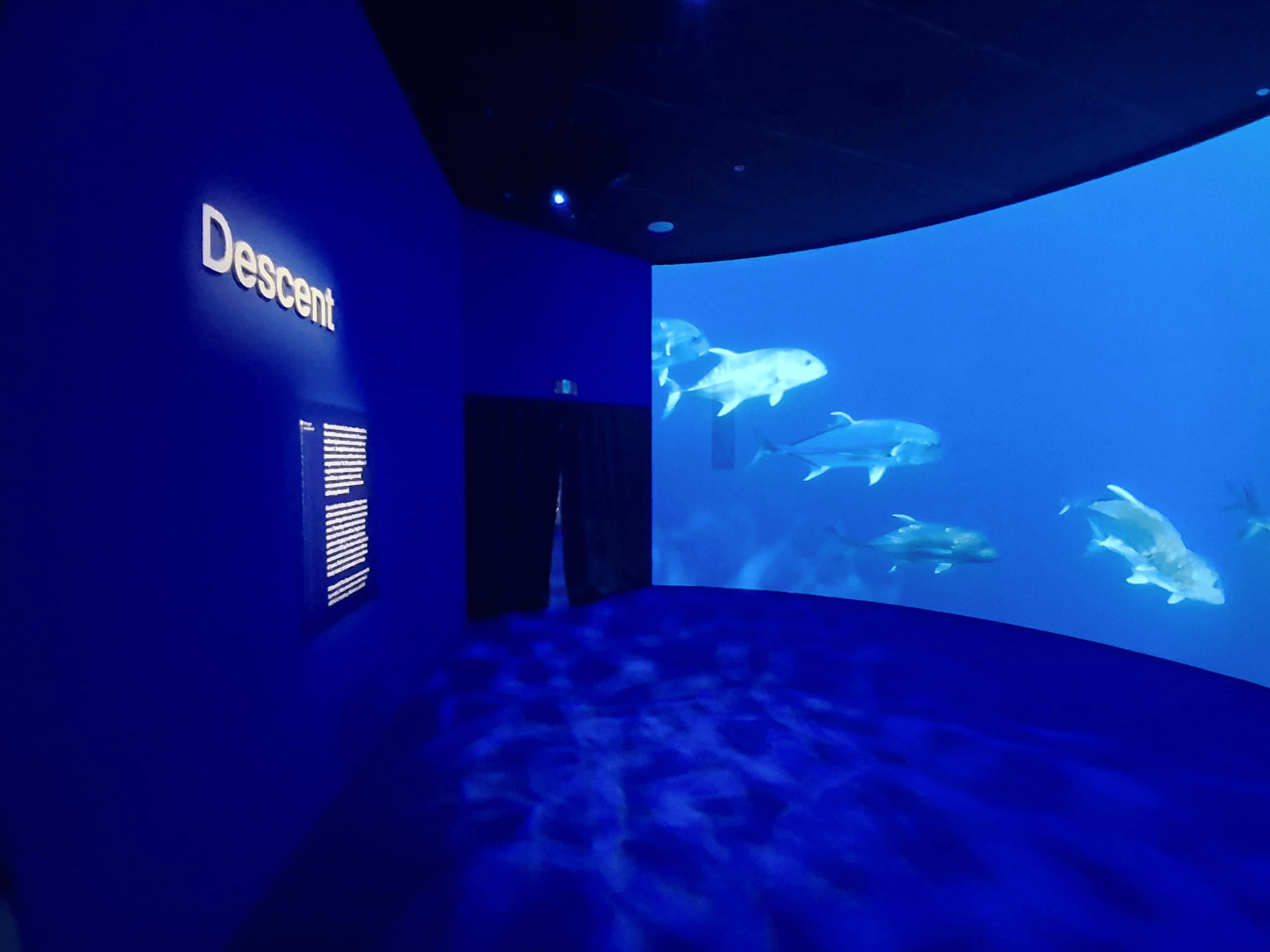
The exhibition beckons us into the underwater world with its first exhibit, Descent. We enter the metaphorical hatch of a relatively brightly lit submersible as it takes us underwater. With the crackle of the radio and the majestic scenes of the sea, the installations evoke a sense of wonder and anticipation as we enter the first section, the Photic Zone.
Here, the museum continues to ease us along. We are first greeted by an exhibition on our Southern Islands’ reef cores in collaboration with the Lee Kong Chian Natural History Museum, the first indication that the ocean’s unfamiliarity is not a problem confined to distant shores. At first glance, this may seem a little out of place in an art gallery, but it makes the unfamiliar unexpectedly local: it beautifully reminds us that even in a bustling and modern city such as Singapore, preservation efforts still occur even so close to home.
Coral samples from our very own shores
This zone employs a wide range of interactive exhibits to immerse visitors, engaging the five senses. Be it salts that mimic the aromas of the Photic Zone, or an installation (courtesy of bit.studio) that situates visitors within a school of helium-filled fish, the zone makes the visitor one with the sea.

One particularly striking installation was an Xbox controller, with which visitors could use a virtual undersea explorer to learn more about the various lifeforms that lie beneath the waves. Though such gamification seemed initially out of place with the other exhibits, it was a popular installation, especially among children. Perhaps this signals the strength of art as a medium of scientific communication: while studying the sea may seem overwhelming at first, this renders difficult concepts much more accessible to younger audiences.

Part 2: Seeing is Believing
The Twilight Zone continues this trend of immersion, with a new emphasis on footage. Utilising footage recorded from the OceanXplorer (the underwater rover used by OceanX), the museum highlights the aquatic life native to the Twilight Zone.

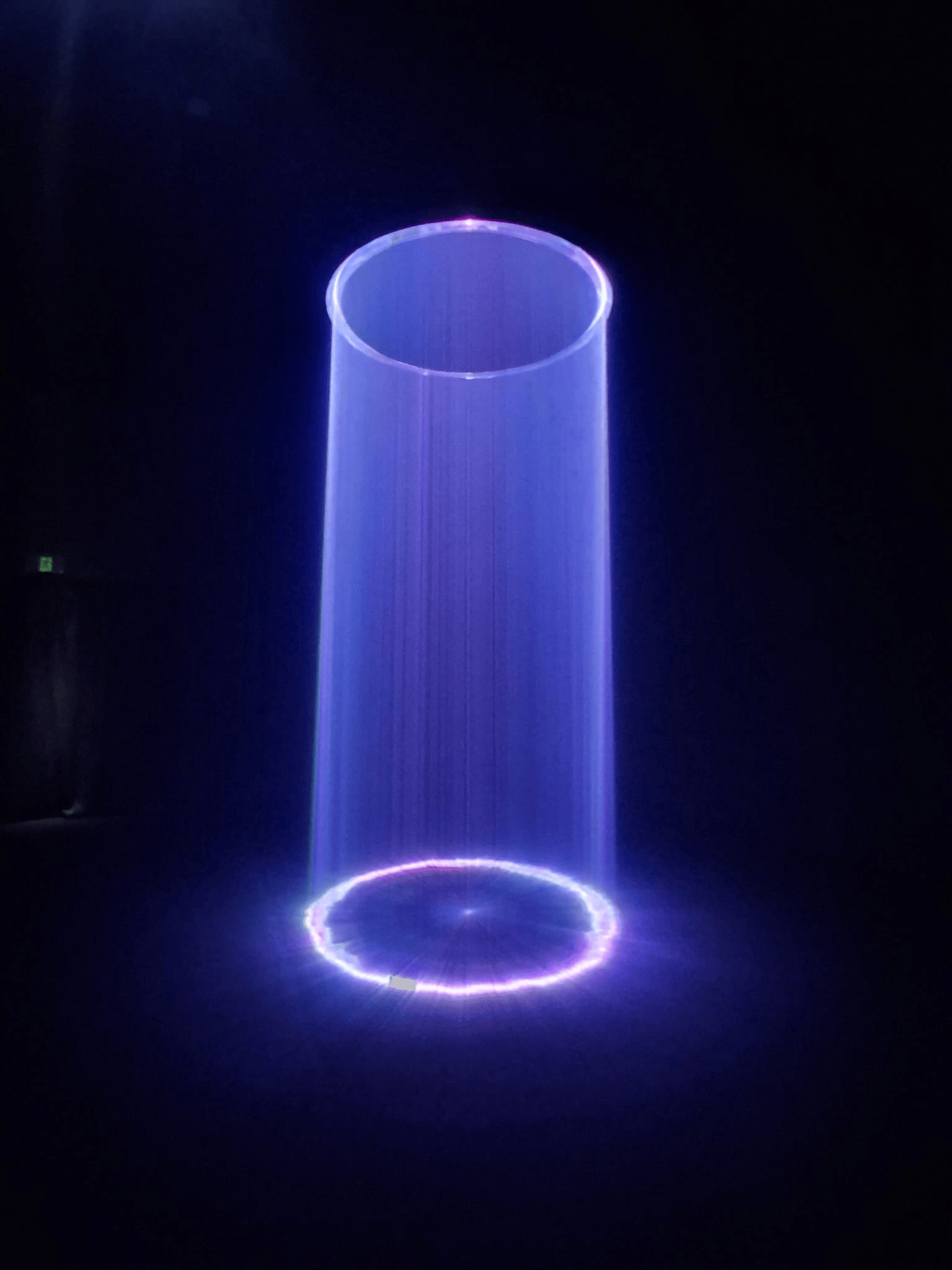
Beyond pure footage, while the Twilight Zone is typically pictured as a vast, dark expanse, its complementary exhibit paradoxically increases its emphasis on light; with exhibitions such as Bioluminescence Tunnel, the visitors are placed in a potpourri of light of all wavelengths reverberating around the tunnel, juxtaposing the darkness of the sea with bioluminescence of deep-sea animals.


Part 3: Displacement and Disorientation
Emerging from the Twilight Zone, we are thrust into the Aphotic Zone, the deepest and darkest parts of the sea. (Before the invention of rovers such as the OceanXplorer, humans knew more about the cosmos than the Aphotic Zone!)
The museum gets noticeably darker and more cramped: the walls get narrower, and the ceiling appears taller, contrasting sharply with the open concept employed in the Photic Zone.
In the first room of the Aphotic Zone, we are greeted by a collection of preserved animal specimens. Personally, their pale nature evoked a deep sense of disgust and aversion; this was perhaps the first time in the whole exhibition that I felt this way.

Proceeding further in, our agency, previously given to us in the Photic Zone through interactive exhibits such as the Xbox and bit.studio, gets stripped away from us: instead of our interactions with the museum being two-way, we find ourselves increasingly swallowed by the exhibits, with little means for us to influence our own relationship with them. We proceed along a pitch-black corridor, the only sounds being the recordings of the haunting cries of marine life in the deep. The immersion that the museum thus so heavily emphasised on earlier thus changes its tone: the control that is given to us earlier gives way to the exhibit controlling us, determining our emotions as we proceed along its path.
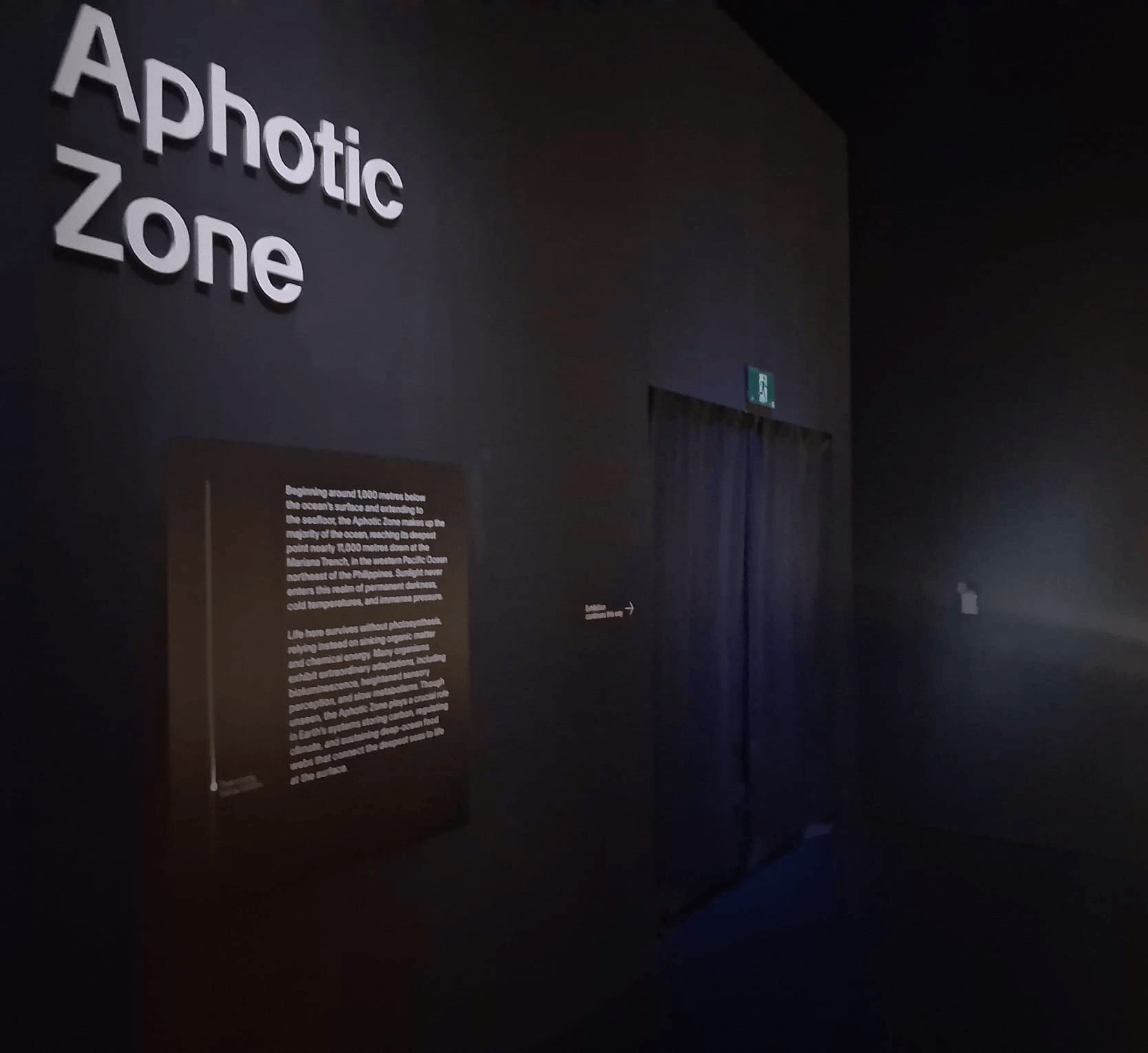
But paradoxically, this design choice evokes the dual feelings of both anxiety and awe. By thrusting us into a setting where our sense of sight is effectively rendered useless, leaving us only with the creepy cries of marine life, the sea metaphorically consumes us, reminding us of just how little we know about the ocean. In being confronted by the sheer power of the ocean, we find ourselves increasingly humbled. In spite of the human agency that we have become so accustomed to, the sea, ultimately, remains so mysterious and unknown, and it would be foolish not to accord it the respect and awe that it deserves.
Part 4: Reflection and SEA-nthesis
And as we “resurface”, we thus find ourselves feeling a little more hopeful and renewed. Sure, the previous sections may have been claustrophobic and fear-inducing, but they also demonstrated the power of the sea in sustaining life even in the harshest of spaces.
“We talk about the search for life on other planets as though it is theoretical … but here it is: a thriving ecosystem in one of the planet’s most extreme environments. Life does not wait for ideal conditions: it leads into the darkness, finds what is there, and builds something extraordinary.”
A video depicting brine pools in the Aphotic Zone
Remarkably, it is only at the end that we are reminded of the pertinent issue of pollution—did the curators deliberately reduce the emphasis on humanity’s impact on the sea? Why would they do that, when ocean conservation remains one of the most pressing issues of today?
As a guide in the museum helpfully pointed out, “The reason why the fish in the Aphotic Zone exist is that humans have not touched them.” Perhaps this offers us a clue: pollution, at heart, is a man-made calamity. Ocean acidification, oil spills, and plastic pollution are but some examples of the destruction of the sea, yet they all share one thing in common: it was man who caused these incidents.
Yet, the museum’s emphasis was never on humans. Perhaps the immersive nature of the museum was intended to avoid the false impression that humans can exert lasting control over nature. Throughout the Twilight and Aphotic Zones, I gained new respect for nature.

The call to action comes only at the end, as we “resurface” from the sea. As we write our pledges to conservation on individual blades of seagrass, beyond a sense of shared commonality in promising to protect the sea, we now make the promise not because of pollution guilt-tripping, but because we have truly understood the beauty and majesty of what we aspire to preserve.


