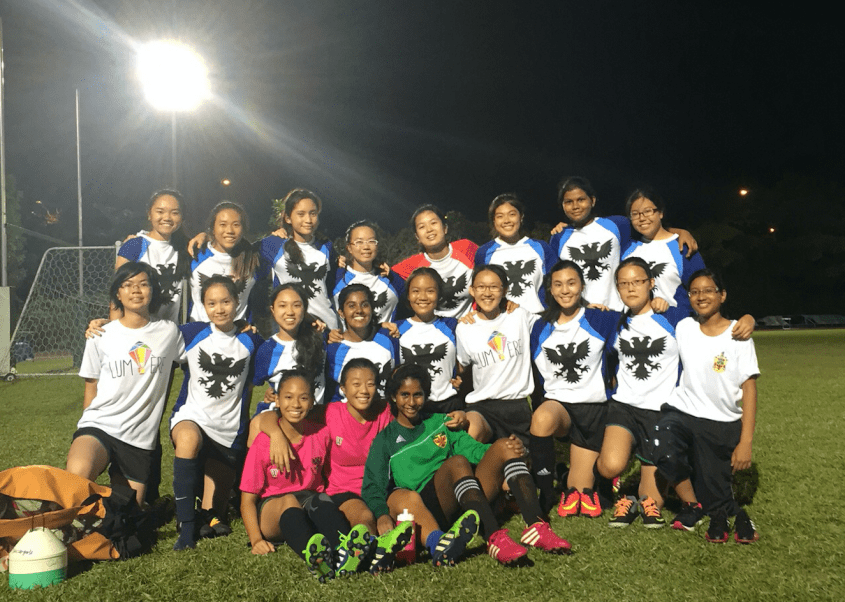
A day in the life of: A Soccer Girl

Reading Time: 4 minutes

This article is part of the CCA Previews for 2016.

By Julia Goh (16A01A) and Lee Rui En (16S06A)

Feature Image

You may not see us with our muddy boots and neon-coloured training jerseys as the popular girls in the school (in fact, you’ll probably hear us before you see us), but we play the most popular sport in the world! What brings us down to the bumpy field in the sweltering heat? Soccer, our love for the sport and of course our love for each other (coaches, teammates and seniors).

Continue reading “A day in the life of: A Soccer Girl”

A day in the life of: A Footballer (Boys)

Reading Time: 2 minutes

This article is part of the CCA Previews for 2016.

By Quah Yu Xuan Edward (16S50A), Vice-Captain

IMG-20151026-WA0001

Here at Raffles Football, we believe that the common quote “Give a man a fish, and you’ll feed him for a day; teach a man to fish, and you’ll feed him for a lifetime” is incomplete. We believe that it’s missing a little something, and that something is “Give a man a ball and he’ll be eternally happy”… or something along those lines anyway.

Continue reading “A day in the life of: A Footballer (Boys)”

A day in the life of: A Fencer

Reading Time: 3 minutes

This article is part of the CCA Previews for 2016.

By Ng Jing Chun (16S06N), Boys’ Captain; Chloe Chu Min (16A01E), Girls’ Captain

1
Our team photo.

Ever watched Pirates of the Caribbean or Star Wars? Well, here is your chance to emulate your movie heroes and be a skilled swordsman/swordswoman!

A typical day of training begins with 30 minutes of warming up, which normally means several rounds around the track followed by some dynamic stretching. Afterwards, we do “foot drills” – intense and fast-paced exercises that aim to increase speed, agility, balance and explosiveness. The coaches then lead us in some footwork training. In fencing, familiarity with combinations of foot movements has to be achieved, much like how a dancer has to perfect a set of body movements and how a boxer learns boxing combinations. After all, fencing is a martial art that has been practised by the likes of Bruce Lee and Arnold Schwarzenegger. These gruelling sets of squats, jumps, lunges and quick foot movements often foster team spirit, as we encourage each other to push through the last set and stretch our limits. It is oft-quoted that going through common adversity forges the strongest bonds, and it is precisely such tests of physical and mental endurance that make us feel a special sense of belonging to the team.

After completing footwork, the call from the coach to “suit up” is one that is greeted with great enthusiasm. There are 3 types of blades in fencing, namely Foil, Epee and Sabre. They each have the same foundational movements, but have different rules in competition. Based on your specific skill sets and physique, our coaches will advise you on which blade you should specialise in. “Suiting up” means that we change into the specific equipment needed for our blade and split into the 3 blade groups, each helmed by 1 coach. Under each blade group’s coach, we learn hits and parries specific to the blade we use. Fencing is often described as “physical chess”, as you have to learn strategic movements and carry them out with dexterity to counter your opponent’s moves.

We put these moves into practise when we end off training with multiple fencing bouts. The rush of adrenaline you feel as you step up to the piste and face your opponent is particularly invigorating. When you fence, someone literally charges at you with a weapon, and you have to have courage and confidence to meet the attack and calmly execute your moves to win the point. The satisfaction of evading an attack and landing your own hit is unmatchable. The sounds of clashing blades, shoes screeching against the floor and triumphant “war cries” make for a galvanising training environment.

This slideshow requires JavaScript.

So, what else can you expect from this CCA? What you can be sure to gain are special bonds you share with your teammates. We bond over the pain of defeat, the backbreaking toughness of training, and the sweetness of victory. Many may argue that fencing is an individual sport without much need for teamwork, but you can be sure that in this CCA, teamwork and team spirit is everything. We’ve worked hard, played hard and fought hard together, and in the process built valuable friendships that we will cherish for life. Due to the relatively small number of fencers in Singapore, the fencing community is also one that is tight-knit. We often see the same faces at the regular competitions that we participate in, and going for free sparring sessions organised by Blade Club (training in school is helmed by Blade Club) during the weekend is also a great way for you to get to know fencers from other schools.

Outside the official trainings on Tuesday and Thursday from 4.30pm-7.30pm, fencers often meet up for meals, additional physical trainings or just to hang out. We make it a point to carry out a fitness program beyond school training, regularly hitting the gym, going for runs and training our agility. The whole team also undergoes regular beep tests to keep track of our fitness. There is also an annual CCA camp organised in March.

4
All smiles after physical training at MacRitchie

So, don’t hesitate to join Raffles Fencing – it’ll be an experience that you will never regret! Not only does it train your mind and body, but more importantly, you will walk away from this CCA with some great memories that you will hold dear for life.

A day in the life of: A Canoeist

Reading Time: 5 minutes

This article is part of the CCA Previews for 2016.

By Canoeing EXCO’16

IMG_9330

“It’s supposed to be hard. If it wasn’t hard, everyone would do it. The hard… is what makes it great.”

– A League of Their Own

It’s the ache that you feel in every part of your body after a killer Saturday morning training. It’s the four minute walk from the shed to the pontoon, a C boat on your shoulder, a K boat in your hand. It’s the feeling of flying down the lanes, the pull of your paddle against heavy water, the wind pushing you forward. It’s watching the sunset along the horizon of the reservoir, and the 3pm sun carefully dusting hints of glitter against clear waters.

It’s the hard that makes it great.

Any canoeist will tell you that this is definitely not an easy sport – canoeing requires dedication, motivation, courage, perseverance and passion. Canoeing may be a sport known for building muscles, but the truth is that it builds much more than that. At each training you are not just training your body – you are training your mind. Each time trial, each trail run, each set of slope sprints and each gym circuit pushes you to your limits and prepares you for the next training’s challenges.

IMG_0514

But you are not alone. The thing about canoeing is that it may be an individual race, but it is never an individual journey. What makes Raffles Canoeing is the team. It’s the team you give your 100% with, 25m away from the finish line in hopes of being the first boat to complete the set. It’s the team you sit on the grass patch with through every post-training debrief, shoulders and hands pressed together as you huddle for the cheer. It’s waiting out the midday storm with seven other teammates under one small umbrella as the rain pours all around. It’s the friends you spend nights talking with, the constant encouragement, the terrible jokes. It’s the voices that ring loud and clear in your head during your race, reminding you of who you are: Raffles Row. You are a part of Raffles Canoeing. A fighter, an overcomer, a member of the team.

IMG_8405

A day in the life of a canoeist begins with finding the shortest possible route to Macritchie, taking out boats, and strapping on your life jacket. Boat on your shoulder, paddle in your hand, you make your way down to the launching pontoon. As you get into the boat, your hands grasp your paddle, and you feel around for the familiar grip, your fingers wrapping around the stiff paddle shaft. You are no stranger to the feeling of carbon composite against skin, and as your blade meets the water, your water training begins.

IMG_8404

There are days when you feel like your body is giving out and days when the water feels heavy and the water condition is not at its best. There are also days when the weather doesn’t hold, and you arrive at the gym instead of the pontoon, ready to begin your land training program. But all these different circumstances – both good and bad – are part of the training of your heart and mind. Different circumstances force you out of your comfort zone, and it is then that the strongest friendships are forged, and where life truly begins.

You will taste courage, defeat, team spirit, perseverance and triumph all rolled into one. There is courage in the moment your hands leave the safety of the launching pontoon despite your apprehension and fears. Defeat when you capsize at the 750m mark, where it is a 250m swim to either one of the 500m or 1000m pontoons. Team spirit when you hear a familiar voice calling out your name and you turn your head to see a K2 boat paddling in your direction to rescue you. Perseverance in the moment your friends help you get back on the boat and your paddle tentatively touches the water again. Triumph when you finally pull through the lanes, your blade cutting through the water in steady frequencies, going 80-90-100-110% until you reach the finish line and a smile stretches across your lips, because you have won the set – you are the fastest boat.

As you sit on the pontoon, feet in the water, ankles slightly crossed, you watch your teammates and friends give it their all, and see the determined look on every one of their faces, fighting for the slightest chance to be great – and you feel something special. You feel it again in the small moments when you stand in a disorderly line at the pull-up bars, around the bench in the gym, watching your teammates fight for an increase in their max reps. And yet again, when you’re at the launching pontoon before your race, when each individual puts their hand on top of another, skin to skin, heart to heart, and two words echo all around: Raffles Row. It is in these little moments that you realize how much this sport and your teammates mean to you. You realize that canoeing has changed your life.

IMG_3653

In the team, there is no mould of the person you should be, or the body you ought to have. There are loud people, quiet people, tall people, short people. There is no single body type or personality type that is more favoured by, or suited for the team. All we are is that we are brought together by a single dream, a desire to make something count for the one and a half years we spend in this CCA. We are not here by chance, but we are determined to make this chance count. This dream pushes us to go further, do better, become stronger. In the beginning, we enter as different individuals. At the end, we emerge as one team.

IMG_4877canoeing feature image

Raffles Canoeing may not have much to offer – it definitely isn’t one of the top schools in the sport, and the odds are stacked high against this team of seventeen-year-olds new to the world of canoeing. This is where our greatest lessons are learnt: of hard work, of overcoming our fears, of being a member of the team, and of believing.

Henry David Thoreau once said: “Everyone must believe in something. I believe I’ll go canoeing.”

What if you believe?

A day in the life of: A Water Polo Player

Reading Time: 3 minutes

This article is part of the CCA Previews for 2016.

By Abielle Yeo (Girls’ Captain), Chan Fang Yi (Girls’ Vice-Captain), Jared Lim (Boys’ Captain), Bryan Yip (Boys’ Vice-Captain)


The weather is hot and school has just ended. The sun’s rays bounce off the glimmering surface of the water, inviting onlookers to enter. The students change and slather on as much sun block as they can onto every visible part of their body. Their toes touch the edge of the water, and they immediately feel a cooling sensation. They are itching to enter the water and escape the scorching heat, which will eventually be the cause of their trademark tanned skin. The team cheer “RAFFLES!” fills the otherwise quiet area and with an almost synchronised effort, they jump into the pool with a resounding splash. Such is the life of a water polo member.

This life, as simple as it sounds, is rather colourful. Water polo is not just about the game. It is about the time spent in training, the commitment to your team, the perseverance in a game, and the trust in your teammates.

First up, training. We train three times a week, every week. On some days, a good gym workout is included before we hop into the water. Water polo is a complex sport of which many skills have to be honed for a team to succeed. It is, of course, a water sport. Thus, the laps are inevitable. It is also a ball sport, where players are not allowed to handle the ball with two hands at once. Hence, shooting, catching, passing, and picking up the ball all have to be done single-handedly, which is a skill that comes with regular training and practice. On top of that, water polo is also a contact sport. This means that the proper technique of struggling with your man and maneuvering around him is essential to the game. Lastly, water polo is a team sport, a six-on-six game (excluding the goalies) that cannot work with just one girl or guy. Team tactics are important, and so is game sense. This comes with experience and training, which brings us to the next portion of a polo player’s life: commitment.

When you commit to your team, you commit your time to training and your body to the game. Water polo is a very time-consuming sport. Besides the fixed two and a half hours of training, we often spend extra time with training equipment, packing for training and after-training baths. Many sports may have similar problems, but many sports are not water sports. Water can be our friend or our enemy, but most times the water is not on our side (think running in water). No matter how tired we are at the end of the day, we still love the sport, and that is why we are willing to commit our bodies to it. As a full contact sport, water polo brings many physical risks, we’ve seen broken noses and bruised bones, yet the commitment to the team always brings polo players back.

Waterpolo Girls

In water polo, you tread water for the entire game. If you’re not sprinting for the ball, you’re wrestling with your man for position, and you only get a short break when a goal is scored, between quarters, or if you are substituted out. The ‘mind over body’ situation literally occurs almost every game or training. ‘Perseverance’ is a word that is familiar to polo-players. The perseverance to continue sprinting back and forth, the perseverance to continue fighting for the ball.

Last, but not the least, is the trust between teammates. In a huge court with only six players in the water, there is only so much one person can cover. When you cover a space in the pool, you trust your teammates to be covering the rest. When you drive towards the goal, you trust your teammates to assist you. When your teammate blocks an opponent’s pass, you trust him or her to be able to protect the ball, and you will commit to a counter-attack. All this trust can only be brought about through the countless hours of training with the team.

All these hours change a water polo players’ lexis. ‘Water polo’ becomes ‘home’. ‘Team’ becomes ‘family’.