CCA Events

Grad Night 2015: Fashion Watch

Reading Time: 6 minutes

by Heather I’anson-Holton (16A01E) and Adelyn Koh (16S06H)
Photos by Chang Po Chun (16S03K) and Hoong Li-Ann (16A03A)

During the annual Grad Night on 3 December a week ago, the fashion sleuths of Raffles Press and Raffles Photographic Society went outfit-watching together among the throng of Year 6s. What we found at this night of class and elegance certainly did not disappoint us, in terms of diversity and creativity from the trendy Year 6s. Read on for some highlights of the fashion parade!

This slideshow requires JavaScript.

At first, Chua Ting Wei planned to buy his suit from Benjamin Barker (a popular choice amongst the guys), but did not manage to find something that could fit him as he was “really small sized”. People of Asia, on the other hand, had just what he needed. (Our vertically challenged readers, take note!) Ting Wei strayed from the conventional black suit, choosing instead a light grey suit with thin black checks that quickly caught our eye. What really made this outfit however, were the details that Ting Wei accentuated it with. A plain white dress shirt was made instantly more attractive with gold rimmed buttons, and a smart purple vest with similar gold buttons provided an additional pop of colour. His accessories didn’t disappoint either – Ting Wei finished off his outfit with a red ribbon bow tie with a pearl and gold button to fit the theme, as well as a matching pocket square, gold collar tips, and a pair of brown brogues that complemented his vest. This was truly an outfit that inspired envy.

This slideshow requires JavaScript.

Dominic originally wanted to get a suit, but in his words, “a nice suit was very expensive.” Instead, he opted for the more wallet-friendly option of a well-paired casual blazer and checkered shirt. The deep blue of the blazer and the warm brown shades of the shirt, pants and shoes gave his whole outfit a level of cohesiveness deserving of praise. We especially loved the blazer’s deep pockets and unique elbow patches, which added a nice amount of detail. Dominic’s outfit just goes to show that if you shop smart, you can look great on any budget.

This slideshow requires JavaScript.

When queried as to why she chose ethnic wear, Marianne provided several reasons: it’s more practical, it’s a unique look (we agree!), and that on a personal level, she feels she looks better in traditional clothes as compared to modern clothes. She also added that “one should not be afraid to wear ethnic attire even when everyone else wears modern clothes. Your culture is your identity and you should not be afraid to flaunt it!”

Marianne was one of few who were unafraid to wear bold colours. Her daring paid off, and she looked exceptionally regal in her sari of royal blue, crimson red, and shimmering gold. Marianne also picked her jewellery well; her gold headpiece helped frame her face and accentuate her features, and her dangly earrings and many bangles served to play up the colours of her outfit. Another thing worth noting is Marianne’s use of henna on her hands, which had the dual purpose of representing her culture, and adding a level of detail that was unique in the ballroom.

This slideshow requires JavaScript.

Some might have thought that such an unusual look must have been coordinated by the two, but when asked, Vint Seng (left) and Danson (right) replied, chuckling, “no we didn’t [coordinate], it was a complete coincidence.” Their reasons behind their choice of trench coat weren’t harmonious either. Vint Seng claimed that “blazers are lame. Everyone wears blazers anyway, it’s boring.” Danson on the other hand, had a more practical reason. “My mom said that I could use the trenchcoat when I go overseas to study. Besides, everything was on discount!” Whatever the reason, their choice paid off, and the boys stood out amongst the crowd. Danson wore his black trenchcoat over a white shirt and red tie with shoes to match, while Vint Seng chose to wear his grey trenchcoat with other dark colours, with the exception of the rather unconventional accessory of a purple knitted scarf, which brightened up his look.

This slideshow requires JavaScript.


Ragini chose this dress because she felt it was “the right mix between party and sweet,” and it was indeed a refreshing change from the many heavy gowns worn by others that night. Ragini brought some sparkle to the event with a bodice encrusted with glittering crystals, which she paired with bejewelled hoop earrings. The sweetheart neckline and bare back showed off Ragini’s figure, helped along by a pale pink chiffon skirt that cinched her waist. We loved the skirt’s flowy layers, which along with the transparent straps of the bodice, helped to balance the heaviness of the jewels, and kept the outfit light and airy.

This slideshow requires JavaScript.

Nicole wanted to her outfit to be classy and elegant, and achieved exactly that with a stunning floor length dress. She still managed to set herself apart, however, with its solid red shade, which she chose for its “daring.” The fit of the dress lent her further advantage by showing off her figure and giving the illusion of longer legs. The outfit was complemented by some gorgeous silver jewellery – simple stud earrings and an eye-catching statement necklace, which were kept in the spotlight by her up-do hairstyle. This was a timeless ensemble that will never fail to charm.

This slideshow requires JavaScript.

What impressed us about Nikhil was his ability to take staple menswear items (a grey blazer, a white shirt, black pants, brown shoes) and make it into an outfit that was his own, proving once again that details are everything. The choice of a wool blazer gave an added textural dimension, gold-rimmed glasses drew attention to and framed his face, and a fun floral print skinny tie gave his look a touch of personality. When asked as to why he chose that particular pattern for a tie, he replied that it felt right and he liked it – sometimes, that’s all it takes. Nikhil’s outfit shows that simplicity can be great too, and with a few careful touches, any wardrobe piece can be revitalised.

This slideshow requires JavaScript.

Justine applied a geometric theme to her whole outfit that we thought was very clever. Her electric blue dress featured a series of black lines that not only framed her figure, but gave the illusion of longer legs, added height, and a slimmer look. The beaded detail of the dress also gave her look some texture. Justine accessorised with dangling chain earrings that mimicked the vertical lines of her dress, a necklace comprised of a series of rectangles, and a clutch with an outer casing that was segmented into triangles – each playing up a geometric element, giving her look an overall sense of cohesiveness. This was an outfit that was meticulously planned, right down to the crisscrossing braid Justine styled her hair with, and we loved it.

Yeung Jek.jpg
Name: Ho Yeung Jek
Everything: Topman

Yeung Jek’s powder blue suit stood out amongst a sea of grey and black, and we loved the soft colour palette that he went with, which was a refreshing change from the many dark and heavy colours sported by the majority of his peers. Yeung Jek kept his outfit perfectly balanced with a white shirt and a silver tie with a slight sheen, which complimented the pale grey buttons on his suit, and a black leather belt and a pair of brown shoes gave the outfit some darker tones, preventing him from looking too washed out. Like Nikhil, it was Yeung Jek’s clever manipulation of the basics made this outfit so great.

This slideshow requires JavaScript.

Mudassar had no explanation as to why he put together this ensemble, only that the inception of a harness as an accessory popped into his head, and he simply had to go with it. This edgy outfit featured black leather straps, an army green button-down with an unusual collar, and smartly polished dark brown shoes. We loved how the pressed vertical crease down the front of each pant leg played upon the lines of the harness, and how the belt buckle, the hoops and accents of the harness, and the reflective watch face provided just the right amount of metallic shine to what could have been a dull colour combination. Another thing worth noting was the attention that Mudassar paid not only to his outfit but to his face too, something less commonly practiced by boys, but which definitely worked in his favour. His sculpted eyebrows, flawless skin, and sharp, defined cheekbones made this great outfit even better. A bold look indeed, this was hands down the most unique outfit of the night.

This slideshow requires JavaScript.

Sinéad’s cocktail dress featured a bodice made of velvet – a daring material few can pull off, but which she certainly did. We loved the details of her dress – the crisscrossing velvet ribbons across the front and back that were reminiscent of a corset, the box pleats of the skirt that provided dimension, as well as its unique buckled shoulder straps. Sinéad’s consistent commitment to diamonds and crystals in all her accessories – double bar hair clips, earrings, bracelet, clutch, even down to her bejeweled stiletto heels and studded nails – brightened up the velvet, and beautified areas often neglected. We also loved the attention she paid to her hair and makeup, such as the interesting ombré effect of the dye and the self-styled soft curls, as well as the bold lip colour that matched her perfectly-manicured nails. Interestingly, we recognise this to be the dress worn by Miranda Cosgrove to a recent movie premiere, and while the dress itself may have been deserving of Hollywood, we believe Sinead’s finishing touches made it truly red carpet worthy.

PHOTO ESSAY: Behind the Bicycle Plays (Part Two)

Reading Time: 11 minutes

By: Choo Shuen Ming (16A01E)

This is Part Two of a photo essay documenting the backstage happenings of Raffles Players’ most recent production, The Bicycle Plays. Part One casts an inward-looking eye on pre-production happenings. Part Two picks off right where Part One leaves off, at the opening of doors and beginning of the audience members’ experience. 

38The Black Box begins to fill up, and an audience member looks through the programme booklet in the meantime.

The programme booklet was created with the help of Beatrice’s friend who’s currently studying design. “I Skyped her 4, 5 times because there were many changes to the design,” Beatrice says, and she explains that while she came up with the general look and themes, and selected the font and images, her friend handled the actual design software and layout. “She’s always willing to help, and she was helping on top of her schoolwork,” Beatrice shares, “and yeah, she came for the show!”

39“The funny thing”, Beatrice says, “is that after so many times back and forth, in the end we still forgot to include the directors’ names, so in the end, we had a black marker, and I just asked the directors to sign with it.” And that’s the story behind why all the 200 or so programme booklets are uniquely hand-signed as pictured.

40


41

Caitlin, Ko Lyn and Rishi (left to right) take their places onstage, amid the hubbub of the audience, and the light pop music playing.

Rishi shares that the house music wasn’t really distracting at all, contrary to what one might think. “It kind of got me in the mood,” he says, a sentiment Ko Lyn echoes: “During that time I personally tune out a little, and get into the rhythm of the audience’s sounds (coughs and fidgets) and clear my mind, to let the character in.” As for Caitlin (16S03A), she was “very nervous for [her] one-line singing part in the play”, and so was in fact singing to herself. “When that part actually came I’d got it wrong on the first night, and was hoping to nail it the second night,” she shares.

42

I do the crazy monologue about eating myself which I actually…liked that part, because it’s weirdly intimate, then it just tails off, and suddenly you just break out of it.” – Rishi

Heart’s Desire by Caryl Churchill gets underway, and grips the audience with its cryptic yet engaging repeats of scenes: the characters repeat almost the same lines, but with different moods, with a little more being revealed with each repeat, as the play gradually uncovers the hidden tensions in the family. Here in one of the more bizarre scenes, Rishi’s character Brian confesses his burning desire to eat himself.

43

“Oh for the wings, for the wings of a dove…” Caitlin sings. Speaking of the lyrics, after my messup on Friday, my batchmates alternated between comforting me on Saturday and telling me to relax – and seeing me from a distance, flapping their hands like wings and singing that line badly to me. It was quite amusing.”

Caitlin shares that as it was, she didn’t manage to nail it this second night, but she adds, “from that, I learned that the show must really go on and that once you’re onstage you can’t afford to let these little things get to you.” Also, this was actually her first time singing onstage – “I was very nervous and was shivering a lot!” Caitlin recounts. As she reflects though, “the play got me to try a lot of new things and it was all nerve-wracking, but ultimately I’m glad I gave it a shot despite the slight embarrassment on both nights.”

44

Sarthak in one of his scenes as Lewis, Susy’s drunk brother.

For his scenes, Sarthak waits behind the curtains off to side before he enters. “On the first night,” Sarthak shares, “I tripped on the curtains so I missed my cue, the velcros at the bottom were still attached and I entered the stage too early.”

45.JPG

“There was a repeat scene where the soft and dappled lights come on, and the sense is that the characters are being introduced to a life they should be familiar with for the first time. It was very tentative and lost, and I felt that echoed how things are in reality. Always groping for the right answer, never finding it. I liked that scene.” – Ko Lyn (pictured)

46

In one of the most absurdly comical and unforgettable moments, Celine’s character Susy dresses up as a chicken and slowly stalks into center stage, before turning toward the audience, letting out a huge squawk, and dashing off.

“With a piece as short as 45 minutes and something new to do all the time, I couldn’t help but feel that every moment was very different and very special,” Celine shares, regarding her experience in the play. “But if I have to pick anything in particular, I guess it’d be the chicken scene. I like making people laugh so I was glad that many audience members seemed to find it funny. Also I am quite self-conscious so I was quite glad to have made it through that scene!”

47

“Well, she’s taking her time.” – says Rishi, for the last time right before the play ends.

The final repeat finally restarts from the beginning, and Susy, whom the family’s been waiting for the whole time, finally arrives and sits at the table. “I always love the part,” Rishi says, “because until then it was all fake – from the start there’s different forms of happiness, confusion, suspicion, and everything, all these – so it is the character, but with certain exaggerated elements…. (the last scene is) the the first time you see everything together, the whole scene, in one piece.”

48

Meanwhile, Kathy’s out here the whole time at the front of house.

“I tend to latecomers, and to pass time I count money and tally them with the ticket records (laughs)”, she shares.  “But I do think it is oddly interesting and fun to be out there … I can hear everything inside, and it feels like I’m watching the plays, only without the visuals … it’s like watching from a new perspective.”

49

“So on the day itself, we just started doing random things” – Sarthak

Soon everyone streams out for the intermission, and the Heart’s Desire cast puts on their intermission mime! They couldn’t really remember how the idea came about, but essentially it was quite spontaneous – they’d come up with it the day before the first night – and it wasn’t rehearsed or pre-choreographed at all. “We just said ‘hmm, you know what’d be cool? Using the windows somehow. We could do some kind of mime stuff.’” Sarthak says. “Very typical of my CCA and our love for thinking up new schemes, I think!” Celine quipped.

50

Friends and audience members crowd up against the windows, laughing and taking photographs of the actors

“It was also interesting to see an audience interact with a player,” Ko Lyn shares, “as they conventionally exist in two disparate realities – the stage, and the audience space.” Celine echoes this too, saying that she’s grateful they were unafraid, and willing to engage with them.


51.JPG

“…okay Sarthak is being weird, Caitlin is being mystical, so maybe I’ll just be angry and crazy, and it was great until I like bent the window bar….but (laughter) yeah, it was overall quite fun.” – Rishi

They clearly had a good time at the windows that night, engaging the audience in those pleasantly unconventional, spontaneous 15 minutes.

52.JPG

The next play, A Painless Way to Die written and directed by Hai Yun, in contrast to the highly experimental and philosophical Heart’s Desire, deals more with emotional depths, with its share of light and heavy moments as it explores the themes of memory and forgetting painful pasts. This humorous scene has the whole room laughing along with Wen Wen’s (right) character’s awkward forced laughter. Beatrice recounts that she was a little nervous in this scene actually, since during rehearsals, it was just ‘so awkward’ she says, but it turned out alright.

53.JPG

One of A Painless Way to Die’s many powerful moments – Beatrice (on the left as Alicia) and Valerie (in white as Dr.Rachel) speak in unison as they wrenchingly recall their miscarriages. “It’s just a split second thing, but I always get chills then because it’s so in sync,” Wen Wen says of such moments

54

Sreshya, Wen Wen and Vasu (left to right) tell Dr. Rachel’s story in an emotionally searching scene.

This scene is a personal favourite of Hai Yun’s as she recalls, “I remember just letting the words flow and how natural it was to write that part”. For the cast as well, Sreshya (16S06P) feels this scene stood out as it let them convey and “[mirror] the feelings of someone who might have truly experienced a miscarriage”, and so carries unique emotional weight. As Vasu adds, “you just feel something inside you when you learn about why a person develops a passion or drive to achieve something, especially when it’s something as emotional as a miscarriage.” With the skilful acting and direction, this scene managed to stay sincere without veering off into the cheesy, making it easily one of the most memorable.

55

The subtle, yet clear pain in the nurses’ faces above speaks to the depth of emotional conflicts A Painless Way to Die attempts to tackle.

Despite how the procedure of Renewal which Dr. Rachel created promises an escape from painful memories, the play puts forth the idea that perhaps, it’s being left with reminders of a memory now out of reach that’s more painful. As Sreshya puts it, “tangible symbols are but a temptingly explicit, yet wan compensation for the far greater weight our minds are made to bear: the serenely implicit memory.” Also, this proved not only interesting to watch, but also to perform: “dramatizing the inner struggles and exploring the theme of memories was something I found very enjoyable as part of my journey” says Sreshya.

56

Initially for this scene, Hai Yun shares that she had wanted to explore physical theatre, and through the process of blocking this scene, they eventually “settled with something simpler, and things we can actually do”, which highlights the evolving and interactive process of putting up their play.  As Wen Wen shares, “A lot of the things hinged on what we were comfortable with saying or doing and then us going from there,” with much of what the audience sees having emerged from improv during their rehearsals. “There was never really a finalised script until the very end.”

57

A Painless Way to Die saw intense, emotionally full performances by the cast, especially in this final scene, and it definitely made an impact on the audience.  As Players senior Katrina (15A13A), says, they sincerely tried to make what could’ve been an abstract piece relatable to the audience. Director Hai Yun sums up: “it was a raw, genuine and transparent experience because it was largely edited by the actresses themselves,” as they found their own words to express the characters’ feelings. “I think that is part of theatre; finding yourself in the characters.”

58

The final play of the night ends, and the cast takes their final bows.

“In that moment,” Sreshya shares, “the only feeling I felt was happiness that we’d put up a good show …  those countless hours of prep and rehearsing and being not focused enough and having to try harder and everything basically – it all had culminated into one finished product, the one that the audience would see and clap for. The one that my friends and parents would see and clap for. The audience had no idea what has gone behind this production, and this journey’s a little secret within ourselves. To the audience, we put up one performance that was our best performance (hopefully!) and honestly, that’s all that mattered to me in that moment.”

59

The lights dim, and the audience streams out, leaving the black box to the players and teachers.

Vasu reflects that in that immediate moment, “it was quite a relief really” that the play was over, that he no longer “had to deal with having wet costumes until a few hours before the performance, once because of a leaky water bottle and the second time because of rain … at least that was the initial feeling, because of course like everyone else I also felt the pang of having to break out of this routine of having rehearsals everyday, and prioritising it over other stuff.”

60

Post play, everyone comes and mills around together, it’s all smiles, a kind of elation in the air.

“I never would have imagined for everything to come together so nicely, and initially it seemed almost impossible considering all our other commitments,” Kathy says. “There were murky moments,” Hai Yun said looking back, “where ironically I had no directions in my head telling me how to unfold the next bit … I don’t quite know how things just managed to fall in place and how quickly time has passed. It is almost like all those didn’t happen; really like a dream I guess? But like most dreams, the experience was something I would desire to go through again (after taking a good break) and it has just been wonderfully enriching.”
61

Carrying on the celebratory mood, everyone gathers round and applauds as Celine presents the posters to their pleasantly surprised teachers.

62

After taking their celebratory groupshots in the black box, the Players all head out to talk and take photos with their supportive friends who came to watch.

64

“It’s just like ‘awwwwwwww’ ” as Valerie puts it, to see friends and people who’ve come to support them. “It’s kind of a thing,” Rishi says, “like it’s in any play and friends afterwards come support and interact, and it’s just nice to have that surrounding.” After a while of hubbub, Isaiah’s voice calls out, “Players debrief!”, and the players stream back in slowly, still giddy, and laughing happily. Celine gently hurries the batch to get the debrief started – “Alright people, let’s settle down so we can all go home and finish our I&Rs.” (oh!– the nostalgia, when PW was still on)

65

The debrief gets underway, and rounds of congratulations are had, and everyone, from the actors to the directors and crew, gets a well-deserved round of applause as one. “It brought the CCA together,” Kathy says of the Bicycle Plays, “I saw really cool and new sides of my batchmates through this experience as well, and I’m glad to have been part of it!”

67

“The post-play atmosphere is sort of…triumphant in a way I guess” – Rishi

The debrief concludes, and at 9pm, production day and the Bicycle Plays comes to an end for Players. 


”It was fun, everyone brought good vibes and great ideas…I am thankful for the journey (laughs)” Celine says, looking back on it all.

68

There’s another round of hurrahs and the room erupts again into loose conversation and celebration. Some final group photos are taken, some who already have to go start packing, goodbyes are exchanged – and so their long Saturday comes to a close.

PHOTO ESSAY: Behind the Bicycle Plays (Part One)

Reading Time: 14 minutes

By: Choo Shuen Ming (16A01E)

This is Part One of a photo essay documenting the backstage happenings of Raffles Players’ most recent production, The Bicycle Plays. Part One casts an inward-looking eye on pre-production happenings. Part Two will pick up right where Part One leaves off, at the opening of doors and beginning of the audience members’ experience. 

1

Production day for Players starts way before the doors open at 6.30pm. By midday, they’re already in the TSD Room, but unfortunately full dress rehearsal has been cancelled this time due to scheduling problems. At 2pm, the black box remains quiet, the sets untouched, right where last night’s run left them.

2.JPG

Locked and tucked away behind the black curtains, the workshop is also tranquil, filled with sets built for previous productions, and racks of tools eager to begin work on future ones.

3

The sets room. The familiar yellow suitcase tucked in the corner at right, Bicycle Plays posters lying on the table, a production tee draped on a chair – touches that bring a small but pleasant kind of life to the quiet space.

Fun Fact – Vasu (16S07D) designed the production tee. “I am quite an amateur,” he says, having ‘almost no experience’ in shirt design.  He recounts an episode where the supplier kept asking for sharper designs and images, but he didn’t know what she wanted. “It was quite embarrassing that she had to sharpen the images herself and send the design over to us to show us what she was asking for”, he says. “But overall, it was really a good learning experience.”

4

The annex, where most of the players are hanging out.

The atmosphere’s rather chill as the players relax, awaiting their turn with Isaiah (in green) for makeup. Quite a contrast to the highly-strung PW OP earlier that week. Unlike OP though, Sarthak (16S05A) notes, they’d more than one run, letting them learn from their mistakes for their second run. “I guess that’s why it was chill on the second day. The first run was a lot more nerve-racking I think, especially since we had a pretty short time to rehearse.” he says, which Beatrice (16S03C) echoes: “Friday is the first day, letting someone into your space….but Saturday night you have the feel of what it’s like to have someone there, so the nerve goes down a lot more.”

5

The script for Heart’s Desire lies untouched on a chair, barely visible through the earphones and jumble .

Also Sarthak says, despite any nervousness, they “didn’t want to run the risk of over-rehearsing and thus lose the instinctive aspect to it.” With over-rehearsing, “you end up just reading your lines in the kind of tone that you’ve established after hundreds and hundreds of runs, so you become more desensitized to the emotions.” shares Wen Wen (16S03G). For her, it’s the “in-the-moment experience that really matters, that kind of thing you can’t anticipate until it actually happens.” “Every night is different.” Beatrice neatly sums up.

6

Aside from these, this relaxed mood is rather normal for them. Wen Wen notes that, “it has never been a mad rush to memorise lines, or frantic run-throughs to the last minute even in our other productions.” “It’s all pretty chill and flexible,” says Sarthak, especially apparent here with their senior Jovi (in red) freely popping in. “We’re really communal,”  Jasdeep says, “if our seniors come back, we just talk to them and joke around.”“It’s a nice place too,” Rishi adds, “it’s fairly quiet, so a few seniors just came back and studied for their SATs and As”, as Jovi’s doing.

7

We used this production to get to know the space. So even through the stress of production, it felt more and more like home.” – Rishi (16A01E)

And indeed, it feels homely, with that warm sense of togetherness as Sreshya describes: “times when we would just sit on the sofas in the room inside TSD and the whole community spirit — people scurrying around, Isaiah making all of us pretty one by one, all of us waiting for the time of fulldress —really made me appreciate my batch a lot better as a unit that worked together to put up this J1 production.”

8

In the annex is also Isaiah Lee (16A01A), who’s doing the makeup for this production, and these are his tools. (of especial note: the 84-colour palette above, and numerous brushes below)

Brushes, sponges and my trusty old ring finger (laughs),” he says when asked about his tools. One might think this collection took years to build, but he says it took a year, as he does throw out makeup that’s been kept too long. “The only thing I keep with me since the beginning is the experience,” he says, having done makeup for about 5 years now. “I started with Youtube videos, my aunt is a makeup artist so I do get tips from her, but mainly it’s from experience and trial and error.”

9

Isaiah at work, featuring his palettes and brushes.

In the makeup process, Isaiah uses the numerous colours on his different palettes to help him build up to colours. This happens especially if he wants to do an ‘ombre look’, where different parts of the eye have different colours. “I would need to blend the colours seamlessly, and say I don’t have the different shades of a colour, then I build to the desired colour by mixing colours from different palettes,” he shares. “I mix, build and work with what I have.”

10

Isaiah holding the powder puff on his ring finger between his hand and Caitlin’s face as he does her makeup.

“Treat the face like a blank canvas.” he says. “After I’ve done the base, I wouldn’t want to mess it up with my hand when I’m applying the rest of the makeup so I use the puff.”

11

Valerie gets her makeup done.

On the actors’ side, the makeup process can be more than skin deep for some. “As the makeup goes on your face,  you slowly get into character,” Valerie (16S07D) shared. “I feel like a different person, and I look different, and that helps me get into character.”

12

Celine, Aishwarya and Beatrice (left to right) erupt into laughter, while Isaiah does Wen Wen’s makeup right beside them.

Oh good lord yes, so distracting!” laughs Isaiah about doing makeup with the rest of Players hanging out in the same room. “I do believe that the makeup process includes interacting with people

 so it is enjoyable too,” he says, “but when they all crowd around the makeup table at times or block passageways, I’m just like, ‘please’ (laughs)”.

13

At around 3pm Ko Lyn arrives, and some minor props repair gets underway in the sets room.  

“I was doing the costumes so I took it upon myself to procure a superglue set” says Ko Lyn (16A01B), which proved rather handy. As Rishi shares, “the shoe is rather old, so each sole, left and right, came out at a certain point in time, and it happened like 3 times.” Thankfully though, it didn’t get in the way of rehearsals, since unlike other actors who had heels on, the flat shoes made less of a difference, and Rishi rehearsed fine barefoot.

14

We stay in the sets a room awhile longer, Ko Lyn putting on a 7-minute song so we’ll know when the glue’s ready. It’s still rather quiet, but now that the three of us are there, it’s got a homey feel, with the piles and jumbles of props around.  

Every year if we buy something for this production or for other productions we add it to the room,” says Rishi, “so there’s a big collection there, from previous generations too.” Reusing old props does make occasional repairs like these necessary, but it has its upsides. “It’s more economical, and environmentally friendly,” Ko Lyn points out, “and, we have more than enough … creativity to adapt old props for new uses.”

15

The song ends, and Ko Lyn and Rishi head back to the annex, leaving rocks in the shoe to help the glue press the sole back on.

Speaking of music, Rishi looks like he’s just watching a video, but he’s actually spending this time writing music.It’s on my own,” he says, “ like I just do it in my spare time, because I like writing … or trying to (laughs)”. He does his writing on an app called Reflow. “It doesn’t sound very good, but it gives you a range of instruments to use so you can just get an idea.”

16

Sarthak on another sofa is likewise absorbed in what he’s doing – in this case, reading The Glass Palace by Amitav Ghosh.

“No I don’t usually read during preshow,” Sarthak says, “but it was kinda free and easy during that time so I just read it”.

“Also because it was about 3 weeks overdue and I hadn’t finished it.” he adds. “But,” he reflects, “I guess it kinda calmed me down and all, helped me with my focus and whatnot.”

17

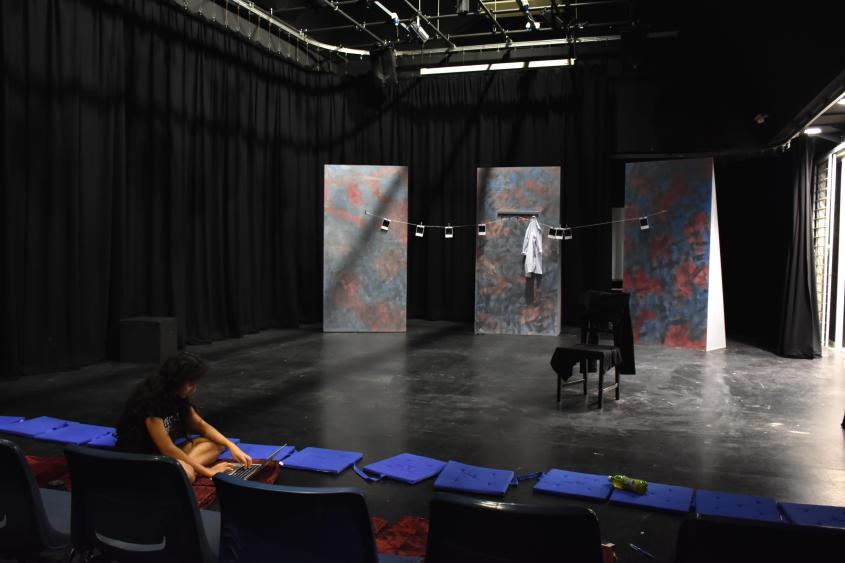
Meanwhile in the black box, Caitlin takes advantage of the quiet to get some work done on her laptop.

Fun fact: the 3 mysterious, oddly reflective flats in the background were designed by Caitlin, Sarthak, Sufyan and Aishwarya. Behind that look was a lot of work – 4 layers of it as they’ll tell you. They wanted a metallic finish, but metallic paint was too pricey, so “it was a lot of experimenting,” Sarthak says, and they eventually nailed the layering – “whitewash, layer of grey, paint red and blue, silver top” and also the exact texture – “dipped two sponges in paint, scrubbed them together and put it on the flats and randomly threw it around.”

18

It’s 4.30pm, and prep slowly gets underway, as Sarthak grabs a rag and starts cleaning the window which they’ll use for their intermission ‘show’ later on.

19

Dinner arrives, and the players shift outside as they dig into their chicken rice and chatter away.

The actors have to be careful what they eat before performing, as Rishi shares that while technically one’s voice is supposed to come from your diaphragm instead of the throat, the chicken rice chilli can make one feel uncomfortable, depending on one’s tolerance. “Guess everyone had a little bit, but generally good to stay away.” In any case, “the chilli’s packed separately anyways,” as Sufyan shares, “so if you can handle it go ahead.”

20

It’s 5.30pm when they finish dinner, and Kathy, Caitlin, Sarthak and Jasdeep (left to right) set up the Front of House, in anticipation of early birds on their way to pick up their pre-orders.

21

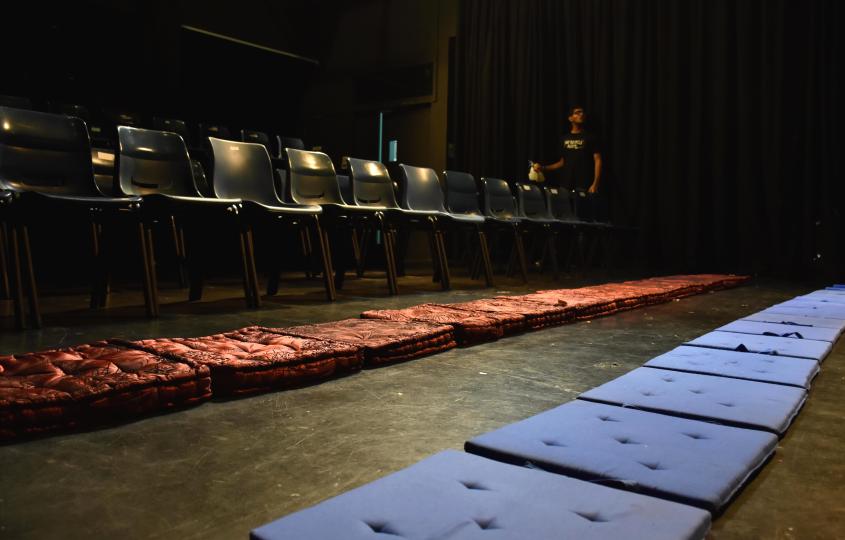
Meanwhile, back inside, Sufyan (in black) checks each and every seat for squeaks, (while Celine on the right races him to test out the last few seats). Aishwarya sprays air freshener on the cushions on the left, and some still drying spray patterns are visible on the blue ones at bottom right. Of the air freshener, Aishwarya (16S03S) shares that interestingly, “it was what [Sufyan and I] took the longest time to decide on when we went out to get stuff, because we couldn’t decide on the smell, so we just opened all discreetly and smelt (laughs).”

22

Sufyan wields his trusty air freshener. “I’ll keep on using those, even after production.”

23

Air freshener aside, much of Aishwarya’s and Sufyan’s effort went into creating the seating layout above. As Aishwarya shares, they planned way in advance, “[taking] measurements from day one of rehearsals” to draw up seating plans, before setting each of them up to physically try them out.  “We really sat and discussed for 2 whole days to make sure everyone can see”, shares Aishwarya, even staying one night to 11pm as they revamped their plans after they discovered they had cushions. As Sufyan (16S06F) says, “it was a tedious process.”


24

On the performers’ end of the black box, actors, director, and senior alike all chip in to clear the flats from last night (incidentally,the reflective paintwork is much more visible here) and set up Heart’s Desire’s set.

Just as how they’re helping each other set up the set, many of the players juggle multiple roles, helping one another out in the different areas of production. From publicity to acting to sets to stage managing just to name a few,  it’s common to find players who are in two or more of those. ‘It’s quite amazing,” as Kathy (16S06I) says, “how they can juggle all these without dying actually, and like they can still be so high and hype the energy up.”

25

Celine on the right packs the suitcase she’ll use as Susy, while Caitlin on the left helps draw out the unique chalk ‘set’.  

Jasdeep (16S03N), director for Heart’s Desire, explains that the chalk, with its yellow border above separating the family and Susy, helps explore why the family’s fighting in the play. “Is it because of what’s happening within, or is it something that’s beyond it – is it Susy? Perhaps this family was broken not because of Susy, and Susy was merely an excuse, and it was this toxic environment, this toxic box that they were stuck in.”

26

The chalk footprints forming paths on the stage also subtly explore the artificiality of the setup, showing that there’s “some greater force that’d already planned that the bird would be walking in that direction” Jasdeep explains, referring to the yellow chicken footprints above. “That idea of reality, and what is fake, the clash between what is created and what is real, and if there’s anything real in the first place is one tension we tried to discuss.”

27

This chalk they used is Jasdeep’s – he really likes chalk.

“I think chalk is really cool, I watched a play about chalk before and it was in a black box, except they put up like chalkboards and drew the set. It was really really cool, and I always wanted to use chalk for a play, so I did it.”

28

Outside, the first attendees arrive to collect their tickets from Kathy, who’s in charge of the front of house this night.

“There were many more parents on Saturday and more RGS girls on Friday,” observes Kathy, and she also enthusiastically shares that sales were really good!” We oversold both nights,” Celine (16A01A) says, “and even squeezed in a few more on Friday!” Kathy adds. On Friday, some called to cancel last-minute, but the popularity of the play was such that “there were a few enthusiasts waiting outside the TSD for extra tickets so we sold it to them!” “It was pretty surprising for us,” she says, and notes that perhaps “it was also because we only had 91 tickets available”. Also, Hai Yun mentions that they tried to keep ticket prices low and affordable at $7, possibly driving up sales too.

29

Back in the black box, Celine and Hai Yun (left to right) write messages on the posters for their teachers-in-charge, Mr Tan and Mr Choo.

“It was a spontaneous decision,” Celine shares. Inexpensive says Hai Yun, but also meaningful. “We wanted to give the teachers something nice, but also relevant to the play” explains Celine, plus, “that’s also what some people do in plays too, so it’d be cool!”

30

It’s 15 minutes from doors-opening, and the players go through their final preparations: Beatrice helps Wen Wen affix the glitter with hairspray, Isaiah adds the final touches to Celine’s makeup…

31

…and of course, the cast and director of Heart’s Desire quickly pose for one final pre-show group photo.

32

In the last few minutes before the doors open, the cast gathers round to do their warm-up.

“It’s like a tradition, we do it every time,” says Val. It’s “very like family … [feeling] together, as one, preparing for the show.” And indeed, it wasn’t just the actors warming up, but the directors and crew too, everyone gathering round. As Jasdeep shares, it’s not so much one’s role, as the fact that they’re part of this community. “Whether you’re doing tickets, acting, directing, lights & sounds, this community is very important because it’s an environment where you create something together. It’s about the friendships you make, the people you meet, and I think that’s really the fun about theatre.”

33

“The shakedown is something we always do, and at the end you’re just supposed to ‘urgh’ one last time, and just purge, like ‘arrr’ get it out of yourself and then calm down, and get in character.” – Rishi, on the pictured ‘shakedown’ part of the warmup.

In theatre we have this idea of energy when you’re on stage,” Jasdeep shares, “what you put into your character to move the audience”, and the shakedown is highly important for that, to getting them ready. “Aside from the practical purposes, like enunciation, making sure you can move without cramping, it’s also about more intangible ideas, like conviction and the energy.” Jasdeep stresses.

34

Aishwarya and Isaiah (left to right) look on and discuss the lighting effects.

As the warmups proceed, Isaiah and Aishwarya are in the lights booth testing the lights and sounds, “how the light shines on faces, the shadow, and the effects – individual lights, and a blue wash in one of the A Painless Way to Die scenes,” says Aishwarya. In the booth, Aishwarya handles lights execution, which Isaiah had programmed, and sounds execution (including announcing and even house music) is taken care of by Isaiah.

35

 In the lights booth itself – winky lights and cool monitors

Aishwarya explains that the orange lights and sliders adjust individual lights’ intensities, and the left monitor is where they can save that lighting setup to a cue sheet. The right monitor then loads those cues, so “on the actual day we simply need to hit ‘GO’ and the lights will automatically almost magically change.” Isaiah says. ‘Almost’, because behind those cues was a lot of work. “Lights was a tedious process,” he says, especially since the lights board was new to him. “We spent hours having technical runs,” he shares, “spending time setting which light goes where, and also figuring out positionings of moving lights, if the directors wanted moving lights.”

36

Aishwarya’s cue sheet in the booth

The work isn’t just in the programming though. In the execution itself, they have to be very careful to hit go on the right cues. Also, “some sound and light cues have to go at the same time,” Isaiah shares, “so Aish and I have to coordinate together… so it’s not so relaxed (laughs)”. Furthermore, it’s really too dark during the play to simply refer to their cuesheets, but, as Aishwarya shares, “we hold the flashlight there for the tricky parts like continuous cues, but most is already memorised due to extensive practice.”

37

It’s finally 6.30pm – doors are now open, and Sufyan and Aishwarya look on as people arrive for the show.

Snippets of Imagination: Film Showcase 2015

Reading Time: 6 minutes

By Alex Tan (16S03B) and Karen Cuison (16A01D)
Images courtesy of Raffles Film Society

Directors of the thesis films taking questions.

When prodded for his greatest takeaways from Snippets of Imagination, chairperson of Film Society Jiaxin Xu (16A01A) quipped that they would probably be the four tubs of ice-cream left over from the showcase. Even though we were not invited to share in the luxury of consuming the delectable confectionery, we were still thoroughly impressed and charmed by Raffles Film Society’s annual showcase. From a behind-the-scenes view of Raffles Runway’s annual fashion show, RE:Collections, to a series of five-minute shorts, and half-an-hour epics, there was something for everyone in the Performing Arts Centre.

Year Five Special Films
A selection of teasingly short films made by Year Fives started the ball rolling. Some were downright cryptic, consisting solely of short clips interestingly juxtaposed, featuring urban cityscapes and black-and-white shots of plaster legs. Others were more easily identifiable and narratively tight, arousing deserved laughter from the audience. A film that documented a friendship grown exclusively on Whatsapp, making real-life interactions impossibly awkward, was notable.

Runway
Film Society collaborated with Raffles Runway to bring a behind-the-scenes view of Raffles Runway’s annual fashion show, RE:Collections. The skilfully crafted shorts premiered at RE:Collections, providing insights into the processes of ideation and creation. It was a refreshing change inserted smartly in between the Year Fives’ Feature Films and the Year Sixes’ Thesis Films.

Y6 Thesis Films
The feature films by the graduating batch of Film members left the audience in the Performing Arts Centre scared, stunned, sad, and in stitches, in that order.

Possessed

The female protagonist (Emma Lau), before tragedy befell her.

Synopsis:
Travelling on a budget? So were they, and renting a long-unused apartment seemed like the perfect solution. But all is not as it seems in the house. Will you be enjoying your stay?

Possessed kicked off the string of feature films with a most innocuous-looking printer, spitting out a booking confirmation for a budget HDB flat. The aptly selected soundtrack stitched together an atmosphere of foreboding and impending disaster from the beginning. This atmosphere was cleverly sustained throughout the eight-minute film – with whitewashed walls, much ambiguity, and gore scenes composed so well they looked discomfitingly like paintings. The frequency of frames shot from the characters’ backs, coupled with the jerky camera movements, contributed to the constant eerie sense that they were being watched by an invisible, supernatural force awaiting its opportune moment to pounce upon them. Although the film abounds in archetypes of its genre (other than its quintessentially Singaporean setting), the effective buildup guarantees that when the jumpscares arrive, aided by masterful special effects they pack plenty of lasting force and shock, fully and satisfyingly. All in all, Possessed was very successful, and its chilling ending, like any other good horror film, promises the horror’s continuity.

Directors: Allan Zhou, Fabian See
Cast: Joel Seow, Emma Lau, Allan Zhou

A Locked Room

locked
Kyle (Katrina Jacinto), on the verge of a new breakthrough.

Synopsis:
Kyle runs an online murder mystery interest forum where users post different crime scenarios and other posters try to solve it and hence improve it, just for the thrill. A particular anonymous thread catches Kyle’s attention. A seemingly real unsolved murder mystery which promises clues only when the right questions has been asked. Will Kyle solve the mystery? and IF she does, what will that earn her?

With its beautiful cinematography set to appositely spine-tingling tinkles, one quickly arrives at the sense that much art was woven into the shooting of this short film, much care taken to intricately establish each scene. Everything has an air of the vaguely disturbing, from the grotesquely bright mythical beasts and uncannily painted faces of Haw Par Villa to the haphazardly scattered books and noddingly mirthful deity in Kyle’s flat. Mystery so pervades Kyle’s existence, that even her moments of interiority revolve around poring over her online murder mystery forum, puzzling over unsolved enigmas. Watching the human presence of Kyle pacing through static surroundings, the sole incarnation of aliveness amidst death and hell, one wonders, with a lingering sense of dissatisfaction: how did Kyle come to solve murder mysteries? What life does she lead beyond these pursuits? What kind of person is she outside of her unwavering detective instincts?  These considerations aside, viewers thoroughly enjoyed the film as it builds with finesse to its horrific conclusion.

Director: Yuki Pan
Crew: Alethea Tan, Priya Ravi, Edina Loo
Cast: Katrina Jacinto and Megan Lourdesamy

The One You’ve Never Met

home
Preparing for his sister’s arrival.

Synopsis:
A story of a boy who learns that his sister has six months more to live. Inspired by a true story.

The premise of The One You’ve Never Met had plenty of potential for poignancy. The film documents the development of the relationship between siblings Aiden and May after the latter finds out she has cancer. Unfortunately, this film stops short of achieving its intended effect. Any height of genuine emotion was dimmed by over-sentimentalized music, histrionic outbursts and an unrealistic script. Many of the lines bluntly tell what could have been more subtly shown, such as when May, frailly lying in her hospital bed, tells Aiden that his effort in visiting her everyday has been “pretty touching, actually”. Yet one finds details which provide brief flashes of pathos. After May’s sudden passing, Aiden remembers that her voice was inadvertently recorded in his small contraption, her presence manifested like a spectre in that tiny object. As a powerful symbol of the unexpected things people leave behind after their deaths, these redeeming moments remind us of the truth in the true story upon which the film is based.

Director: Lorraine Fong
Crew: Linette Chan. Lim Jingzhou
Cast: Gary Huang, Celeste Tan

A Canon of Proportions

canon
Student and teacher side by side.

Synopsis:
Who treads on your dreams? Paul and Felix, everyday boys in everyday modern life, hide secrets beneath their separate veneers. As their facades unravel under the influence of a hard-headed teacher, questions linger- what are they striving for, and for whose sake? Shot mainly in long, uninterrupted camera takes lasting up to 7 minutes in length, ‘a canon of proportions’ chronicles their efforts in dealing with individuality, modernity, and the remnants of an antiquated philosophy.

The first thing that stood out in A Canon of Proportions was its cinematography. Long, sprawling takes endowed the most mundane setting ever – school – with a majestic unfamiliarity. The estrangement, it seems, was part of the plan, fitting in impeccably in a plot about two boys questioning the veneers that living in modernity necessitates. On a deserted rooftop, Paul says, “It’s just not who I am … all this standing under the spotlight, all this nodding in the corridors when people walk back and forth, and I can’t stand it anymore.” Several lines later, his counterpart replies, “I’ve always wanted to produce something meaningful.” Although the film’s latent momentum was maintained in a balance of physical movement, humour and dialogue, the protracted stretches of Nietzsche-infused dialogue was heavy-handed and a little too self-indulgent. The subtlety and dimension of the film was, however, delightful. One can only speculate at, for example, the fate of Felix, who disappears at some point, or the homoerotic subtext between the various male characters in the film. Overall, Canon’s perplexity made for a rewarding – though at times vexing – viewing experience.

Director: Andrew Chen
Crew: Zhang Yuchen, Jeremy Tian
Cast: Gabriel Ng, Hethav Siva, Ariwan Kai

For us (and, we believe, many members of the audience), Snippets was an eye-opening opportunity to view conflicts and concepts through the able and sensitive cinematographic lenses of our peers. We would love to enjoy it again, with ice-cream next time.

Keep Calm: An Introduction

Reading Time: 4 minutes

By Louisa Li (16A13A) and Md Khairillah (16A01B)

Interview by Adelyn Tan (16A01E) and Choo Shuen Ming (16A01E)

Familiar?
Familiar?

Around campus, two sights are familiar to all: that of the Rafflesian studying, and that of the Rafflesian trying to study. Raffles Press speaks to counsellors Kah Hwee and Mei Hui for tips on how to navigate a school life constantly marred by abject and inevitable stress, as well as the support available when we feel overwhelmed by it.

Stress is the common denominator among all teenagers: Kah Hwee stressed that “the teenage years are a developmental stage, and it can result in high emotional intensity.” Most teenagers go through similar issues, if communal moaning about problems in general teenager linguo is anything to go by. What does differ however, is the intensity of the issues we undergo, coming down to our individual capacities to adjust and manage the changes. Someone who lacks stable and effective stress management mechanisms may be better off with external help, which is of course no indictment on one’s personality or disposition. Requiring more support and help to build the skills needed to stay mentally healthy is wholly understandable, and encouragingly, something which our counsellors have plenty to say on.

First and foremost, mental wellness is a skill, not just a state of being. Mental wellness, as an extension, provides a support structure for dealing with stressors when they come. As Mei Hui puts it, “You’ll be able to handle them better; you’ll be more adaptable; you have more resources on hand and they’re less likely to cause a mental illness.”

Such support structures include having a good social network to manage the stress in your life, and leading a healthy and balanced lifestyle. To that end, you should ensure that there are constant positives in your life; the smallest pleasures and interests can often reap enormous benefits and leave you with a feeling of ease and comfort. Basic physiological needs for instance are unexpectedly important: our sedentary lifestyles mean that we don’t get enough sleep, eat well enough or exercise enough. Our bodies are created to work, and movement is a way of countering and managing the stress built up in the body over a period of time. A lot of things can slip in the long run if we don’t pay attention to these things.

Apart from building support structures to ensure that you remain healthy, helping your friends by listening to them is important too. Rather than needing people to outright ‘solve their problems from the get-go,’ people often ‘just need to vent and feel like they’re being cared for.’ As friends, our focus needs to shift from solving people’s problems to understanding these problems from their own perspective; Kah Hwee mentions that just being there  “can actually go a long way in helping people feel better and they might realize they don’t need anything beyond that.”

image

However, Kah Hwee cautions against being the only supporter and carrying the burden yourself. Expanding the support network by bringing another good friend in would ensure that your friend doesn’t become over-dependent on you – you should think about taking care of yourself as well. “If not,” Kah Hwee jokes, what ensues are “phone calls at midnight and texting till 3am.”

The last people that teenagers would ever think of turning to would ironically be their parents, as “the relationship between a lot of teens and their parents can be very complicated”. Growing up is the process of finding your own identity, and many teenagers tend to drift apart from their parents. Nevertheless, your parents are still the ones who brought you up all these years; they do care about you. Mei Hui qualifies that the “majority of the parents we speak to genuinely love and care for their children. It may be hard for teenagers to see that now, but whatever happens, they’re still your family. If one parent is unsupportive, try talking to the other!”

Other than your friends and family, support is also readily available in school. Kah Hwee recommends coming down to speak to the counsellors, or talking to your teachers if you’re comfortable with it. If the situation worsens and you suspect that you might have a mental illness, the counsellors can also administer screeners, and talk to you to get a sense of whether or not you display enough symptoms to warrant a diagnosis. “We can take you through the whole process. For students who are afraid to speak to their parents about it, we could also invite their parents to come down and have a chat.”

This Keep Calm week, try your hand at some of the fun activities in the canteen, while learning about how to deal with a bevy of life crises. Don’t wait for one to happen before you start worrying about stress management!