School Life

IHC 2014: Musicfest

Reading Time: 7 minutes

By Lu Jinyao (14A01D) and Joyce Er (15A01A)
Photos by Isaac Siaw (15S03Q)
Cover photo by Matthew Yeo of Raffles Photographic Society

Last Friday night, IHC Remix kicked off with Musicfest, a three-hour music extravaganza featuring various interpretations of pop, classical and rock pieces. Whether students were there to support their friends, their house, or even to relax after a long week, Musicfest proved to be enjoyable for all.

Throwing together a performance in two weeks is no mean feat, and the criteria for this year’s competition, organised by Chamber Ensemble, did not make things any easier for participants. In 10 to 15 minutes, each house was to put up one classical re-arrangement of a pop song, and the reverse: one re-arrangement of a classical piece in any other form. Judging that night’s performances were Ms Michelle Kwok (our GP teacher), Mr Jarrod Lee (an ex-teacher with Broadway-style vocal experience) and Mr Hazli (our very own sound technician).

What makes a good performance? Houses were rewarded for audience engagement, technical proficiency and diversity of instruments onstage. An additional, unspoken criteria which affected audience engagement was song choice. Although many Rafflesians have some form of musical background, those who don’t tend to be able to identify with and appreciate more mainstream pop/rock tunes, while obscure songs let the audience’s minds wander.

BB’s Nicholas Quek’s guzheng rendition of a pop song entertained and enthralled the audience.

As a whole, houses fared well in terms of technical proficiency. Many of the Musicfest participants are H2 Music students or members of various performing arts CCAs, which heightened the baseline standard. The performers taking the stage were individually capable and many were well rehearsed, which showed in their confident performances and the fact that few needed to refer to their score sheets. Individual highlights included Nicholas Quek of BB with his invigorating guzheng take on If I Lose Myself, and MR’s drummer, Shaun Mak, who provided the perfect rhythm for MR’s power vocalists Jonathan Boey and Esther Chan’s with their rendition of Where Have You Been. HH vocalist Melissa Tang’s sultry vocals shone during her jazzy performance of her house cheer in song form, drawing audible gasps from the audience, while HH’s piano rendition of Erlkonig, especially the sustained ostinato in the bass, was technically stunning.

Of course, the performances were not judged on the basis of individual competency – Mavis Tan, who helped with arranging MT’s set list, said, “The important thing about a performance is that it must be put together, on time, and in tune.” The challenge of including a diversity of instruments and unifying each instrument’s distinctive sound added a new dimension of complexity to the competition. Over the course of the night’s performance, an eclectic mix of instruments from the suona to the egg shaker made their appearance onstage. As Mr Lee said, while all performers were individually proficient, it was working together to produce a cohesive set piece that truly tested each house’s abilities.

BB took the stage as one team and impressed the audience with their fluid arrangement which also left room for showcasing individual talent.

Ultimately, Musicfest had as much to do with good arrangements and capable performers as it did with good teamwork. BB’s strategy in the competition was inclusive and got everyone on board while letting each individual shine. As Daniel Ang, BB’s double bassist and co-composer puts it, they were able to come up with “a seamless and complete package, where each of the segments were closely linked to each other,” despite the changes in genre from pop to classical. He added, “Also, we felt that the space created by transitions could be used to showcase the solo abilities of our performers, giving them room to creatively express themselves while still being part of the team concept!” Their performance was also punctuated by percussion instruments for comedic effect, which kept audience members entertained and enhanced the atmosphere of their performance.

It goes without saying that the amount of effort put into the process was integral to determining each house’s outcome. BB on decided their repertoire the very day competition requirements were released. This enabled them to finish composing and begin rehearsals more than a week before the actual event. Practicing up to five hours a day in the leadup to Musicfest took serious dedication from each member of the team. Indeed, BB’s unbroken melody seemed well-rehearsed, and while there were minor slip ups in the otherwise powerful vocal performances by Emma Lau and Lorraine Fong, the overall reception to their performance was positive.

The level of preparedness each house had made a huge impact on the chemistry of performers on stage. Houses that fared better in engaging the crowd, featured performances that were more cohesive and overall allowed for a strong performance. One such combination was MR’s pairing of Jonathan Boey and Esther Chan on vocals. When asked about the chemistry between him and Esther, Jonathan said, “Her skill level and confidence also made it easier for both of us to communicate and understand where the other was going during the performance itself. It also helped that we got along in general, which is an important thing when you’re making music with other people.”

HH’s team was prepared enough that sheet music was unnecessary.

Those in attendance that night might also remember that HH was the only house that didn’t use sheet music onstage – again a testament to their confidence. Said Casey Chan, HH’s violinist, “I think that intuition, creativity and the ability to improvise, rather than the following of a fixed music score, are core traits of true musicians that the HH team have emulated well in Musicfest.” Another benefit of not needing scores was that the stage looked less cluttered, and the HH team, more cohesive.

BW’s Gordon Kang on the drums during a piano/drums duet with Dean Fu (not pictured).

Determined to impress, BW decided to take a chance with a self-composed song, titled Mimblegrimble. BW’s Gordon Kang said that his original song performed during Musicfest was not a last-minute composition, but something he composed a while ago and dusted off for this competition: “I hate forcing out music so I thought it’ll be more interesting to start with sometimes refreshing and original.” In a stroke of creative genius, they also performed a memorable, fast-paced piano/drums duet rendition of Moonlight Sonata 3rd Movement, which, again, distinguished them from the rest.

However, it wasn’t smooth sailing for all houses. Over the course of Musicfest preparation, each house inevitably met with their fair share of difficulties, which contributed to the quality of their final performance. As with any team effort, coordination is necessary, and for HH, their biggest challenges during rehearsals originated from technical difficulties, and the difficulty of coordinating rhythm and tempo.

Despite a relative lack of preparation, MT’s team put up a commendable performance.

Prior to the big day, rumours that MT had only started rehearsals on Wednesday were circulating. These were confirmed by Ace Tay, who played the trombone during their performance. Said Ace, “There were only three or four practices. We only decided on the songs in the first practice, and decided to play This Is War two hours before Musicfest.” This was perhaps because, according to Stefanus, their vocalist, no Musicfest IC was officially appointed for MT, and preparations only began in earnest the Saturday before. More remarkable is the fact that Shawn Chan, their drummer, was in fact recruited as a pianist and learned to play the drums a day before Musicfest to compensate for their a general lack of diverse instruments, including the drums. That said, it is a testament to these performers’ grit and their dedication to their craft that these houses managed to pull through and put up a commendable performance.

At the end of the night’s performances, and after a brief segment by Rock to tide over the audience while the judges were deliberating, the results were released:

1st: BB

2nd (tied): BW and MR

3rd: HH

4th: MT

The judges specifically pointed out that sound imbalance was a recurring leitmotif among all the houses – that the loudness of the electric guitar and drums, for instance, drowned out the rest of the ensemble. Also, occasionally, in the attempt to max the number of instruments, the outcome was more of a dissonant. Consequently, BB’s win was probably due to their seamless arrangement, evident in Ms Kwok’s parting comments, ‘Think of music as a soundscape: you can design the sounds that you want to create… but [an instrument] has to either cut through or blend, not stick out like a sore thumb’. From the looks of it, BB managed to achieve that precise blend. Mr. Jarrod Lee pointed out that many singers tried too hard to emulate an American style, and advised the performers to ‘find your own voice, your own beat, your own style’.

Ultimately, one needs to accept that a one-time performance always leaves as many regrets for the performers as awe it gives to the audience. Due to nervousness, or the lack of time to pursue perfection, stage performances rarely reflect the hundred percent ability of individuals. Beyond the music technicalities, we are even more impressed by the amount of effort and dedication each house invested to see a performance from its start to the end.

For first-time participants especially, Musicfest was a valuable learning opportunity, allowing BB’s Emma Lau to “learn and develop the technical skills of the pop/rock genre”, while seeing firsthand “how instruments come together”.

More than that, we are certain that what participants took away from Musicfest was not the final judging, but the seeds of friendship sown. Indeed, as HH’s Casey Chan said, “The Musicfest experience was definitely a great one for me – through overcoming challenges and making music with the HH Musicfest team, I’m glad to say that I’ve made many new friends and had lots of fun. What was also heartening was what happened right after Musicfest – Regardless of result, musicians from different houses came together in the amphitheatre to jam, revelling in the music that they enjoyed in common.” Or, in the words of Koh Kai Jie, chairperson of Chamber Ensemble, “The final results are meaningless numbers as long as the houses outdo themselves and enjoy the process.”

A-Level Results 2014: Ground Sentiment

Reading Time: 4 minutes

By Ching Ann Hui (15S03A) and Michelle Choy (15S05A)
Photographs by The Raffles Photographic Society

The GCE A-Level results were released on Monday, 3rd March 2014. Even though many envisioned it to be a nerve-wracking day with life-changing repercussions, the atmosphere at the Multi-Purpose Hall was rather light-hearted, with all the J3s excited to see their schoolmates again. Deputy Principal Mr Magendiran was equally pleased to meet the batch of 2013 once again, and commented that “they are spirited, full of energy, and they live up to the traditions of all the previous batches. They have done us proud.”

IMG_8087

Before the address began, the batch of 2013 sang the Institution Anthem for the very last time. It was also Mr. Chan Poh Meng’s first time delivering the Principal’s Address to the awaiting J3s, since joining the school in January. He jokingly promised to not dwell very long on the slides, so that they could receive their much awaited results as soon as possible.

Mr Chan addressed the school with the overall statistics of the batch of 2013, and featured some noteworthy students (more can be read here). It seemed as though it was barely after Mr Chan began his speech, when it was time for students to file into their respective venues to collect their results. And when the moment for students finally came, there were varied reactions – some bore glad smiles, others squealed out in joy, ineluctably, there were also tears, and somber silence.

140303_AlevelsResultsRelease_NataliaChioang_053

To some, the results came as a pleasant surprise. Benjamin Wong (13S06D) said, “I didn’t really expect this. I expected worse!”, as he clutched his results slip – straight As! When asked about his future plans, he expressed interest in studying in Singapore Management University (SMU).

While speaking to some of the civics and subject tutors, they were pleased with how their form classes had performed. Mrs. Lim, civics tutor of 13S06K, commented that her form class “generally did well”, as did most of the other civics tutors. Mrs. Shirley Tan, deputy principal of Academic Studies in RGS who was there to provide moral support for her ex-students, was “very very proud of all the girls”. When asked about possible tips and suggestions for the current batch of Year Sixes, Mr Edward Ng advised, “as long as the students try their best, I’m sure that the results will come automatically.”

IMG_8097

Parents were also very impressed with this year’s results, with many saying that the school performed very well. Mrs. Ang, a parent, expressed appreciation that the school has placed its focus on providing a holistic education for Rafflesians. She was also pleased that by featuring the all-rounders and focusing less on just those that did performed exceptionally academically, less emphasis was placed on results this year.

When asked about their stellar results, many commented that it was ultimately the support from friends and family that helped them over the finishing line. Adam Rafey (13S06K), the former BW house captain of 2013, expressed that it was from “a lot of love from my friends and family. Especially my mum and my dad.” Similarly, Lee Zi Xin said, “Definitely my parents, and friends. We’ll gather all the physics definitions, and really help each other out.”

As for students who were unable to achieve their desired results, Ms Avadhani, a GP tutor, commented that “it’s an opportunity to look at alternative careers and subjects. There isn’t only one way to achieve something or do something, so this is the time to get creative. If they are willing to push themselves, they should be alright.” She also noted that the people who did well are people who’ve been working very consistently, as compared to those who often liked to do last-minute work. For the Year Sixes reading this article, it’s probably time to start reading up on materials outside the syllabus for GP!

Other students also expressed great gratitude for their teachers, both school teachers and CCA teachers. Bryan Yong, captain of the cross country team, expressed thanks to his CCA teacher in-charge Mr. Tay, and his coach Mr. Steven, for really “helping him out through these two years”. Similarly, another student (who wishes to remain anonymous) commented, “my economics teacher Miss Amelia Heng is awesome! She stayed back with me until 6pm for consultations.”

To all those going to take their A-Levels this year, we found this advice by Ang Tiong Han (13S03A) particularly apt:

“Just study hard, and make sure that you don’t have regrets when you actually get your results – even if you don’t do well, you’ll know that you’ve at least put in your very best.”

Class of 2013: High Achievers

Reading Time: 3 minutes

By Gao Wenxin (14A03A) and Allison Choong (14S05B)
Additional reporting by Valerie Chee (15S07A) and Kang Yi Xi (15S03N)

DSC03815

Anticipation ran high as the 1,239 students from the Class of 2013 awaited the release of the 2013 ‘A’ Level Examinations results today. Overall, the cohort turned in excellent grades, with 97.6% of the cohort achieving 3 H2 passes with a pass in GP or KI. This is above the national average of 91.1%, and an improvement from last year’s 97%. Roughly 68% of the cohort also scored at least 3 H2 distinctions, and 170 students achieved distinctions in all subjects offered (including H3), compared to 129 from last year.

Today also marks the first time that Mr Chan Poh Meng delivered the ‘A’ Level results as Principal, and he congratulated the batch on their personal and community achievements. His presentation featured students who were talented in areas of sports, arts, leadership, community service, as well as all-rounder JAE students. One memorable aspect was the emphasis on some “noteworthy tough cookies”, or students who had juggled their school life alongside personal challenges or difficult circumstances.

Our reporters with Mr Chan

Mr Chan also highlighted that 339 students (27%) have achieved a perfect University Admission Score, with the mean score in RI being 85 out of a total possible of 90. In an interview with Raffles Press, Mr Chan reiterated that such “quality grades will put [students] on a good stead” with local university applications, even in competitive faculties, and hopes today’s outcome will help the 2013 batch “achieve their personal aspirations”. He also urged students to broaden their horizons no matter their results, and be open to options beyond traditionally prestigious courses and universities.

Those who were former RGS girls were also surely encouraged by the presence of Mrs Shirley Tan and Ms Chin Jen Fu, who were in attendance today. When approached for comment, Mrs Tan told our reporters that she was very proud of the girls, and that the results were “a great affirmation of all that they have done in all the 6 years, and an affirmation for the RP” as it is “testimony that they are laid very strong foundations.”

subjbreakdown

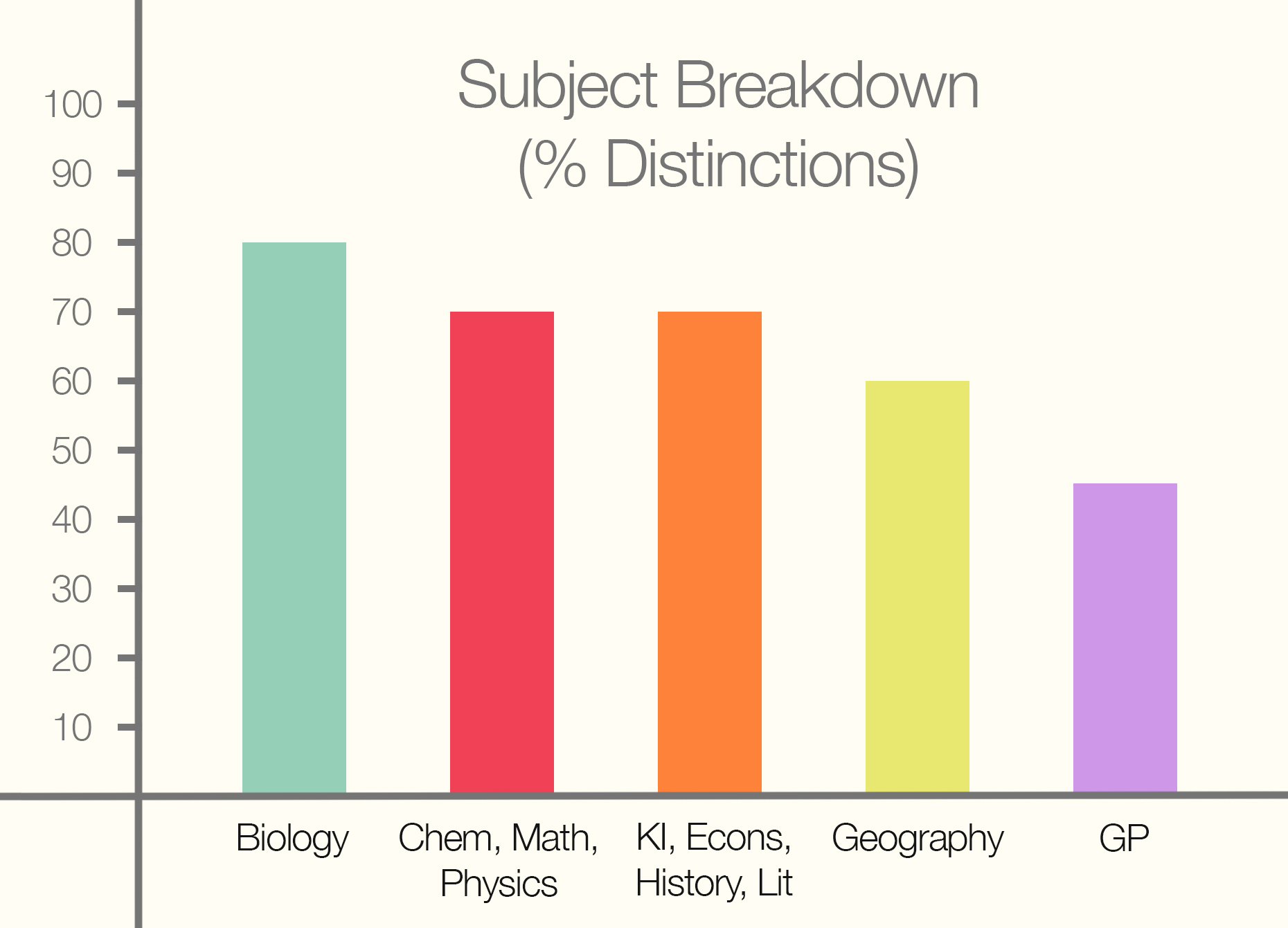
Subjects-wise, Biology maintained a 80% distinction rate, as did Chemistry, Mathematics, Physics, and History at 70%. Economics has shown an encouraging improvement with a 70% distinction rate as well, and one Economics tutor enthused that the results “couldn’t be better” and that this year saw “highest distinction rate ever”. The percentage of those scoring distinctions in General Paper, Knowledge & Inquiry, English Literature, and Geography have dipped slightly from the previous year; however, it should be noted that the 2013 ‘A’ Levels featured a revised Literature syllabus as well as the removal of the “Vocabulary” section from the GP paper.

Mrs Lim Lai Cheng, surprisingly, also had some final words for the batch via a slide in Mr Chan’s presentation. She asks the students to “always believe in yourself, and through small acts, work towards changing the world.” On that note, we will like to congratulate the Class of 2013 on their achievements and we wish all J3s the very best for their future endeavours!

Class of 2012

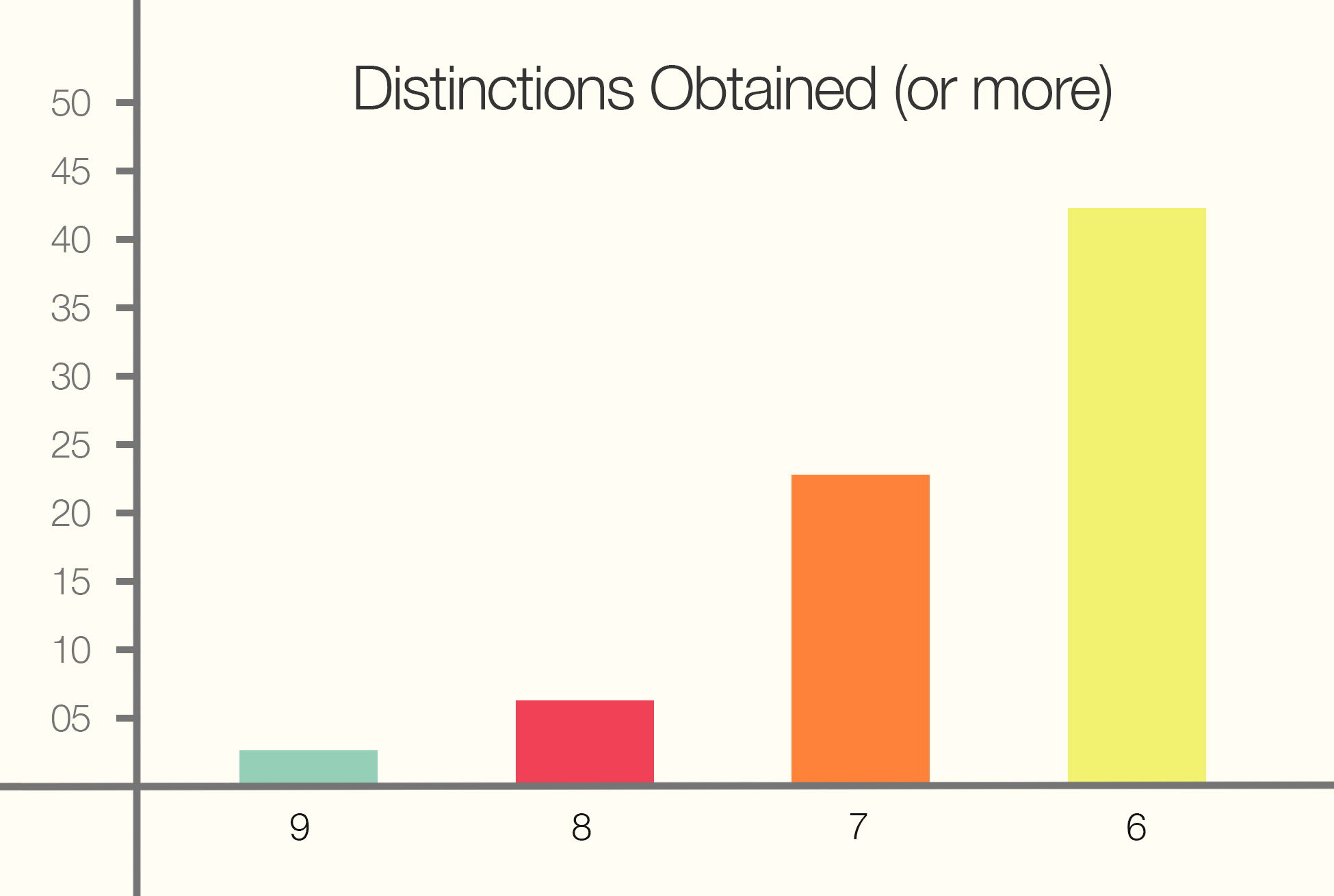
9 Distinctions: 10 students (i.e. 0.81%)
At least 8 Distinctions: 88 students (i.e. 78 with 8 Distinctions, i.e. 6.29%)
At least 7 Distinctions: 282 students (i.e. 194 with 7 Distinctions, i.e. 15.65%)
At least 6 Distinctions: 543 students (i.e. 261 with 6 Distinctions, i.e. 21.05%)

There were 1,240 candidates.

Class of 2013

distinctions

9 Distinctions: 4 students (i.e. 0.32%)
At least 8 Distinctions: 80 students (i.e. 76 with 8 Distinctions, i.e. 6.13%)
At least 7 Distinctions: 277 students (i.e. 197 with 7 Distinctions, i.e. 15.90%)
At least 6 Distinctions 533 students (i.e. 256 with 6 Distinctions, i.e. 20.16%)

There were 1,239 candidates.

Eclipse of an Orientation Cycle: Survival of the Fittest (OGs)

Reading Time: 4 minutes

By Lee Wei Hern (14S03T) and Benedict Koh (14S06N)

Before the Year 5s open a new chapter in their lives and embark on two years of JC life, they go through a traditional rite of passage- the four-day long Orientation programme. It’s an experience every Rafflesian can relate to as we are allocated into an Orientation Group (OG), and make our first JC friends through ice-breakers and OG dinners. After those four days, however, school life starts to kick in proper – a (largely) dreary routine of lectures, tutorials, CCAs, and revision which never seems to end. The mundane tasks of our everyday life can be so time-consuming that some of us end up unable to spend time with our OGs. Hence, for many unfortunate OGs, the ‘OGlings’ stop hanging out, and in some cases, cease any contact whatsoever; such a situation is commonly referred to as the “death of an OG”. Yet miraculously, some OGs still manage to remain alive and active. So, why is it that some OGs are longer-lasting than others?

ogs 1

According to our survey conducted on Year 6 students in October, we were surprised to find that only 7 in 20 respondents considered their OG to still be alive.  What was even more shocking was finding that more than 40% of the respondents NEVER met up with their OG after Orientation.

Strangely enough, when asked to rate the importance of Orientation in JC life, on a scale of 1 to 10 (with 1 being the least important and 10 being the most important), half of the responses registered a reading of 7 and above. Since many Rafflesians hence view Orientation as such an important aspect of their JC lives, why then do OGs still die? We tried probing further by asking our respondents whether they felt it was important to maintain contact with their OGs AFTER Orientation and their supporting reasons.

Upon inspection, we realized many of our respondents felt that maintaining contact with their OGs after Orientation was important as it helped to boost house spirit (since OGs are formed within houses). Moreover, on a more personal level, they felt that the OG provided them with an additional backbone of support, especially for students who had not yet fully assimilated into the rhythm of JC life and were facing extra difficulties coping. The OG hence became one group of friends one could rely on for support.

“ OG-mates are no longer called OG-mates, but friends. Lasting friendships are formed during Orientation, which also provided some of the best memories in one’s JC life.” – (Bryan Tan, 14SO6H)

ogs 2

While many felt that it was important for students to maintain contact with their OGs after Orientation, it seemed that keeping OGs bonded became an increasingly difficult task, as time constraints from academics, CCAs, enrichment programmes and the like prevented the OG from meeting up often. A typical JC student’s hectic life sees him/her focus on so many personal commitments that it is unsurprising how staying bonded to his/her OG has not been a main priority for many. On a deeper level, many also felt that Orientation was too short for the OG mates to get to know each other well enough to forge strong bonds with each and every member – hence perhaps leading to the fragmentation and formation of cliques within the OG.

“Classmates bonding together were of greater importance, the OG staying together was an added bonus, not a necessity.” (Rachel Quek, 14SO3T)

Since the Y5s are randomly sorted into their OGs, it is a wonder why certain OGs somehow manage to survive, whereas others die off almost immediately after Orientation. We asked our respondents about the reasons behind the survival of their OGs, or the reasons why it all just didn’t work out.

The main reasons why respondents felt their OGs remained long-lasting was due to enthusiastic people who were willing and able to put in effort to organize regular outings. Despite their numerous time constraints, they did their best to rally their OG-mates to meet up, making use of various social media platforms such as WhatsApp and Facebook. In fact, some OGs were more bonded as the routine of meeting up at a specific table in the canteen every morning (for example) had become a norm.

ogs 3

On the other hand, we discovered a trend among our many respondents whose OGs went their separate ways – that OGs usually ‘die’ around Term 2 of that year. In addition, many respondents agreed that the key reason behind this ‘death’ was due to the presence of other friends from their classes, or from their CCAs. As one would spend (almost) his/her entire JC life with his/her class, it is unsurprising that one would form stronger bonds with his/her classmates than OG-mates. Another factor to be considered is that OGs will be made out of people with different subject combinations. Having different streams and timetables undoubtedly makes it harder for the OG to find a time when most (if not all) members are available to meet up.

For the batch of 2014, it has been one year since Aurora. It has been one year since we first nervously met our OGs in the MPH on our first official day of JC life, one year since we made our first new friends in JC, one year since we forged many memories – memories of fiercely playing war games in defence of our houses, or recalling the moves of our batch dance (and awkwardly trying to execute them).

These memories will be irreplaceable for most of us, even if some of us have moved on from our OGs. At the end of the day, though, while the survival of OGs after Orientation is indeed important, we must remember that in every RJ student’s schedule, there will be many more commitments that he/she is likely to prioritize over his/her OGs. While the survival of your OG should not be taken for granted and is definitely not a given, it’s certainly not impossible. Keeping your OG alive is something that might be beneficial to you, should your OG weather the storms of JC life.

More Than Words: Kaleidos 2014

Reading Time: 5 minutes

By Celine Liu (15A01E), Michelle Zhu (15A01B), and Nai Jie Lin (15A13A)

Photo Credits: Raffles Institution Year 5 - 6 Orientation 2014 Facebook Page
Photo Credits: Raffles Institution Year 5 – 6 Orientation 2014 Facebook Page

Kaleidos – from Ancient Greek Kalos, meaning beautiful, and eidos, meaning form.

We are all aware of that which we call a kaleidoscope, a narrow, enclosed tube filled with beads and pebbles and other beautiful things all crammed and packed into a mangled mess of colour that, when observed, launches into a medley of brilliant light. Kaleidos 2014, a time once so woefully dreaded and eagerly anticipated, has come to a close after 4 short days and an even shorter weekend packed with new experiences, new memories and new friendships.

Or so that’s the plan.

Though to the casual observer orientation must have seemed a jumble of energy, excitement and light, for some of us more inconspicuous pebbles in the midst this was far from the case. Being surrounded by people seemingly on a constant, albeit rather artificial high- the energy can become exhausting, the excitement forced and the light- blinding.

What is an introvert?An oft-seen term that’s frequently tossed around and loudly (and ironically) claimed on the internet. Yet putting the ‘introvert pride’ debate aside,  an introvert is simply a person who gains energy by being alone, and expands energy when communicating and interacting with others. By that definition, orientation must of course seem like every introvert’s worst nightmare, when one is literally surrounded by strangers sunrise to sunset. But that does not necessarily have to be the case. While eliminating the socializing aspect of orientation may defeat the purpose of orientation itself, there are still many ways in which one may fulfill the aims of orientation, that is, initiation into a new community, without systematically excluding the needs of those who are not content with relationships formed over the span of 4 days and a lot of adrenaline.

3

Something that most may agree on, yet few dare to say, is that orientation can be rather superficial, a fact that can be ascertained by the sobering small number of OGs that manage to stay together throughout the two short years in JC. Despite the various OG ‘bonding’ activities and the copious amount of time spent together, it seems I’ve come away from orientation knowing absolutely nothing about anyone. And before an angry mob descends upon me in protest, I would just like you to stop and think for a moment about how much you truly know about your OG mates. What are their hopes, their stories, their fears, their loves? And no, whom they choose to shoot, shag, or marry doesn’t count. While we applaud the efforts of some OGLs to initiate ‘H2HT’s within the OG, the whole idea of forcing a connection can be rather oxymoronic.

Perhaps the real issue here can be put across by a Year Five, who commented that “I am more comfortable knowing a person before choosing to spend time with them because I know I will enjoy it, which is the opposite of orientation.” Personally, I have no qualms about being chummy with people I’ve only just met, but many people fail to realize that this may cause some discomfort amongst introverts who prefer interacting with people within their own comfort zone, and that comfort zone takes time to expand to accommodate new people – time which we don’t have.

2

In a period crippled with uncertainty and anxiety, trying to drown out your apprehension through fun and games and loud music may not appeal to everyone. Some may say that it all comes together with time, yet ought not the point of orientation to be to ease this process of transition? Perhaps some changes to enable better quality interaction with our peers may be at hand to benefit not just those who require deeper interaction to feel comfortable with people but everyone as a whole. While OGs may broaden your social circle and enable you to meet a larger variety of people, bringing 20 people together and then tearing them apart immediately after seems rather cruel, especially for those who already have trouble forming relationships quickly. Indeed, some introverted Year 5s admitted to intentionally distancing themselves somewhat from their OGs because there is little meaning in the superficial interactions that do not culminate into genuine friendships. Perhaps orientation should be geared less towards a focus on the OG alone and instead directed towards developing a passion and sense of identity with the school. The focus and emphasis of “socializing” with our OGmates is really only a fraction of the big picture, that is, providing a smoother transition into the school and its systems.

Even within the OG/House system, the large amount of physical bonding activities may not be the most effective in bringing people closer. Speaking candidly from an introvert’s perspective, team-building activities may even be a factor in widening the gap between introverts and extroverts; while extroverts derive energy and enjoyment from them, introverts tend to shrink and retreat, preferring more intimate one-on-one time with their OG mates instead. Activities like station games and war games may be a lot of fun, but some time could be set aside for more meaningful getting-to-know-you activities, instead of relying solely on OG dinners and downtime to really sit down and talk. This is especially so when you consider how these times usually end up occupied more by embarrassing dares and forfeits than anything more sincere. As a self-proclaimed introverted batchmate aptly put, “what brought us together as an OG were the times we sat together and ‘talked about strange things’.” True and heartfelt interactions were much likelier when the introverts feel comfortable with their fellow OGmates, possibly even with the slight nudges of their extroverted friends. To be plunged into team-building activities is a prospect that appeals more to the extroverts, and continues to prove itself intimidating and tiring to others.

However, as OIC Ruthanne so fittingly puts it: ‘Orientation doesn’t necessarily cater to any type, extroverts or introverts. Rather, it is dependent on how willing the individual is to participate; life is all about choices after all.’ It is easy to claim the short end of the stick, but rarely is anything moulded and pressed to fit precisely your form. Nothing stops you from making this your experience, be it as an introvert, extrovert, or somewhere in between. Proposals and planning can only go so far, but at the end of the day, the real stories and friendships you forge are of your own creation, and worth so much more than words.