School Life

Destemido: Sporting Moments (Part 2)

Reading Time: < 1 minute

By Joyce Er (15A01A)
Photos courtesy of Amanda Chang (15A03A), Gary Huang (15S03B), Abdul Musawwir (15S03Q), Gabrielle Jeyaseelan (15SO6A), Vivian Ngiam (15S06O), Nigel Gomes (15S06R)

IHC Sports 2014 drew to a close on Thursday, with BB coming out tops, followed by BW, MR, HH, and MT in that order. The season has certainly been a great opportunity for Rafflesians to try new sports and catch up with their OG-mates. Raffles Press would like to thank CCAD, the IHC Sports I/Cs, Clara Chua, Fu Xinyi and Low Yi Fen, as well as all Raffles Photographers for their tireless efforts over the course of Destemido, and wishes all houses the very best for IHC Remix 2015!

This slideshow requires JavaScript.

Go Without, Look Within: Hair for Hope 2014

Reading Time: 4 minutes

By Michelle Zhu (15A01B), Valerie Chee (15S07B)
Photos by Gabrielle Jeyaseelan (15S06A), Teri Tan (15A01E)

For the next few weeks or so, do not be surprised to witness groups of RI students, girls and boys alike, roaming the campus with starkly shaven heads. On 18th July, RI hosted their Hair for Hope satellite event 2014 in the ISH with over 200 courageous student volunteers shaving to support children with cancer. This year, Community Advocate has put substantial effort into bringing out the event theme of “Go Without, Look Within”, a slogan that connected deeply with many of the shavees by reinforcing the purpose of the ceremonial shaving, namely to find an intrinsic purpose in shaving strong enough that you would relinquish material effects in order to stand up for this common cause.  Even as our shavees did the deed with their individual motivations, the event held an unusually personal significance to the school; that of supporting Mr Chan Poh Meng’s current battle with cancer, as mentioned by Mr Mag in his speech during the opening ceremony.

Ceremonial shavees Shermaine Ng and her father

From the beginning of the event, the deep sentiment behind the event was further emphasized as the ceremonial shavees each shared their personal motivations for shaving. For Daniel Sitoh, Chairperson of the Raffles Community Advocates, it was for a deeply personal reason– as a tribute to his grandfather, whom he was close to, passed away from cancer last year. For Shermaine Ng, shaving was about courage. Like many others, she’d skirted the matter and eventually backed out for the past two years. “It might just be hair, but you will hesitate anyway”, she shared in her speech. And indeed, for girls especially, walking around with a bald head inevitably draws stares from passing strangers, as Shermaine bears testament to in her blog. In fact, managing to stand strong against this often disconcerting attention fulfills the intention of challenging the social stigma childhood cancer patients face.

As the event carried on, students began to stream into the hall, and we got comments from several members of the crowd. Unsurprisingly, shavees cited a wide range of reasons for their participation– from personal reasons to raising funds and awareness. It is interesting to note that while some shavees believed awareness was the main purpose of the event, others were doubtful of the capability of the event in raising awareness but instead shaved for the funding it would provide for cancer children. One such person was Naresh Manoj (15A01B), who shared that he did not personally believe in advocacy, instead doing it for the purpose of raising funds, although he fully supported CA in their aim of raising awareness. Even within CA itself there seemed to be disagreement — on the one hand, head of organising team Tan Hui Ying (15S03I) remarked that “It [shaving] is about being ambassadors and the publicity”, and that “behind the hype there are real stories to tell”. On the other hand, the CA teacher I/C, Ms Ruth Ong held that “shaving is good for your own soul, but is ultimately limited in helping the cancer patients”, instead granting greater importance to the concrete support given by fundraising.

Boldly bald
Boldly bald

At first glimpse, an event where the organisers cannot single out their main goal seems to be cause for alarm. Yet does it really matter that the personal motivations of the various stakeholders may differ? As we spoke to several of the event organisers, we uncovered an especially compelling sense of their conviction in their event slogan, “Go Without, Look Within”. At the end of the day, the message to take away is that we shouldn’t shave for the sake of shaving. Ms Ong shared with us her personal thoughts on how shavees should really be making an effort to collect money instead of shaving with a (mostly) blank card, and how some of these people may be “too occupied with looking good rather than being good”. Shaving is after all something that draws attention to the self, with eyes lingering on the egg-shaped heads longer than one would expect, to the extent that it sometimes becomes a “cool” thing to do. Something that perturbed us was how many shavees were instantly surrounded by friends clamouring to touch their newly bald heads and take numerous selfies. This seemed to place the spotlight on the perceived courage of the shavees rather than the gravity of the issue, and begged the question of whether it was more a publicity stunt than anything else. Thankfully, only 27 out of 237 shavees this year came in with the minimum $20 donation required to participate, an optimistic indication that most students registered with the best of intentions.

HFH supporters
HFH supporters

The theme of “Go Without, Look Within” is one that applies to more than this event alone– looking within each of us and doing what is good for yourself and others. Shaving, as with any other good act, should never be for the sake of looking good. To borrow Ms Ong’s words, the focus of any altruistic action should not be looking good, but being good — reflected by the organising team’s attempt to shift the focus away from the image of baldness, and more towards inculcating the spirit of advocacy in the shavees. Beyond all the hype that comes with such an event, we must not forget the reason for shaving. Whether your personal motivation for shaving is advocacy, raising funds, or most heart-rendingly, personal experience, it ultimately serves one purpose: to show the children that they are not alone.

Hair for Hope 2014 at RI has raised over $40,000 to date. If you would like to contribute to helping the childhood cancer patients, you can donate to HFH here. Donations close in September 2014.

Destemido: Sporting Moments (Part 1)

Reading Time: < 1 minute

By Yeo Jia Qi (15S03H), Joshua Tee (15A01D)
Photos courtesy of Gabrielle Jeyaseelan (15SO6A), Serena Tan (15SO3I), Arel Chua (15SO3N), Hee Xin Wee (15S03I), Hethav Sivakumar (15AO1E), Ernest Low (15SO6O), Sharmaine Toh (15SO7C) of the Raffles Photographic Society

IHC Sports 2014: Destemido kicked off last Monday, with Dodgeball and Tennis. Running for three weeks, the five houses send their best to compete in various sports ranging from Archery to Water Polo. After a week of exciting sporting action, Raffles Press brings to you the results of Destemido: Week 1. Look out for more updates for weeks 2 and 3!


This slideshow requires JavaScript.


In the SpotLi(gh)t: Literature Week 2014

Reading Time: 7 minutes

by Joyce Er (15A01A), Valerie Yap (15S07D)
Additional reporting by Katrina Jacinto (15A13A), Joshua Tee (15A01D), Michelle Zhu (15A01B)
Photos by Joyce Er (15A01A), Michelle Zhu (15A01B)

All and sundry were welcome at this year’s Literature Week, also given the witty alternative name SpotLit. Organised by the J2s of the Humanities Programme and their dedicated Literature teachers, the week featured workshops held by seminal local authors and industry experts, a literature quiz, a movie screening of Kazuo Ishiguro’s The Remains of the Day, and the annual Literature Night.

The workshops, which were held by acclaimed Rafflesian alumni, offered its participants brief but novel observations about everything from the inner workings of a bookstore to storylines in music videos and comics, straight from the mouths of local literature’s best. As promised, Joshua Ip’s poetry-writing workshop challenged its participants with ‘thinking inside the box’, or using established poetic structures as a source of writing inspiration. Similarly, Daren Shiau’s engaging and thoroughly enjoyable workshop examined storylines in MV’s such as Radiohead’s ‘Just’ and P!nk’s ‘Perfect’, as well as in comics by Tony Chin and Adrian Tomine. Adopting a more disciplinary, rather than craft-based, approach, young novelist Jolene Tan opened her workshop with the poignant AS Byatt quote “Art does not exist for politics, or for instruction – it exists primarily for pleasure, or it is nothing”. This launched an insightful dialogue on the main focus of the session – the complex and at times convoluted relationship between literature and politics, especially significant in light of the NLB controversy and social taboos which have come under scrutiny.

While the Literature Week workshops provided students with an enriching local perspective on Singapore’s literature scene, the publishing domain was not ignored with sessions headed by the directors of both Epigram Books and Math Paper Press, two of the most renowned local publishers. Kenny Leck, the owner of Math Paper Press and the conductor of the workshop, has also pioneered several literary initiatives in Singapore, including the establishment of BooksActually, the bookstore with the largest local literature collection islandwide.

In his workshop, students were exposed to a comprehensive overview of the local publishing scene, through an informal question-and-answer session as well as a descriptive lecture on the basics of publishing in Singapore. Covering topics such as intellectual property, ISBNs, and a broad history of Singaporean literature, while refusing to avoid potentially controversial questions (i.e. the recent NLB controversy), Kenny Leck’s expertise was apparent throughout the workshop, and he was able to alternate between specific and general answers with ease. Epigram books offered a cocktail of what it takes to be a writer, encouraging aspiring writers to “learn to write by writing”, as well as enlightening perspectives on how to market a book in the local literary scene and the particular difficulties faced, such as the lack of receptiveness from Singaporeans.

litweek1

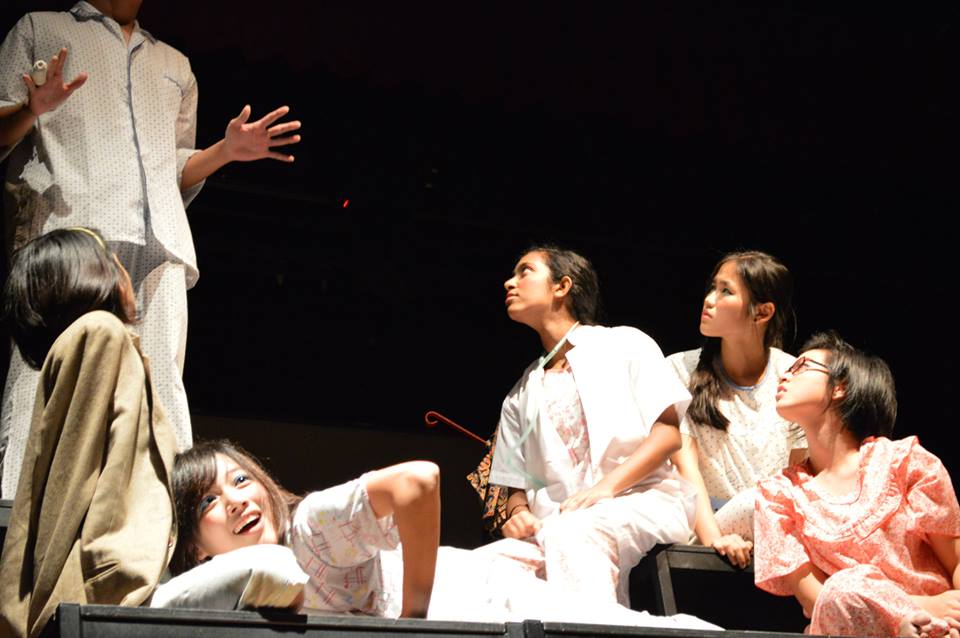
The week ended off with the Literature Quiz and Lit Night, which, as one might expect, was a veritable cocktail of hilarity, poignant sadness, wit and talent. It opened with Raffles Players’ The Sleepover, directed by Jovi Tan (15A01B) and cast Rachel Koh (15A01A), Syafiqah Nabilah (15A01B), Katrina Jacinto (15A13A), Megan Lourdesamy (15S03C), Cheng Yi Ern (15S03B) and Celeste Tan (15A01C). The physical theatre piece started off innocuously enough with six children at a sleepover but weaved in increasingly complex themes, blurring the lines between make-believe and reality. Nine-year-old children brush their teeth, make self-conscious remarks about their noses and complexion, and play dress up in their parents’ oversized coats, transforming transiently, chillingly, into figures of authority as they do so. The inappropriate maturity of their actions, juxtaposed with their obvious youth, added up to an absurd hilarity which had the audience in stitches, but simultaneously drew attention to the awkward self-discovery we have all known.

Initially a tongue-in-cheek commentary on how sleepovers represent opportunities for exploration of an adult world inflated to mythological proportions, the play also delved into more disturbing themes such as marital violence and teenage pregnancy, as its characters took on issues much larger than themselves, some of which they had yet to encounter, and some of which they unfortunately already had. So absorbed were its characters in their play-acting that they eventually appeared to become wholly sucked into the pretense, and the piece ended in a chillingly Golding-esque manner with the apparent death of a child at the hands of her friends. Despite the surrealism of this plotline, it bears testimony to the poignant simplicity of children’s language – after Syafiqah’s character ‘dies’, Rachel’s character observes, “The older I get, the smaller she will become.” The play is a cogent and heartrending exposition on uncertainty and tainted innocence, and the ways in which the realm of the adult intersects that of the child.

Impressively, the production was put together in the space of a mere three weeks from start to finish. The cast wrote the script together, although Syafiqah’s line “I remember, when we were moving into our new house, we had to get a whole new set of furniture, because my parents had thrown them all at each other,” was what planted the seed of The Sleepover. Jovi summed up the play thus: “It was driven by stories most of all. There’s a lot about childhood and about feeling small, which I think is why audiences might feel for it since we’ve all felt that way before.” Indeed, the production garnered positive reception from most of the audience that night, and was an excellent opening to the night.

litweek2

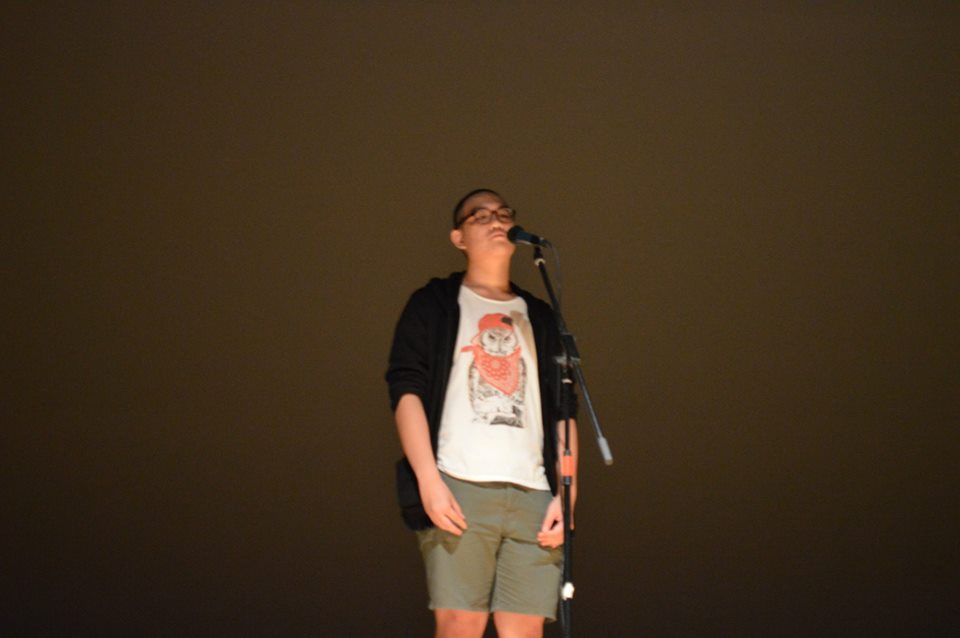
The audience also enjoyed a poetry slam segment performed by William Hoo (15A01E) and Gabriel Ng (15A01B). William took the stage with two poems in memory of his father, who passed away from cancer last year. His first poem, ‘A Wake’, is blithely wrenching in its recount of his father’s wake. There is a careful attention to detail in the ‘peanuts and melon seeds’ partaken of by those paying their respects; lines like ‘She looks at you as though she has never seen you before,/When in fact, she will never see you again’ deliver a proverbial sucker-punch to the gut. The second poem, titled ‘100’, was written to commemorate the 100th day of his father’s passing, when loved ones can conventionally begin to dress in colours again. Addressed directly to his father, it is characterised by reconciliation despite grief. Again, there are lovely moments in this poem, such as the audial congruence of ‘Our mourning stopped this morning’, and the sense of unwittingly coming full circle in ‘My reflection looks me in my mother’s eyes/and bites your lips’. Mrs Perry particularly liked that line, and praised his poetry as “very good, very moving”. Both poems handle a difficult and personal subject with great skill and emotion, leaving teachers and students alike greatly impressed.

Gabriel, who last performed slam poetry at CultuR Shock!, returned with what he called ‘a poem of vague emotions’. Despite the quintessentially ‘poetic’ nature of the images he stringed together, he evaded the widely-panned pitfall of poet voice, the tempo of lines like ‘quill upon your fingertips and paper on my skin’ appropriately accelerating and slowing to remarkable effect.

litweek3

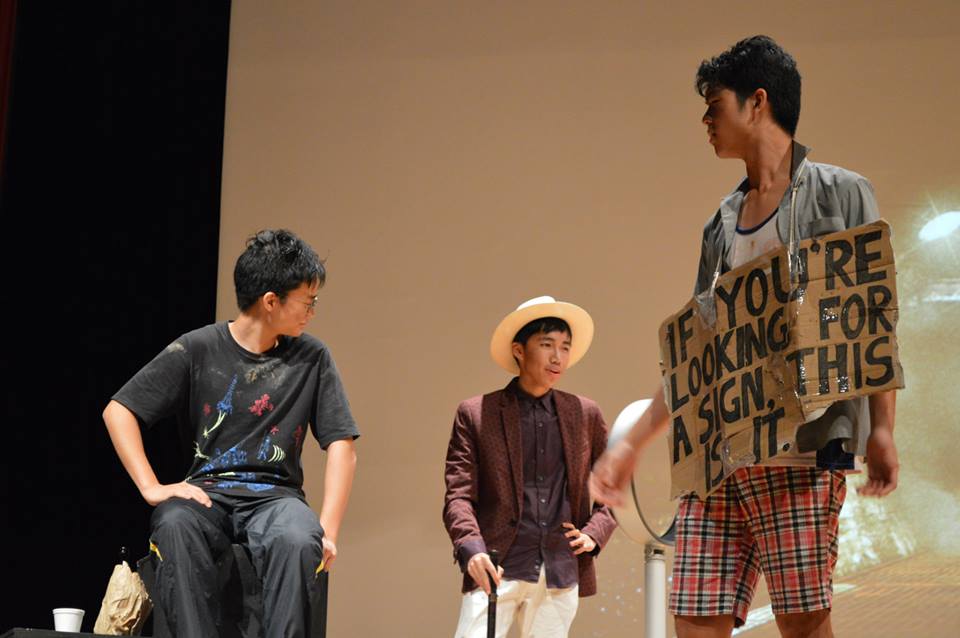
At the peak of the audience’s enthrallment with the slam poets and poetry, the J2s took the stage with their spin-off of Oscar Wilde’s Lady Windermere’s Fan, which pretty much fell flat, in more ways than one. While Sleepover hit all the right notes with the audience, the J2s’ performance garnered a mixed reception from the audience. Titled Lady Windermere’s Biggest Fan, it was directed by Jeremy Khoo (14A01B) and Marc Leong (14A01A), and was intended to be a satirical twist on Act 3, which deals with sexism and gender stereotypes. In this scene, the men of the play are gathered in Lord Darlington’s house and discussing the women, Mrs Erlynne in particular. Aeron Ee’s Cecil was obnoxious and crude in all the right ways, but this did not conceal the fact that ultimately, the adaptation was facetiously over-reliant on slapstick humour and was ridden with one too many cheap and repetitive wisecracks. The line, “She’s the apple of my pie,” punctuated with a suggestive action, drew equal measures of laughter and sighs. Indeed, the play came across as sexist, with many lines unnecessarily rephrased that seemed to objectify women. As one audience member put it, “It’s immediately funny when you watch it because we’re 18 years old, but not when you realise what you’re laughing at.” Or to borrow Mrs Perry’s more critical words, “It was somewhat lacking in subtlety…I’m not entirely convinced that Wilde would have approved [of that].” Jeremy declined to comment.

The night’s programme also included a literature pageant in which each class sent one representative dressed as a famous literary character to either perform a self-chosen talent or answer a question. Particularly memorable was Vice-Captain of MT, Sean Ong’s (15A01A) modernised version of Sir Andrew Aguecheek of Twelfth Night, who ditched the suit of armour for comic mismatched neon football socks and shades, completing the look with his characteristic ‘general air of ineptitude’. His (euphemistically termed) ‘interpretive dance’ brought out the character’s clownish role in the play perfectly, drawing enthusiastic applause from the audience. Arjun Vadrevu (14A01B) also entertained the audience with his rendition of “A Whole New World” as Aladdin from The Arabian Nights, in which he successfully sang the parts of both genders. Other contestants also showcased their talents with David Wang’s (15S05A) dance as The Terminator and Shirley Yong’s Glinda the Good Witch from The Wizard of Oz. The overall winner though was Deon Kiew from 15A01B, who dressed as Count Dracula complete with cape, fangs and dripping faux-blood. He answered questions in a commendable imitation of a Romanian accent and stayed in character to the very end, where he jokingly “bit” the emcee, Lee Chin Wee (14A01B).

litweek4


In addition, the audience were treated to a snippet of the Literature Quiz which each Y5 Literature class sent 5 representatives to take part in. The audience participation round featured stills from movies adapted from famous literary works, including J.G. Ballard’s Empire of the Sun and Charles Dicken’s Oliver Twist. This had audience members, initially somewhat reticent, tussling to answer and receive a chocolate bar. The results of the Literature Quiz that afternoon were then announced, with 15A01B taking the lead with a comfortable 15-point margin, ahead of 15A13A.

The week’s numerous literary activities, which also included a movie screening of The Remains of the Day, were summarised thus by Mrs Perry: “It gets people involved, gets people thinking.” This goes not only for students who are not typically exposed to literature, but also applies to students currently studying literature, who may well become disillusioned with the technicalities of academic demands. For many of us, Lit Week was indubitably a great way to rediscover the intrinsic joy and worth in appreciating literature. Let’s not forget the hard work of the Organising Committee, comprising the J2 Literature students for their enthusiasm in putting it all together.

RenXchange: Bang for Your Buck

Reading Time: 5 minutes

By Kang Yi Xi (15S03N)


renxchange1

A bustling marketplace within the school, in which one can easily buy and sell goods of his or her choice in a hassle-free and safe manner – such is what RenXchange, the Raffles Entrepreneurs’ Network (REN)’s flagship business venture, aspires to become. This new project certainly seems to be something that has great potential to enhance students’ lives within the school, and it goes without saying that quite a few of us have become considerably excited by it over the past few weeks. In the run-up to RenXchange’s upcoming launch on Wednesday, Raffles Press has decided to feature the organising committee behind the whole business – after all, just as the invisible hand silently grinds the gears of the free market mechanism, so too do these students toil away behind the scenes to make RenXchange a quality experience for all.

Its self-explanatory name aside, REN’s exact goals and functions continue to remain slightly puzzling to some. As the committee explains, it is actually a club where like-minded budding entrepreneurs learn about business and entrepreneurship from each other and the entrepreneurs that they invite on a regular basis. “Ultimately, we want to produce change-makers who will make an impact in the world,” says the organising team. True to that vision, REN’s current crop of members has fearlessly invested much time and effort into developing RenXchange in the hope that they can meet some of us students’ unfulfilled wants.

renxchange2
The main organising committee behind RenXchange. From left to right: Chun Soon Kon (Advisor), Low Tian Ling (Auditor), Ernest Low (Accountant), Kathleen Chow (Operations Manager), Zhang Yuchen (Project Manager).

The idea for such a service stemmed from the club’s desire for an avenue that would enable both them and subsequent batches to gain some real experience in running a business, since solely having theoretical knowledge is clearly inadequate. Their market research was illuminating – numerous students indicated their wish for a school-based platform for them to buy and sell the personal items that they no longer use or want. In fact, as the committee claims, “66% of our respondents said that they have items that they would like to sell, and a whopping 90% of them said that they will buy second-hand items in reasonable condition…(this) shows that there is indeed a market for RenXchange and there are people who will use it.” On a broader scale, the club also hopes that the business will make the school a more happening, vibrant and unique community.

While we will likely find out about how to utilise this service in greater detail on its launch day, the committee briefly outlined the steps a student will need to take in order to buy or sell a product. A person who is interested to sell an item of his/hers has to contact the committee through the RenXchange Facebook page, email or directly at their booth. Then, a selling price agreeable to the seller will be fixed, and the approved item is then handed over. Note that this list price is non-negotiable for any buyers. The items will then be put up on sale through a listing on their Facebook page and will be temporarily stored by RenXchange. Students eager to buy a product can appraise the items on display at RenXchange’s booth in the Canteen Walkway, which is manned from 1.30pm to 2.20pm every Wednesday. A service that will likely be welcomed is the ability for buyers to reserve items in advance via the business’s Facebook page.  As for revenue, the budding entrepreneurs will take a small percentage cut of the sale price of successfully transacted goods as their commission; the commission decreases as the price of the good increases. Some of the business’s profits will be donated to the school’s 1823 fund.

The enterprise is certainly unique within the school, but one may wonder how RenXchange aims to distinguish itself from the countless similar companies that pepper the Internet. The added convenience offered by RenXchange is definitely a big boon for students, for, as the committee feels, “When one uses other external services like Gumtree or eBay to buy items or sell their personal things, they usually have to arrange for a meetup time and location for the transaction. From our own personal experiences, this is not always convenient for both the buyer and seller, and (the transaction alone) will usually take up a lot of time.” The team also highlighted how this process may entail significant risks, such as meeting with strangers and the possibility of falling for scams, which are minimised by their school-based marketplace. Moreover, RenXchange lets customers readily purchase items on-the-spot; the organisers are also of the opinion that student blogshop owners “may find RenXchange to be a better platform to reach out specifically to the school population.”

Like any other ambitious project, however, RenXchange’s developmental journey was not bereft of setbacks. The members found balancing the needs for consumer satisfaction and feasibility to be a delicate and problematic task. Designing an effective and convenient inventory and transaction system also proved rather complicated. Fortunately, the large amount of feedback collated by the members has substantially alleviated their difficulties by helping them to refine their ideas. The team would like to declare that they will continue to be receptive to additional feedback, for this will aid them in optimising the service and enable them to provide students with a more customer-friendly experience.


renxchange3

If what RenXchange has planned so far sounds exciting enough, the team has even grander plans, though they remain in the pipeline and are contingent on the success of the RIJC-based undertaking. REN is considering the possibility of expanding their business to the RI (Year 1-4) side and, in the longer run, to RGS when its new campus has been built. RenXchange aside, REN also has other activities lined up for the school: namely an inaugural Raffles Business Symposium featuring eminent speakers, as well as an Entre Week. So, do keep your eyes and ears open over the course of the school term! We at Raffles Press have been markedly impressed by the concept of RenXchange and are waiting with bated breath for the service’s release, and we encourage the rest of the school population to try this promising venture out as well.