

By: Saadhana Kalimuthu (27A01C)
You know that instinct to sprint up the stairs the second you turn off the lights? Or the hesitation before looking into a mirror at 3 AM?
For a country as modern and brightly lit as Singapore, we have a surprising number of ghost stories. We pass by these supposedly haunted spots on our daily commutes, and we’ve all heard the legends passed down by friends or family. But have you ever wondered where these stories actually come from?
Many of our most famous haunts aren’t just fabricated to scare people, but rather deeply rooted in history. Once you look past the surface-level scares, you’ll realise these places are much more than just urban legends.

Old Changi Hospital—The Ghosts of War
Drive past Old Changi Hospital and it’s hard to miss the massive, decaying colonial building sitting quietly near the beach. It’s arguably the most famous haunted location in Singapore, with constant claims of shadow figures in vintage medical uniforms staring out from the upper floors or phantom screams at night.
Long before it became an abandoned playground for thrill-seekers, it was a hospital built by the British in the 1930s. However, when the Japanese Occupation ravaged Singapore, the hospital was converted into a POW camp and a base for the Kempeitai, the military police. They set up torture chambers in specific blocks, 24 and 37, leaving the morgue perpetually overflowing. Countless soldiers were tormented within those walls.
So when people say they feel a heavy presence in those empty corridors, it’s because of its hellish past. Some say the old torture rooms and the mortuary are the most active, bedevilled by the sound of chains swaying in still air, or the phantom laughter of children in the old wards…

Pulau Tekong—A Rite of Passage
Next up is the one every guy in Singapore knows by heart—or will very soon, if you’re about to enter NS: the three-door bunk in Pulau Tekong. The legend goes that a recruit from Charlie Company died during a route march, and his spirit haunted the bunk until they built a third door to let him out.
Chillingly, the stories say that the ritual didn’t just let him out. The door supposedly stays open for any spirit that wants to wander in. Maybe that’s why the old bunk was eventually sealed off, forever leaving a haunting reminder that some doors, once opened, are better left closed.
But why has this specific story survived for decades? Imagine yourself now in Basic Military Training (BMT). You’re thrown onto a dense, unfamiliar jungle island, cut off from your phone, and pushed to your physical limits.
When you’re isolated and consumed by stress, the ghost stories like the Tekong legend are passed down to the next batch of blur recruits as a rite of passage, a form of social glue. Whether the ghost is real matter less than the collective fear which bonds everyone together, and that is what keeps the story alive.
Bishan—Built on Bones
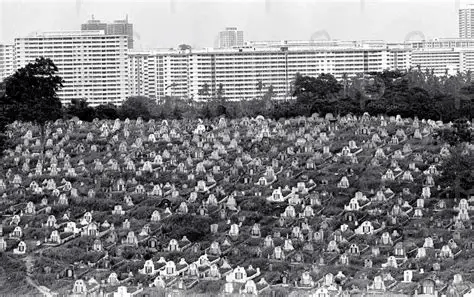
Even the mundane commute via train through Bishan can feel a bit eerie once you know the lore. People constantly whisper about phantom coffin bearers marching through the MRT tunnels, or headless figures wandering the corridors of the older HDB blocks.
The reason for all this? Bishan is literally built on top of the bones of the dead. Before it became a bustling estate with a giant mall and an MRT interchange, the area was home to Peck San Theng Cemetery, which was a massive, 384-acre Chinese cemetery established back in 1870. It was so huge that it had its own pavilions and temples.
But in the 1980s, the government needed land. They exhumed tens of thousands of graves to make way for urban development. As the new town rose, stories of spooky encounters reported by new residents rose with them. Yet today, thousands of people go to Junction 8 to eat, study, and hang out, completely unaware that they are sitting on top of a massive former graveyard. The government may have moved the tombstones, but not the souls of the old residents. So next time your train slows down in the tunnel outside the station, try not to think too hard about what used to be down there.

Pasir Ris—The Prowl of the Pontianak
If you’ve ever had a late-night BBQ or cycled through Pasir Ris Park, you know how dark and quiet it can get after the sun goes down. According to local legend, that’s exactly when the Pontianak comes out to play.
You’ve probably seen her in local movies or on TikTok—the beautiful woman in a white dress who turns into a terrifying, long-haired spirit with fangs. But the Pontianak isn’t just a movie monster. She’s basically the Dracula of Southeast Asia—the most famous ghost in the region, partly because of her massive pop culture presence, and partly because the actual city of Pontianak in Indonesia is named after her. While she goes by different names depending on where you are, such as the Kuntilanak in Indonesia, the terrifying concept remains the same.
The story goes that she is the spirit of a woman who died while pregnant or during childbirth. Before modern medicine, this was a tragically common reality. Folklore says her tragic death corrupted her spirit, turning her grief into deep anger and jealousy toward the living. People say you can smell a strong, sweet scent of frangipani flowers before you see her. If you ever catch a whiff of that in the middle of the night, you’re supposed to hold your breath, because she hunts by smell.
She’s also a master of disguise. While she may first appear like a beautiful woman, as she attacks, you would be greeted with a terrifying face with long fangs and a hollowed-out back where her organs should be.
While she’s known to haunt the whole region, Pasir Ris Park is a notorious hotspot. Maybe it’s because of the dense trees or the dark, winding paths. Either way, people claim to have seen a woman in a white dress floating near the mangroves. So if you’re ever cycling there late at night and catch a sudden whiff of flowers, do pedal a little faster.
The infamous V-shaped Devil’s Bend
Old Upper Thomson Road—Devil’s Bend
Old Upper Thomson Road is already sketchy enough just because of how dark and winding it is. But the real reason it’s so terrifying is what happened on that road decades ago. Back in the 1960s, this winding strip of asphalt was the original Singapore Grand Prix circuit. But it wasn’t a safe, modern track with barriers and run-offs. It was a literal death trap.
Drivers were flying down a narrow public road with blind corners and zero safety features. The most famous turn, Devil’s Bend, was notoriously lethal. If you didn’t brake at the exact right millisecond, you were flying straight into the jungle. The circuit was eventually shut down in the 1970s, but the road never really stopped being dangerous. Even today, it’s a hotspot for reckless speeding, illegal street racing, and horrific motorcycle accidents.

And that’s exactly where the ghost stories come from. When so many people die violently on a single stretch of road, people start seeing things. Late-night bikers constantly report a phantom motorcyclist speeding past them, only to realise the rider is completely headless.
But taxi drivers seem to have it worse. There are countless stories of drivers picking up a normal-looking passenger, who was usually a woman in a white dress or an old man, and taking them to their destination. But when the driver turns around to collect the fare, the backseat is completely empty. The only thing left behind is a wad of hell money (joss paper). Imagine the sheer terror of realising you just gave a lift to a spirit, and you’re now holding a stack of ghost currency that wasn’t there a second ago.
Ghosts or not, the deadly crashes definitely were real. Between the blind corners, the pitch-black jungle, and the road’s bloody history, this place is terrifying enough without a phantom rider. Just keep your speed down and maybe don’t stop for any late-night hitchhikers.
At the end of the day, ghost stories are just our way of processing the dark parts of history that we don’t really talk about otherwise. Whether it’s a wartime tragedy or a massive urban redevelopment project, turning those heavy realities into spooky legends makes them a lot easier to digest.
But it still leaves us with an unresolved case. If we know these are just urban legends and old history, why do we still get so unnerved? Why do perfectly logical people still feel an impulse to sprint up the stairs or look over their shoulder after hearing a story?
Maybe humans have been the biggest mystery all along. We can be completely rational, but our brains still love to believe in the supernatural. Part 2 is going to look at exactly that: the psychology behind why we crave these scary stories, and why some people are superstitious while others couldn’t care less.

