Written by Shikhar Gupta (15S06M) and Lorraine Fong (15A01C)
Photos by Isaac Siaw (15S03Q)
Lift, breathe, swing, release. Strike.
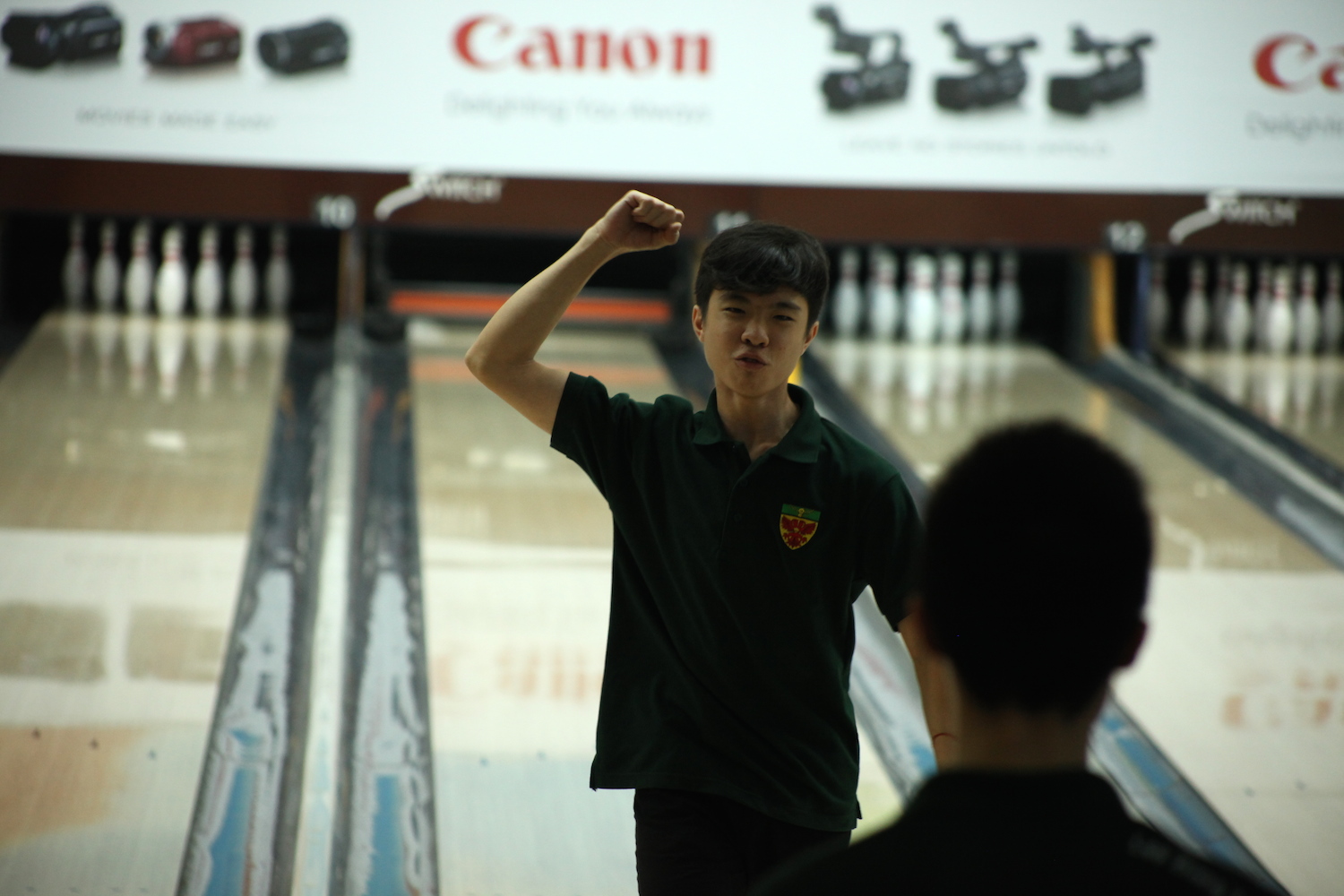
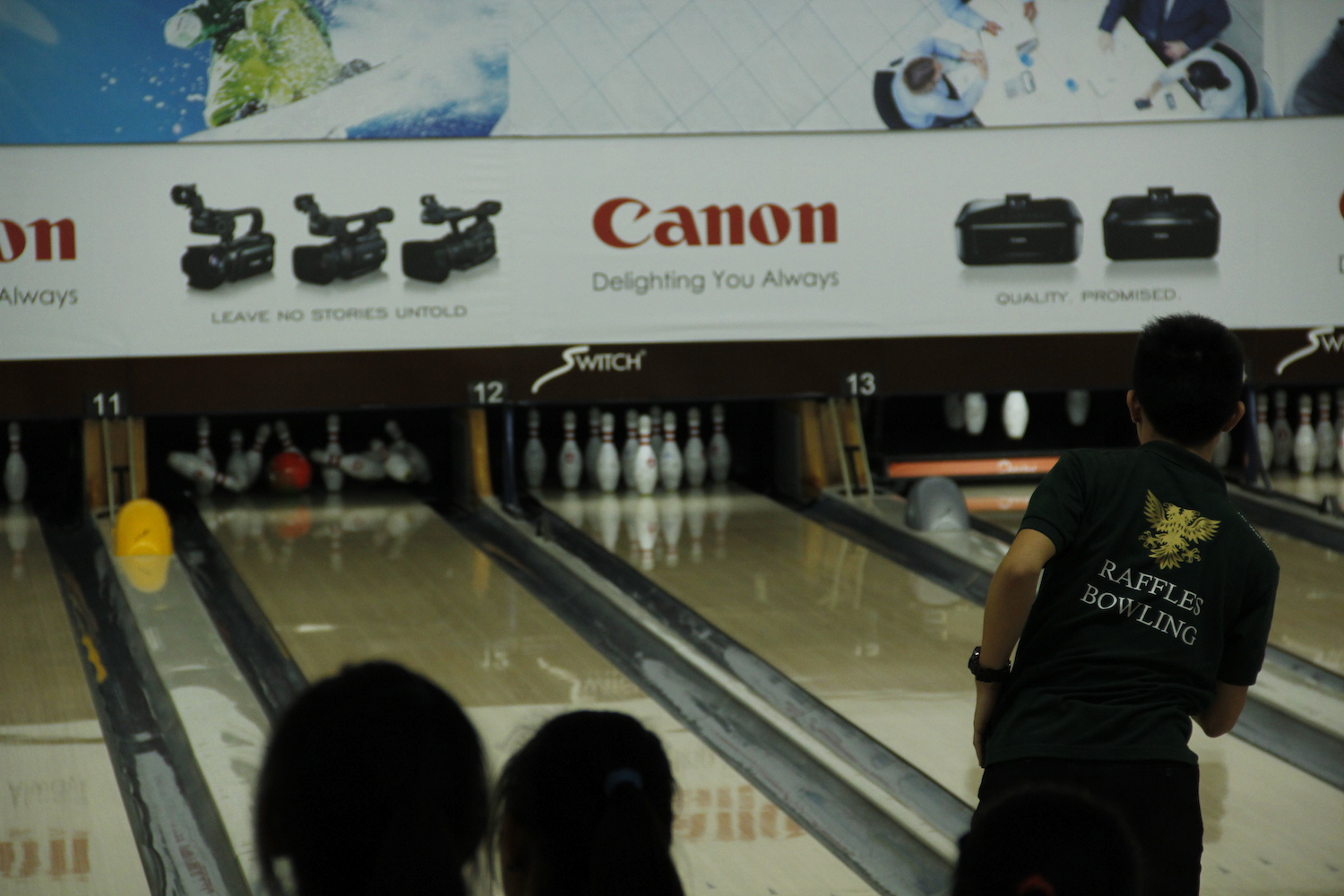
The electric atmosphere at Orchid Bowl in Orchid Country Club was unmistakable for anything but the pride of the various supporters for their schools, and there was never a moment when the cheering stopped. With the 34th Council pouring on the support, the A-Division bowlers of Raffles Institution bowled their way to strong finishes.
Boys
Surprisingly, the boys were not always in command, as one would surmise looking at their performance on 29th April at Orchid Bowl. They had been trailing Anglo-Chinese Junior College (ACJC) for the first two days of the tournament, but pushed hard to claim the lead on the third day. Following that they gave no quarter on the final day, and cruised to victory, claiming the overall school champions spot.
The Boys’ team takes home the overall schools’ championship title
Speaking to Press, team captain Jevarn Li said “I’m really happy and proud. We lost to ACJC last year by one point, and I am proud that we managed to win it back by a larger margin.”
Both he and his teammates were clearly elated at their success. The team comprising Marcus Seah, Ian Siow, Ng Kai Xiang and Jevarn came in first for the Team event, Jevarn and Marcus came in 2nd runner’s up for the Doubles event, and Jevarn clinched the overall all events gold with a 29 pin lead.
Girls
The girls also performed strongly, however they missed out on top spot for overall schools, losing narrowly to the ACJC girls. They had taken the lead on the first day, but after ACJC had wrested it back on the next, they were left playing catch-up.
Cheritta Low, captain of the RI female bowling squad reflected, “We trained very very hard this year, it seemed very promising, but luck wasn’t on our side. However, I am very proud of my team for persevering through trainings, and throughout the four days of the tournament and never giving up.”
Team members Jamie, Rebecca, Clarie and Limin huddle together to encourage and spur each other on during the tournament
The team of Joey Yeo, Kristin Quah, Cheritta Low and Darolyn Tan came in first for the team event, but their performance was not enough to take the overall girls’ champions position. Also a national bowler, Joey Yeo performed spectacularly. She and Jamie Lim came in first and first runner’s up for the Singles event, respectively.
In the Doubles event, the pairs of Joey and Kristin, placed first, while Darolyn and Cheritta came in second. Not only did Joey win the high game award for two separate events, scoring pinfalls of 248 and 247 during the Singles and Team event, she also clinched the overall girls gold with a 326 pin lead in what was a seemingly effortless performance.
From left to right: Darolyn, Cheritta, Joey and Kristin proudly accept their gold trophies for the team event
Clearly the star of the show, Joey Yeo felt satisfied with her performance, and thanked the team for their never ending support, camaraderie, and perseverance. The bowling teacher-in-charge, Mr Lee Chee Keong was also happy with both the boys’ and girls’ performances. When asked to sum up his feelings about the tournament, his reply was simply “Good job.”
When asked about the future of RI Bowling, Cheritta was pensive. “Seeing a lot of our juniors train for the past half a year or so, I’ve seen them improve a lot and I am very proud of them. And though we placed 2nd, there is still a chance to fight. There is no definite ‘winner’ or ‘loser’, it can only go up from here,” she said.
All five teams were also buoyed by the constant support by the Rafflesian councilors,who themselves were enjoying the action. One of the supporters even wanted in on it, saying that “everyone [wanted] to bowl, because it [was] so fun.” The bowlers never forgot the supporters even throughout the whole four hours of the final day, acknowledging their cheers constantly.
Amidst all the feelings about the game, Rebecca Wong felt wistful that her competitive days were probably over. “I’ll probably and hopefully continue [bowling] as a leisure sport, and it’s so sad as this is our last major competition,” she told Press.
Framing it up: RI Bowling poses for the camera with their awards lined up before them
The fight is not yet over for Joey, Cheritta, Jevarn and Kai Xiang, though. The four of them ride high on confidence into the Masters Finals, to be held on the 3rd of May at Orchid Bowl. The event will be starting at 8 AM, so do hop by to offer your support if you can! All of us here at Raffles Press would like to congratulate everyone, and the best of luck to those competing this Saturday.
Written by Ching Ann Hui (15S03A), Michelle Choy (15S05A), and Tan Su (15S07A)
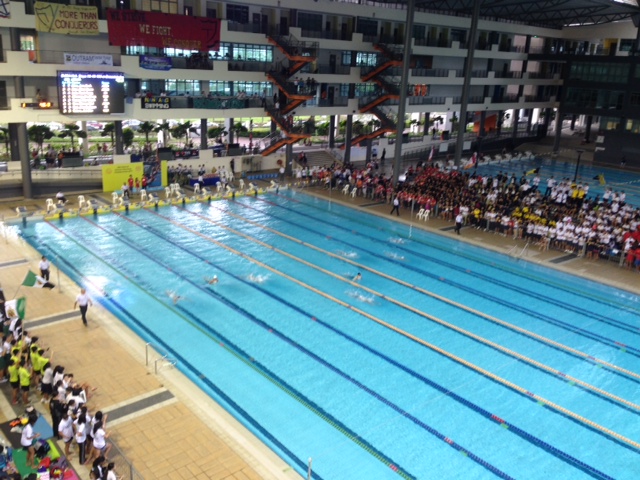
Months of intense training – including coming to school before assembly to train – boiled down to 2 days of finals for Raffles Swim. As Madeline Quek put it, the trainings were “tiring physically, but worth it”. Looking at the results now, it is clear that it was indeed worth it – with the A division girls clinching 1st overall and A division boys being awarded first runners up.
It was a close fight and tensions were rising with RI’s rival schools ACS(I) and ACJC proving to be strong competitors. The coach of RI swim Mr Lim Yao Xiang commented early on that there was no clear indication on which school would emerge victorious, and that it might even “boil down to the last relay.” Despite having “no national swimmers on the team”, the stellar achievements stood as testament to the sheer grit and hard work of our swimmers.
GIRLS
The girl’s segment of the competition began with our girls team placing in the top 3 for almost all races – a result consistent with what we have seen in previous years.
For the 50m Freestyle race, tensions rose as Song Ai Vee went neck and neck with Annis Loy from Temasek Junior College. The two eventually tied for second place after an intense fight, with Nicole Ong Ting Zhi racing in a close third just milliseconds after. Nicole Ong also bagged a bronze medal for the 50m backstroke.
Similar victories were seen in the 200m freestyle where Dayna Ang and Christiane Tan placed 1st and 2nd respectively. Richelle Ang also made a podium finish – clinching third place in the 200m individual medley. Rachel Lee put up a strong showing with two wins: 3rd in the 50m breaststroke as well as in the 100m breaststroke.
Madeline Quek was another serial medallist with her placing of 2nd in the 50m backstroke and butterfly. Over at the 200m breaststroke, Grace Tan placed 3rd and Gayle Tan placed a commendable 2nd despite facing strong competitors from ACJC.
The 400m freestyle elicited cheers from the Rafflesian crowd as Teo Jing Wen, Kimberly Yeo and Chloe Tan all placed 1st, 2nd and 3rd respectively, sweeping the awards for that category.
A breathtaking dash to the finish in the 200m breaststroke event led to Samantha Yeo setting a new competition record, clocking in at 2.34.17 – almost 3 whole seconds faster than the previous record.
Samantha again clinched first position for the Girls 100m Breaststroke, with a record breaking timing of 1:11.65, 1.06 seconds faster than the previous record. Unfortunately, the result was subsequently disqualified due to her doing a double fly kick.
Despite that, spirits soared as the much-anticipated 4x50m Freestyle Relay saw our girls relay team (Samantha Yeo, Teo, Jing Wen Shan, Madeline Quek and Song Ai Vee) bring a roaring victory to RI by coming in first with a timing of 1:50.44 9 in the 4×50 Meter Freestyle relay. The 4x50m Medley relay had a similar showing, with the girls securing the overall gold medal for our team.
BOYS
Victory was never a certain prospect with our boys team facing up against strong rivals such as ACJC, ACSI and Singapore Sports School (who had home advantage). Swim team coach Mr Lim Yao Xiang had realistic expectations of the boys team, remarking that “with no national swimmers in the team i feel that second is already a very good result.”
In the 200m freestyle race – a race primarily between RI, ACSI and ACJC, Andy Lo was able to clinch the gold medal, beating ACSI by 1.23 seconds. The other 2 RI swimmers,, Aloysius Tan and Bryan Tan came in 4th and 5th respectively. Other notable races include the 100m breaststroke where Alexander Tseng Wei Chen, Teo Cheng Quan Edmund and Lee Teck Fang Kenneth came in 2nd, 3rd and 4th respectively. Despite the stiff competition for the 100m backstroke, where a new record was set by one of our arch competitors, Andy Lo and Joshua Koh fought to clinch the 2nd and 5th respectively. Joshua Koh also took home a bronze for the 200m Backstroke.
Quan Ren Barry Koh fought hard to finish 5th in the 200m butterfly race. In the first and second laps, he was placed 6th with timings of 1:07.18, 1:44.4 respectively. However, at the last lap, after putting up a valiant fight, he finally emerged 5th, with the timing of 2 2:23.54.
The 4x50m freestyle and medley relays were both highly anticipated races. For the freestyle race, our team fought hard but ACSI took the lead and clinched gold by a narrow 3-second difference. Ultimately the Raffles Swim team came in second for both races, making the school extremely proud. The team consisted of Bradley Samual, Windley, Teo Chang Quan Edmund, Lee Teck Fang Kenneth and Tan Xuan Fu.
The fight to the finish is never easy, just as the race to the finals was tough for the Raffles Swim team. However, as A-division girls captain Kathleen Leong said: We really hope that the raffles legacy will be able to continue for many years to come and that everybody will be able to swim for pride, glory, honour – Raffles!
By Myko Philip (15A01B), Michelle Zhu (15A01B), Chew Sher Mein (15S03H), Katrina Jacinto (15A13A)
Photos by Tan Wei Xin (15A01B)
Raffles Chorale performing their opening number
This year’s edition of Raffles’ annual arts festival commenced last Wednesday with the Raffles Choirs performing at a packed Esplanade Concert Hall. In what was a spectacular kick off to Arts Season 2014, the Raffles Choirs comprising Raffles Voices (the Year 1-4 choir) and Raffles Chorale (the Year 5-6 choir) captivated audiences with their highly eclectic repertoire and deliciously sweet singing. It was an evening that saw the audience whirled around in an iridescent vortex that brought them from the solemn, high-ceilinged halls of cathedrals in continental Europe, to the deep south of America with its upbeat tunes and alleluias, all the way to Africa with its kaleidoscope of sounds inspired by animals and the surrounding landscape. This far-reaching odyssey of music all happened within the inspiring and formidable wooden halls of the Esplanade, its size lending itself in giving the choirs a slight echo and a sense of vastness.
Raffles Chorale eased us smoothly into the programme with their haunting rendition of “How Can I Keep From Singing”, arranged by their conductor, Mr Toh Ban Sheng. It was an apt song to begin the programme– a hymn which exults so greatly in the presence of God it cannot help but express itself in song. True to style, Raffles Chorale made an impressive entrance. As the lights dimmed and the scattered glow of cellphones subsided, Chorale left us in a palpable darkness for some time, before the calm and honeyed voices of Daphne Quek and Ma Yuqing cut through. Light slowly began to fall on the stage as the sweet singular voice was joined by another, and yet another, gradually forming a powerful but austere chorus reverberating around the theater. As the light grew stronger on the stage, figures could be discerned walking deliberately and purposefully to centre stage, and when they came on in full brightness, the entirety of Raffles Chorale was before us. Masterfully using a technique called chance singing, in which each singer takes a chance at their own tempo, the song was multi-layered, with different waves of sound moving against and along each other that convalesced in a glowing whole. Needless to say, the audience was entirely dazzled.
After a brief rearrangement of singers, they dove straight into their second piece, Josef Rheinberger’s “Abenlied”, a post-resurrection story about the light of Christ. If their first piece was like numerous rays of light melding together into a continuous whole, then their second piece was like waves crashing on rocks. What shone through were the deep and mellow tenors and bases, offering a rich contrast and foundation for the higher melodies that were superimposed on top of it. The song was memorable for its elegant and brilliant close: it ended on a brief but candid descent, as if down a flight of stairs, to reach a soft but solid and resounding note.
One of the night’s highlights was their third and fourth pieces. Departing from the angelic aura of the previous two songs but nevertheless keeping to a semi-religious theme, Raffles Chorale indulged us in their energetic and passionate delivery of Z. Randall Stroope’s “The Conversation of Saul”. In the Bible, Saul was someone who initially persecuted Christians but was eventually turned over and became one of Christianity’s forward and belletristic writers. Beginning with a driving, pulsing chant from the boys that was constantly returned to throughout the song, the girls slowly joined in with their own refrains that complemented but did not mimic the boys’. Immediately, we felt a tingling sensation in our spines; the music seeped into our bones. Violent but coordinated feet stamping was weaved into the song, imitating thunder. It was seemingly frenetic but beneath the apparent chaos was a very controlled and skillful execution of music. Towards the denouement, we began to hear crazy descending chromatic scales, giving the effect of something spiralling out of control. It was the most exciting piece of the evening.
From this terrifying and gripping piece, we were immediately catapulted into the realm of the stars: next on their repertoire was Audrey Snyder’s “And In The Evening”. Based on William Blake’s poetry, it was a song that promised to juxtapose the mystical nature of dreams with a wide field of stars, and it did not disappoint. Notably, the choir distributed wine glasses filled with water to varying levels during the emcee’s introduction. The song was largely amorphous and ethereal, flowing in a certain direction but seemingly flowing everywhere as well. Indeed, we were brought up and down as if a sloping mountain range and from the weirdness of dreams to the terrible vastness of a star-filled night sky. The choristers slid their fingers over the rims of the glasses, producing a discordant but spectral sound that seemed to echo around the concert theater. Shayna Yap accompanied on the piano and played solid chords that, in tandem with the contrastingly eerie sound of the water glasses, gave the song a sonorous feel. With that, Raffles Chorale concluded their first set and gave the stage to Raffles Voices.
Raffles Voices in their spirited rendition of Amani
Where Chorale was more timid and had sharper and more powerful high notes, Voices delivered their characteristic and entertaining theatrics. They were generally more lighthearted, even if they appeared more nervous when arranging their blazers and being asked to shuffle about on stage into position. Having been brought across continental Europe by Chorale, Voices took us into the heart of Africa with Audrey Snyder’s Amani, which means “peace” in Swahili. Although accompanied by slightly awkward posing and marching, the upbeat and cheerful tune along with the rhythmic beating of percussion African drums had the audience’s feet tapping to the music. We then had David Dickau’s “If Music Be The Food of Love” (a reference to Shakespeare’s ‘Twelfth Night’), a piece similar to the first in terms of its need to express its joys in music, then “J’entends Le Moulin” by Donald Patriquin, an equally mesmerizing song because of its usage of various sound onomatopoeic sound effects to conjure a colourful soundscape. Cheng Xin Yu and Guan Xin gave accompaniment on the percussion, and Gavin Jared Bala gave an astounding and instructive performance on the piano, at times even surpassing the choir. With that, they yielded the stage once again to Chorale.
Chorale gave us a taste of a different palette this time, moving away from sordid hymns and requiems to much more upbeat devotional tunes. To this end they gave us “Non Vos Relinquan Orphanos” by William Byrd, “Wade In The Water” arranged by Allen Koepke and “If I Can Help Somebody” arranged by Ray Liebau. It was a smooth and lively transition from Voices’ segment as well as an refreshing pick-me-up and contrast to their opening four songs. “Wade In The Water” in particular, a Negro hymn sung in the American south, had a throbbing pulse to it that made it akin to Adele’s “Rolling In The Deep”, albeit with more flair and colour. It got blood flowing through the audience’s veins. Tan Fong Han of 15A01B, one of the choristers, said that the song was her favourite of all any that she performed, saying that “there’s something about the song that makes it both liberating and oppressive at the same time. It’s a layered song and I think when we sang it in SATB (Soprano, Alto, Tenor, Bass) it resembles to me a progression of letting go- along with transition from bass to sop[rano]. It’s an emotional piece that is also controlled.”
Raffles Voice treated us to another two songs, “Northern Light” by Ola Gjeilo, which melancholic notes reflected the mysterious beauty of the aurora borealis, and Oscar Galian’s “Salseo”, where the swingy and rhythmic tune along with the trademark Spanish lyrics provided great entertainment. Then, the combined choir came on stage to give us the world premier of “Tui Sunt Coeli” by Vytautas Miskinis, a song that blended a whole smorgasbord of tunes to one continuous whole, as well as the iconic and easily recognized “Baba Yetu”, or the Swahili Lord’s Prayer, noted by many to be Civ-4’s theme song. The soulful and melodic piece had distinct African roots and Marc Leong and Jonathan Tan delivered riveting performances as the piece’s two solos and enthralled audiences with their mellifluous but powerful voices. Even as we sat at the back of the first floor, we could feel the vibrations from their singing. It was, as Zhang Yimin of 15S03H said , “so beautiful that it was disconcerting”.
The combined Raffles Choirs performing their finale
As the evening drew to a close, and amidst fanatic cries of “encore!”, the combined choirs departed somewhat from tradition and delivered another piece, Stephen Paulus’ “The Road Home” before performing the much more expected and customary school song. Even a parent we overheard was somewhat surprised by this encore, as were the most of us. This piece was a pleasant surprise with a much simpler arrangement than most of the complex multi-layered repertoire, yet held its own rustic charm.
The evening finished of course with the institution anthem, at which tentative Rafflesians glanced around nervously at the hall to see if they should stand up. After one or two did, however, all the students in the Esplanade stood up at attention. The choirs’ rendition of the school song is always something to look forward to, a refreshing change from the dreary and somewhat gaudy version played on not-so-adequate speakers at morning assembly. The ending, with its delayed last line, is always a delight, where the song reaches an entire octave higher than it normally would. The sound was sublime and we surrendered readily to the familiar melody. In those four stanzas, singing the school song in front of the rest of the audience, you could definitely feel proud to be a Rafflesian.
And so, encore included, the entirety of choirs’ repertoire of fourteen songs had just been performed. Raffles Chorale and Raffles Voices alike brought us a magical night of music that will be remembered fondly by the audience and choristers alike. “There were many magical moments on stage,” writes Mr Toh Ban Sheng, conductor for both choirs, and I would say it’s one of the most memorable performances in the Esplanade.” One of the issues was the Esplanade’s “unique acoustics” which were a double-edged sword. Initially a challenge to “grapple” with, it nevertheless highlighted the haunting quality of many of the religious songs. Whatever issues they had with the idiosyncrasies of their venue went unnoticed and never once hindered their performance: “once we got it settled after some time-consuming first round,” writes Mr Toh, “we were able to make music more comfortably.”
Echoing Mr Toh’s statements, Chorale chairperson I-Vivek Kai Wen added that no small measure of hard work was involved, but was glad that it all worked out in the end and went very well. To put on a show that lasted an evening, hours and hours of sheer effort were spent in school after lessons preparing, not just during official training but outside of it as well. Tan Fong Han of 15A10B recounts to us how from 2 to 3 sessions per week they gradually ramped up to 3 combined sessions in addition to 3 sectionals per week. Even mornings were not spared; in the lead up to the concert, mornings were usually devoted to “mental work [like] recall[ing] details of every song, where to crescendo, where to back out etc…It’s pretty intensive but after a while, it doesn’t become a chore so much as it becomes second nature. Outside of practices, I’m pretty sure everyone else hums [or] sings on their own.”
In fact, in class, it is not unusual to find her quietly but delightfully humming some of her favourite tunes from their repertoire. That the performance went so smoothly that the evening flew by is testament to the combined choirs’ dedication to making good music (and the implied hours that this dedication demands) and putting on a hell of a show. No mean feat considering that their pieces were scattered in terms of style and mood as well. Explaining the eclecticism and diversity of their song selections (and a possible religious undertone), Mr Toh said “the repertoire usually consists of songs that we programme for participation in international festivals we are taking part in. For Chorale, it is taking part in a Musica Sacra International Festival in Czech Republic. To fulfil the requirements of the 2 categories we taking part in and the grand prix, it resulted in a predominantly sacred music programme this year. Nonetheless, I try to find music that embodies contrasting characteristics and yet appeals to the singers. It’s always a challenging task.” He explained similarly that Raffles Voices travels in December and thus has little room to programme in something more than the competition repertoire. Hence, they performed an African song of peace, a lush modern American work, a virtuosic French folk arrangement, a modern sacred Latin piece, and an onomatopoeic Salsa piece.
Raffles Chorale charmed the audience with its ability to blend seamlessly complementing layers of music into a harmonious web; once the audience was caught, they were never let go. While Raffles Voices was not as technically brilliant as their senior counterparts, their characteristic passion more than made up for it. Their spirited and theatrical renditions of songs were infectious and kept audiences glowing long after they left the stage. Limelight 2014 was a real pleasure and set a high standard for Arts Season: both choirs put on show-stopping performances and kept audiences spellbound for the entire evening. The whirlwind ride from one region of the world to another was pulled off deftly and convincingly despite the difficulties of this monumental task. Both choirs handled the repertoire expertly and highlighted innocent nuances in their performance and, for two brief hours, sang the devils out of the details, bringing us away from the Esplanade and onto a breathtaking journey of music.
By Bryan Chua (14A01A)
Photo credit: http://blogs.greekpod101.com/blog/2011/06/11/greek-word-of-the-day-short-adjective/
I hate taking the class photo. There, I said it. The annual ritual of gathering together as a class, with photographers and everything set up at a central location with the big screens and flash umbrellas to take a series of photos to be put in the yearbook (and on your bedroom wall, if you love your class that much).
The thing is, I don’t hate the awkward smiling, or being uncomfortable with who I’m standing next to in the photo, or having to look somewhat presentable for the camera or anything like that. No, what I’m really bothered about is this incredibly annoying ritual that revives an unnecessary obsession with height. No other time will you not only stand in a line in ascending order of height, but also stand back-to-back asking the question “Who’s taller?” On no other occasion do we find a reason to arrogantly stand with our backs as straight as possible, lift our heads up as high as we can just to say, “Ha! I’m taller than you.”
In fact, nobody ever tries to compete to be the shortest in the row. What does happen, instead, is that the second shortest guy turns to you and says, “I was actually really depressed (about being shorter), but then I realised you’re there,” followed by an apology even Karen from Mean Girls would know was completely insincere (in case you didn’t know, Karen’s the ‘dumb blonde’ in the film). Did you really mean to apologise for asserting your height over me? We all know this is a competition, and being taller than just one person is often enough to feel slightly better about ourselves.
We forget though, that there has to be someone who stands at the front of that line, and is shoved out to the unimportant edges of the photo by virtue of simply being shorter than everyone else. The one person who stands at the front of every row, can never sit in the back row just so he/she can see the board and is the target of every single short joke known to man. Oh, the humiliation.
Thing is, despite the constant barrage of reminders that I’m just simply shorter than everyone else, I don’t really care anymore. Why is it such a big deal, being shorter or taller? Does it really say anything about you? I’m reasonably certain this is just a thing to make ourselves feel better when we know that at least we’re better than someone else at something, even if it is just a matter of genetics and biology that grants us that.
But we cherish height, don’t we? It’s constantly about trying to grow taller, trying to gain that extra few centimetres of height and move into that bracket of “tall” to “taller”. Sure, there are benefits of being tall, like being able to reach that book you accidentally left on the top shelf while packing your room, or being able to see your teacher eye-to-eye to help reduce the trembling fear that strikes when you’re looking up at your Civics Tutor who’s telling you off for falling asleep in his class.
Being short is cool though. Someone on Thought Catalog wrote a piece on 20 reasons why “being short is the best”. Probably a massive overstatement, but there are at least some benefits to being short. For starters, it’s so much easier to slot in and out of crowded MRT stations, or fit on the train at peak hour since you take up (in general) so much less space – plus, it’s more comfortable, since you don’t have to crane your neck and contort your body just to fit in that little gap in the train. Also, it’s far easier to get a cheaper lunch when you smile widely and lie through your teeth when trying to convince a waiter you’re young enough for the child discount, when you’re really not. Fine, maybe that’s a little unethical – but that’s besides the point.
Sure, we’d all like to be taller because it not only gives us a sense of superiority over the next person, but perhaps also a representation of what we all are – just trying to be better than the next guy. We’ll jump at any chance we get to assert ourselves over the next person just to boost our own sense of self-worth, forgetting that really, sometimes it really doesn’t matter.
All that aside, that’s why I really hate this annual, laboured ritual of photo-taking, and having to line up in a row in order of height just to make the photo look symmetrical. I hate it, but I’ll still proudly take my place at the front of the line, while everyone battles with one another trying to measure that additional 0.1cm to warrant moving further down the line. It’s so much easier.