Reading Time: 7 minutesby Joyce Er (15A01A), Valerie Yap (15S07D)
Additional reporting by Katrina Jacinto (15A13A), Joshua Tee (15A01D), Michelle Zhu (15A01B)
Photos by Joyce Er (15A01A), Michelle Zhu (15A01B)
All and sundry were welcome at this year’s Literature Week, also given the witty alternative name SpotLit. Organised by the J2s of the Humanities Programme and their dedicated Literature teachers, the week featured workshops held by seminal local authors and industry experts, a literature quiz, a movie screening of Kazuo Ishiguro’s The Remains of the Day, and the annual Literature Night.
The workshops, which were held by acclaimed Rafflesian alumni, offered its participants brief but novel observations about everything from the inner workings of a bookstore to storylines in music videos and comics, straight from the mouths of local literature’s best. As promised, Joshua Ip’s poetry-writing workshop challenged its participants with ‘thinking inside the box’, or using established poetic structures as a source of writing inspiration. Similarly, Daren Shiau’s engaging and thoroughly enjoyable workshop examined storylines in MV’s such as Radiohead’s ‘Just’ and P!nk’s ‘Perfect’, as well as in comics by Tony Chin and Adrian Tomine. Adopting a more disciplinary, rather than craft-based, approach, young novelist Jolene Tan opened her workshop with the poignant AS Byatt quote “Art does not exist for politics, or for instruction – it exists primarily for pleasure, or it is nothing”. This launched an insightful dialogue on the main focus of the session – the complex and at times convoluted relationship between literature and politics, especially significant in light of the NLB controversy and social taboos which have come under scrutiny.
While the Literature Week workshops provided students with an enriching local perspective on Singapore’s literature scene, the publishing domain was not ignored with sessions headed by the directors of both Epigram Books and Math Paper Press, two of the most renowned local publishers. Kenny Leck, the owner of Math Paper Press and the conductor of the workshop, has also pioneered several literary initiatives in Singapore, including the establishment of BooksActually, the bookstore with the largest local literature collection islandwide.
In his workshop, students were exposed to a comprehensive overview of the local publishing scene, through an informal question-and-answer session as well as a descriptive lecture on the basics of publishing in Singapore. Covering topics such as intellectual property, ISBNs, and a broad history of Singaporean literature, while refusing to avoid potentially controversial questions (i.e. the recent NLB controversy), Kenny Leck’s expertise was apparent throughout the workshop, and he was able to alternate between specific and general answers with ease. Epigram books offered a cocktail of what it takes to be a writer, encouraging aspiring writers to “learn to write by writing”, as well as enlightening perspectives on how to market a book in the local literary scene and the particular difficulties faced, such as the lack of receptiveness from Singaporeans.

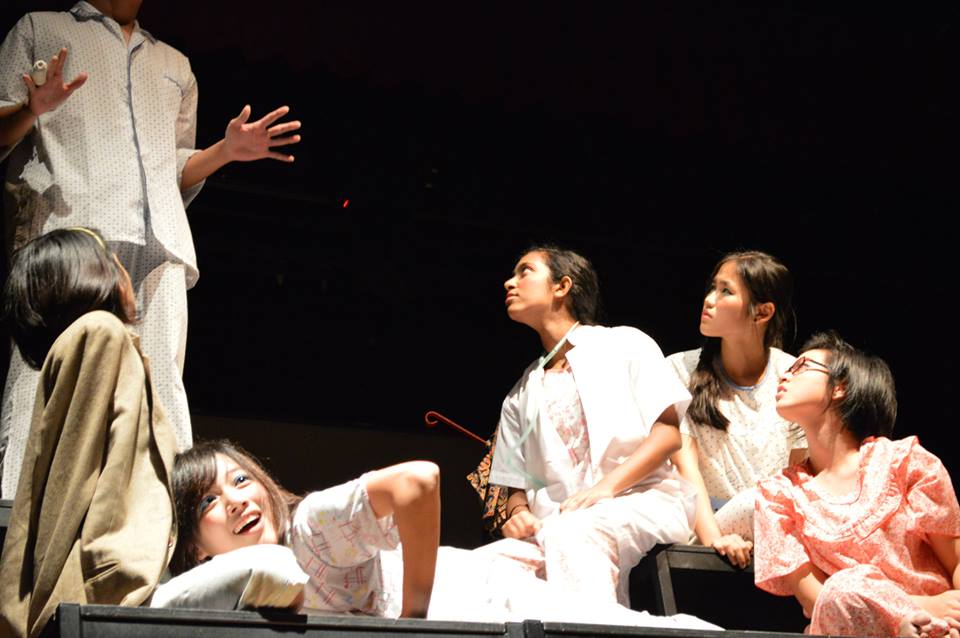
The week ended off with the Literature Quiz and Lit Night, which, as one might expect, was a veritable cocktail of hilarity, poignant sadness, wit and talent. It opened with Raffles Players’ The Sleepover, directed by Jovi Tan (15A01B) and cast Rachel Koh (15A01A), Syafiqah Nabilah (15A01B), Katrina Jacinto (15A13A), Megan Lourdesamy (15S03C), Cheng Yi Ern (15S03B) and Celeste Tan (15A01C). The physical theatre piece started off innocuously enough with six children at a sleepover but weaved in increasingly complex themes, blurring the lines between make-believe and reality. Nine-year-old children brush their teeth, make self-conscious remarks about their noses and complexion, and play dress up in their parents’ oversized coats, transforming transiently, chillingly, into figures of authority as they do so. The inappropriate maturity of their actions, juxtaposed with their obvious youth, added up to an absurd hilarity which had the audience in stitches, but simultaneously drew attention to the awkward self-discovery we have all known.
Initially a tongue-in-cheek commentary on how sleepovers represent opportunities for exploration of an adult world inflated to mythological proportions, the play also delved into more disturbing themes such as marital violence and teenage pregnancy, as its characters took on issues much larger than themselves, some of which they had yet to encounter, and some of which they unfortunately already had. So absorbed were its characters in their play-acting that they eventually appeared to become wholly sucked into the pretense, and the piece ended in a chillingly Golding-esque manner with the apparent death of a child at the hands of her friends. Despite the surrealism of this plotline, it bears testimony to the poignant simplicity of children’s language – after Syafiqah’s character ‘dies’, Rachel’s character observes, “The older I get, the smaller she will become.” The play is a cogent and heartrending exposition on uncertainty and tainted innocence, and the ways in which the realm of the adult intersects that of the child.
Impressively, the production was put together in the space of a mere three weeks from start to finish. The cast wrote the script together, although Syafiqah’s line “I remember, when we were moving into our new house, we had to get a whole new set of furniture, because my parents had thrown them all at each other,” was what planted the seed of The Sleepover. Jovi summed up the play thus: “It was driven by stories most of all. There’s a lot about childhood and about feeling small, which I think is why audiences might feel for it since we’ve all felt that way before.” Indeed, the production garnered positive reception from most of the audience that night, and was an excellent opening to the night.

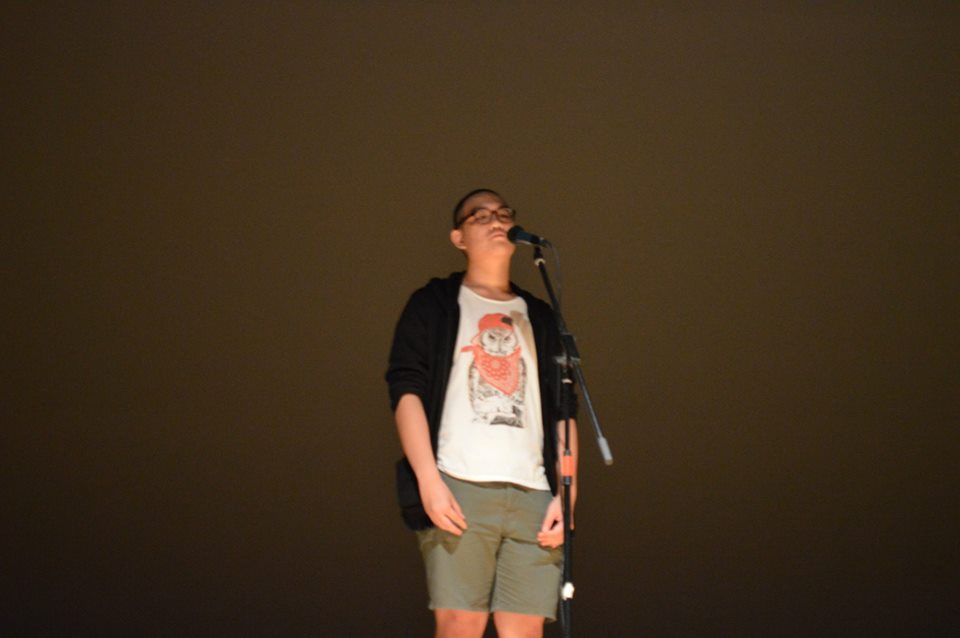
The audience also enjoyed a poetry slam segment performed by William Hoo (15A01E) and Gabriel Ng (15A01B). William took the stage with two poems in memory of his father, who passed away from cancer last year. His first poem, ‘A Wake’, is blithely wrenching in its recount of his father’s wake. There is a careful attention to detail in the ‘peanuts and melon seeds’ partaken of by those paying their respects; lines like ‘She looks at you as though she has never seen you before,/When in fact, she will never see you again’ deliver a proverbial sucker-punch to the gut. The second poem, titled ‘100’, was written to commemorate the 100th day of his father’s passing, when loved ones can conventionally begin to dress in colours again. Addressed directly to his father, it is characterised by reconciliation despite grief. Again, there are lovely moments in this poem, such as the audial congruence of ‘Our mourning stopped this morning’, and the sense of unwittingly coming full circle in ‘My reflection looks me in my mother’s eyes/and bites your lips’. Mrs Perry particularly liked that line, and praised his poetry as “very good, very moving”. Both poems handle a difficult and personal subject with great skill and emotion, leaving teachers and students alike greatly impressed.
Gabriel, who last performed slam poetry at CultuR Shock!, returned with what he called ‘a poem of vague emotions’. Despite the quintessentially ‘poetic’ nature of the images he stringed together, he evaded the widely-panned pitfall of poet voice, the tempo of lines like ‘quill upon your fingertips and paper on my skin’ appropriately accelerating and slowing to remarkable effect.

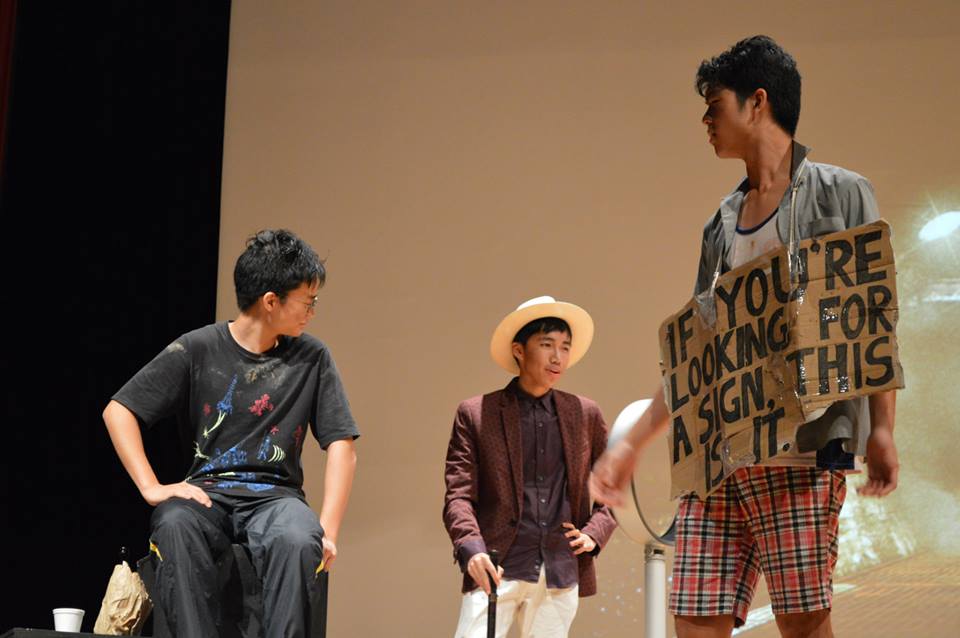
At the peak of the audience’s enthrallment with the slam poets and poetry, the J2s took the stage with their spin-off of Oscar Wilde’s Lady Windermere’s Fan, which pretty much fell flat, in more ways than one. While Sleepover hit all the right notes with the audience, the J2s’ performance garnered a mixed reception from the audience. Titled Lady Windermere’s Biggest Fan, it was directed by Jeremy Khoo (14A01B) and Marc Leong (14A01A), and was intended to be a satirical twist on Act 3, which deals with sexism and gender stereotypes. In this scene, the men of the play are gathered in Lord Darlington’s house and discussing the women, Mrs Erlynne in particular. Aeron Ee’s Cecil was obnoxious and crude in all the right ways, but this did not conceal the fact that ultimately, the adaptation was facetiously over-reliant on slapstick humour and was ridden with one too many cheap and repetitive wisecracks. The line, “She’s the apple of my pie,” punctuated with a suggestive action, drew equal measures of laughter and sighs. Indeed, the play came across as sexist, with many lines unnecessarily rephrased that seemed to objectify women. As one audience member put it, “It’s immediately funny when you watch it because we’re 18 years old, but not when you realise what you’re laughing at.” Or to borrow Mrs Perry’s more critical words, “It was somewhat lacking in subtlety…I’m not entirely convinced that Wilde would have approved [of that].” Jeremy declined to comment.
The night’s programme also included a literature pageant in which each class sent one representative dressed as a famous literary character to either perform a self-chosen talent or answer a question. Particularly memorable was Vice-Captain of MT, Sean Ong’s (15A01A) modernised version of Sir Andrew Aguecheek of Twelfth Night, who ditched the suit of armour for comic mismatched neon football socks and shades, completing the look with his characteristic ‘general air of ineptitude’. His (euphemistically termed) ‘interpretive dance’ brought out the character’s clownish role in the play perfectly, drawing enthusiastic applause from the audience. Arjun Vadrevu (14A01B) also entertained the audience with his rendition of “A Whole New World” as Aladdin from The Arabian Nights, in which he successfully sang the parts of both genders. Other contestants also showcased their talents with David Wang’s (15S05A) dance as The Terminator and Shirley Yong’s Glinda the Good Witch from The Wizard of Oz. The overall winner though was Deon Kiew from 15A01B, who dressed as Count Dracula complete with cape, fangs and dripping faux-blood. He answered questions in a commendable imitation of a Romanian accent and stayed in character to the very end, where he jokingly “bit” the emcee, Lee Chin Wee (14A01B).

In addition, the audience were treated to a snippet of the Literature Quiz which each Y5 Literature class sent 5 representatives to take part in. The audience participation round featured stills from movies adapted from famous literary works, including J.G. Ballard’s Empire of the Sun and Charles Dicken’s Oliver Twist. This had audience members, initially somewhat reticent, tussling to answer and receive a chocolate bar. The results of the Literature Quiz that afternoon were then announced, with 15A01B taking the lead with a comfortable 15-point margin, ahead of 15A13A.
The week’s numerous literary activities, which also included a movie screening of The Remains of the Day, were summarised thus by Mrs Perry: “It gets people involved, gets people thinking.” This goes not only for students who are not typically exposed to literature, but also applies to students currently studying literature, who may well become disillusioned with the technicalities of academic demands. For many of us, Lit Week was indubitably a great way to rediscover the intrinsic joy and worth in appreciating literature. Let’s not forget the hard work of the Organising Committee, comprising the J2 Literature students for their enthusiasm in putting it all together.