ODAC’s annual Gear Up event never fails to excite Rafflesians, cycling amateurs and well-traveled pros alike.
Really, what better way is there to spend the mid-term break’s first weekend other than covering 67.74 kilometres (although it certainly felt longer than that) of Singapore’s most exciting biking trails with friends? Raffles Institution’s Outdoor Activities Club (ODAC) offered many treats at their annual overnight cycling event Gear Up – including paths along homely farmsteads in Lorong Halus (almost anomalous to the kind of urban ubiquity we’re used to seeing everyday), stunning city sights along Marina Bay – no less awe-inspiring than they usually are – and Park Connectors around the heartlands. Gear Up began at East Coast Park and traced Singapore’s eastern perimeter, then cut a path through Ang Mo Kio-Bishan, Marina Bay, to return back to the starting point. The journey was expected to take an estimated 7 to 8 hours with four brief rest stops, and ahead of us lay several daunting challenges, like seemingly endless inclines, staircases, and a sleepless night. Participants were split into groups of 10, each led by several ODAC members who, having cycled the route up to 4 times prior in preparation, were more than acquainted with its challenges and well-qualified to guide the motley pack. “The practice runs mainly helped us build stamina for the long distance trip. It’s a really great opportunity to bond as an ODAC batch and get to know each other better as well,” Ryan Chua (16A01A) laughs, “It’s also meant to get us properly familiarized with the route so we don’t lead y’all into a ditch!” Sure enough, our ODAC guides exuded just the kind of confidence and leadership we needed to keep the pedals going. They were serious when it came to safety and ensured each group member was coping well, but that didn’t stop them from being great sports as well — laughing and joking along with the rest of us.
The 67.74 kilometres journey took us around Singapore’s eastern end through vibrant cityscapes and quiet, empty roads.
The night began at East Coast Park, where close to a hundred rented bicycles had been lined up neatly in rows outside the bike rental station, safety lights twinkling in what seemed almost to be an early Christmas. By the time we arrived to find our groups, Rafflesians were already milling about performing bike checks and taking photographs together as they awaited their turns to set off. ODAC members distributed energy bars and glowsticks, the latter of which quickly adorned wrists, bike handles, or backpacks, adding to the medley of bright colors in the blackness of night. Between the starting line and the first rest stop lay 20 kilometres of road to cover. Encouraged by a gentle sea breeze, participants cycled through East Coast Park on a straight path out, then moved along the seemingly ever-lasting Changi Coast Road as the deafening whir of planes roared overhead. Close to 2 hours had passed when the groups first arrived at Changi Village for a short stay to cool off their sore limbs. Shortly after, we were off once more, this time up the north-eastern road towards Punggol Waterway, cycling through scenic boulevards surrounding by domineering housing estates only recently completed, and thus still unoccupied. The tranquility offered a serene and enjoyable calm, but also a strange sense of solitude. Nevertheless, we sought comfort and security in the companionship of our fellow groupmates and soon found ourselves on deserted roads past Lorong Halus’ farms. The lack of high-rise buildings and relatively little lighting allowed us to view the moon and stars in their fullest, unreserved grandeur — a privilege rarely found in Singapore’s densely urban environments. As we began to tire out, every bit of encouragement from our peers became even more important to give us just that little boost we needed to finish the trip. Entering the heartlands, the groups weaved past familiar neighbourhoods and reached another rest stop nestled within Bishan Park, greeted by ODAC members handing out drinks and bananas before the journey’s final leg. Another 2-3 hours later, we were breezing down the expansive Formula One racetrack towards the Singapore Flyer. Finally, each groups lined up for pretty pictures by the cityscape before making their way slowly back to East Coast Park. “The night was really cold,” Syazwani Nonis (16S03B) said, “But it also felt warm on the inside because of the comfort and freedom we had at Gear Up and I’m really glad the group I was with enjoyed it so much too!”
The stunning night cityscape greeted us at our final pitstop before the last leg to Gear Up 2015’s finishing line.
Although Gear Up 2015 gave participants just as much physical and mental exhaustion as it did good sights, if not more, you can be doubly sure Raffles ODAC easily fulfilled its promise to deliver 68 kilometres’ worth of amazing memories riding the stars and racing the night together.
By Tasharani Palani (16S03P), and Trudy Chak (16S03D)
Photos by Raffles Interact, and Bryan Goh (16A13A)
“Good luck, and don’t get lost!”
The usher at the door chirped before we plunged into almost-swallowing darkness. I could barely make out the faint outlines of bulky banners surrounding the entranceway. Well, how bad could it be?
Once the door had shut, we were plunged into swallowing darkness. Even more, we were sent into complete disorientation. The mild buzz and hullabaloo within the hall mirrored that of turmoil, all in a dither. Faint yet shrill rings of traffic light beeping, high-pitched jingles and clanging of tambourines and bells all clamoured for attention. Is this confusing mess what the blind deal with everyday? How do they garner the patience and strength to handle such stress and disorientation over and over again?
With the lives of a human train of eight participants as my responsibility, I walked and groped around in the pitch-blackness, trepidation and mild excitement overlapped each other at the back of my mind. What if I fell? Would everyone come tumbling behind me and end up in a massive heap of impossible-to-disentangle flailing limbs? How could I make sure everyone- a jolting pain smothered my face– I had hit a wall.
Confusion erupted behind me, a chain reaction resulting from my vocal yelp and jerky halt. From then on, prioritizing the safety and well-being for my diners became my sole mission for the night. Get them to the table. Actually get each of them on the seats. Get them talking. Get them food, drinks, ice cream, second-helpings, tissue, anything and everything. Get them to the washroom. Get them back safely. Satisfy all the needs, and prioritize their well-being above all else.
Behind the scenes, the set-up in Albert Hong Hall just before the arrival of the diners.
It’s interesting to look behind the scenes of Dine In The Dark such as the above described ushering experience and wonder how the entire event was pulled off in pitch-black darkness. “How on earth did they manage to make the hall completely dark?”, “How do they even find their way around?” and other murmurings along those lines were common questions overheard from the diners throughout the event. For all they knew, maybe each one of us Interactors wielded Deluminators. In particular, the self-assembled obstacle course segment, In Their Shoes, raised a lot of buzz amongst diners.
The obstacle course was designed with the idea of experiencing walking in the shoes of the visually handicapped on a daily basis in mind, incorporating activities such as crossing a road and using tactile paving for guidance. In the words of the Organizing Team, they “wanted to simulate how bewildering it is to navigate in a crowd of noise and people without sight.” It clearly served its purpose well though. During the event dry-runs, us Interactors realised that even with practice and familiarity, it doesn’t get any easier. What more for first-time diners? A J1 diner mentioned that she found it difficult “because I really couldn’t navigate my way through” and “felt vulnerable and helpless”, and finally came to the conclusion that “sometimes as normal people, we can’t really empathize with the blind so I felt that really was an eye-opener for me”.
To add on to that sentiment, most are unaware that the term ‘visually impaired’ doesn’t necessarily mean being completely blind. Most of the visually handicapped suffer from eye conditions that still allow them to see, albeit partially. As a result, they require costly visual aids and do face a fair amount of stigma in society for not being ‘truly’ blind. The hugely insightful sharings by Mr Leow and Ms Christina, who are both representatives from SAVH, gave both Interactors and diners a deeper perspective of how a visually impaired person’s daily life is like and any challenges they may face. The Q&A session in particular received quite a few laughs especially when we heard about Ms Christina’s encounter with a stranger off the streets of New York. However, I was most struck by Mr Leow’s empowering sharing that while he may have lost his sight, he didn’t lose his vision. It gave me renewed respect for the visually impaired and reminded me that they too have their own hopes and dreams in spite of the huge challenge they face.
Following that, the presentation of audio-described movies Up, and The Avengers, was a unique highlight of the event which added another dimension to the experience for diners. It allowed them to further better understand the lives of the blind via experiencing first-hand how audio description is capable of making visual media such as theatre, cinema, and television, more accessible for the blind and partially sighted people. For the curious, audio description is a form of narration that involves a narrator describing happenings on screen during natural pauses in the audio, or otherwise, for those who may have difficulty seeing what goes on on screen.
With a creative twist, the programme continued on with wittily-named games such as ‘Blind-Fold’, where all diners were unknowingly tasked with folding origami hearts and paper planes, ‘Private Eye’, where during dinner, diners were encouraged to take a stab and pen down their guesses about the enigmatic mystery dishes. In addition to that, the lottery ‘Spot On!’ had diners scrambling for their tickets in an attempt to decipher what their numbers were. The lucky numbers were printed in Braille lettering onto diners’ official tickets, an innovative addition to the concept behind the event as a whole, which aspired to provided diners with more insights into the lives of the blind.
Throughout the night, there was a general feel-good buzz in the atmosphere and a distinct energy pulsing in the hall. Perhaps it was the good music that brought it about, thanks to the astounding musical talent performing, with the likes of Ampersand, Triumviratus, and our very own Interact Band taking to the stage with upbeat crowd pleasers. Ampersand ignited the good vibes for the night with a soul-searching rendition of Little Talks by Of Monsters and Men. Across the afternoon and evening, Take One took us back to the instrumental basics for both lunch and dinner, performing their creative takes on various songs such as Somewhere Beyond The Sea by Frank Sinatra and Oppa Gangnam Style by PSY, as well many others between lunch and dinner.
From the Faith Music Centre, we had the pleasure of hosting Cactus Rose and the Visually Impaired Band (VIB), both of which gave outstanding performances. Notably, one of the performers in the VIB hit the ripe old age of seventy-three this year, yet he still continues to perform with gusto and delight.
Possibly the brightest part of the event was right before it ended, diners were told about the hidden light sticks under their chairs and pulled them out just as the Interact Band burst into a rousing performance of See You Again. Amidst good music and a glowing sea of lights, Raffles Interact had its first Dine In The Dark photo!
However, due credit must be given to our esteemed seniors who ensured that the event went along smoothly without a hitch. We asked Vint Seng (15S03H), one of the OT members, about his experience and speaking on behalf of the OT, he shared that, “For this year, we wanted to go back to DITD’s roots; it was always meant to illuminate a world of darkness so we can see the light that is the courage of the visually handicapped.” Judy Hong Ruilan (15S03R) noted that “When we were conceptualising the experience for 2015, we wanted it to be more than just the food or the performances; We wanted to showcase the strength and the talents of the visually handicapped. We hope that DITD provided some “Food for Thought”, and motivated diners to act in whatever capacity they can- be it by donating, volunteering, or offering help to any of the visually handicapped who cross their paths.”
The J2 Organizing Team at DITD! (Not pictured: Abraham Lee, Gabrielle Ong, Goh Yiling, Joyce Lee, Kathleen Ng, Megan John, Nadia Nasuha, Nicholas Tan)
The unanimous echoed sentiment of an eye-opening, enlightening and extremely meaningful experience was evident we asked diners about their experiences. If any indication of the event’s success, people have mentioned that it really lent greater awareness as to how the visually impaired feel and how they now have added respect for their independence and even greater appreciation for sight.
To quote Tan Kai Wei Felix (15S03U), he mentioned that he “definitely got a better idea of what it is like being completely blind and the difficulties that they face.” Jia Wei (16S03O), another J1 diner noted that “there are many things that we take for granted but should actually be thankful for”. Along the same lines, a few J1 Interactors reaffirmed the hope for diners to be able to “now empathize a bit more with the visually impaired”. Apart from all the fun and games, they wished for diners to “realize just how hard it is to be visually handicapped, so that they may cherish their vision more.”
Personally, as an Interactor, the entire experience raised an extensive number of questions and provided a thought-provoking range of insights into the difficulties faced by the blind. It has compelled me to reflect and build upon my at best- skimpy understanding of the very real challenges faced by them.
In retrospect, Dine In The Dark 2015 will be remembered for its good food, great music, and most importantly, the very best of dining experiences- where dining is more than just a meal. Raffles Interact would like to thank all who came down to show their support and hopes that everyone enjoyed themselves tremendously! We will (not) see you next year!
In addition, Raffles Interact would like to thank these talented student performers for coming down to perform!
Ampersand: Wu Bing Anthony (15S06L). Ian Ho Jin Yi (15S06H), Thia Zhang Wei (15S03G), Lorraine Fong Rei (15A01C) and Jonathan Pong (15S03G)
Take One: Ding Yu Chen (15S06E), Casey Chan Fay Ching (15S06H), Ian Ho Jin Yi (15S06H), Wu Bing Anthony (15S06L) and Chua Zhe Xuan (15S06J)
Interact Band: Pong Jia Jing, Jonathan (15S03G), Saik Chin Wen, Sharon (15S03O), Daniel George (15S06D), Megan John (15S03F), Gabrielle Ong Hui Min (15S06A)
Triumviratus: Ethan Ong 4P, Muhammad Syazwan Bin Ramli 4C, Yeo Jun Wei 4C, Ganesh Gunasekeran 4D
By Heather I’anson-Holton (16A01E), Alex Tan (16S03B) and Karen Cuison (16A01D)
Photos by Li-Ann Hoong (16A03A) of Raffles Photographic Society
Snaking ticket booth queues stood testament to the high level of anticipation surrounding Raffles Runway’s Singapore-themed spectacle. Aptly named re: collections, it celebrated Singapore’s 50th birthday and Runway’s 10th year as an official CCA.
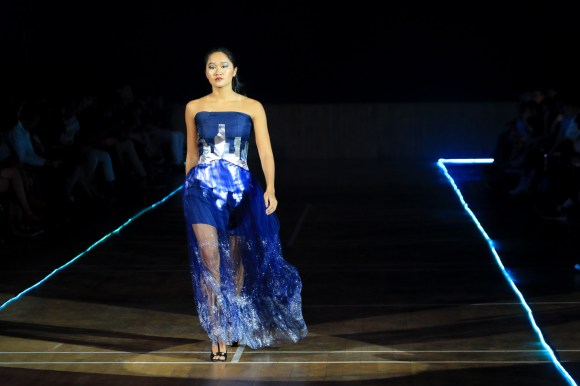
Audience members were greeted by delicate paper moons and stars suspended from the entrance of the Albert Hong Hall. Puffs of dense smoke permeated the entire room, undercut by vivid, shifting beams of multi-coloured light and a throbbing bassline courtesy of DJ AK. Two strips of blue fluorescent light flanking the runway took it from drab to dazzling. The show’s shimmering, otherworldly atmosphere was a clear indicator of what was to come.
Outfits followed loose themes, including urban isolation and entrapment, comfort and change. The photo booklet created by Runway organized the garments by times of day. This ambiguity created the impression of a lack of cohesion – but this was understandable, with so many designers with diverse styles. If anything, the ambiguity stimulated dialogue, giving audience members the space to interpret garments freely. The diversity also showed the magnitude to which Runway took to their overall theme, reflecting the individuality of the Singapore experience.
Workmanship was generally of a high standard. The garments showcased a breadth of technical expertise: from the pleats and braiding in Xiao Wei’s dress (15S06J), to the intricate beading in Teo Kai Wen’s (15S03H) poufy garment, each piece demonstrated delicate craftsmanship and a careful eye for detail. Ang Xue Ling (15S03F) mentions, “Some people managed to finish theirs over the December holidays, and some took a whole year.”
A bright, well-constructed orange maxi dress. (Designer: Xiao Wei)Intricate beading, immaculate poufiness. (Designer: Teo Kai Wen)
Designers’ interpretations of the SG50 theme were varied and refreshing, personal yet relatable. At the same time, the clothes resonated with one another, linked by their common inspiration. Some designers made use of tangible, recognizable icons, but the results were anything but predictable. Lim Wan Ling (16A01D) juxtaposed a city skyline against a lake to stunning effect, while Lim Ee Sing (16S07B) tastefully drew upon the MRT system to create a costume that looked simultaneously familiar and alien.
A garment inspired by Singapore’s skyline. (Designer: Lim Wan Ling)A quirky twist on our MRT system went into the designing of this dress. (Designer: Lim Ee Sing)
Other designers employed more abstract ideas. Megan Goh (16A01D) tried to replicate the ‘comfort and safety’ of HDB flats in designing her cape dress with soft, pastel fabrics. On the other end of the spectrum, Huang Zhoudi (15S06J) chose to highlight Singapore’s darker side with her gothic garments.
Soft colours reflect the comfort and safety of the HDB flats which most Singaporeans reside in, in this dress designed by Megan Goh (16A01D).Gothic glamour from designer Zhou Di.
re: collections featured thoughtful collaborations. The senior batch of Modern Dance put up an energetic, dynamic performance, while behind-the-scenes clips from Film Society demonstrated an acute sensitivity to the mood and intent of the artists. It also lent the audience a glimpse into the clamour before the glamour – including, but certainly not limited to, setting up audio-visual equipment, planning venue layout, and liaising with lighting technicians. Overall, both collaborations lent edge and unity to re: collections.
Modern Dance at re:collections
If there was anything we had to nitpick on, re: collections took a while to hit its climax, making for a sleepy and somewhat awkward first twenty minutes of the show. In addition, many of the menswear pieces seemed to take on a similar structure – loose cape over ordinary collared shirt and black pants.
The process of putting the show together was not without its challenges. For one, designers had to consciously transcend common, literal and too-dogmatic interpretations of a seemingly limiting SG50 theme.
“Quite a few people wanted to use the Supertrees as inspiration, and initial sketches had very obvious signs of them, like veins in red running down the fabric. The design itself wasn’t bad, it’s just that we asked the designer instead, “what do you feel about Gardens by the Bay? What do you feel about Supertrees? Is there any other way to express a Supertree other than literally taking the veins of the tree on a dress?” From there, it changed.”
Irene Tee (15S07D)
Surely, fashion would not be fashion if it were not provocative, and re: collections had its fair share of controversy. During the matinee show, a model walked down the runway in a white varsity-style top studded with red sequins that read “Peace Love Happiness” on the front, and a large “50” on the back, coupled with glittering golden shorts and similar knee-high socks. This prompted a noticeable increase in buzzing and murmuring from the audience, who mocked both the model and the piece, and circulated pictures on social media. Not wanting their model to have to suffer the repercussions of a subversive design, the golden shorts and socks were substituted for black, more neutral tones during the evening show. Runway laments the audience’s response, expressing regret that they could not support and showcase the work of all artists.
Guest designer Mudassar Ahmad (15S03A), who was behind this bold costume, told us that he aimed to marry the celebration of national values and the dismantling of masculine stereotypes. Whereas “peace” and “happiness” are tenets of Singaporean society, familiarly embedded into the pledge we take daily, “love” is not as prominent. “I feel like in our society we don’t really give much for loving people, just for them being people,” he opined. When queried about the audience’s uncalled-for response, Mudassar expounded on his idea of fashion as a form of art, and art as a vessel of change in society. “I think it’s precisely because people aren’t ready that there’s all the more need for us to step out and make a statement, because that’s how change happens.”
In her closing address, teacher-in-charge Ms Janissa Soh summed up the show best, urging the audience to see RProject as a process rather than an end: “The designers started this process to get us thinking and looking at our own society. I’m not talking about other people. I’m talking about you and me. How have we contributed to this society? How have we made it cold, white, harsh? As we start this process, as we start SG50, we hope all of you can join us to take a moment to reflect.”
By Tag Wan Yi (15S03N), Liu Hong Zhan (15S03O), Shayna Toh (15A01D), Chua Siwei (15S03E), and Yu Xinkai (15S03U)
Additional reporting by Justin Lim (16A01B)
Foreword:
An air of finality marks this year’s Ecoweek. For some, Ecoweek’s the first campaign targeted at the environmental issues that plague our planet amidst all the other worthy causes advocated for in the school; but for Community Advocates’ Glassark, this year’s Ecoweek marks the closure of the the very interest group that had organized this annual affair. Rather than to exist as a singular body to advocate for environmental change, Glassark’s aims will now be a batch-effort. This organisational change could, on a symbolic level, represent a shared burden across all citizens of the planet. But to members of the Glassark, this marks an unfortunate end to a brilliant annual initiative that encapsulated an undying advocacy for environmental change.
Before it effectively disbands in 2016, Glassark was one of CA’s four main student interest groups that aimed to each raise awareness for specific issues. The group has aimed to bring relevance and attention to environmental issues ranging from global warming to the energy crisis – issues that were often neglected in favour of more prominent social issues such as immigration or poverty.
But just as how the Earth is important to us as a home, it is important to raise awareness of the misdeeds to her environment. While this year’s Ecoweek aims to shed greater light on the issue of wildlife conservation– a shift in focus from last year’s advocacy for the recycling of scrap materials– Glassark’s members share with Press that this in no way means that environmental conservation should stop: that we ought to do away with our “backyard syndrome” and begin to acknowledge the fact that the entirety of Planet Earth is our “backyard”.
Whether be it through the conservation of wildlife, or through recycling or energy saving, Glassark sends an important message to us: That the fight against environmental issues never stops, and that it is still on our onus to protect and conserve our planet’s resources.
Ecoweek’15: The What and the Why
Ever heard of sharks having their fins brutally sliced off, only to be thrown back into the ocean for an imminent death? What about snakes and crocodiles bred in captivity to be skinned for the most expensive of purses? Or even the brutal extraction of ivory from the tusks of elephants?
Illegal wildlife trade is one of the main threats causing animal extinction, among other factors such as pollution and climate change. Up to 73 percent of the world’s flora and fauna has been lost. This is not a distant worry found far in the Kenyan forests, or some threat only levelled on the Amazon: wildlife trafficking is a pressing and pertinent issue right in our backyard. Singapore ranks among the world’s top 10 illegal wildlife smuggling hubs, due to, quite ironically, its clean reputation as an efficient port. Our excellent and efficient transportation network has been exploited by criminal organisations to smuggle endangered wildlife species and by-products to fuel the growing appetite for such products in the region. The Southeast Asian region alone is set to lose a fifth of its species by the next century. That’s one in 5 species that our children’s children will never get to see.
Wildlife trafficking has been a widespread and ongoing issue in Southeast Asia. Two weeks ago, more than 24 critically endangered Yellow-crested cockatoos were rescued by police at the Port of tanjung Perak in Surabaya, Indonesia, after being found stuffed in water bottles for illegal trade.
The Yellow-crested cockatoo was listed as a critically endangered species by the International Union for the Conservation of Nature and Natural Resources in 2007.
“Illegal ivory estimated at $8 million,” reported the Straits Times’ on 19th May, just a mere two days ago. The shipment, which consists of about 3.7 tonnes of illegal ivory, is the second largest seizure of illegal ivory since 2002, the Agri-Food and Veterinary Authority (AVA) and Singapore Customs said in a joint press release on Tuesday.
1,783 pieces of raw ivory tusks, 4 pieces of rhinoceros horns and 22 pieces of canine teeth believed to be from African big cats were concealed among bags of tea dust.
Despite governmental crackdowns, wildlife trafficking proves to be an enduring profitable enterprise – and you know how it goes. If it makes money, go for it. At least 10,000 species in the wild go extinct each year and we fear more.
Where does Ecoweek come in?
That being said, this year’s Ecoweek aims to raise awareness for the global threat to wildlife, and highlight the importance of wildlife conservation. Wildlife trafficking activities have increased in scale, severity, and pervasiveness in the recent years, and the school population ought to understand the urgency of this issue.
Posters by the World Wide Fund for Nature have been put up around school: ones which we believe have encapsulated the danger and threat of wildlife trafficking with both clarity and poignancy. In addition to that, our booth in the canteen walkway explains the current situation and its implications, as well as how you can play a part to stop the illegal and unsustainable wildlife trade.
Some times to support wildlife conservation efforts.
While we may not have participated directly in the killings of these endangered wildlife animals, nor do we have the capacity to resolve this issue entirely. But, we, as consumers, continue to be the root cause of this issue – we drive the demand for such products. And all it requires of us to take that first step in making the right choices and spreading the message. We hope that with Ecoweek 2015, we can spark an active conversation regarding wildlife conservation and inspire others to join in the movement with us because it’s a matter of: Cherish, or Perish.
By Tasharani Palani (16S03P), Trudy Chak (16S03D), Vanessa Chia (16A13A), Isabel Elizabeth Siow (16S03I)
Photos by: Isabel Lee (15S06C)
Cueing an onslaught of a sea of red and white, ‘Uptown Funk’ reverberated throughout the Atrium @ Toa Payoh Hub during the late hours of the bustling Saturday morning, 18th April. This attracted curious glances from casual passersby as enthusiastic jeans-clad students broke out into a flash mob. Indeed, the spirited showcase truly symbolized the essence of passion for service and volunteerism. Over the course of the day, our Interactors’ infectious enthusiasm and exuberance drew many onlookers to take a peek into what Raffles Interact had in store for the day.
In essence, Youth Got Heart (YGH) is a highly-anticipated annual outreach event organized by Raffles Interact. Its main purpose each year has been to provide a platform for youths to find out more about volunteerism, as well as to seize the opportunity to give back to the local community in a meaningful way. With that in mind, the event showcased an extensive variety of VWOs, including The Nature Society (Singapore), Movement for the Intellectually Disabled of Singapore (MINDS), and Family Life First, The event was graced by the president of the Singapore Rotary Club and Mrs Josephine Teo, Senior Minister of State at the Ministry of Finance and the Ministry of Transport, as the Guest-of-Honour.
In commemoration of SG50 this year, YGH 2015 hoped to incite the collective spirit of Singaporeans to play an active role in contributing and sustaining service to the community under the theme “Past, the Present, and the Future”.
In the words of Mrs Josephine Teo,”The whole story of Singapore is about how ordinary people come together to create the extraordinary and likewise for volunteers- each one contributes a small piece- a bit of time, sometimes mentoring others, sometimes helping them. But when all these efforts, little efforts are added up, they amount to a lot. It makes our society different from others, and also it makes each one of use bigger than ourselves.”
The event’s programme for the day kickstarted with an address by Isabel Lee, the main student organizer of YGH 2015, who provided a few insightful words about her experiences with service. She elaborated upon her motivations for dedicating herself to such a daunting yet meaningful project and delved into the story behind her own intrinsic passion for service. This thoughtful address reached out to the audience and encouraged them to participate in service themselves.
Isabel Lee, Head of YGH’s organising committee with Ms Josephine Teo, Guest of Honor
Although the intended target audience for YGH was the youth, it was encouraging to see that this year’s turnout ended up a diverse one, which included many members of the public, ranging from the elderly to families. Additionally, many Rafflesians also came down to Toa Payoh that afternoon to lend their support for their fellow schoolmates. This was truly heartwarming for many of the Interactors, especially the Organizing team who dedicated many hours to perfecting the entire event to painstakingly ensure its smooth success. The organizing team commented, “YGH was an amazing experience for us. To see our ideas come to life, and the impact it’s had on the community, if only for a day has made it worth the effort. We hope that the experience has been as great for everyone who came down as it was for us.”
Interactors getting hyped during YGH 2015!
In particular, the highlight of the event was an extensive array of informative booths, each representing a particular VWO that, with the combined efforts of all Interactors, were decorated with personalized infographic posters. The boothes communicated key details about service opportunities through engaging visuals and verbal dialogue with staff and interactors. Delegated Interactors and organization representatives were key to the event’s main objectives, as they provided detailed information about the available volunteering opportunities and the specific needs of each VWO. They were able to advise the public on the most suitable volunteering opportunities for them, according to the beliefs, interests, and schedule of potential volunteers. This was essential towards ensuring a mutually beneficial and ultimately rewarding volunteering experience for each and every one.
The whole event infused elements of the Past, the Present and the Future, into its layout. The main attraction was a “Hall of Fame” exhibition detailing volunteering efforts of the past, informative booths representing the needs of the present, as well as photo-wall filled with polaroids to symbolize the hope of the youth for future volunteerism efforts within Singapore.
Members of the public having their picture taken at the photo booth.
Additionally, innovative station games, assembled for all to try their luck at, managed to entice participants to complete the entire course in order to win a special food pack. Sporting members of the public, ranging from gutsy aunties to ever-curious children, gamely tried their hand at searching for specific items in a Mystery Box while blindfolded, as well as drawing with their eyes closed– aimed at allowing participants to briefly place themselves in the shoes of the visually handicapped.
Adding to the hype was a myriad of performances, ranging from a performance by alumni members from Raffles Street Dance’s energizing take on the pop chart-topper Bang Bang by Jessie J, Ariana Grande, and Nicki Minaj, to Raffles Rock’s assortment of tunes, including Pompeii by Bastille and You Only Live Once by The Strokes, as well as performances by the Interact Band, all of which kept the audience drawn to the atrium the entire afternoon.
Raffles Street Dancers showing off their talent and skilful moves!
Wahid Al Mamun, of 15A01A from Raffles Rock shared with us that “Personally, I found it cool that we got to take part in this community initiative as well as meet so many different people – volunteers, elderly, and to learn a bit more about other people’s lives.” Ernest Yee, a J3 graduated member of Street Dance, mentioned that he had simply hoped “to make everyone feel happy from watching our dancing” and had placed audience enjoyment as their top priority. To quote him, “we hoped the audience enjoyed it as much as we did!” Indeed, these talented performers managed to engage, delight, and amaze throughout the course of the day.
We even had our very own Interactors gamely stepping up to the challenge of hyping up the audience. With engaging and charismatic emcees and Interactors spontaneously breaking out into dance to the beat of Bruno Mars’ Uptown Funk, showcasing their passion and spirit for volunteerism, it really added much vibrancy and energy to the atmosphere that afternoon.
Throughout the day, it was heartening to see a fair share of individuals, who personally embodied community spirit and displayed the rarely seen kinder, more pro-active side of Singaporeans today. For example, we had Interactors dancing with some of the more spirited elderly folk who got off their seats to dance alongside the performers; and in another instance, members of the public were kindly reminding the Interactors to stay hydrated in the humid mid-afternoon weather. It was truly incidents like these that made the long day worth it.
In retrospect, some members of Interact mentioned that they would hope to achieve a more balanced demographic in the future. However, given the location of the event, its sphere of influence and impact was largely limited to the significantly higher proportion of elderly visitors rather than meeting original expectations of engaging youths. Despite this minor setback, Youth Got Heart still undoubtedly helped to raise awareness and incite public support for a vast array of VWOs. All in all, 2015’s YGH was a resounding success, managing to connect dozens of potential volunteers to short-handed VWOs.
Selfie time with the Guest-Of-Honor, Ms Josephine Teo!
Raffles Interact promises to intensify their efforts for next year’s YGH, so do keep a look out for more exciting opportunities to serve the community coming your way! With your valued support and continued encouragement, Raffles Interact will strive to find more ways to connect youth to volunteerism and serve the community as well as the school.
Interact ‘15-’16 would like to thank everyone who came down to show your support!