Commentary

Smashing Success: Clean Sweep at Table Tennis Championships

Reading Time: 8 minutes

By Qiu Kexin (16A13A), Naomi Koh (16A13A), Sean Lim Zhen (16A13A), Agatha Sacha Lim (16A01B)
Additional Reporting by Stella Soon (16A01C)
Photos by Amy Goh (16A13A)


No lack of excitement at the venue!

On the 21st of April, for the first time in history, the Raffles table tennis players achieved a clean sweep in their finals, securing Gold medals for all 6 categories. Despite the fierce competition from powerhouse and traditional rival Hwa Chong Institution, the A division players persevered to win 3-0 in the boys’ category and 3-2 in the girls’ category.

In Table Tennis, the format of scoring for the competition is as follows:

In both the Boys’ and Girls’ Divisions, teams play up to 5 matches against each other, and the team which wins 3 matches out of 5 emerges victorious. These 5 matches played are: 1st singles, 1st doubles, 2nd singles, 2nd doubles and 3rd singles.

In each match, players play to the best of 5 sets, meaning that the first player/pair to win 3 sets wins. In each set, players/pairs have to win 11 points to win the set, but minimally by a 2 point difference. That means, players cannot win a set 11-10; when the score reaches 10-10, players play to 12, and when it reaches 11-11, they play till 13 and so on.

A DIVISION BOYS:
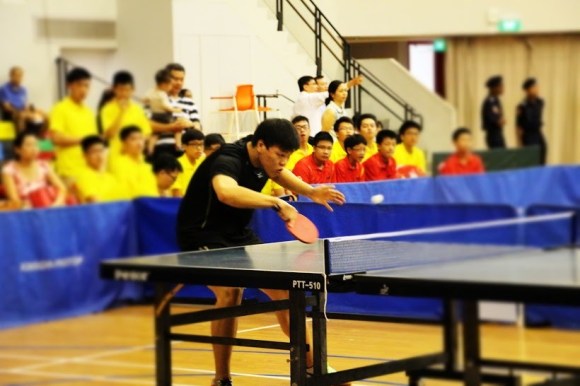
Liu Tian scoring a point

The championships opened with a match between Liu Tian and his competitor, who both exuded skill and an ardent resolve. Although the first set was won by Raffles with a score of 11-3, the Hwa Chong competitor did not let this faze him and fought back valiantly in the next set, winning it 4-11. However, Liu Tian regained his composure, and secured victory in the following set 11-9.

In the last, and most exciting set between Liu Tian and his opponent, both fervently pitted themselves against the other, and the match score quickly equalised at 4-4. Both players went neck-to-neck; whenever one player seemed to be gaining on the other, the other player would make a return and equalise the score. The pressure mounted – both players refused to yield in the heat of their back-and-forth exchange. However, in the last few seconds, Liu Tian scored a point and secured a 2-point edge, winning the 4th set with a score of 12-10, bringing a first win for Raffles.

Following Liu Tian’s valiant efforts, it was time for the boys’ duo, Daryl Tan and Heng Kai, to take over. They got off to a good start, winning the first set for Raffles 12-10. However, they conceded the next set to Hwa Chong with a score of 3-11. Luckily, Daryl and Heng Kai quickly found their momentum, combining skilful defense with calculated aggressive play to easily win the third set 11-6, and race to a quick 7-1 lead in the fourth set. Some uncharacteristic errors from the Hwa Chong side brought us to match point at 10-3, but we suddenly seemed to face some difficulty closing the match. Nevertheless, even while our competitor’s moral was slowly rising, our resolve remained: the pair called for a timeout to regroup and focus, and after a short chat with their coach, Daryl and Heng Kai finally managed to decisively secure the match on the next point, winning 11-8 in the fourth set.

The power duo, Daryl and Heng Kai.

With Raffles comfortably up 2-0, it was up to Yin Jing Yuan to win a third match against Hwa Chong Institution and secure victory – which he did in a convincing fashion. Winning the first set 11-5, Jing Yuan continued his momentum to sweep the next two sets, 11-2 and 11-4. With that, Jing Yuan won the overall 2nd Singles round, helping the A Boys conclusively clinched the title with a score of 3-0 over Hwa Chong Institution.

The competitors who represented Raffles Institution were as follows:
1st Singles – Liu Tian
1st Doubles – Daryl Tan and Heng Kai
2nd Singles – Yin Jing Yuan

A DIVISION GIRLS:
While the boys may have had a relatively fuss-free course on the way to their title, the girls did not quite have a similar walk in the park. Those who had thought that they were on course for an effortless victory were sorely mistaken; the Hwa Chong contingent, backed up by an enthusiastic bunch of supporters, refused to back down.

There was a sense of suspense and tension evident even from the opening match, played by Melissa Tan against her Hwa Chong contender, which was rife with passion and competition. Despite losing the first set, she eventually rallied to win her overall match 3-1.

Melissa Tan – a steadfast player.

This triumph set a precedent for the next match, the girls’ first doubles, in which Charlene Koh and Liao Fang won 3-0 with ease, sweeping aside their Hwa Chong opponents who never won more than 5 points in each set, putting Raffles up 2-0.

Charlene Koh and Liao Fang, playing together for their doubles match.

The 2nd singles match which followed was arguably the most emotionally charged of the afternoon, pitting Li Jiaxin against a feisty Hwa Chong opponent. The two players were noticeably aggressive from the get-go, trading the first 2 sets evenly. More spectators began to gravitate towards their table to catch a glimpse of the enthralling encounter.

Li Jiaxin just after sending a good serve.

Jiaxin’s opponent stepped up a notch in the 3rd set, pulling off a series of aggressive plays and shots that pulled Jiaxin from side to side, which helped her take the set comfortably with a score of 11-4. In the 4th set, Jiaxin started out strong, racing off to a 4-0 lead. However, her opponent struck back by winning several tight, extended rallies which had the crowd leaning on the edge of their seats. With the score tied at 8-8, tensions ran high – both players were furiously pumping their fists after each point. Yet, despite a valiant fight, Jiaxin eventually lost 11-9. However, she never gave up and fought fervently throughout the match against an equally-spirited opponent in a laudable show of her persevering attitude.

The score thereafter was now 2-1, in favour of Raffles. Was Hwa Chong mounting a comeback?

The next match involving Cheryl Tang and Tan Qi was similarly fiery, consisting of many long rallies and constant switch-ups in style, with the girls on both sides rapidly switching between offense and cautious defensive play that ensured the match never lost its entertainment value. Every time one team appeared to have gained momentum, the situation soon swung back dramatically in the opposite direction, resulting in a battle that was neck-and-neck throughout almost 45 minutes. However, despite a spirited fight, the Raffles pairing lost in 5 close sets (5-11, 12-10, 5-11, 11-7, 7-11).

Hocus focus. (Cheryl Tang and Tan Qi)

With both schools tied at 2 wins each, victory boiled down to the result of the final singles match which fielded Xue Qi, who was Captain of the girls’ team. Faced with the arduous task of bearing the pressure of defending the school’s A Girls title on her shoulders, one would have expected Xue Qi to crumble under the pressure. She was momentarily fazed at the beginning of the match, where some concessions caused Xue Qi to fall behind 3-7 in the first set. However, admirably, she soon composed herself and fought back with a series of well-crafted manoeuvres to tie the score at 7-7. The next few points were nail-bitingly close; however, a couple more errors resulted in the Hwa Chong player claiming first blood, winning the first set 12-10.

Ng Xue Qi just after winning a set in the 3rd Singles round.

The next set was a case of deja vu, and Xue Qi was behind 1-4. Still, she never gave up and persisted in levelling the score. Then came a crucial point midway; at 8-10, the Hwa Chong player had 2 set points to win the match, a lead that she seemed likely to gain. However, Xueqi maintained her composure and played the next 4 points brilliantly, staging a dramatic comeback to take the second set 12-10. While the momentum may have clearly been on Hwa Chong’s side, it was clear after the end of the second set that Xueqi had gained confidence whereas the morale of the Hwa Chong contingent took a slight blow, becoming more subdued. With newfound confidence, Xueqi easily took the 3rd set 11-5, putting Raffles one set away from a complete sweep of titles.

The final set appeared incredibly one-sided in favour of Xue Qi as her constant aggression persistently troubled her opponent, helping her gain an 8-3 lead. With victory on the horizon, the Raffles supporters erupted into a frenzy, almost tasting victory on their lips. Yet, the Hwa Chong player refused to give in, fighting back in an unbelievable fashion to claim the next 5 points, thereby levelling the set at 8-8. This evidently shook Xue Qi as well as many of the Raffles supporters who thought Xue Qi might have been experiencing a ‘choke’, which is a situation where a player lets a position of clear advantage slip from his/her grasp. However, Xue Qi was able to regroup during a short time-out, after which she claimed 3 consecutive points to close the enthralling match in style. The cheers became even more memorable with our RI and RGS counterparts joining us in supporting Xue Qi in the relentless back-and-forth volleys. As soon as her opponent’s final shot sailed long, Xue Qi’s teammates burst from their spectating spots to entrap her in a warm group-hug. Tears flowed and cries of joy erupted from the girls, and many of the spectators could not help but feel pride for them.

With that, Raffles Institution successfully completed a clean sweep of the A Division, B Division and C Division titles, a feat which had not been accomplished by them in recent times.

Throughout the course of the afternoon, the volume in the Pasir Ris Indoor Sports Hall had noticeably amped up with the tension, with the hall resounding all around with the sound of spectators cheering their hearts out for their team. Spectators from the 4 school bodies – Raffles Institution, Raffles Girls’ Secondary School, Hwa Chong Institution and Nanyang Girls’ High School – were collectively cheering their loudest for their schoolmates; there was a veritable cacophony when the two schools attempted to drown each other out. In all, the spirit displayed by all students as they enthusiastically spurred their fellow schoolmates in the arena, from both the Raffles and Hwa Chong side, was commendable.

Many Rafflesians left their seats to crowd as close as they could to the fray, to shout words of encouragement to the competitors.

For Team Raffles, in the intensely apprehensive moments of the final, decisive match, the persistently energetic cheers embodied the high hopes of the schools present that day. In such raw moments, we caught true glimpses of the genuine pride we felt for our schools’ players. Perhaps this was what had, as Li Jiaxin (16S07D) later remarked, “inspired [the team] to give our all and put up our best performance.”

Winning 6 titles was definitely not easy, as Li Jiaxin maintained: “The opponents we played against were formidable for all the 6 teams – but still, we’re glad that our dream came true.” Indeed the atmosphere in the Centre felt surreal after news broke of Raffles’s victory, but the tears of joy and heartfelt hugs shared between members of the Table Tennis team were real, a mark of a team who had given their all, and for it, emerged ever stronger and ready for the road ahead in the future.

The competitors who represented Raffles Institution’s Girls Team were as follows:
1st Singles – Melissa Tan
1st Doubles – Charlene Koh and Liao Fang
2nd Singles – Li Jiaxin
2nd Doubles – Cheryl Tang, Tan Qi
3rd Singles – Ng Xue Qi

Review: For Sale: One Chair Plays

Reading Time: 3 minutes

By Celine Ng (16A01A)

Cast with friends.
Cast with friends.

For Sale: One Chair Only was a collection of one chair plays (with one dialogue segment) put up under The Humanities Initiative (THI) as part of its efforts to raise awareness about Human Trafficking. Organised by Year 6 students of the Humanities Programme with support from Emancipasia and Hagar, its remarkable commitment both to the aesthetics of the piece as well as the worthy cause it advocated for were evident from start to finish. Notably, the performative pieces were followed with a presentation and question-and-answer segment by Dr Michael Hakim (executive director of Hagar) and Ms Ng Wei Chern (Head of Programmes for Hagar, head of the Trauma Recovery Programme for trafficking survivors in Singapore), a testament to the organisers’ efforts to educate as well as entertain.

The lights came up on a clean and minimalist set –a single stool set off against plain white flats –, starting the show with a monologue by Syafiqah Nabilah (15A01B). Beginning with a disquieting introduction to her character’s current plight, the monologue proceeded to bring us through a quick succession of events which showed off Syafiqah’s versatility. Disquietingly naive and innocent as she marvelled at the luxuries on her first flight, Syafiqah was also odiously manipulative as Susie (a cousin who convinces her character to ‘clean tables in Singapore’) and menacing as a Singaporean pimp. No wonder, then, that it was almost with a sense of bitter relief that the audience reached the end of her piece.

This was followed by a dialogue between a Singaporean employer of a construction company, played by Myko Balbuena (15A01B), and his exploited foreign worker, played by Sarthak Panwar (16S05A). At turns quietly taunting and explosively ferocious, Myko put up a strong performance matched by Sarthak who, crucially, was no pathetic victim to Myko’s tormentor. While predominantly fearful and uncertain, Sarthak’s performance was underlined with a strong sense of his character’s strength, courage and love for his family, rounding out the piece nicely.

Next up was a monologue by Rachel Koh (15A01A). Also exploited and pushed into prostitution, Rachel’s character was notably different from Sya’s on multiple points. Content-wise, it addressed the issue of her character’s struggle to re-adjust after having returned home and mounting sense of helplessness. This was reflected in the overall tone of the piece, which was significantly more concerned with the lasting psychological trauma she faced. Rachel’s performance was deeply compelling and elegantly controlled, lending voice both to the complexities of her character’s mental struggle as well as her raw anguish.

Finally, the performance closed with a monologue by Katrina Jacinto (15A13A) who played a domestic helper from the Philippines. Just as thought-provoking and heart-wrenching as the preceding pieces, this monologue was perhaps especially notable for its treatment of a subject many might perhaps never consider part of ‘human trafficking’. Indeed, the writers made a deliberate and respectable effort not to paint an exaggerated picture of the character’s plight; at the same time, the vulnerability of her situation was made clear to the audience, as was Katrina’s portrayal of the adverse effects it had on her character’s emotional well-being.

With a strong cast, dedicated organisers and talented directors, it is no wonder that For Sale: One Chair Only was a successful performance both in terms of production value as well as thematic depth. Crucially, it was not an easy performance to sit through and multiple audience members remarked that it was emotionally draining. Yet this was rightly so considering the nature of the subject matter as well as its presentation -with minimal characters and stark sets, the performers made it clear that there would be no relief offered from their characters’ stories. Overall, the production was commendable for its aesthetic value and maturity, as well as the sensitivity with which it explored larger issues through personal stories. In the words of producer Lee Yoonji (15A01B), “We see them not just as victims, but as people –with anguishes, desires and inhibitions –who have become reduced to nothing but expendable commodities. We laugh, cry and fear with them, and from this, turn our attention from individual tragedy to the global system that allows human trafficking to take place.” As a work of theatre, the performance was certainly worth it for its refined production value. As a work of advocacy, it was insightful in its treatment of the subject matter and certainly worthy of greater support.

For Sale: One Chair Plays will be having one more show on 3rd May at the Esplanade. Tickets can be purchased at tinyurl.com/onechairplays.

The EmancipAsia series is one that aims to raise awareness of human trafficking in Singapore, and call for reflections on the treatment on foreign workers in our nation. To read more articles from this series: click here.

A Division Fencing National Finals: Proving a Point

Reading Time: 7 minutes

By Samuel Loh (16A01A), Nah Sze Perng (16A13A), Olivia Tan (16A01E)
Photos by Isaiah Tan (15S06G)

It’s all smiles and good memories with the RI fencing team as they conclude another successful national season

It’s often easy for one to think of fencing as a sport that places a great premium on individual skill, and to do so wouldn’t be far from the truth — the sport demands nothing but the quickest of wits and most attuned of instincts. But Raffles Institution’s showing at the recently concluded National Inter-Schools Fencing Championships offered a refreshing perspective on this discipline, with our A Division fencers individually proving to us just what it really meant to be part of a team. Each one stepped forth with the backing of their teammates, proudly bearing the Gryphon on their sleeves.

In fencing, athletes vie for points by striking at predetermined scoring zones on their opponents within a fixed period of time. Teams compete in three different events, distinguished by the weapon used: the foil, épée, and sabre. The tournament began with a series of preliminary rounds, requiring fencers to score 5 points to win that particular bout. Based on their total individual scores, 32 proceed to compete in the elimination rounds, where scoring 15 points clinches a spot in the next stage. Nimble footwork, precise blade-handling, and lightning-fast reflexes are important elements of the sport, where mere fractions of a second could mean the difference between triumph and defeat. Watching the action was certainly nerve-wracking.

Men’s

Blades clash as Raffles Institution fencers storm their way to victory

The Men’s Foil event was particularly intense with foilists going against several formidable national fencers, including top fencers in Asia. Preliminary bouts were especially hard to pass due to daunting opponents — however, 4 out of RI’s 5 foilists managed to qualify. Foilist Ian Chung lost to finalist Jet Shang in a cruel match ending with a score of 15-1. Despite the intimidating point gap, Ian’s grit and tenacity remained unwavering till the very end of the match, which was very admirable indeed. RI’s Ariel Lim (15A01E) successfully qualified past the Men’s Foil preliminary bouts after gaining an impressive 21 points. His entry into the quarterfinals was greeted by the cheers of his fellow fencers, where he went up against Kevin Chan from HCI.  Ariel’s perseverance especially shone during the semifinals as he stood strong and narrowed the disadvantageous point gap from a stressful 11-4 to a stunning 14-11. It was an intense match indeed and both competitors were on edge with the constant turning of tables. However, his hotly-contested matchup was lost to eventual event champion (and Asia’s top 16) Kevin Chan from HCI on a close 15-14 margin.

The Men’s Épée event was no less of a tense fight, with RI’s fencers pitted against tough and experienced opponents. The Round of 16 saw Zhan Zhide (15S06B) and Kumar Baid Dhruv (15S06L) paired against each other, whilst Paul Rin (16S06K) faced off against senior and fellow teammate Loh Huai Kai (15S06I). Effectively, Raffles was guaranteed a place in the quarterfinals, but at the cost of two fencers being eliminated by their peers. Keeping in mind the spirit of friendly competition and mutual respect, Paul and Zhide progressed to the quarterfinals. Paul put up a valiant performance, rallying his momentum and pulling back from an initial 1-5 disadvantage to 9-11, before losing 11-15 to HCI’s Justin Lim, the eventual champion of this event. Despite Zhide’s best efforts, he lost 3-15 to Jean Hun of TPJC, and the RI épéeists were dropped from the Épée title’s running.

RI’s top performing sabreur Isaiah Tan (15606G) performed commendably in his early rounds, attaining second overall position in the qualifiers after gruelling bouts against fierce competition. Although Isaiah sparred skillfully, Tan Yue Fang from IJC was the one to leave the quarterfinals victorious on a 15-2 scoreline. 

Women’s

Raffles Institution’s Chloe Chu lunges forward to score.

The Women foilists weren’t about to be outperformed either; Chloe Wong (15S06N) sprinted her way through after qualifying overall second in the preliminary bouts with a comfortable 25 points. But the finals was certainly no walkover. In an exhilarating confrontation against CJC and national team fencer Rachel Yu, the duo matched each other closely in points. Advantages were almost immediately lost as the other responded in turn, exploiting weaknesses and executing highly-precise but equally well-calculated attacks. The scoreline froze at a stalemate three times throughout the entire finals — Chloe lost her 5-1 lead to 5-5, then 9-9, and finally 11-11. The stakes surged incredibly as the timer hit zero: the next point would be the game-deciding tiebreaker. A decisive lunge by Chloe brought an end to the finals’ nail-biting suspense, with the champion’s title ceded to RI amid resounding applause.

All of RI’s fencers in the Women’s Épée event made it past the preliminary stages with little difficulty. Fencers Chloe Chu (16S01E) (who also performed well in Women’s Sabre) and Grace Tern (15S03E) fought their way into the quarterfinals comfortably — until Chloe meets HCI’s Cher-Lyn Low in the quarterfinal match with great difficulty, ending the match with a close defeat of 15-12 despite her best efforts. Our first runner up Grace picked up an early lead, breezing through to the quarterfinals, then beating HCI’s Lim Jie Ying 15-4 to secure a spot in the finals. Facing off against national fencer Nicole Aw from NUSHS, Grace’s focus and agility was unwavering by neither her opponent’s threatening attacks nor the clock ticking down slowly. She fought for every point to the best of her abilities, but her friend and competitor was simply too high a hurdle — closing the match with a tight scoreline of 15-12. True to her name, Grace remained respectful and gracious in defeat, embracing her counterpart — an inspiring display of sportsmanship and sheer dedication to the sport they all loved.

Our quarterfinalists of the Women’s Sabre event included Denise Tan, Cheng Wai Yee and Chloe Chu. Chloe’s match against eventual champion Lim Xin Yi was particularly stirring as she fought on despite the immense lead her opponent had over her. Every point by Chloe was received with cheers of encouragement by the Rafflesians — though it was a mere 3 point she had scored in the entire match, Chloe’s perseverance was admirable. Cheng Wai Yee’s flawless performance continued in the quarter finals as she and Denise Tan advanced to the semis with little difficulty. Wai Yee’s competes with Chloe’s previous opponent, Xin Yi, and puts up a good fight against the eventual champion. Despite her skilful sparring, Wai Yee lost 15-8 to Xin Yi, leaving Denise to face Xin Yi in the finals. Denise Tan (15S06N) bested every one of her opponents in the preliminary bouts. Each hard-earned score was accompanied with her fearless cries of triumph, which soon gained the attention of many competitors. Her relentlessly aggressive style made her one to be wary of. Up against NYJC’s formidable fencer Lim Xin Yi in the finals, the pressure built as each fencer fought point for point on the strip — the scores on each side inching closer and closer to the coveted 15. The match peaked as the scoreboard flashed a worrying 14-12 to NYJC. Denise resiliently pushed on, closing the gap to 14-13 against the backdrop of roaring cheers of Rafflesians, but ultimately lost 15-13. Still, her remarkable fight was truly one for the books — her teammates gathered around to share reassuring embraces and kind words of encouragement.

Fencers prepare to begin another intense bout

As the fencers celebrated their individual successes, they never once forgot their belonging to something greater than themselves: one team gunning for common goals. Captains Chloe Wong and Ian Chung (15S03I) were pleased to say that “words could not emphasise enough the appreciation and joy” they felt for their team’s effort and hard work. “They forged a team spirit that could last a lifetime, and made memories that they would cherish forever. They got up, and never gave up”, asserted the captains, who acknowledged that victory was pleasant, but only ever secondary to the shared experiences and closer relationships forged. “Winning was just a bonus,” Grace concurred, “It was heartening to see everyone giving their all and knowing they’ll leave without any regrets. It wasn’t just about the results. It was knowing I had given my all,”.

Our fencers put in long hours and boundless effort to perfect their craft, never doubting the solidarity of their collective spirit. “One would think that fencing is a solely individual sport, but what we have experienced over the last 2 days has shattered that notion,” said the two Captains unanimously. Weapon Captain Ariel praised the team’s combined determination, “Everyone did much better as a team, and functioned really well together,”. And if there’s one thing we learnt from this season, the Rafflesians certainly rose together — as a team. It was indeed inspirational to see each fencer never allow their individual aptitude get the better of team strength, or lose sight of their shared aspirations; it wasn’t just about themselves, but always being there to break each other’s falls and support them on their ascents.

Raffles Institution was represented at the A Division National Inter-Schools Fencing Championships by:

Women’s Épée

  1. Grace Tern – 2nd
  2. Chloe Chu
  3. Faith Koh
  4. Anushri Rathina Sabapathi
  5. Cheo Kai Qing

Women’s Foil

  1. Chloe Wong – 1st
  2. Nicolle Chew
  3. Lois Quek
  4. Praveena M Naidu
  5. Alethea Tan

Women’s Sabre

  1. Denise Tan – 2nd
  2. Cheng Wai Yee – 3rd
  3. Chloe Chu
  4. Angela Ho
  5. Liu Siqi

Men’s Épée

  1. Paul Rin
  2. Zhan Zhide
  3. Dhruv Baid
  4. Loh Huai Kai
  5. Lee Jin Huey

Men’s Foil

  1. Ariel Lim
  2. Ian Chung
  3. Jeremy Ng
  4. Samuel Tan
  5. Isaac Tham

Men’s Sabre

  1. Isaiah Tan
  2. Kennedy Oung
  3. Chew Zi Jing
  4. Punniyakotty Athitya Vel
  5. Vu Nguyen Anh

How to Improve the Raffles Diploma

Reading Time: 5 minutes

By Yeo Jia Qi (15S03H)

Screenshot_2015-04-27-11-35-48
Page 4 of the Raffles Diploma booklet, issued to all Rafflesian students.

Ever since it was introduced, the Raffles Diploma has been received by students with a significant amount of cynicism. The RD has been dismissed as an attempt to copy a rival school, a tokenistic effort to polish our records even more, yet another chance for students to create a laundry list of achievements, and even a way to force us to achieve a minimum grade for Mother Tongue or attend Assembly programmes. I believe that such criticisms are short-sighted and ignore the RD’s inherent potential and genuine merits. However, the reality is that students have become disillusioned with the RD, taking issue with how the Diploma is designed, the perceived inflexibility in the way it is awarded, and its inability to motivate us. This makes the RD a wasted opportunity.

Continue reading “How to Improve the Raffles Diploma”

Splits and Scales: Rhythmic Gym Finals

Reading Time: 3 minutes

By Karen Cuison (16A01D)

Additional reporting by Megan Goh (16A01D)

Photos by Hee Xin Wei (15S03I), Teri Tan (15A01E) and Vivian Feng (15S03K)

L-R: Chia Shing Leng, Soo Zhen, Coach Shen, Vivian Feng, Jessie Low, Lee Hui Min

All manner of gymnastic apparati and bejewelled leotards could be observed whizzing within Bishan Sports Complex at last Friday’s National Inter-Schools Rhythmic Gymnastics finals. Our gymnasts impressed with their skill and poise, bringing home two silvers and three bronzes.

Vivian Feng nails a ball scale

Rhythmic gymnastics, as defined on the Singapore Gymnastics website, is ‘a sport where individuals or teams manipulate one or two apparatus: rope, hoop, ball, clubs and ribbon.’ At this year’s finals, our gymnasts competed individually. They married deft manipulation of their apparatus with graceful feats of acrobatic agility in a mere 90 seconds. Their performances were then assessed based on the difficulty and execution of their routines.

Chia Shing Leng ending her third-placed hoop routine with a grin

Chia Shing Leng’s routines were set to graceful Oriental music, and accompanied with equally graceful movements, including a number of well-executed split jumps and tricky needle pirouettes. Her enthusiasm for the sport and seemingly boundless energy were palpable even to distant spectators, which could have helped her net her podium finishes.

Jessie Low leaps to third place with her clubs routine

Jessie Low was clearly in her element during her clubs routine. Clubs routines are usually full of jumps, but Jessie had to cut back on those because of her sprained ankle. Nonetheless, she tossed her clubs – and herself – about with gusto, braving her injury to net a deserved third place. Making the achievement even more impressive was the fact that Jessie learnt her routine only one month before the competition.

Soo Zhen breezing through her ribbon routine

Preparation for the competition was definitely not without its difficulties, especially since routines underwent last-minute changes. Hui Min, who finalized her clubs routine only a week before the competition, said she simply “tried to make as few mistakes as possible”. In addition, Hui Min, Soo Zhen and Vivian put up commendable performances despite having picked up rhythmic gymnastics a mere year ago. Our gymnasts also had to juggle schoolwork with their clubs. Y6 Common Tests were very close to competition season, and season meant thrice-weekly training ending past 9pm. Although the experience was stressful, as Vivian put it, “We are all really happy to have had this experience, and happy with how we did!”

Lee Hui Min executes a side scale during her hoop routine

Soo Zhen would like to clear up the common misconception that gymnasts’ ribbons are painless to practice with (“Most people forget about the stick!”). Another common misconception is that gymnastics is an individual sport – it is really more of a team endeavour. The unity and support everyone gained from each other was crucial to, and quite possibly, the highlight of our gymnasts’ competition experience. Shing Leng shared that “[she] wouldn’t have been able to achieve [her wins] without the support of her fellow teammates”. Just as commendable as this strong team spirit was the healthy sportsmanship on display. Many a dropped club and runaway hoop was confidently salvaged, and gymnasts were egged on by enthusiastic cheers from the audience, whether or not they were from the same school. Well done to all!

Results:

Hoop

3rd – Chia Shing Leng

Ball

3rd – Chia Shing Leng

Clubs

2nd – Chia Shing Leng

3rd – Jessie Low

Rope

2nd – Chia Shing Leng