Commentary

RI Cricket Dismantles ACS (I) with a 9-wicket Win

Reading Time: 5 minutes

By Shikhar Gupta (15S06M)
Photos by Shikhar Gupta (15S06M) and Choo Shuen Ming (16A01E)

Right from the very start, this had been RI’s game to lose. Having defeated ACS (I) in the group stages previously, the mood was buoyant in the pavilion of an RI victory. Even then, ACS (I) showed an initial spark of fighting fire as the first four balls saw three boundaries off Vinay Gupta’s (15S03J) spin. Not much happened after that, with ACS(I) generally restricted to a run-rate below 6 runs per over (RPO) – a par score for the ‘A’ Division level – and wickets falling at a steady rate.

Following the 12 runs conceded from the first over, ACS (I) found the spin-pace duo of Vinay and Himanshu Kubal (15S06G) difficult to hit, and lost their first wicket on the first ball of the 3rd over to a sharp catch at slip by Vivek Tadikamalla (15S06M). Even with the fast outfield aiding them, the boundaries for ACS dried up, leaving them with just a single boundary outside the six fours that the openers shared between them.

RI’s wicketkeeper Harish Thiyagarajan (16S03F) runs out the last ACS (I) batsman on the final ball (Photo: Shikhar Gupta)

RI did have lapses of concentration in their fielding, with a missed run-out, two dropped catches and a couple of overthrows, but the tight bowling kept the runs from bleeding and the wickets falling. Eventually, ACS (I) were bundled out for 88 runs, losing a wicket to a run-out on the last ball.

Striding out to bat, Ameen (16S06M) and Kaushik (15S06G) plundered 20 runs off the first over with three 4s and a 6. The next over saw another 16 runs, and by 2.4 overs, RI had brought up their fifty score. Balls were continually peppered down leg-side by the ACS (I) bowlers, and the fact that they were short of length just gave Ameen and Kaushik every excuse to send them screaming over the leg-side boundary.

Ameen plays a shot on the leg-side (Photo: Shikhar Gupta)

Occasionally, ACS (I) bowled deliveries on the middle and off-stump, but the deliveries hardly gave the RI openers any trouble, with Ameen clobbering one ball over cover for 4. There were also a few deliveries stopped well by point and short third man, but it hardly did anything to stem the tide of runs. By the end of the fourth over, RI had been blasting away at 14.75 RPO, and the required runs had fallen to a mere 20 off 96 balls.

Sixes were aplenty in the RI innings, with Kaushik blasting the first one off the second delivery he faced, pulled strongly over fine leg. Ameen did not hold back either, with a strong pull giving him his first 6 of the day. The poor ACS (I) bowling also conceded 15 extras, propelling RI even more quickly towards the 89-run total.

Ameen scored 52 runs (not out) off 24 deliveries (Photo: Shikhar Gupta)

Throughout the match, Kaushik was firmly in control of the RI innings, and provided a steady anchor with ones and twos. Over at the other end, Ameen unleashed a flurry of attacking strokes to bring up his 50 in just 20 balls, reaching the landmark through two consecutive sixes on the leg-side. There was a minor bit of drama, as the ball could not be recovered after one of Ameen’s sixes. This situation, coupled with the impending rain, raised fears that all of RI’s efforts would be for naught if the game was washed out with just 7 runs to win. Soon after, play resumed, but after bringing up his 50, Ameen defended the next four balls to give Kaushik the chance to hit the winning runs.

In a bit of an anti-climax, ACS (I) managed to claim the wicket of Kaushik on the first ball of the 6th over as he tried to slam the ball over long-on, but found himself clean bowled. It was a wicket for ACS (I), but a completely inconsequential one, for the game ended two deliveries later with a bye.

RI displayed complete dominance, in both bowling and batting. Deservedly, Kaushik and Ameen were the stars of the day, scoring 74 runs and taking 6 wickets between them. Even the coach was effusive in his praise, calling their performance “splendid”.

The team poses for the post-match photo (Photo: Choo Shuen Ming)

Even with his brilliant innings, Ameen was modest after the match, pointing out that “doing it for the team is more important than the individual achievement”, but added that all his shots were being pleasantly hit by the middle of the bat, allowing him to race to 52 off 20 balls.

As the rest of the team strode onto the pitch in a boisterous manner to celebrate, Kaushik had tears in his eyes and hugged Ameen tightly, citing the fact that in the past few seasons he had “let [the team] down, and this [game] was a good send-off”. Evidently, his plan to bowl dot-balls to build up pressure had worked very well and had snared him 4 wickets.

Sidanta Gunasinghe (15S03K), the Captain of the RI team, gave credit to ACS (I) for putting RI “on the back-foot right at the start” with 12 runs off the first over. However, he showed faith in his bowlers’ ability to “take on any opponent” and was rewarded handsomely with all ten wickets.

The game was a one-sided affair, but had plenty of action to satisfy neutrals and the RI support. For a team to be cruising at a run rate just below 17 RPO is tremendous any way you put it, and it is now up to next year’s team to pick up the mantle from where it has been placed. The win is even sweeter as it sees the title return to RI after the loss last year. In the meantime, let’s congratulate the RI side and join them in celebration.

Final Scoreline
RI 89 for 1 (Ameen 52*, Kaushik 22) beat ACS (I) 88 all-out (Santosh 15, Kaushik 4-16, Ameen 2-18)

Reflections on re:collections

Reading Time: 5 minutes

By Heather I’anson-Holton (16A01E), Alex Tan (16S03B) and Karen Cuison (16A01D)
Photos by Li-Ann Hoong (16A03A) of Raffles Photographic Society

Snaking ticket booth queues stood testament to the high level of anticipation surrounding Raffles Runway’s Singapore-themed spectacle. Aptly named re: collections, it celebrated Singapore’s 50th birthday and Runway’s 10th year as an official CCA.

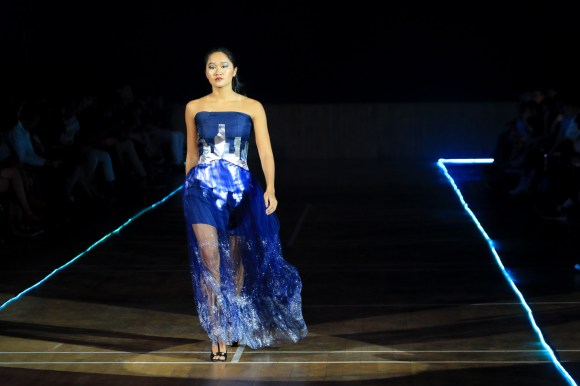
Audience members were greeted by delicate paper moons and stars suspended from the entrance of the Albert Hong Hall. Puffs of dense smoke permeated the entire room, undercut by vivid, shifting beams of multi-coloured light and a throbbing bassline courtesy of DJ AK. Two strips of blue fluorescent light flanking the runway took it from drab to dazzling. The show’s shimmering, otherworldly atmosphere was a clear indicator of what was to come.

runway4
Psychedelic pre-show lights (photo: Raffles Runway Instagram page)

Outfits followed loose themes, including urban isolation and entrapment, comfort and change. The photo booklet created by Runway organized the garments by times of day. This ambiguity created the impression of a lack of cohesion – but this was understandable, with so many designers with diverse styles. If anything,  the ambiguity stimulated dialogue, giving audience members the space to interpret garments freely. The diversity also showed the magnitude to which Runway took to their overall theme, reflecting the individuality of the Singapore experience.

Workmanship was generally of a high standard. The garments showcased a breadth of technical expertise: from the pleats and braiding in Xiao Wei’s dress (15S06J), to the intricate beading in Teo Kai Wen’s (15S03H) poufy garment, each piece demonstrated delicate craftsmanship and a careful eye for detail. Ang Xue Ling (15S03F) mentions, “Some people managed to finish theirs over the December holidays, and some took a whole year.”

Photo 1.
A bright, well-constructed orange maxi dress. (Designer: Xiao Wei)
Photo 2
Intricate beading, immaculate poufiness. (Designer: Teo Kai Wen)

Designers’ interpretations of the SG50 theme were varied and refreshing, personal yet relatable. At the same time, the clothes resonated with one another, linked by their common inspiration. Some designers made use of tangible, recognizable icons, but the results were anything but predictable. Lim Wan Ling (16A01D) juxtaposed a city skyline against a lake to stunning effect, while Lim Ee Sing (16S07B)  tastefully drew upon the MRT system to create a costume that looked simultaneously familiar and alien.

wanling
A garment inspired by Singapore’s skyline. (Designer: Lim Wan Ling)
mrt
A quirky twist on our MRT system went into the designing of this dress. (Designer: Lim Ee Sing)

Other designers employed more abstract ideas. Megan Goh (16A01D) tried to replicate the ‘comfort and safety’ of HDB flats in designing her cape dress with soft, pastel fabrics. On the other end of the spectrum, Huang Zhoudi (15S06J) chose to highlight Singapore’s darker side with her gothic garments.

megan
Soft colours reflect the comfort and safety of the HDB flats which most Singaporeans reside in, in this dress designed by Megan Goh (16A01D).
Gothic glamour from designer Zhou Di.

re: collections featured thoughtful collaborations. The senior batch of Modern Dance put up an energetic, dynamic performance, while behind-the-scenes clips from Film Society demonstrated an acute sensitivity to the mood and intent of the artists. It also lent the audience a glimpse into the clamour before the glamour – including, but certainly not limited to, setting up audio-visual equipment, planning venue layout, and liaising with lighting technicians. Overall, both collaborations lent edge and unity to re: collections.

Modern Dance at re:collections

If there was anything we had to nitpick on, re: collections took a while to hit its climax, making for a sleepy and somewhat awkward first twenty minutes of the show. In addition, many of the menswear pieces seemed to take on a similar structure – loose cape over ordinary collared shirt and black pants.

The process of putting the show together was not without its challenges. For one, designers had to consciously transcend common, literal and too-dogmatic interpretations of a seemingly limiting SG50 theme.

“Quite a few people wanted to use the Supertrees as inspiration, and initial sketches had very obvious signs of them, like veins in red running down the fabric. The design itself wasn’t bad, it’s just that we asked the designer instead, “what do you feel about Gardens by the Bay? What do you feel about Supertrees? Is there any other way to express a Supertree other than literally taking the veins of the tree on a dress?” From there, it changed.”


Irene Tee (15S07D)

Surely, fashion would not be fashion if it were not provocative, and re: collections had its fair share of controversy. During the matinee show, a model walked down the runway in a white varsity-style top studded with red sequins that read “Peace Love Happiness” on the front, and a large “50” on the back, coupled with glittering golden shorts and similar knee-high socks. This prompted a noticeable increase in buzzing and murmuring from the audience, who mocked both the model and the piece, and circulated pictures on social media.  Not wanting their model to have to suffer the repercussions of a subversive design, the golden shorts and socks were substituted for black, more neutral tones during the evening show. Runway laments the audience’s response, expressing regret that they could not support and showcase the work of all artists.

Guest designer Mudassar Ahmad (15S03A), who was behind this bold costume, told us that he aimed to marry the celebration of national values and the dismantling of masculine stereotypes. Whereas “peace” and “happiness” are tenets of Singaporean society, familiarly embedded into the pledge we take daily, “love” is not as prominent. “I feel like in our society we don’t really give much for loving people, just for them being people,” he opined. When queried about the audience’s uncalled-for response, Mudassar expounded on his idea of fashion as a form of art, and art as a vessel of change in society. “I think it’s precisely because people aren’t ready that there’s all the more need for us to step out and make a statement, because that’s how change happens.”

In her closing address, teacher-in-charge Ms Janissa Soh summed up the show best, urging the audience to see RProject as a process rather than an end: “The designers started this process to get us thinking and looking at our own society. I’m not talking about other people. I’m talking about you and me. How have we contributed to this society? How have we made it cold, white, harsh? As we start this process, as we start SG50, we hope all of you can join us to take a moment to reflect.”

Shooting for the Stars: Basketball Boys Finals

Reading Time: 3 minutes

By Stella Soon (16A01C) and Karen Cuison (16A01D)
Photos by Carla Mosqueda (16A03A) of Raffles Photographic Society

Smiling for the camera with medals in hand.

On the 19th of May, Raffles Basketball played an electrifying match, against long-time powerhouse Hwa Chong Institution. In spite of their intimidating streak of having won the Championship title for the past 9 years, Raffles Institution’s team did well in their pivotal match, wresting the A Division title for the first time in nine years.

From the start of the game, Raffles set up a stable ten-point lead. Most Valued Player Justin Yeo (#10) stood out for his clever moves which outwitted the Hwa Chong defenders throughout the game. While the whole team displayed excellent chemistry, another standout player of the game was Vignesh Rengarajan (#11), who helped to score many goals using his quick reflexes and nifty footwork.

Justin (#10) shooting into the hoop for the team.

Similarly, Hwa Chong’s team lineup featured many capable players, so both teams were matched evenly in terms of skill and physical ability. Despite this, Raffles pushed on to take advantage of Hwa Chong’s minor slips in ball handling in the midst of their intense match, and tapped on several free throws, to add significantly to the scoreline. At one point of the game, the difference in scores even went up to 20, in favour of Raffles.

The game reached its climax in the last quarter, with Raffles putting in their utmost to retain their lead from the third quarter, and Hwa Chong trying desperately to close the gap. It was a frantic last lap, with both teams’ coaches repeatedly calling for timeouts to give the players pep talks and motivate them in the last few minutes of the game. Unfortunately, the large scoreline gap between the teams proved too big for Hwa Chong to close, thus ending the game with a 17-point victory to Raffles. The team spirit of the Raffles basketballers was evident in a poignant moment at the conclusion of the game, when the other players spontaneously ran onto the court for one big, comforting group hug.

The team in a moment of friendship and camaraderie.

When asked about his thoughts on the team’s performance, the Boys’ Coach Mr. Liu Tong immediately replied that they had done “very well”. With 8 years of experience in training Raffles Basketball under his belt, he commented that this year’s team was particularly “capable” and “well-behaved”, and could rise to champions as long as they had the necessary team spirit. The importance of team spirit was echoed by Ejin Tan (#9) (16S03S), who mentioned that the most impressive part of their victory had been their teamwork, as they did their best to sync the ball and create open chances to score. Ejin shared that the team had put substantial effort into their game preparations; committing to physically-demanding trainings thrice a week, as well as having serious talks about their game strategy. It was undeniably not an easy journey for our players, but they managed to rise above the occasion to do the school proud despite the tough competition. Raffles Press would like to congratulate the Basketball Boys for their hard-won victory!

Final Scoreline
RI 78-61 HCI

List of Players:
Ernest Chng (#4)
Joel Ong (#5)
Jieren Teh (#6)
Chean Shao Jie (#7)
Phi Phat (#8)
Ejin Tan (#9)
Justin Yeo (#10)
Vignesh Rengarajan (#11)
John Zhang (#12)
Zaki Tan (#13)
Jovi Lim (#14)
Daran Huang (#15)

One Small Step for Manna, One Giant Leap for Raffles Institution

Reading Time: 2 minutes

By Khairillah Irwan (16A01B) and Karen Cuison (16A01D)
Photos by Khairillah Irwan (16A01B)

The café in the process of its renovation.

Ever wondered about that abandoned cafe spot you see when alighting at the pick-up point? Ask your seniors about it and they might mention, not without a tinge of sadness, the mysterious closing of the Manna Cafe early this year. This sense of loss is best captured by Valerie Chee (15S07B): “Manna Cafe was a great alternative to standard canteen fare! Many of us miss the variety of affordable food it provided, as well as its homely atmosphere.”

Loyal fans of Manna Cafe however may have noticed that, very recently, there have been renovations going on at the Manna Cafe. With much excitement and anticipation, Raffles Press is delighted to report that the Manna Cafe will reopen on the 25th of May, next Monday!

Following an interview with Mr Kelvin Wong of the Estate Department, Raffles Press has managed to glean some information about the new Manna Cafe.

Aside from an entirely new look, the cafe will also be employing a new chef, and hence, a new and wider selection of food choices all at affordable prices. Instead of offering set meals like before, the new Manna Cafe will be categorising food into main and side dishes, much like the system employed by Aston’s. And for our Muslim friends, fret not because Manna Cafe is in the midst of obtaining a halal certification too!

The re-opening of Manna brings with it a reinvigoration of Rafflesians’ former love for the Café. Neville Ng (16A01D) enthuses, “I really loved going there to eat and chat with my friends, so it’s great that I can bring my new friends here.”

Indeed, the re-opening of Manna brings it with plenty of opportunity to further enrich your culinary and social experience at Raffles Institution. Looking for an air-conditioned and lively environment for your weekly Orientation Group meeting? Looking to isolate yourself somewhere with nothing but food and your notes for the General Paper Common Test next Wednesday? Then try out a trip to Manna Cafe!

Cherish or Perish: The Very Last Ecoweek

Reading Time: 4 minutes

By Tag Wan Yi (15S03N), Liu Hong Zhan (15S03O), Shayna Toh (15A01D), Chua Siwei (15S03E), and Yu Xinkai (15S03U)

Additional reporting by Justin Lim (16A01B)

Foreword:

An air of finality marks this year’s Ecoweek. For some, Ecoweek’s the first campaign targeted at the environmental issues that plague our planet amidst all the other worthy causes advocated for in the school; but for Community Advocates’ Glassark, this year’s Ecoweek marks the closure of the the very interest group that had organized this annual affair. Rather than to exist as a singular body to advocate for environmental change, Glassark’s aims will now be a batch-effort. This organisational change could, on a symbolic level, represent a shared burden across all citizens of the planet. But to members of the Glassark, this marks an unfortunate end to a brilliant annual initiative that encapsulated an undying advocacy for environmental change.

Before it effectively disbands in 2016, Glassark was one of CA’s four main student interest groups that aimed to each raise awareness for specific issues. The group has aimed to bring relevance and attention to environmental issues ranging from global warming to the energy crisis – issues that were often neglected in favour of more prominent social issues such as immigration or poverty.

But just as how the Earth is important to us as a home, it is important to raise awareness of the misdeeds to her environment. While this year’s Ecoweek aims to shed greater light on the issue of wildlife conservation– a shift in focus from last year’s advocacy for the recycling of scrap materials– Glassark’s members share with Press that this in no way means that environmental conservation should stop: that we ought to do away with our “backyard syndrome” and begin to acknowledge the fact that the entirety of Planet Earth is our “backyard”.

Whether be it through the conservation of wildlife, or through recycling or energy saving, Glassark sends an important message to us: That the fight against environmental issues never stops, and that it is still on our onus to protect and conserve our planet’s resources.


Ecoweek’15: The What and the Why

Ever heard of sharks having their fins brutally sliced off, only to be thrown back into the ocean for an imminent death? What about snakes and crocodiles bred in captivity to be skinned for the most expensive of purses? Or even the brutal extraction of ivory from the tusks of elephants?

Illegal wildlife trade is one of the main threats causing animal extinction, among other factors such as pollution and climate change. Up to 73 percent of the world’s flora and fauna has been lost.  This is not a distant worry found far in the Kenyan forests, or some threat only levelled on the Amazon: wildlife trafficking is a pressing and pertinent issue right in our backyard. Singapore ranks among the world’s top 10 illegal wildlife smuggling hubs, due to, quite ironically, its clean reputation as an efficient port. Our excellent and efficient transportation network has been exploited by criminal organisations to smuggle endangered wildlife species and by-products to fuel the growing appetite for such products in the region. The Southeast Asian region alone is set to lose a fifth of its species by the next century. That’s one in 5 species that our children’s children will never get to see.

Wildlife trafficking has been a widespread and ongoing issue in Southeast Asia. Two weeks ago, more than 24 critically endangered Yellow-crested cockatoos were rescued by police at the Port of tanjung Perak in Surabaya, Indonesia, after being found stuffed in water bottles for illegal trade.

The Yellow-crested cockatoo was listed as a critically endangered species by the International Union for the Conservation of Nature and Natural Resources in 2007.

“Illegal ivory estimated at $8 million,” reported the Straits Times’ on 19th May, just a mere two days ago. The shipment, which consists of about 3.7 tonnes of illegal ivory, is the second largest seizure of illegal ivory since 2002, the Agri-Food and Veterinary Authority (AVA) and Singapore Customs said in a joint press release on Tuesday.

1,783 pieces of raw ivory tusks, 4 pieces of rhinoceros horns and 22 pieces of canine teeth believed to be from African big cats were concealed among bags of tea dust.

Despite governmental crackdowns, wildlife trafficking proves to be an enduring profitable enterprise – and you know how it goes. If it makes money, go for it. At least 10,000 species in the wild go extinct each year and we fear more.


Where does Ecoweek come in?

That being said, this year’s Ecoweek aims to raise awareness for the global threat to wildlife, and highlight the importance of wildlife conservation. Wildlife trafficking activities have increased in scale, severity, and pervasiveness in the recent years, and the school population ought  to understand the urgency of this issue.

Posters by the World Wide Fund for Nature have been put up around school: ones which we believe have encapsulated the danger and threat of wildlife trafficking with both clarity and poignancy. In addition to that, our booth in the canteen walkway explains the current situation and its implications, as well as how you can play a part to stop the illegal and unsustainable wildlife trade.

Some times to support wildlife conservation efforts.


While we may not have participated directly in the killings of these endangered wildlife animals, nor do we have the capacity to resolve this issue entirely. But, we, as consumers, continue to be the root cause of this issue – we drive the demand for such products. And all it requires of us to take that first step in making the right choices and spreading the message. We hope that with Ecoweek 2015, we can spark an active conversation regarding wildlife conservation and inspire others to join in the movement with us because it’s a matter of: Cherish, or Perish.