Arts

CultuR Shock!: Team Rocket

Reading Time: 8 minutes

by Martin Lim (15A13A), Kang Yi Xi (15S03N), Chew Sher Mein (15S03H)
Photos by Michelle Zhu (15A01B)

A flurry of wildly moving, iridescent disco lights met our eyes as we entered the concert venue, LT2 – a place normally bathed in an aura of strictness and gravitas. In stark contrast to most other concerts held in the school, which tend to feature performances revolving around a single aesthetic domain, CultuR Shock! promised to be an event that would showcase a myriad of artistic talents. Additionally, as Organising Committee member Liu Fangzhou said, “We’re hoping to use this CultuR Shock! as a platform to promote the website CultuR, where we’re basically trying to give all the different arts and arts groups in RI a chance.”

It was not long before the curtains parted and the emcees, former Council President Ashlynna Ng as well as Lawrence Ora, welcomed the crowd with cheery dispositions and puns aplenty. Mr. Kenneth Kwok, a former Deputy Principal of the school who had a stint working for the National Arts Council, was then invited to kick off the event by sharing several anecdotes about his colourful history with the local arts scene. In a surprising revelation, he recounted how he had performed with Emma Yong – who later became a member of the locally-renowned musical cabaret group, the Dim Sum Dollies – during his time in RI.

Without further ado, alumni band Branranaway (comprising Chris Loke on vocals, Wenwei Chionh and Alex Yeo on guitars, Gordon Kang on drums and Stephanie Yeap on the keyboard/guitar/vocals) started the concert on a high note with ‘Jenny Was A Friend Of Mine’, a song penned by the ubiquitous rock band, The Killers, and ‘Arabella’ by the Arctic Monkeys. The guitar riffs against a backdrop of thundering drums, coupled with the impressive vocal chops displayed by Chris, galvanised the crowd into spontaneous clapping to the rhythm of the music, with the songs ending in roaring applause. Sustaining their momentum with Paramore’s iconic ‘Crushcrushcrush’, Stephanie took over Chris as the lead vocalist. Despite struggling slightly with the first few notes of the song, she soon got her act together and her rendition of the Paramore song had the audience tapping their feet to the rhythmic repetitions of the lyrics. With their next song, ‘My Body’, by Young The Giant, the band managed to keep the audience’s anticipation running high as Chris took over once again, ending the song with a single high pitched note that showed off his range. Upon hearing calls for an encore, the band’s set ended with one of their trademark set list songs: ‘All These Things That I’ve Done’, another widely acclaimed hit from The Killers. With the conclusion of their enthralling set, it was clear to the audience that the subsequent performers would have much to live up to.

The crew of Branranaway engaging in a gripping cover  of ‘Arabella’.
The crew of Branranaway engaging in a gripping cover of ‘Arabella’

The next person to take the stage was a face familiar to all. Edward Kim was aptly introduced by Lawrence as the “Student Council president with good grades, hot body, and pretty girlfriend”. That night, he added another talent, beatboxing, to his repertoire. Edward led off with a short but nonetheless rousing number in which he evinced his aptitude at recreating the sounds of a drum kit. This was merely a prelude for a much more intriguing performance featuring the usage of looping (done via an iPad application), a technique that enables one to layer multiple soundtracks on top of one another to create a musical piece. Despite technical problems being rampant through his performance, with plenty of mike-adjusting and speaker-screeching, Edward managed to pull off commendable renditions – complete with instrumental sound effects and soothing harmonies – of the OneRepublic song ‘Apologize’ and the rhythm and blues classic ‘Stand By Me’ by Ben E. King, both of which were met with resounding applause and catcalls.

To the crowd’s surprise, the next performance was not by a student, but by Mr. Koh Say Yong, a teacher in the PE and CCA Department who has been playing the guitar since his secondary school years. Trading his usual track shoes and sports shirts for an acoustic guitar, he launched into the heartwarmingly romantic covers of the Beatles’ White Album classic, ‘Blackbird’, and Cyndi Lauper’s popular love ballad, ‘Time After Time’. The melodious, elegant tunes produced by his instrument as well as his distinctive country twang and sensitive, soulful voice gave the LT a rustic atmosphere and also served as a well-timed contrast to the previous two electronics-heavy performances.

Liu Fangzhou, a Writer’s Guild member, then made the mood in the auditorium more serious with her recitals of two rather sombre and thought-provoking literary works: a self-composed poem titled 21122012 and an untitled prose piece by Catherine Hu. Notably, the former piece had clinched a merit award in the prestigious Foyle Young Poets competition. The lyrical, expressive compositions were definitely engrossing to listen to and well worth reflecting upon. Those who missed the performance may find the poems in the anthology ‘Love, Death and Some Things In Between’, which can be purchased from Writers’ Guild at $6 along with a free copy of ‘Compositions’, a collaboration between Writers’ Guild and the Raffles Photographic Society.

Next, Lim Wei Khai took the stage and proceeded to regale the crowd with a self composed poem about a monstrous boogeyman-esque creature. He was promptly followed by Aaheli Tarafdar, who told a similarly grisly narrative about a family’s deadly outing to the zoo. Both narrated their stories in ironically exaggerated, jocular tones of voice, and the tales were also chock-full of black humour, making for a decidedly mirthful and enjoyable listening experience.

The boisterous peals of laughter the storytellers managed to elicit from the audience faded away as Feng Yu Chen and Clevereno Dairini from Raffles Chordslingers played the introductory notes to a mashup of ‘Counting Stars’ by OneRepublic, ‘Timber’ by Pitbull ft. Ke$ha and ‘Wrecking Ball’ by Miley Cyrus on two majestic grand pianos, lulling the audience into tranquility. Raffles Chordslingers is a self-initiated piano interest group not unlike RI’s Chamber Ensemble, and comprises Year 2-3 RI boys who arrange their own music and perform their own covers. A well coordinated duet between two pianists is no mean feat, and Yu Chen and Clevereno, with their relatively smooth rendition of the band’s hit single, successfully managed to surmount the considerable challenges inherent in executing such a performance.

The well-positioned stage lighting gave the performance a mystical, haunting quality.
The well-positioned stage lighting gave the performance a mystical, haunting quality

Legendary amongst actors and non-actors alike within RI, J3 alumnus Shrey Bhargava’s stand-up comedy routine was, without doubt, a much-anticipated performance for many of the attendees. As it turned out, ‘boring’ is the last word one would use to describe the talented thespian’s act. Shrey’s stage presence and overwhelming confidence had the audience in guffaws and applause throughout his performance, despite it being only his second attempt at stand-up comedy. His performance included imitating various witty versions of accents and national stereotypes from around the globe, and he touched on features such as the ‘small mouth’ effect of Russians and the ‘politely violent’ undertone of Japanese accents. His interpretation of Indian accents was met with especially uproarious laughter, and so were the hilariously unsuccessful attempts of the three volunteers he had invited onto the stage to learn from his ‘tutelage’.

Actor Shrey Bhargava doing a particularly expressive accent impression.
Actor Shrey Bhargava doing a particularly expressive accent impression

The emcees then informed the audience that the next performance was about ‘Slam Poetry’; this was a strange-sounding concept many of us viewers were unfamiliar with. All queries were quelled when Wahid Al Mamun, Naresh Manoj and Gabriel Ng each carried out a trenchant, captivating recital of their self-penned poems, which bravely grappled with difficult topics such as alcoholism, depression and the nature of love. The quality of their poetry was indeed commendable and symbolism was rife within their works.

The three aspiring poets are, as Naresh revealed, part of a community called Burn After Reading Poetry (BARPo) – a spoken word poetry interest group. Naresh related how he had found poetry “way too inaccessible” until he had spent an eye-opening time with the branch of BARPo located in England while on his Gap Semester trip. Upon his return, he and a few other like-minded peers came together to form a Singaporean offshoot of the programme.  “We plan on an anthology soon and recently had our first performance at Artistry Cafe, which was exciting,” he shared. Clearly, Naresh’s participation in such extracurricular activities, like that of so many other Rafflesians, is indicative of his unalloyed passion for his chosen field.

Wahid Al Mamum deeply absorbed in reciting a poem about one’s ruminations on love, ‘The Horoscopes are Lying’

The rather pensive atmosphere generated by the poetry recital was immediately broken by the appearance of the popular performing arts group Raffles Street Dance, who performed to a pulsing, energetic remix of the OneRepublic hit ‘If I Lose Myself’. Their perfectly synchronised hip hop choreography and visually stunning formations against a backdrop of radiant, flashing strobe lights created an eclectic effect that channelled the spontaneity of street culture with the grace and elegance of dance. Such was the quality of Street Dance’s performance that Ernest Chng from 15S03H praised it as his favorite performance of the evening. The arresting performance, made even more impressive by the fact that it was the J1’s debut performance as a batch by themselves, certainly could not have been pulled off without much hard work and enthusiasm on the part of the dancers. As member Lim Kai Bing Danson said, “We spent quite a lot of time cleaning our movements for that set of choreography…we were also extremely excited and hoped that our audience could feel our spirit and energy.”

Next was Yeo Min, one of the top-eight finishers in the 2013 Campus Superstar competition and a multi-instrumentalist who can handle the cello, guitar and piano. She first started her two-song performance with the song ‘魔鬼中的天使 (Angel Devil)’ by  Hebe Tien; the intermingling of her voice and the soft chords of the piano created a near-perfect rendition of the Mandopop hit.  Displaying the musical virtuosity and flexibility that had carried her so far into the competition, Yeo Min followed this performance with a stellar rendition of the classic and heartrending love song, ‘Love Me’ by Collin Raye, which told a story about a couple’s journey in love through the years. The song featured poignant vocals and melancholic piano playing that tugged on the heartstrings of many amongst the crowd, the authors not excluded.

Yeo Min serenading the audience with her vocal prowess and refined piano-playing

Though it flourished nearly a century ago, in the Roaring Twenties, the audience’s spirited response to the Raffles Jazz team’s set made it patently evident that jazz music remains relevant to many in the present day. Their first song, Canadian singer Nikki Yanofsky’s ‘Bienvenue Dans Ma Vie (Welcome to My Life)’, was defined by powerful, evocative vocals from Faith Ng and first-rate musical accompaniment. Stefanus Phan then took the microphone for a lilting, rousing performance of ‘Pedestal’ by Charlie Lim, during which the audience became so enlivened that they started clapping of their own volition. The finale, a purely instrumental piece named ‘Strasbourg/St. Denis’ by Roy Hargrove, marked a consummate showing of the Jazz team’s proficiency at their genre of choice. Bassist Zhu Wei Jie, who had little experience with performing prior to RIJC, remarked that in her time in Jazz this year she had learnt to “enjoy the time standing on stage and make music as a conversation with audience, instead of getting stressed.” With that, CultuR Shock! concluded amidst fervent applause from the audience.

Overall, we found CultuR Shock! to have been a greatly entertaining and unforgettable experience. Though their sets were only 15 minutes long at the most, it was clear that all the performers had passionately invested considerable amounts of effort into preparing for their brief appearances under the spotlight. More importantly, though, CultuR Shock! was an arts buffet that showcased the sheer diversity of Rafflesian talents, while opening our eyes, ears and minds to a diverse variety of individuals and art forms that, owing to a lack of awareness, we had never really appreciated before. Credit must also be given to the organisers, who had planned the order of the performers such that different genres of performances were evenly spaced out throughout the concert – the musical performances alternated with the literary ones – and this meant that we never felt overloaded by a single type of performance and paid rapt attention throughout.

Guitar Ensemble strikes a chord with Esperanza: The Light of Hope

Reading Time: 5 minutes

By Tan Su (15S07A), Amanda Chang (15A03A), Qiu Jia Hui (15S03B)
Photos by Yang Yang (15S06P), Amanda Chang (15A03A) of Raffles Photographic Society

As the curtains parted, “Esperanza” itself was quite literally seen from the strings of fairy lights that illuminated the entire stage, giving rise to an almost magical atmosphere. This theme represented the hope that Raffles Guitar Ensemble (RJGE) wished to bring to the audience with their music, and we can assuredly say that they achieved what they set out to do.

guitar1

The concert kicked off with the main ensemble performing a selection of lilting tunes such as “Summers Wind” and “Coup de Couer – Les Reves du Matin”. “Summers Wind” was an uplifting and pleasant piece, which occasionally inherited mysterious undertones at times, but edged the audience into a spirit of light-hearted nostalgia with pizzicato plucking in the main melody. “Coup de Couer – Les Reves du Matin”, on the other hand, was a piece that commenced deceptively cheerfully but took its audience on a rollercoaster of emotional highs and lows. Halfway through the performance, the peaceful tones smoothly transitioned into a wistful melody with a series of deep, resonant notes, as the ensemble employed a few pregnant pauses to allow a dark and melancholic mood to settle in. This heavy mood then swelled as rapid and slightly disconcerting riffs crescendoed until the ensemble eventually burst into an abruptly ecstatic melody. The overwhelming enthusiasm in the piece was quickly tempered, as the ensemble gently brought across the final cadences of the piece. This performance truly kept the audience on the edge of their seats, engaging the dynamics of music to accentuate its mystifying nature.

All pieces by the RJGE main ensemble, including two other pieces of Ai No Kurashi and Scherzino Mexicano, were conducted by Mr Michael Gaspar, a graduate of LaSalle College of the Arts with a Diploma in Music who has picked up numerous awards in his professional career as a guitarist such as the Grand Prix awards in the Singapore Guitar Festival.

guitar2

Following the Main Ensemble, the Junior Ensemble put on a wonderful performance, made all the more impressive by the fact that it was their first time on stage. According to Mr Gaspar, the confidence level of the Year 5 batch was remarkable, seeing that the time they had to learn the pieces was very limited. Classical guitar pieces including “Calypso” and “English Country Garden” allowed the audience to unwind with their spirit-lifting and cheerful tunes. Backed up by the Year 5 batch on guitar, the impressive rendition of OneRepublic’s “Counting Stars” also put vocalists Alina Sng, Alyssa Chua, Sarah Chooi and Jaron Chong in the limelight. They took turns to display their vocal prowess to the audience, and their solid harmonies certainly did not fail to enrapture and entertain, seeing that some members of the audience were bobbing their heads along to the catchy tune. However, it was unfortunate that their vocals, perhaps a tad too powerful, drowned out the ensemble’s accompaniment. The performance, though already outstanding, could have been improved with better sound balance.

guitar3

The concert could not have been complete without guest performers from the Raffles Girls Guitar Ensemble (RGGE). Decked in elegant, flowy gowns, the ensemble worked harmoniously, greeting the audience with lively tunes such as Howl’s Moving Castle Theme – “Promise of the World”, and “Tango” which got the audience’s feet tapping. It was clear from their fluid performance that they had had months of practice under their belt and were truly passionate about their music. Their enthusiasm truly rubbed off on the audience, who thoroughly enjoyed their pieces. A highlight of the RGGE’s time on stage was “Duet” performed by Lim Jiahui and Joelle Ocampo. The two had near-perfect coordination, fingers skipping over the frets deftly with only eye contact as communication between them. The connection between the two performers in their unspoken understanding, provided the audience brief glimpses of the chemistry that guitarists share. What was even more admirable and impressive was that the pair did not have, or rather need, to refer to score sheets. What a testament to their skill and the effort that they put into the performance!

The chemistry between performers was also demonstrated through smaller group items as performed by the different sections of the RJGE; sections took turns to charm the audience with themed, often colourful costumes, showing off their wide repertoire of songs. Examples included recent hit “Let Her Go” by Alto 1, while Prime section performed “Itsumo Nando Demo” from the movie “Spirited Away” by the widely acclaimed musical composer Joe Hisaishi. “Childhood Memories” by Alto 2 was a vivid performance featuring familiar tunes which ignited fervent chatter amongst audience members each time someone managed to identify a song. Incorporating melodies like the theme song of Doraemon allowed each member of audience to reconnect with his or her cherished childhood memories. “I Believe”, the theme song of hit Korean drama “My Sassy Girl” performed by Bass section, certainly enlivened some K-pop fans in the audience.

guitar4

Other performances included “Air On A G String” by the Executive Committee of RJGE and “One” by Yu Chen and Zong Tai. “Little Talks” by Anabelle, Wei Sheng, Alysia and Nicholas even ventured into other instruments such as conga drums, which infused a clear sense of rhythm. This definitely demonstrated the sheer versatility and talent present within the RJGE community. Watching the sections and groups perform individually also allowed the audience to engage themselves in the unique camaraderie that each performing group had developed over hours of practising together. While the pieces may not have been perfect, it was clear that the sections had given it their all. This was sufficient for those in the audience that day, and the overall atmosphere of the concert was in general a joyful one.

At 9.30pm, the curtain was brought down after a final item by the main ensemble: “Tanquillo de Cadiz”, a particularly rhythmic piece incorporating powerful strumming and strong bass tones to create a warm and lively mood- the perfect recipe for an impressive finale.

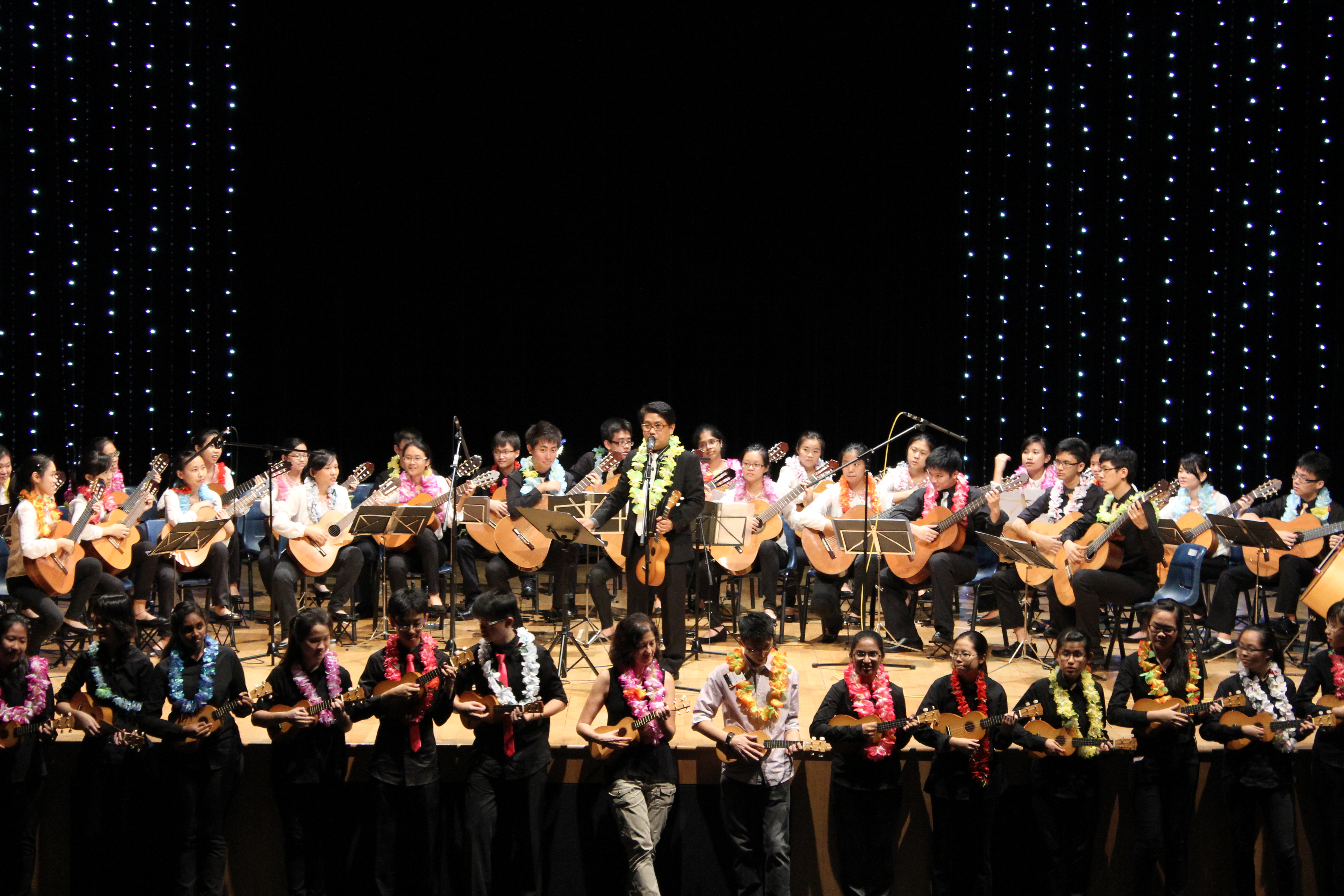
However, the concert wasn’t over just yet. As the emcees took the stage, the audience quickly caught on to the emcees’ hints at more to come, cheering the guitarists on with cries of ‘Encore!’ True enough, the guitar ensemble was ready with what was considered by most to be the highlight of the evening. After an introduction to the encore piece by Mr Gaspar and a brief prelude by the main ensemble, the rest of the ensemble drew laughter and applause when they entered decked out with ukuleles and brightly-coloured leis to line the front of the stage. The two teachers-in-charge, Mdm Low Chor Huang and Mr Winston Cheong were not spared the Hawaiian treatment either!

guitar5

With that, the ensemble began “Aloha Oe” (Farewell to Thee), a folk song by a Hawaiian princess that was adapted into English by Elvis Presley in the movie “Blue Hawaii”. “I liked how different styles of music were played on different instruments. It was a quirky but heartwarming ending,” said Xu Yanling of 15S03C. Truly, the mellow, cheerful chords of the ukulele complemented the main ensemble’s smooth harmonies, and light-hearted “Aloha!”s from the entire ensemble ended off the concert on a brilliant note.

In the Limelight – Raffles Choirs

Reading Time: 9 minutes

By Myko Philip (15A01B), Michelle Zhu (15A01B), Chew Sher Mein (15S03H), Katrina Jacinto (15A13A)

Photos by Tan Wei Xin (15A01B)

Raffles Chorale performing their opening number

This year’s edition of Raffles’ annual arts festival commenced last Wednesday with the Raffles Choirs performing at a packed Esplanade Concert Hall. In what was a spectacular kick off to Arts Season 2014, the Raffles Choirs comprising Raffles Voices (the Year 1-4 choir) and Raffles Chorale (the Year 5-6 choir) captivated audiences with their highly eclectic repertoire and deliciously sweet singing. It was an evening that saw the audience whirled around in an iridescent vortex that brought them from the solemn, high-ceilinged halls of cathedrals in continental Europe, to the deep south of America with its upbeat tunes and alleluias, all the way to Africa with its kaleidoscope of sounds inspired by animals and the surrounding landscape. This far-reaching odyssey of music all happened within the inspiring and formidable wooden halls of the Esplanade, its size lending itself in giving the choirs a slight echo and a sense of vastness.

Raffles Chorale eased us smoothly into the programme with their haunting rendition of “How Can I Keep From Singing”, arranged by their conductor, Mr Toh Ban Sheng. It was an apt song to begin the programme– a hymn which exults so greatly in the presence of God it cannot help but express itself in song. True to style, Raffles Chorale made an impressive entrance. As the lights dimmed and the scattered glow of cellphones subsided, Chorale left us in a palpable darkness for some time, before the calm and honeyed voices of Daphne Quek and Ma Yuqing cut through. Light slowly began to fall on the stage as the sweet singular voice was joined by another, and yet another, gradually forming a powerful but austere chorus reverberating around the theater. As the light grew stronger on the stage, figures could be discerned walking deliberately and purposefully to centre stage, and when they came on in full brightness, the entirety of Raffles Chorale was before us. Masterfully using a technique called chance singing, in which each singer takes a chance at their own tempo, the song was multi-layered, with different waves of sound moving against and along each other that convalesced in a glowing whole. Needless to say, the audience was entirely dazzled.

After a brief rearrangement of singers, they dove straight into their second piece, Josef Rheinberger’s “Abenlied”, a post-resurrection story about the light of Christ. If their first piece was like numerous rays of light melding together into a continuous whole, then their second piece was like waves crashing on rocks. What shone through were the deep and mellow tenors and bases, offering a rich contrast and foundation for the higher melodies that were superimposed on top of it. The song was memorable for its elegant and brilliant close: it ended on a brief but candid descent, as if down a flight of stairs, to reach a soft but solid and resounding note.

One of the night’s highlights was their third and fourth pieces. Departing from the angelic aura of the previous two songs but nevertheless keeping to a semi-religious theme, Raffles Chorale indulged us in their energetic and passionate delivery of Z. Randall Stroope’s “The Conversation of Saul”. In the Bible, Saul was someone who initially persecuted Christians but was eventually turned over and became one of Christianity’s forward and belletristic writers. Beginning with a driving, pulsing chant from the boys that was constantly returned to throughout the song, the girls slowly joined in with their own refrains that complemented but did not mimic the boys’. Immediately, we felt a tingling sensation in our spines; the music seeped into our bones. Violent but coordinated feet stamping was weaved into the song, imitating thunder. It was seemingly frenetic but beneath the apparent chaos was a very controlled and skillful execution of music. Towards the denouement, we began to hear crazy descending chromatic scales, giving the effect of something spiralling out of control. It was the most exciting piece of the evening.

From this terrifying and gripping piece, we were immediately catapulted into the realm of the stars: next on their repertoire was Audrey Snyder’s “And In The Evening”. Based on William Blake’s poetry, it was a song that promised to juxtapose the mystical nature of dreams with a wide field of stars, and it did not disappoint. Notably, the choir distributed wine glasses filled with water to varying levels during the emcee’s introduction. The song was largely amorphous and ethereal, flowing in a certain direction but seemingly flowing everywhere as well. Indeed, we were brought up and down as if a sloping mountain range and from the weirdness of dreams to the terrible vastness of a star-filled night sky. The choristers slid their fingers over the rims of the glasses, producing a discordant but spectral sound that seemed to echo around the concert theater. Shayna Yap accompanied on the piano and played solid chords that, in tandem with the contrastingly eerie sound of the water glasses, gave the song a sonorous feel. With that, Raffles Chorale concluded their first set and gave the stage to Raffles Voices.

Raffles Voices in their spirited rendition of Amani

Where Chorale was more timid and had sharper and more powerful high notes, Voices delivered their characteristic and entertaining theatrics. They were generally more lighthearted, even if they appeared more nervous when arranging their blazers and being asked to shuffle about on stage into position. Having been brought across continental Europe by Chorale, Voices took us into the heart of Africa with Audrey Snyder’s Amani, which means “peace” in Swahili. Although accompanied by slightly awkward posing and marching, the upbeat and cheerful tune along with the rhythmic beating of percussion African drums had the audience’s feet tapping to the music. We then had David Dickau’s “If Music Be The Food of Love” (a reference to Shakespeare’s ‘Twelfth Night’), a piece similar to the first in terms of its need to express its joys in music, then “J’entends Le Moulin” by Donald Patriquin, an equally mesmerizing song because of its usage of various sound onomatopoeic sound effects to conjure a colourful soundscape. Cheng Xin Yu and Guan Xin gave accompaniment on the percussion, and Gavin Jared Bala gave an astounding and instructive performance on the piano, at times even surpassing the choir. With that, they yielded the stage once again to Chorale.

Chorale gave us a taste of a different palette this time, moving away from sordid hymns and requiems to much more upbeat devotional tunes. To this end they gave us “Non Vos Relinquan Orphanos” by William Byrd, “Wade In The Water” arranged by Allen Koepke and “If I Can Help Somebody” arranged by Ray Liebau. It was a smooth and lively transition from Voices’ segment as well as an refreshing pick-me-up and contrast to their opening four songs. “Wade In The Water” in particular, a Negro hymn sung in the American south, had a throbbing pulse to it that made it akin to Adele’s “Rolling In The Deep”, albeit with more flair and colour.  It got blood flowing through the audience’s veins. Tan Fong Han of 15A01B, one of the choristers, said that the song was her favourite of all any that she performed, saying that “there’s something about the song that makes it both liberating and oppressive at the same time. It’s a layered song and I think when we sang it in SATB (Soprano, Alto, Tenor, Bass) it resembles to me a progression of letting go- along with transition from bass to sop[rano]. It’s an emotional piece that is also controlled.”

Raffles Voice treated us to another two songs, “Northern Light” by Ola Gjeilo, which melancholic notes reflected the mysterious beauty of the aurora borealis, and Oscar Galian’s “Salseo”, where the swingy and rhythmic tune along with the trademark Spanish lyrics provided great entertainment. Then, the combined choir came on stage to give us the world premier of “Tui Sunt Coeli” by Vytautas Miskinis, a song that blended a whole smorgasbord of tunes to one continuous whole, as well as the iconic and easily recognized “Baba Yetu”, or the Swahili Lord’s Prayer, noted by many to be Civ-4’s theme song. The soulful and melodic piece had distinct African roots and Marc Leong and Jonathan Tan delivered riveting performances as the piece’s two solos and enthralled audiences with their mellifluous but powerful voices. Even as we sat at the back of the first floor, we could feel the vibrations from their singing. It was, as Zhang Yimin of 15S03H said , “so beautiful that it was disconcerting”.

The combined Raffles Choirs performing their finale

As the evening drew to a close, and amidst fanatic cries of “encore!”, the combined choirs departed somewhat from tradition and delivered another piece, Stephen Paulus’ “The Road Home” before performing the much more expected and customary school song. Even a parent we overheard was somewhat surprised by this encore, as were the most of us. This piece was a pleasant surprise with a much simpler arrangement than most of the complex multi-layered repertoire, yet held its own rustic charm.

The evening finished of course with the institution anthem, at which tentative Rafflesians glanced around nervously at the hall to see if they should stand up. After one or two did, however, all the students in the Esplanade stood up at attention. The choirs’ rendition of the school song is always something to look forward to, a refreshing change from the dreary and somewhat gaudy version played on not-so-adequate speakers at morning assembly. The ending, with its delayed last line, is always a delight, where the song reaches an entire octave higher than it normally would. The sound was sublime and we surrendered readily to the familiar melody. In those four stanzas, singing the school song in front of the rest of the audience, you could definitely feel proud to be a Rafflesian.

And so, encore included, the entirety of choirs’ repertoire of fourteen songs had just been performed. Raffles Chorale and Raffles Voices alike brought us a magical night of music that will be remembered fondly by the audience and choristers alike. “There were many magical moments on stage,” writes Mr Toh Ban Sheng, conductor for both choirs, and I would say it’s one of the most memorable performances in the Esplanade.” One of the issues was the Esplanade’s “unique acoustics” which were a double-edged sword. Initially a challenge to “grapple” with, it nevertheless highlighted the haunting quality of many of the religious songs. Whatever issues they had with the idiosyncrasies of their venue went unnoticed and never once hindered their performance: “once we got it settled after some time-consuming first round,” writes Mr Toh, “we were able to make music more comfortably.”

Echoing Mr Toh’s statements, Chorale chairperson I-Vivek Kai Wen added that no small measure of hard work was involved, but was glad that it all worked out in the end and went very well. To put on a show that lasted an evening, hours and hours of sheer effort were spent in school after lessons preparing, not just during official training but outside of it as well. Tan Fong Han of 15A10B recounts to us how from 2 to 3 sessions per week they gradually ramped up to 3 combined sessions in addition to 3 sectionals per week. Even mornings were not spared; in the lead up to the concert, mornings were usually devoted to “mental work [like] recall[ing] details of every song, where to crescendo, where to back out etc…It’s pretty intensive but after a while, it doesn’t become a chore so much as it becomes second nature. Outside of practices, I’m pretty sure everyone else hums [or] sings on their own.”

In fact, in class, it is not unusual to find her quietly but delightfully humming some of her favourite tunes from their repertoire. That the performance went so smoothly that the evening flew by is testament to the combined choirs’ dedication to making good music (and the implied hours that this dedication demands) and putting on a hell of a show. No mean feat considering that their pieces were scattered in terms of style and mood as well. Explaining the eclecticism and diversity of their song selections (and a possible religious undertone), Mr Toh said “the repertoire usually consists of songs that we programme for participation in international festivals we are taking part in. For Chorale, it is taking part in a Musica Sacra International Festival in Czech Republic. To fulfil the requirements of the 2 categories we taking part in and the grand prix, it resulted in a predominantly sacred music programme this year. Nonetheless, I try to find music that embodies contrasting characteristics and yet appeals to the singers. It’s always a challenging task.” He explained similarly that Raffles Voices travels in December and thus has little room to programme in something more than the competition repertoire. Hence, they performed an African song of peace, a lush modern American work, a virtuosic French folk arrangement, a modern sacred Latin piece, and an onomatopoeic Salsa piece.

Raffles Chorale charmed the audience with its ability to blend seamlessly complementing layers of music into a harmonious web; once the audience was caught, they were never let go. While Raffles Voices was not as technically brilliant as their senior counterparts, their characteristic passion more than made up for it. Their spirited and theatrical renditions of songs were infectious and kept audiences glowing long after they left the stage. Limelight 2014 was a real pleasure and set a high standard for Arts Season: both choirs put on show-stopping performances and kept audiences spellbound for the entire evening.  The whirlwind ride from one region of the world to another was pulled off deftly and convincingly despite the difficulties of this monumental task. Both choirs handled the repertoire expertly and highlighted innocent nuances in their performance and, for two brief hours, sang the devils out of the details, bringing us away from the Esplanade and onto a breathtaking journey of music.


IHC 2014: Dramafeste

Reading Time: 15 minutes

By Celine Liu (15A01E) and Bryan Chua (14A01A)
Photos by Samuel Tan (15S03K) and Nigel Gomes (15S06R)

Two short weeks of late nights, grueling rehearsals and hard work came together on the 6th and 7th of March for Dramafeste 2014. As evening fell, a steady stream of theatregoers made their way into the PAC foyer, which was abuzz with energy and chatter. Dramafeste has developed a solid reputation for delivering entertaining amateur productions, and the theatre was crowded with students keen on showcasing their house spirit and wanting to support their friends.

Rumours of rooftop rehearsals, production teams getting locked in school and houses that rehearsed in the dark had only heightened the sense of apprehension around campus, yet those fears prove to be unfounded. Despite the ever-shortening rehearsal time, low budgets and lack of rehearsal space, Dramafeste 2014 definitely did live up to its hype. The sheer amount of dedication required to undertake such a task cannot be understated; nevertheless the friendships and experiences gained more than made up for the undone homework and sleepless nights.

As one actress fittingly put it, ‘When I’m busy rushing tutorials before rehearsals it’s easy to think that I’ll be so relieved when Dramafeste ends, but now that it’s over, I just wish we could have another one all over again!’

Hadley Hullet: Payday

Synopsis:

Hadley- Hullett’s Payday takes place in an alternate reality where time and life itself lies in the hands of a corporation led by two characters of questionable morality. When Angie is hired into the corporation under mysterious circumstances, she finds the fate of a young boy’s life under her charge and, after deeming him a ‘waste of time’, takes it into her power to end it. Yet this action comes with dire consequences as Angie realizes that each life comes intertwined with so many others, and struggles to come to terms with her decision and her humanity.

10003347_10152273971093944_1914231399_n

A rather abstract piece that dealt with heavy themes of love, life and man’s inability to play God, Payday showed great potential to develop into an inspired, thought-provoking play that perhaps fell short due to a lack of polish. Putting an interesting perspective on a dystopian theme, the play proved itself to be both touching yet humorous with witty dialogue, larger than life characters and sound acting.

The play started off promisingly, with a dramatic entrance by the ensemble introducing the theme of time with a clear yet wordless bit of physical theatre. Katrina Jacinto’s portrayal of Angie as a robotic, subservient employee showed remarkable stage and vocal presence throughout the play, although her initial exaggerated walk and laughter did sometimes become distracting, instead of illustrating her character’s seemingly inhuman nature. The rest of the cast fared just as well with their exceptional acting. Myko Philip’s loud character as the fraudulent surgeon shone with great attempts at humour, drawing uproarious laughter from the crowd.

1622787_10152273970808944_1800341204_n

A main weakness with this play, however, lay in its lack of a consistent flow. Perhaps due to the time constraints, parts of the play tended to be too hurried to allow for sufficient emotional engagement with the audience. The conclusion in particular ended with a whimper instead of a bang. The incongruous moral awakening and the awkwardness of the transition between the conclusion and the previous left audiences with a lingering taste of incompleteness. This was compounded by a seemingly random introduction of the ‘stakeholder’ who has control over all time and a rather abrupt ending where everybody, literally, runs out of time.

As for the judges, they added, “We felt that the whole play had a really strong and consistent vision and the sets really complemented it; special mention to the surgeon, Myko, and Angie, Katrina. However, we felt that the pacing could’ve been improved, especially at the end, which we felt was a bit rushed.”

Payday was very much a work in progress with great ideas that could have been better executed, though its attempts at staging a profound yet entertaining piece should be acknowledged. Its ambition and impressive acting too, should be applauded, given the short span of time in which it was put together.


Buckle- Buckley: Mona Lisa

Synopsis: Buckle-Buckley’s Mona Lisa follows the life of Steve, a disturbed child from a broken family. After witnessing the decline of his parent’s abusive relationship, Steve grows up in an unstable environment with his domineering father, never completely coming to terms with his mother’s abandonment. As a surgeon, he believes that any heart that has stopped beating more than 30 seconds is dead, yet he soon realizes that 30 seconds could be all he needs to make the decisions that will change his life.

Mona Lisa was an emotional play that stood out in its relatability. With strong, identifiable characters and impressive staging, BB managed to pull off an eloquent piece with weighty yet everyday themes dealing with the question that we have all asked ourselves at some point in time: what if?

Naresh Manoj’s portrayal as Steve’s father set the play off to a brilliant start; the chilling encounter between husband and wife was shocking and all too real, and despite limited stage time Naresh managed to play a difficult role with impassioned mastery. One cannot deny the talent in the cast, especially Joel Seow’s performance of the protagonist Steve being both adorably awkward and lacking in confidence, while soberingly realistic in his insecurities and struggles. His character’s likeability shone in particular when he attempted to stop a suicidal man, played by Teo Weilong, in a poignant scene that highlighted greatly his character’s imperfections and with it, his humanity. Weilong’s character too was both well-written and well-executed, his quiet melancholy was effective in conveying his despair without resorting to melodrama, again adding to the play’s relatability.

1966827_10152273975143944_216975820_n

Another great moment in the play was when the two storylines of Steve reuniting with Lisa, and his mother respectively were presented side-by-side on stage, culminating in both Lisa and the mother calling out, “Please, it’s nothing! Don’t worry, Steve” in unison. Credit must indeed go to the actresses for the execution of this scene, as coordinating their timing was certainly no mean feat.

The play manages to deal with some heavy themes without being off-putting, coupled with fantastic sets that were simultaneously aesthetic and functional. The backdrop of constellations present throughout the play stood out in particular with both its breathtaking beauty and significance, illustrating the idea of lucky stars aligning. The ensemble’s countdown every time Steve gave up the chance to make a life-changing decision was a laudable attempt at physically presenting the gravity of life’s everyday choices, yet it could have been much better executed; at times, the significance of the countdown was not made very clear or obvious and may have been lost to much of the audience, who did not understand what it meant. Scripting was not all perfect either, as the secondary storyline of Steve’s reunion with a girl from the past was, although not entirely irrelevant, rather cliche in its execution and even a cause for some laughter amongst the audience. Its conclusion too seemingly left the Lisa plotline unresolved, as the last we saw of Lisa and her daughter was when they abruptly left Steve to go look at childrens’ books together, never to return. Although this may have been necessary in creating the intimate reunion between Steve and his mother, it left audiences feeling dissatisfied, as if Lisa’s story was unfinished.

935198_10152273976348944_832921156_n

The judges added, “We felt that the set was gorgeous and that Dad, played by Naresh, and older Steve played by Joel had really good emotional acting. However, we weren’t really clear on the significance of the 30 seconds, as well as the – we didn’t really like the blackouts because there were too many.”

Overall, a great play from BB with professional sets and great casting, which stood out in its simplistic nature and down-to-earth tones.

Bayley-Waddle: That Place

Synopsis: Danny and his girlfriend Lena, who are facing relationship problems, have joined a gang of ruffians intent on overthrowing the government, greatly worrying his parents. But does the revolution really matter? As they imprison a dissident, die in war and wait in the afterlife, it seems that nothing does.

That Place started off with a revolution that took a heavy toll on the protagonist’s relationships, touching upon themes ranging from race to religion to bureaucratic inefficiency. Yet it soon gravitated away from that and ultimately focused on Danny’s estrangement from his parents and girlfriend, with the revolution providing the context for this plot line. While the flurry of disparate themes was rather confusing at times, That Place’s unique approach provided a breath of fresh air.

1456042_10152273976608944_2037007401_n

The play featured solid acting from a strong cast. Gary Huang was proficient as Danny, being realistically irritable and awkward when confronting his parents and girlfriend, while sorrowfully nostalgic when recalling better times. Jovi Tan and Rachel Koh, in addition, shone as the revolutionaries Alex and Emma, with their careless, unabashed manner and occasional wit helping to lighten the depressing mood. The sets were also crafted well, with the incongruous, brightly-coloured doors in the afterlife showing the ending’s otherworldly character. Perhaps the only issue with That Place’s sets was the bar in the corner of the stage, which never seemed to leave even when clearly irrelevant.

That Place also featured several impressive scenes. For example, in the elevator scene, the revolutionaries imprisoned a dissident, Adam, for challenging their goal by pointing out that his people had been in the country from the beginning, and that they, the established racial majority, had no moral authority to start a revolution. Mudassar Ahmad then delivered a quivering, powerful soliloquy filled with fear and despair as Adam while the revolutionaries towered over him on chairs, creating an image of a helpless prisoner in a claustrophobic jail. The breakup scene between Danny and Lena was both unique and beautifully poetic, as they made their way down the aisles of the theatre delivering lines entirely in verse, every word steeped in grief and heartbreak. In another instance, the absolute silence that met a messenger’s pronouncement of Danny’s death was incredibly poignant, conveying shock and sorrow more movingly than any tears could.

1896898_10152273977578944_684512440_n

However, while the play stood out at particular moments, it became slightly confusing when it deviated from the central theme of the revolution to tangentially related topics. Furthermore, by portraying the afterlife as an eternal limbo suffering from an ‘earthly’ bureaucracy, the entire significance of the plot seems to be compromised; what, after all, was the point of all that suffering given that the whole point of the play was “in the end, nothing matters.”

The judges added, “We felt there were really good physical theatre movements, and that a shining moment in the play was by Adam, played by Mudassar with a really memorable soliloquy. However, there were many big ideas in the play that we felt were too many to fit into the 20 minutes given. But, still, it was wonderful.”

Perhaps the manner through which the overall play went from script to stage unfortunately overshadowed the crisp acting and brilliant individual scenes, making That Place good in moments, but lost in its entirety. In the end, as Alex said in the play’s final scene, we were just waiting – for something more .

Moor-Tarbet: The Bigness of Small Things

Synopsis: Tom and Mary are completely different – one’s a clumsy romantic, while the other’s a tomboyish, cynical pragmatist. Each engages in brief romantic relationships with other people – Tom with an obsessive stalker against his will, and Mary with a shy, weak boy – only to break up with them. In their adulthood, Tom meets a childhood friend, the Broomstick Girl, and asks her out, only for her to go with a former schoolmate later. Broomstick Girl does, however, introduce Mary to Tom, finally bringing the two protagonists together.

‘Just remember two things for our play: one, metaphors are dangerous things. Two, when you wish upon a star, you are a few million light years late. The stars are dead.’

With this depressing synopsis from the MT Dramafest team, we expected a disheartening play about the futility of hope. To our surprise and delight, we were absolutely wrong. The Bigness of Small Things distinguished itself from the other Dramafest plays by dismissing complex themes or dark psychological discussions for a simple romantic comedy that brought the house down.

The actors were simply brilliant, with the supporting characters being the stars of the show. Rahul Jayaprabha in particular was uproariously funny as the boorish bully, while Anthea Chua was similarly hilarious as a creepy stalker who fell in love with the most absurd of things –  Tom’s sneeze. As for the protagonists, their little imperfections aided the message that even awkward and apparently incompatible characters could find true love. The scenes themselves were executed excellently; even as the play maintained its light-hearted nature, we felt the pang of heartbreak as Mary was rejected by her first boyfriend and bittersweet emotion as the reformed bully shyly confessed to the Broomstick Girl with tender awkwardness. The final scene, whereby Tom and Mary sat eye to eye in love after all their failed relationships, moved the audience to a standing ovation. In that moment we were genuinely happy for the characters, with The Bigness of Small Things successfully engaging us emotionally.

10001317_10152273965783944_1147242535_n

Yet the most impressive aspect of the show was undoubtedly the exquisite sets, being divided into four parts that acted as Tom’s bedroom, the broom cupboard in which he and the Broomstick Girl hid, Mary’s bedroom, and a classroom respectively. Each part had unique designs, such as the detergent bottles in the cupboard and the blackboard in the classroom, allowing the cast to act continuously through different scenes without changing sets, facilitating the play’s smooth flow. The set’s true value, however, was only revealed during the final scene, when it was rotated to reveal a breathtaking, hand-painted picture of a starry night sky above forests and mountains, providing a perfect, romantic background to Tom and Mary’s union. This final touch awed the audience to thunderous applause, bringing many more to their feet.

1947409_435248453245565_1951447923_n

No performance, however, can be perfect, and The Bigness of Small Things could perhaps be criticised for its pacing. The play in fact ran overtime on both nights and had to be cut off, and while the crew managed to shorten the scene to a few seconds to provide conclusion, it is a pity when one wonders what may have been lost in those final moments under the starry starry night.

The judges commented, “MT had a really good sense of pacing and we felt that not a moment was wasted. (commented that thursday’s performance was more energetic, friday’s was slightly slower) Still, the cast had really lovely presence and energy and Mary and Tom were lovely too. However, we felt that they still could have been given more lines so they could flex more of their acting muscle and show us some stuff. So, good job to MT.”

Nevertheless, the play’s merits superseded its trifling flaws, and despite the cumulative effect of three consecutive gloomy plays, The Bigness of Small Things gave us renewed faith in love and human nature.  If we had no idea what was happening now and then, we were too busy laughing to care.

Morrison-Richardson: Anna

Synopsis: Morrison-Richardson’s Anna follows the investigation involving a mysterious and shocking murder- that of the circus’s psychic, Madame Cassandra. To add to the riddle an ominous note had been painted on the wall, claiming “five can walk away unscarred / one lies dead in pooling blood”. Now the whole circus troupe is under suspicion; each defends their innocence introducing us to a colourful cast of characters as the mystery slowly unveils itself to its bone-chilling conclusion…

The preamble to MR’s plan, Anna, reminded audience members to constantly pay attention to the stage, because “nothing is ever as it seems”. Investigating the murder of a psychic fortune teller, the play takes several twists and turns on its way to a revelation that, while not leaving audience members in the dark, still felt somewhat unsatisfying.

One of the bright points of the play was definitely the performance by a reasonably strong cast, in particular Syafiqah, playing a rather aggressive, independent telekinetic who led most of the play’s central plotline – of finding out who killed the psychic. The rest of the cast did a great job in willingly playing their rather comical roles at times, from the Xu Yanling’s portrayal of a bearded lady to Low Ker Yang’s portrayal of a rather amusing monkey trainer. In addition, we must also mention the mime, played by Brian Au Yong, who despite (clearly) not having any lines, became a great source of comic relief throughout the play, for example hiding behind a rather flimsy leaf in a bid to retrieve a sword from the stage, while the other characters continued speaking around him. In the end, Brian continued to do a brilliant job when he portrays being taken over by the spirit found in the doll, ending in a very well executed suicide scene that concluded the play.

1779097_10152273966833944_660597539_n

However, while the ending was well acted, it didn’t appear to make too much sense when first watched. With the numerous characters on stage, and the multiple theories as to who killed Madame Cassandra, the ending was not immediately clear. With more thought, one realises that the doll Anna was indeed the mastermind behind the murders and the deception, but with the mime dying in the final scene and the ringmaster seemingly murdering Madame Cassandra, one perhaps could be forgiven for not really being sure of what happened by the play’s conclusion.

This wasn’t helped by a rather misleading secondary plotline, through which the audience is shown how each character meets the fortune teller, and subsequently why they could – or couldn’t have – killed the fortune teller. Inevitably, thinking back, one realises that this was all a plot by Anna to have everyone come in contact with the fortune teller and accuse each other of murder. Yet, this again is not made immediately clear – in fact, one (again) could be forgiven for thinking the case of the stolen hair removal cream was a separate plotline altogether. With a bit more time, perhaps, the idea of everything be linked together could’ve been made more obvious, and definitely would’ve made the play far more effective.

1781937_10152273966103944_632408175_n

On balance, of course, the sets and lighting were done decently. Despite slight mishaps with the sets on occasion, all the sets were very beautifully designed and presented effectively, with the background painting and writing on the world definitely creating the dramatic horror effect the play presumably sought to bring across. Yet, horror is an incredibly difficult genre to pull off on stage, and while Anna definitely tried its best, the idea of horror did not carry itself across the entire play, and was left to bursts of scarier moments that made the horror more sporadic than effective in leaving its impression on the audience.

The judges added, “The whole crew of circus freaks were really enjoyable to watch – Syafiqah as the telekinetic had really good stage presence, and Xu Yanling was able to emote very well despite her hair (fake beard). However we felt that the script had a lot of potential that was not fully realised, and so we encourage you to continue working on the script, we felt it was good.”

As a whole, we agree with the judges comments, who said that MR gave the play a good go, but unfortunately could have done a lot more with a script that showed great promise but failed to deliver on stage.

EXCO Spoof

As is a regular tradition at Dramafeste, the EXCO of Raffles Players puts up a spoof of some key or standout moments in the 5 houses plays, combining them effectively in a manner that was incredibly light-hearted, and very well executed.

Consisting of Jo-Ann Heng, Eugenia Tang, Seah Beiying, Natalie Ng and Rachel Quek (and missing Won Xue Li due to injury), the Players EXCO spoof tackled scenes such as actually pretending to swallow a sword, the renaming of the psychic from Madame Cassandra to Madame Lasagna, and blaming the originally eerie voice of the doll on a ‘sore throat’, all of which are from MR’s Anna. This goes on to even satirise parts of real life – such as the school’s recent decision to lock all other gates by 10pm.

Another highlight of the spoof comes from Seah Beiying, who spoofs a scene from BW’s That Place, emerging from the back door of the PAC before arriving on stage, combining scenes from Anna and HH’s Payday as she brutally murders each of the other EXCO members (bar Rachel Quek, who was asleep in a set from MT’s The Bigness of Small Things), blaming them for making her do announcements, starting the EXCO spoof without her and, finally, for wasting time, a line from Payday.

The EXCO spoof soon concluded with a spoof of the final scene from That Place, as the curtains draw to a close and the EXCO frantically fights over a lone chair, before finally looking up and echoing the line, “Do I at least get a chair?”

In the end, the EXCO spoof drew uproarious laughter from everyone in attendance on Results night (Friday night), and was a magnificent way to round off the performances for the night.

Judging

Both the judges and Players’ teacher-in-charge Mr Peter Booth shared the sentiment that the performances at Dramafeste 2014 were impressive, particularly for the short 2 to 3 week span each house had to put together a 20 minute production. Mr Booth added, “After the judging, one of the judges who’s not been to RI before to see Dramafeste said to me that what impressed him was the great amount of energy and commitment that had gone into every single play, and he also said that I should tell the students that whether they win something or not tonight, they can all leave the PAC with a great sense of achievement, and I would echo that sentiment entirely. In fact this really is just the glossy ending to 2, 3 weeks of really hard work and I think that’s what you will take away with you that’s more important than a golden statue or a vase.”

As for the actual results:

Best Script – The Bigness of Small Things

Best Set Design – The Bigness of Small Things

Best Actor – Mudassar, That Place

Best Actress – Swan Yee, The Bigness of Small Things

Best Ensemble – The Bigness of Small Things

Best Direction – The Bigness of Small Things

Best Overall Play – The Bigness of Small Things

1800207_435249066578837_1455987256_n

As was the general sentiment of the night, MT’s play was definitely the strongest of all 5 houses, but it must be said that all houses did put up incredible performances across the 2 days, in spite of a few errors and unfortunate situations in the build up the performances – or, as Mr Booth called them, “bumps along the way.”

We would like to congratulate all the winners, but also all the cast and crew members involved in Dramafeste 2014, for what was an incredibly effort in creating theatre that was truly enjoyable to watch, and we definitely look forward to what Dramafeste 2015 has in store for us.


A Night of Dance and Fun: Dancefeste 2014

Reading Time: 7 minutes

By Wahid Al Mamun (15A01A) and Maasha (15A03A)
Photos by Isaac Siaw (15S03Q)

On the 5th of March, students filled the RI auditorium, waiting for Dancefest 2014 to begin. As a highlight of the IHC Remix calendar, it was no surprise that the auditorium was packed to the brim, with many students having to resort to sitting on the steps or the floor. Expectations were high, with the five houses giving two performances each. With their recently made friends performing, the energy from the audience was really high too. However, things started off slowly as the emcees, Charlotte and Jingyi, tried in vain to keep the boisterous crowd under control. Despite the sluggish start, the J2 team from Buckle-Buckley kicked off what turned out to be a great two hours.

"One of the dancers of the Buckle-Buckley J2 team pulling off an acrobatic stunt which dazzles the audience."
“One of the dancers of the Buckle-Buckley J2 team pulling off an acrobatic stunt which dazzles the audience.”

The dances definitely did not disappoint. To the loud cheers of the audience, the dancers pulled off each choreographed move effortlessly. All ten teams put up stunning displays of team cohesion and stamina to pull off their respective segments. This year’s Dancefest also saw several houses maximising their creativity to come up with really memorable segments. Of particular note was Moor-Tarbet’s usage of a mystery box placed centre stage, from which they would draw random items and dance accordingly. There was a part where they took out a crown from the box and immediately started dancing to Fantastic Baby by Big Bang, eliciting a wild response from the people present.

Additionally, the Bayley-Waddle J2 team ended off their dance segment with a tableau of the iconic “The Circle of Life” scene from the Lion King, to the amazement of the audience. They also included a tap dancing segment in their performance, which went well with the judges who noted that “tap dancing was something new, something never seen in previous Dancefests”. Likewise, the audience were visibly impressed by the prowess of the two dancers who performed the tapdance, with the segment receiving amongst the loudest cheers of the night.

Some of the houses also made use of humour to make their performances stand out – Hadley-Hullett’s J2 team choreographed a literal tree-cutting segment to the song “Timber” which was met with applause and laughter from the audience. Similarly, Moor-Tarbet’s J2 team mixed pop culture into their dance by choreographing the popular app “Flappy Bird” into their dance, with Moor-Tarbet’s phoenix mascot making a guest appearance as Flappy Bird.

"Moor-Tarbet's J2 team's final pose, featuring a very special guest appearance."
“Moor-Tarbet’s J2 team’s final pose, featuring a very special guest appearance.”

Other houses made use of their ten minutes on stage to tell stories to the audience through the art of dance. Buckle-Buckley’s J1 crew, for instance, told a story of how toys came to life in a child’s bedroom after dark. The crew made clever use of costumes and props to depict themselves as toy soldiers, clowns, dolls and the like. All in all, this performance was an interesting one focused on the concept of dreams. The J1 BW team, on the other hand, decided to translate a common-day sibling squabble into dance. The crew made the most of their skewed gender ratio – the crew consisted of two guys and eight girls – to put up a whimsical yet creative interpretive dance of a fight between two siblings over who should watch TV.

To round off an excellent night of dancing prowess, five members from the Modern Dance exco put up a well-choreographed dance item. This was then followed by an impromptu dance-off where individual dancers showed off their arsenal of dance moves despite being exhausted from their prepared pieces.

“All five houses did really well and we honestly think that Dancefest this year was damn good,” said Saaradha Muthunatarajan (15S03T). “We can see how everyone put in tons of effort into making this work too. It was generally very nice to watch,” added Natalie Ann Chan (15S03B). Many of the dance crews customized t-shirts and caps just for the performance that day even when it wasn’t a necessity, showing just how much dedication they had to the cause. “MR’s usage of the umbrellas was really cool too! Very innovative,” added Faith Ng (15A01E). Many of the other members of the audience shared the same sentiment for the first segment of the MR J2 dance crew’s piece where they made use of umbrellas and danced to Con te partirò (Time To Say Goodbye) by Paolo Bernardi as if in an orchestra as well.

"The Morrison-Richardson J2 team's choreography with the umbrellas was definitely one of the more creative dances of the night."
“The Morrison-Richardson J2 team’s choreography with the umbrellas was definitely one of the more creative dances of the night.”

Among the talented crew of dancers who put up the scintillating show was Ang Deng Seng (14S03J), a member of Raffles Street Dance. He, like many other J2s, decided to take part in Dancefest 2014 due to this being their very last year in RI(JC). “It’s fun and something I enjoy doing, so why not?” was what he said right before Dancefest began. Simon Tang (14S06O) of Morrison-Richardson and Raffles Street Dance, added that he joined Dancefest despite it being so close to the CT period because he wanted to help people connect to dance. “I have so many friends who want to dance but don’t know how to start because they aren’t in dance CCAs, so I wanted to join to help spread the culture, to share the little bit that I know and see more people come to enjoy it as I have!”. With his experience as a Street Dancer, Simon was also involved in the conceptualisation and choreography of his team’s dance, including the innovative umbrella dancing segment.

And yet, the dancers do not only consist of the so-called ‘veterans’ of the game. Indeed, a lot of eager participants joined their Dancefest crews with little or no experience in dancing. Participants such as Moor-Tarbet’s Francis Tan (15S06D) decided to join Dancefest after realising that he had a passion for dancing having taken part in the Orientation Night dance-off. Since he only had two years in RJ, he wanted to step out of his comfort zone and do something that he had never done before.

However, a natural concern for many of these new dancers would have been stage fright, with Dancefest being their first dance event in front of a huge crowd of people, mostly consisting of new friends or complete strangers, for that matter. Having said that, Buckle-Buckley’s Ellson Chow (15S06P) said that he didn’t really have any stage fright. “I just felt really prepared and the huge support i had from my friends made me realise that I had no right to be afraid, but instead put on my best show to show my appreciation towards them and to not disappoint them.” What pushed most of these dancers though, was the passion and love that they had for this art form. “There were many tiring nights but my amazing dance crew and my love and passion for dancing were what helped me get through all the intense trainings,” said Pearl Ding (15S03L) of Hadley-Hullett.

"Bayley-Waddle's J1 team fighting over the TV remote through dance"
“Bayley-Waddle’s J1 team fighting over the TV remote through dance”

Nonetheless, preparation for Dancefest definitely entailed a lot of hard work, usually at great personal sacrifice. David Wang (15S05A) of Morrison-Richardson lamented on how “[he] didn’t touch a single lecture note or tutorial for the last week” because of how the rehearsals dragged on until well past 9pm every day. Another Buckle-Buckley dancer said that he was “initially shocked at the amount of practice [they] had to do”.

While the dancers did have to stay back in school over the span of just over a week to undergo intense preparation, none of them were complaining. “All the dumb stuff we did was amazing,” said a dancer from the MR J1 dance crew. They also proudly proclaimed that they were now best friends, despite not knowing each other before Dancefest itself.

After ten amazing performances and the spectacular dance-off, the judges, all alumni of RI(JC), took their time to deliberate and finally announce the winners of Dancefest 2014 – Morrison-Richardson. Most of the judges’ comments revolved around maintaining energy throughout the entire performance and showmanship and how performing with a smile no matter how drained one is feeling is of utmost importance in a good performance.

Still reeling from the high, almost everyone testified that what mattered the most to them was the friends they had made and the journey that they had been through and not the results in it’s entirety. “We had the best team ever!” exclaimed many of the dancers after their performances.

"Ultimately, Dancefest was more of a collaborative group effort than it was a competition."
“Ultimately, Dancefest was more of a collaborative group effort than it was a competition.”

In the meanwhile, as noted by David, Dancefest could be utilised as a platform to create a dance community within Raffles. “At the moment, only a few people get into dance CCAs, but there are actually a lot of people with a passion for dance, especially after watching events such as Dancefest.” As seen in the sheer breadth and quality of dances presented by all the crews despite having only about a week to prepare for the event, it is pretty evident that there is a hotbed of promising young dancers in Raffles despite their lack of experience. For them, Dancefest seems to be the only outlet to express their knack for the stage. Hence, in creating a dance community, there will be a chance for such hidden gems to explore and discover their innate passion for dance.

In conclusion, Dancefest was definitely a success for both dancers and the audience who came down to watch the performances. One can only wait in eager anticipation for the next instalment of Dancefest in 2015.