Arts

PHOTO ESSAY: Behind the Bicycle Plays (Part Two)

Reading Time: 11 minutes

By: Choo Shuen Ming (16A01E)

This is Part Two of a photo essay documenting the backstage happenings of Raffles Players’ most recent production, The Bicycle Plays. Part One casts an inward-looking eye on pre-production happenings. Part Two picks off right where Part One leaves off, at the opening of doors and beginning of the audience members’ experience. 

38The Black Box begins to fill up, and an audience member looks through the programme booklet in the meantime.

The programme booklet was created with the help of Beatrice’s friend who’s currently studying design. “I Skyped her 4, 5 times because there were many changes to the design,” Beatrice says, and she explains that while she came up with the general look and themes, and selected the font and images, her friend handled the actual design software and layout. “She’s always willing to help, and she was helping on top of her schoolwork,” Beatrice shares, “and yeah, she came for the show!”

39“The funny thing”, Beatrice says, “is that after so many times back and forth, in the end we still forgot to include the directors’ names, so in the end, we had a black marker, and I just asked the directors to sign with it.” And that’s the story behind why all the 200 or so programme booklets are uniquely hand-signed as pictured.

40


41

Caitlin, Ko Lyn and Rishi (left to right) take their places onstage, amid the hubbub of the audience, and the light pop music playing.

Rishi shares that the house music wasn’t really distracting at all, contrary to what one might think. “It kind of got me in the mood,” he says, a sentiment Ko Lyn echoes: “During that time I personally tune out a little, and get into the rhythm of the audience’s sounds (coughs and fidgets) and clear my mind, to let the character in.” As for Caitlin (16S03A), she was “very nervous for [her] one-line singing part in the play”, and so was in fact singing to herself. “When that part actually came I’d got it wrong on the first night, and was hoping to nail it the second night,” she shares.

42

I do the crazy monologue about eating myself which I actually…liked that part, because it’s weirdly intimate, then it just tails off, and suddenly you just break out of it.” – Rishi

Heart’s Desire by Caryl Churchill gets underway, and grips the audience with its cryptic yet engaging repeats of scenes: the characters repeat almost the same lines, but with different moods, with a little more being revealed with each repeat, as the play gradually uncovers the hidden tensions in the family. Here in one of the more bizarre scenes, Rishi’s character Brian confesses his burning desire to eat himself.

43

“Oh for the wings, for the wings of a dove…” Caitlin sings. Speaking of the lyrics, after my messup on Friday, my batchmates alternated between comforting me on Saturday and telling me to relax – and seeing me from a distance, flapping their hands like wings and singing that line badly to me. It was quite amusing.”

Caitlin shares that as it was, she didn’t manage to nail it this second night, but she adds, “from that, I learned that the show must really go on and that once you’re onstage you can’t afford to let these little things get to you.” Also, this was actually her first time singing onstage – “I was very nervous and was shivering a lot!” Caitlin recounts. As she reflects though, “the play got me to try a lot of new things and it was all nerve-wracking, but ultimately I’m glad I gave it a shot despite the slight embarrassment on both nights.”

44

Sarthak in one of his scenes as Lewis, Susy’s drunk brother.

For his scenes, Sarthak waits behind the curtains off to side before he enters. “On the first night,” Sarthak shares, “I tripped on the curtains so I missed my cue, the velcros at the bottom were still attached and I entered the stage too early.”

45.JPG

“There was a repeat scene where the soft and dappled lights come on, and the sense is that the characters are being introduced to a life they should be familiar with for the first time. It was very tentative and lost, and I felt that echoed how things are in reality. Always groping for the right answer, never finding it. I liked that scene.” – Ko Lyn (pictured)

46

In one of the most absurdly comical and unforgettable moments, Celine’s character Susy dresses up as a chicken and slowly stalks into center stage, before turning toward the audience, letting out a huge squawk, and dashing off.

“With a piece as short as 45 minutes and something new to do all the time, I couldn’t help but feel that every moment was very different and very special,” Celine shares, regarding her experience in the play. “But if I have to pick anything in particular, I guess it’d be the chicken scene. I like making people laugh so I was glad that many audience members seemed to find it funny. Also I am quite self-conscious so I was quite glad to have made it through that scene!”

47

“Well, she’s taking her time.” – says Rishi, for the last time right before the play ends.

The final repeat finally restarts from the beginning, and Susy, whom the family’s been waiting for the whole time, finally arrives and sits at the table. “I always love the part,” Rishi says, “because until then it was all fake – from the start there’s different forms of happiness, confusion, suspicion, and everything, all these – so it is the character, but with certain exaggerated elements…. (the last scene is) the the first time you see everything together, the whole scene, in one piece.”

48

Meanwhile, Kathy’s out here the whole time at the front of house.

“I tend to latecomers, and to pass time I count money and tally them with the ticket records (laughs)”, she shares.  “But I do think it is oddly interesting and fun to be out there … I can hear everything inside, and it feels like I’m watching the plays, only without the visuals … it’s like watching from a new perspective.”

49

“So on the day itself, we just started doing random things” – Sarthak

Soon everyone streams out for the intermission, and the Heart’s Desire cast puts on their intermission mime! They couldn’t really remember how the idea came about, but essentially it was quite spontaneous – they’d come up with it the day before the first night – and it wasn’t rehearsed or pre-choreographed at all. “We just said ‘hmm, you know what’d be cool? Using the windows somehow. We could do some kind of mime stuff.’” Sarthak says. “Very typical of my CCA and our love for thinking up new schemes, I think!” Celine quipped.

50

Friends and audience members crowd up against the windows, laughing and taking photographs of the actors

“It was also interesting to see an audience interact with a player,” Ko Lyn shares, “as they conventionally exist in two disparate realities – the stage, and the audience space.” Celine echoes this too, saying that she’s grateful they were unafraid, and willing to engage with them.


51.JPG

“…okay Sarthak is being weird, Caitlin is being mystical, so maybe I’ll just be angry and crazy, and it was great until I like bent the window bar….but (laughter) yeah, it was overall quite fun.” – Rishi

They clearly had a good time at the windows that night, engaging the audience in those pleasantly unconventional, spontaneous 15 minutes.

52.JPG

The next play, A Painless Way to Die written and directed by Hai Yun, in contrast to the highly experimental and philosophical Heart’s Desire, deals more with emotional depths, with its share of light and heavy moments as it explores the themes of memory and forgetting painful pasts. This humorous scene has the whole room laughing along with Wen Wen’s (right) character’s awkward forced laughter. Beatrice recounts that she was a little nervous in this scene actually, since during rehearsals, it was just ‘so awkward’ she says, but it turned out alright.

53.JPG

One of A Painless Way to Die’s many powerful moments – Beatrice (on the left as Alicia) and Valerie (in white as Dr.Rachel) speak in unison as they wrenchingly recall their miscarriages. “It’s just a split second thing, but I always get chills then because it’s so in sync,” Wen Wen says of such moments

54

Sreshya, Wen Wen and Vasu (left to right) tell Dr. Rachel’s story in an emotionally searching scene.

This scene is a personal favourite of Hai Yun’s as she recalls, “I remember just letting the words flow and how natural it was to write that part”. For the cast as well, Sreshya (16S06P) feels this scene stood out as it let them convey and “[mirror] the feelings of someone who might have truly experienced a miscarriage”, and so carries unique emotional weight. As Vasu adds, “you just feel something inside you when you learn about why a person develops a passion or drive to achieve something, especially when it’s something as emotional as a miscarriage.” With the skilful acting and direction, this scene managed to stay sincere without veering off into the cheesy, making it easily one of the most memorable.

55

The subtle, yet clear pain in the nurses’ faces above speaks to the depth of emotional conflicts A Painless Way to Die attempts to tackle.

Despite how the procedure of Renewal which Dr. Rachel created promises an escape from painful memories, the play puts forth the idea that perhaps, it’s being left with reminders of a memory now out of reach that’s more painful. As Sreshya puts it, “tangible symbols are but a temptingly explicit, yet wan compensation for the far greater weight our minds are made to bear: the serenely implicit memory.” Also, this proved not only interesting to watch, but also to perform: “dramatizing the inner struggles and exploring the theme of memories was something I found very enjoyable as part of my journey” says Sreshya.

56

Initially for this scene, Hai Yun shares that she had wanted to explore physical theatre, and through the process of blocking this scene, they eventually “settled with something simpler, and things we can actually do”, which highlights the evolving and interactive process of putting up their play.  As Wen Wen shares, “A lot of the things hinged on what we were comfortable with saying or doing and then us going from there,” with much of what the audience sees having emerged from improv during their rehearsals. “There was never really a finalised script until the very end.”

57

A Painless Way to Die saw intense, emotionally full performances by the cast, especially in this final scene, and it definitely made an impact on the audience.  As Players senior Katrina (15A13A), says, they sincerely tried to make what could’ve been an abstract piece relatable to the audience. Director Hai Yun sums up: “it was a raw, genuine and transparent experience because it was largely edited by the actresses themselves,” as they found their own words to express the characters’ feelings. “I think that is part of theatre; finding yourself in the characters.”

58

The final play of the night ends, and the cast takes their final bows.

“In that moment,” Sreshya shares, “the only feeling I felt was happiness that we’d put up a good show …  those countless hours of prep and rehearsing and being not focused enough and having to try harder and everything basically – it all had culminated into one finished product, the one that the audience would see and clap for. The one that my friends and parents would see and clap for. The audience had no idea what has gone behind this production, and this journey’s a little secret within ourselves. To the audience, we put up one performance that was our best performance (hopefully!) and honestly, that’s all that mattered to me in that moment.”

59

The lights dim, and the audience streams out, leaving the black box to the players and teachers.

Vasu reflects that in that immediate moment, “it was quite a relief really” that the play was over, that he no longer “had to deal with having wet costumes until a few hours before the performance, once because of a leaky water bottle and the second time because of rain … at least that was the initial feeling, because of course like everyone else I also felt the pang of having to break out of this routine of having rehearsals everyday, and prioritising it over other stuff.”

60

Post play, everyone comes and mills around together, it’s all smiles, a kind of elation in the air.

“I never would have imagined for everything to come together so nicely, and initially it seemed almost impossible considering all our other commitments,” Kathy says. “There were murky moments,” Hai Yun said looking back, “where ironically I had no directions in my head telling me how to unfold the next bit … I don’t quite know how things just managed to fall in place and how quickly time has passed. It is almost like all those didn’t happen; really like a dream I guess? But like most dreams, the experience was something I would desire to go through again (after taking a good break) and it has just been wonderfully enriching.”
61

Carrying on the celebratory mood, everyone gathers round and applauds as Celine presents the posters to their pleasantly surprised teachers.

62

After taking their celebratory groupshots in the black box, the Players all head out to talk and take photos with their supportive friends who came to watch.

64

“It’s just like ‘awwwwwwww’ ” as Valerie puts it, to see friends and people who’ve come to support them. “It’s kind of a thing,” Rishi says, “like it’s in any play and friends afterwards come support and interact, and it’s just nice to have that surrounding.” After a while of hubbub, Isaiah’s voice calls out, “Players debrief!”, and the players stream back in slowly, still giddy, and laughing happily. Celine gently hurries the batch to get the debrief started – “Alright people, let’s settle down so we can all go home and finish our I&Rs.” (oh!– the nostalgia, when PW was still on)

65

The debrief gets underway, and rounds of congratulations are had, and everyone, from the actors to the directors and crew, gets a well-deserved round of applause as one. “It brought the CCA together,” Kathy says of the Bicycle Plays, “I saw really cool and new sides of my batchmates through this experience as well, and I’m glad to have been part of it!”

67

“The post-play atmosphere is sort of…triumphant in a way I guess” – Rishi

The debrief concludes, and at 9pm, production day and the Bicycle Plays comes to an end for Players. 


”It was fun, everyone brought good vibes and great ideas…I am thankful for the journey (laughs)” Celine says, looking back on it all.

68

There’s another round of hurrahs and the room erupts again into loose conversation and celebration. Some final group photos are taken, some who already have to go start packing, goodbyes are exchanged – and so their long Saturday comes to a close.

PHOTO ESSAY: Behind the Bicycle Plays (Part One)

Reading Time: 14 minutes

By: Choo Shuen Ming (16A01E)

This is Part One of a photo essay documenting the backstage happenings of Raffles Players’ most recent production, The Bicycle Plays. Part One casts an inward-looking eye on pre-production happenings. Part Two will pick up right where Part One leaves off, at the opening of doors and beginning of the audience members’ experience. 

1

Production day for Players starts way before the doors open at 6.30pm. By midday, they’re already in the TSD Room, but unfortunately full dress rehearsal has been cancelled this time due to scheduling problems. At 2pm, the black box remains quiet, the sets untouched, right where last night’s run left them.

2.JPG

Locked and tucked away behind the black curtains, the workshop is also tranquil, filled with sets built for previous productions, and racks of tools eager to begin work on future ones.

3

The sets room. The familiar yellow suitcase tucked in the corner at right, Bicycle Plays posters lying on the table, a production tee draped on a chair – touches that bring a small but pleasant kind of life to the quiet space.

Fun Fact – Vasu (16S07D) designed the production tee. “I am quite an amateur,” he says, having ‘almost no experience’ in shirt design.  He recounts an episode where the supplier kept asking for sharper designs and images, but he didn’t know what she wanted. “It was quite embarrassing that she had to sharpen the images herself and send the design over to us to show us what she was asking for”, he says. “But overall, it was really a good learning experience.”

4

The annex, where most of the players are hanging out.

The atmosphere’s rather chill as the players relax, awaiting their turn with Isaiah (in green) for makeup. Quite a contrast to the highly-strung PW OP earlier that week. Unlike OP though, Sarthak (16S05A) notes, they’d more than one run, letting them learn from their mistakes for their second run. “I guess that’s why it was chill on the second day. The first run was a lot more nerve-racking I think, especially since we had a pretty short time to rehearse.” he says, which Beatrice (16S03C) echoes: “Friday is the first day, letting someone into your space….but Saturday night you have the feel of what it’s like to have someone there, so the nerve goes down a lot more.”

5

The script for Heart’s Desire lies untouched on a chair, barely visible through the earphones and jumble .

Also Sarthak says, despite any nervousness, they “didn’t want to run the risk of over-rehearsing and thus lose the instinctive aspect to it.” With over-rehearsing, “you end up just reading your lines in the kind of tone that you’ve established after hundreds and hundreds of runs, so you become more desensitized to the emotions.” shares Wen Wen (16S03G). For her, it’s the “in-the-moment experience that really matters, that kind of thing you can’t anticipate until it actually happens.” “Every night is different.” Beatrice neatly sums up.

6

Aside from these, this relaxed mood is rather normal for them. Wen Wen notes that, “it has never been a mad rush to memorise lines, or frantic run-throughs to the last minute even in our other productions.” “It’s all pretty chill and flexible,” says Sarthak, especially apparent here with their senior Jovi (in red) freely popping in. “We’re really communal,”  Jasdeep says, “if our seniors come back, we just talk to them and joke around.”“It’s a nice place too,” Rishi adds, “it’s fairly quiet, so a few seniors just came back and studied for their SATs and As”, as Jovi’s doing.

7

We used this production to get to know the space. So even through the stress of production, it felt more and more like home.” – Rishi (16A01E)

And indeed, it feels homely, with that warm sense of togetherness as Sreshya describes: “times when we would just sit on the sofas in the room inside TSD and the whole community spirit — people scurrying around, Isaiah making all of us pretty one by one, all of us waiting for the time of fulldress —really made me appreciate my batch a lot better as a unit that worked together to put up this J1 production.”

8

In the annex is also Isaiah Lee (16A01A), who’s doing the makeup for this production, and these are his tools. (of especial note: the 84-colour palette above, and numerous brushes below)

Brushes, sponges and my trusty old ring finger (laughs),” he says when asked about his tools. One might think this collection took years to build, but he says it took a year, as he does throw out makeup that’s been kept too long. “The only thing I keep with me since the beginning is the experience,” he says, having done makeup for about 5 years now. “I started with Youtube videos, my aunt is a makeup artist so I do get tips from her, but mainly it’s from experience and trial and error.”

9

Isaiah at work, featuring his palettes and brushes.

In the makeup process, Isaiah uses the numerous colours on his different palettes to help him build up to colours. This happens especially if he wants to do an ‘ombre look’, where different parts of the eye have different colours. “I would need to blend the colours seamlessly, and say I don’t have the different shades of a colour, then I build to the desired colour by mixing colours from different palettes,” he shares. “I mix, build and work with what I have.”

10

Isaiah holding the powder puff on his ring finger between his hand and Caitlin’s face as he does her makeup.

“Treat the face like a blank canvas.” he says. “After I’ve done the base, I wouldn’t want to mess it up with my hand when I’m applying the rest of the makeup so I use the puff.”

11

Valerie gets her makeup done.

On the actors’ side, the makeup process can be more than skin deep for some. “As the makeup goes on your face,  you slowly get into character,” Valerie (16S07D) shared. “I feel like a different person, and I look different, and that helps me get into character.”

12

Celine, Aishwarya and Beatrice (left to right) erupt into laughter, while Isaiah does Wen Wen’s makeup right beside them.

Oh good lord yes, so distracting!” laughs Isaiah about doing makeup with the rest of Players hanging out in the same room. “I do believe that the makeup process includes interacting with people

 so it is enjoyable too,” he says, “but when they all crowd around the makeup table at times or block passageways, I’m just like, ‘please’ (laughs)”.

13

At around 3pm Ko Lyn arrives, and some minor props repair gets underway in the sets room.  

“I was doing the costumes so I took it upon myself to procure a superglue set” says Ko Lyn (16A01B), which proved rather handy. As Rishi shares, “the shoe is rather old, so each sole, left and right, came out at a certain point in time, and it happened like 3 times.” Thankfully though, it didn’t get in the way of rehearsals, since unlike other actors who had heels on, the flat shoes made less of a difference, and Rishi rehearsed fine barefoot.

14

We stay in the sets a room awhile longer, Ko Lyn putting on a 7-minute song so we’ll know when the glue’s ready. It’s still rather quiet, but now that the three of us are there, it’s got a homey feel, with the piles and jumbles of props around.  

Every year if we buy something for this production or for other productions we add it to the room,” says Rishi, “so there’s a big collection there, from previous generations too.” Reusing old props does make occasional repairs like these necessary, but it has its upsides. “It’s more economical, and environmentally friendly,” Ko Lyn points out, “and, we have more than enough … creativity to adapt old props for new uses.”

15

The song ends, and Ko Lyn and Rishi head back to the annex, leaving rocks in the shoe to help the glue press the sole back on.

Speaking of music, Rishi looks like he’s just watching a video, but he’s actually spending this time writing music.It’s on my own,” he says, “ like I just do it in my spare time, because I like writing … or trying to (laughs)”. He does his writing on an app called Reflow. “It doesn’t sound very good, but it gives you a range of instruments to use so you can just get an idea.”

16

Sarthak on another sofa is likewise absorbed in what he’s doing – in this case, reading The Glass Palace by Amitav Ghosh.

“No I don’t usually read during preshow,” Sarthak says, “but it was kinda free and easy during that time so I just read it”.

“Also because it was about 3 weeks overdue and I hadn’t finished it.” he adds. “But,” he reflects, “I guess it kinda calmed me down and all, helped me with my focus and whatnot.”

17

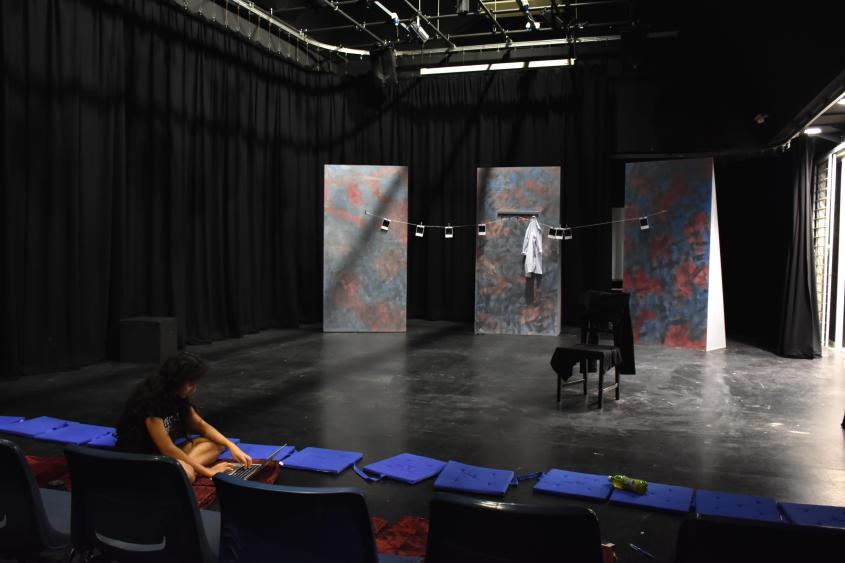
Meanwhile in the black box, Caitlin takes advantage of the quiet to get some work done on her laptop.

Fun fact: the 3 mysterious, oddly reflective flats in the background were designed by Caitlin, Sarthak, Sufyan and Aishwarya. Behind that look was a lot of work – 4 layers of it as they’ll tell you. They wanted a metallic finish, but metallic paint was too pricey, so “it was a lot of experimenting,” Sarthak says, and they eventually nailed the layering – “whitewash, layer of grey, paint red and blue, silver top” and also the exact texture – “dipped two sponges in paint, scrubbed them together and put it on the flats and randomly threw it around.”

18

It’s 4.30pm, and prep slowly gets underway, as Sarthak grabs a rag and starts cleaning the window which they’ll use for their intermission ‘show’ later on.

19

Dinner arrives, and the players shift outside as they dig into their chicken rice and chatter away.

The actors have to be careful what they eat before performing, as Rishi shares that while technically one’s voice is supposed to come from your diaphragm instead of the throat, the chicken rice chilli can make one feel uncomfortable, depending on one’s tolerance. “Guess everyone had a little bit, but generally good to stay away.” In any case, “the chilli’s packed separately anyways,” as Sufyan shares, “so if you can handle it go ahead.”

20

It’s 5.30pm when they finish dinner, and Kathy, Caitlin, Sarthak and Jasdeep (left to right) set up the Front of House, in anticipation of early birds on their way to pick up their pre-orders.

21

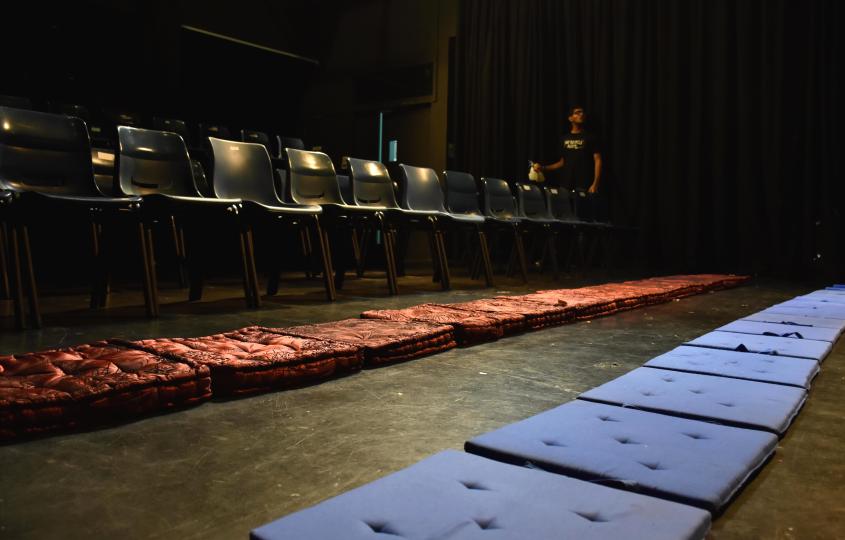
Meanwhile, back inside, Sufyan (in black) checks each and every seat for squeaks, (while Celine on the right races him to test out the last few seats). Aishwarya sprays air freshener on the cushions on the left, and some still drying spray patterns are visible on the blue ones at bottom right. Of the air freshener, Aishwarya (16S03S) shares that interestingly, “it was what [Sufyan and I] took the longest time to decide on when we went out to get stuff, because we couldn’t decide on the smell, so we just opened all discreetly and smelt (laughs).”

22

Sufyan wields his trusty air freshener. “I’ll keep on using those, even after production.”

23

Air freshener aside, much of Aishwarya’s and Sufyan’s effort went into creating the seating layout above. As Aishwarya shares, they planned way in advance, “[taking] measurements from day one of rehearsals” to draw up seating plans, before setting each of them up to physically try them out.  “We really sat and discussed for 2 whole days to make sure everyone can see”, shares Aishwarya, even staying one night to 11pm as they revamped their plans after they discovered they had cushions. As Sufyan (16S06F) says, “it was a tedious process.”


24

On the performers’ end of the black box, actors, director, and senior alike all chip in to clear the flats from last night (incidentally,the reflective paintwork is much more visible here) and set up Heart’s Desire’s set.

Just as how they’re helping each other set up the set, many of the players juggle multiple roles, helping one another out in the different areas of production. From publicity to acting to sets to stage managing just to name a few,  it’s common to find players who are in two or more of those. ‘It’s quite amazing,” as Kathy (16S06I) says, “how they can juggle all these without dying actually, and like they can still be so high and hype the energy up.”

25

Celine on the right packs the suitcase she’ll use as Susy, while Caitlin on the left helps draw out the unique chalk ‘set’.  

Jasdeep (16S03N), director for Heart’s Desire, explains that the chalk, with its yellow border above separating the family and Susy, helps explore why the family’s fighting in the play. “Is it because of what’s happening within, or is it something that’s beyond it – is it Susy? Perhaps this family was broken not because of Susy, and Susy was merely an excuse, and it was this toxic environment, this toxic box that they were stuck in.”

26

The chalk footprints forming paths on the stage also subtly explore the artificiality of the setup, showing that there’s “some greater force that’d already planned that the bird would be walking in that direction” Jasdeep explains, referring to the yellow chicken footprints above. “That idea of reality, and what is fake, the clash between what is created and what is real, and if there’s anything real in the first place is one tension we tried to discuss.”

27

This chalk they used is Jasdeep’s – he really likes chalk.

“I think chalk is really cool, I watched a play about chalk before and it was in a black box, except they put up like chalkboards and drew the set. It was really really cool, and I always wanted to use chalk for a play, so I did it.”

28

Outside, the first attendees arrive to collect their tickets from Kathy, who’s in charge of the front of house this night.

“There were many more parents on Saturday and more RGS girls on Friday,” observes Kathy, and she also enthusiastically shares that sales were really good!” We oversold both nights,” Celine (16A01A) says, “and even squeezed in a few more on Friday!” Kathy adds. On Friday, some called to cancel last-minute, but the popularity of the play was such that “there were a few enthusiasts waiting outside the TSD for extra tickets so we sold it to them!” “It was pretty surprising for us,” she says, and notes that perhaps “it was also because we only had 91 tickets available”. Also, Hai Yun mentions that they tried to keep ticket prices low and affordable at $7, possibly driving up sales too.

29

Back in the black box, Celine and Hai Yun (left to right) write messages on the posters for their teachers-in-charge, Mr Tan and Mr Choo.

“It was a spontaneous decision,” Celine shares. Inexpensive says Hai Yun, but also meaningful. “We wanted to give the teachers something nice, but also relevant to the play” explains Celine, plus, “that’s also what some people do in plays too, so it’d be cool!”

30

It’s 15 minutes from doors-opening, and the players go through their final preparations: Beatrice helps Wen Wen affix the glitter with hairspray, Isaiah adds the final touches to Celine’s makeup…

31

…and of course, the cast and director of Heart’s Desire quickly pose for one final pre-show group photo.

32

In the last few minutes before the doors open, the cast gathers round to do their warm-up.

“It’s like a tradition, we do it every time,” says Val. It’s “very like family … [feeling] together, as one, preparing for the show.” And indeed, it wasn’t just the actors warming up, but the directors and crew too, everyone gathering round. As Jasdeep shares, it’s not so much one’s role, as the fact that they’re part of this community. “Whether you’re doing tickets, acting, directing, lights & sounds, this community is very important because it’s an environment where you create something together. It’s about the friendships you make, the people you meet, and I think that’s really the fun about theatre.”

33

“The shakedown is something we always do, and at the end you’re just supposed to ‘urgh’ one last time, and just purge, like ‘arrr’ get it out of yourself and then calm down, and get in character.” – Rishi, on the pictured ‘shakedown’ part of the warmup.

In theatre we have this idea of energy when you’re on stage,” Jasdeep shares, “what you put into your character to move the audience”, and the shakedown is highly important for that, to getting them ready. “Aside from the practical purposes, like enunciation, making sure you can move without cramping, it’s also about more intangible ideas, like conviction and the energy.” Jasdeep stresses.

34

Aishwarya and Isaiah (left to right) look on and discuss the lighting effects.

As the warmups proceed, Isaiah and Aishwarya are in the lights booth testing the lights and sounds, “how the light shines on faces, the shadow, and the effects – individual lights, and a blue wash in one of the A Painless Way to Die scenes,” says Aishwarya. In the booth, Aishwarya handles lights execution, which Isaiah had programmed, and sounds execution (including announcing and even house music) is taken care of by Isaiah.

35

 In the lights booth itself – winky lights and cool monitors

Aishwarya explains that the orange lights and sliders adjust individual lights’ intensities, and the left monitor is where they can save that lighting setup to a cue sheet. The right monitor then loads those cues, so “on the actual day we simply need to hit ‘GO’ and the lights will automatically almost magically change.” Isaiah says. ‘Almost’, because behind those cues was a lot of work. “Lights was a tedious process,” he says, especially since the lights board was new to him. “We spent hours having technical runs,” he shares, “spending time setting which light goes where, and also figuring out positionings of moving lights, if the directors wanted moving lights.”

36

Aishwarya’s cue sheet in the booth

The work isn’t just in the programming though. In the execution itself, they have to be very careful to hit go on the right cues. Also, “some sound and light cues have to go at the same time,” Isaiah shares, “so Aish and I have to coordinate together… so it’s not so relaxed (laughs)”. Furthermore, it’s really too dark during the play to simply refer to their cuesheets, but, as Aishwarya shares, “we hold the flashlight there for the tricky parts like continuous cues, but most is already memorised due to extensive practice.”

37

It’s finally 6.30pm – doors are now open, and Sufyan and Aishwarya look on as people arrive for the show.

7 Letters: A Review

Reading Time: 5 minutes

By Celine Ng (16A01A)
Photos from 7letters.sg

7 Letters is a collection of 7 short films by Singaporean directors Boo Junfeng, Eric Khoo, K. Rajagopal, Jack Neo, Tan Pin Pin, Royston Tan and Kelvin Tong. Fundamentally a celebration of home, the short films orbit this theme with fascinating coherence and touching individuality, offering one of those rare collections of stories which build off rather than compete against each other.

7_directors_with_title_0-750x457

In all honesty I attended the screening with some ambivalence. ‘Singaporean’ works of art have on occasion struck me as somewhat heavy-handed in their treatment of our national identity and I wondered if the films would come across the way I interpreted some of the publicity: aesthetically pleasing but somewhat pretentious, framed in the token-nostalgic but largely mystifying location with a bright SG50 to boot.

Watching 7 Letters turned out to be an immensely humbling experience for me, for which I am grateful. Each film treated its subject matter with genuine affection and ‘local’ issues were woven into the stories with varying degrees of subtlety but an enduring sense of purpose.

(Note: The audience was asked by two directors who had attended the screening to approach the films with fresh eyes regardless of what we’d read about them before. I was fortunate in that, never having read any reviews, this was easy for me to do. To avoid giving spoilers, the following paragraphs are deliberately conceptual in description, and do not appear in the same sequence which the films do.)

Parting by Boo Junfeng was a deeply nostalgic piece to do with memory and loss. The film is notable for the skill with which it wove personal drama with reflections on what some viewers interpreted as a reference to Singapore’s separation from Malaysia in 1965. Conceptually, the non-linear progression was effective in creating the persistent sense of loss that undergirded the piece as well as lending sympathy to the drama -from demolished landmarks to changed faces, images conveying this sense of loss emphasised the difficulty of the Protagonist’s search for memory in a world that had utterly changed.

Sinema by Eric Khoo was possibly one of the most cleverly conceptualised in my opinion and an affectionate take on “the golden era of Singapore filmmaking”. The strength of this piece lies in its ability to reference familiar tropes -as evidenced by the immediately recognisable low-budget film-in-a-film, complete with word-art-like opening title, jerky cinematography and tacky Pontianak -and re-work them with affection and humor. Keenly aware of the narrative tropes it played off as well, the film as a whole was able to create strong parallels between its plot and construction, conveying across multiple levels the idea that what lends value to stories is a freshness defined not by utter separation from what is past but rather a meaningful engagement with history.

Sinema, Eric Khoo
Sinema by Eric Khoo

The Flame by K. Rajagopal was a compelling tale of family drama catalyzed by historical currents and the most narratively compact of all seven films. The film precipitated a collision of its four main characters with efficiency and vigour, allowing the key tensions of their struggle to be played out with sustained intensity. This efficiency was also apparent in the dialogue, which was tightly tethered to these tensions throughout, conveying through silences and stilted exchanges the unspoken concerns of each character.

That Girl by Jack Neo opened with a sequence that had me turning to my friend with a whisper of ‘confirm Jack Neo’ which was met with a suppressed laugh and a nod. Plot and thematic concerns aside, the film in itself is capable of evoking nostalgia for those of us who might see in it echoes of films such as I Not Stupid and Homerun. Crucially, however, the ‘local’ elements in this film were able to seem less like gimmicks and more like parts to a comprehensively -if a bit too deliberately -constructed whole, lending heart to a sweet if somewhat predictable story.

Pineapple Town by Tan Pin Pin was another film which audiences saw political undertones in, with some reviewers outright labelling it political allegory. Personally, I admired it for a very clean, down-to-earth style which I felt granted the most autonomy to the plot. The strengths of this piece lie in a complete independence of the story from narrative ‘enhancers’  and subtly balanced depictions of different character types (the middle-class lady and literal coffee-shop aunty, for instance).

Pineapple Town, Tan Pin Pin
Pineapple Town by Tan Pin Pin

Bunga Sayang by Royston Tan was a sweet and heartfelt story of friendship, one of my favourites for its balance of sentiment and humour. Reviewers seem to have mixed reactions to the film’s blend of the naturalistic with the whimsical and at times outright surreal, which was fun if somewhat confusing. I personally felt that the defining aspect of this piece and its greatest strength was a deeply feeling but understated quality to the storytelling. The friendship which emerges between both protagonists is made all the more compelling by the fact that their loneliness elsewhere and genuine fondness for each other is largely implied and at most articulated on occasion by timing and facial expressions.

Grandma Positioning System by Kelvin Tong was remarkable for how well it worked, with my friend and I agreeing that it was “by far definitely the tackiest but possibly the best”. This film managed even to outstrip That Girl in its use of stereotypes and Sinema in its use of tropes, but was nonetheless deeply enjoyable, again for its blending of heart and humor. Most remarkable to me was the skilful construction of the family dynamic which was deeply compelling in the way it lent depth and dignity to a series of tropes that were often simultaneously touching and comical. Perhaps the best way to encapsulate the spirit of this piece would be the reactions my friend and I had to its ending, which we both agreed should have made us cringe but actually had us crying.

Grandma Positioning System, Kelvin Tong

On the whole, 7 Letters was a truly admirable show and one that I would recommend. I believe there is something in it for everybody, and as someone who views any art specifically marketed as “Singaporean” art with immense skepticism, I am grateful for this humbling reminder that there is art out there which explores local themes with intelligence and insight.

7 Letters will be having a short run at Golden Village and tickets are available online at their website.

Literature Night 2015: A Night of Introspection and Inspiration

Reading Time: 7 minutes

By Vanessa Chia (16A13A) and Sean Lim (16A13A)
Photographs by Hoong Li-Ann (16A03A)

Closing a vibrant week of exciting workshops, dazzling performances and impromptu original poetry by Writers’ Guild, Literature Night 2015 was the manifestation of the school’s long-standing and dynamic Literature scene. Literature Night took the discipline out of the classroom and dreary lecture theatres, where seemingly incomprehensible extracts are tirelessly analyzed. Instead, the audience at the Performing Arts Centre (PAC) last Thursday night was treated to a delightful amalgamation of plays, quizzes and even a fashion show (of sorts, under the moniker of a Character Dress-Up), all composed and created by our very own students. This served to showcase just how far the Literature scene has grown and blossomed in Raffles Institution, as well as how the subject is so much more than what we are exposed to or our preconceived notions of it, from nightmarish recollections of memory work to possible hair-pulling from red-marked exam scripts.

The initial chatter of the audience, comprising largely of the school’s Literature students, immediately died down to a hush as emcees Myko Philip (15A01B) and Lee Chin Wee (14A01B) took to the stage. Livening the evening with light humour and tropes pointed out with panache and good-natured humour (e.g. the cliche-ridden nature of morning announcements and the tendency of Raffles Players’ works to perpetually surround melancholic, dispiriting themes), the audience knew they were going to be in for a treat.

“Chin Wee: But seriously. This ticks every single trope that was featured in RI Dramafeste.

Myko: Like what, dysfunctional family?

Chin Wee: Check.

Myko: Purportedly minimalist set which only looks pretentious and well thought out because it needs to hide the fact that they had no budget?

Chin Wee: Yep.”

As the curtains parted open to a stage swept up in utter darkness, the quiet energy of the audience was palpable for the first play of the night, All Good Things Discarded, directed by Isaiah Lee (16A01A). All Good Things Discarded was a raw, introspective look at how times of adversity can change the family unit, either for better or worse. The context of the play is as such; Bernard, an elderly grandfather has a mental illness which is putting a toll on the family (comprising the father Drake, the mother Grace, and the little daughter Melody), both in terms of medical costs and in terms of their cohesiveness as a family. Arguments emerge between the parents; The mother, Grace flares up at how much of a burden Bernard is to the family and she is worried that as Melody spends more time with Bernard, speaking in a language unbeknownst to anyone besides both of them, the more she will be isolated from the rest of humanity.

As the play progresses, both Drake and Grace explore what Bernard and his late wife Sylvia (mother to Drake) have left them as emblems of a passed down heritage. Once Bernard escapes from the mental institute to seek refuge from the plight of loneliness, the play explores what it means for a family to live together and go through tough times as a single entity. Bernard’s wife Sylvia, though not physically seen, has a presence that resonates in each one of the characters as they recollect memories of their past with her. In the end, Melody reveals her innermost secrets; her emotions and thoughts are a physical expression of the true meaning of what it means to love and be loved unconditionally.

The piece, which was the brainchild of Isaiah who had  written and conceptualised the production since Secondary 2, had gone through a deluge of modifications prior to its showing. “The play has undergone multiple changes and variations to reach the standard and stage it is presented as tonight,” quipped Isaiah, whose hard work and intense pursuit of perfection was clearly evident in his production. It was a touching, heartwarming yet thoroughly thought-provoking look at, as Isaiah put it, at ‘what it means to be a part of a family’ and ‘what we should count as the most important part of that family unit’. It was a stellar opening act, a play which resonated with the heartstrings of many amongst the audience, and that was made all the more poignant by the impressive chemistry between the actors who had put in ‘months of hard work’. Perhaps Isaiah put it best: it was simply a piece that was ‘uncomfortably vulnerable, painfully honest and beautifully worth it.’

hhhhh
Bernard, a.k.a Grandfather (Rishi Vadrevu, 16A01E) and Melody (Valerie Chua, 16S07D) embarking on an imaginary, other-worldly adventure through time, space, and alternate realms.

What followed next was the ‘Poetry Slam’ segment, where Gabriel Ng (15A01B), Wahid Al Mamun (15A01A) and William Hoo (15A01E) each recited some of their original poems, with subject matters ranging from playful themes to sentimental pieces and even some abstract works— a wide variety that kept the audience entertained and captivated throughout.  With each poem, the audience seemed to be brought into a different realm, thoroughly invested within the minds of the poetry slammers as they brought their personal, unadulterated experiences to life.

ebse
Slam poet, Gabriel Ng (15A01B) reciting his original work

The second play of the night, It’s A Different Model, directed by Celine Ng (16A01A) followed next. The play followed a father-daughter relationship between Mark and Lauren, and their interactions in the face of Lauren’s decision to move out. With commentary on the idea of primarily defining human relationships based on love, it exemplified how even though the nature of love may change over time, it is ever-present.

The piece conveyed how love ultimately overcomes all obstacles in a relationship, such as ‘bitterness, resentment, diffidence and pettiness’ in Celine’s words. She added on that ‘what makes Mark Lauren’s father is not in fact what he does for her because even the final act of pouring breakfast for her is only made possible because Lauren allows it, not because she requires it. What makes Mark Lauren’s father is the love for her that has always undergirded these genuine – if somewhat laughably bumbling – expressions of care. [Similarly], what makes Lauren Mark’s daughter is not the fact that she is nurtured by him, but simply the fact that she loves him, cares for him, and is in some ways emotionally dependent on him. They belong to each other emotionally!’

tbyb4
Mark (played by Vasu Namdeo, 16S07D) and Lauren (Cheang Ko Lyn, 16A01B) caught in an intensely emotional moment

Literature Quiz 2015 was an exciting affair, with three shortlisted teams from 15A01B, 15A01E and 16S03B out of all Literature classes in Y5-6 competing to clinch the honour of being, unofficially, recognised as the most esteemed literary connoisseurs of the school. Questions ranged from authors to book covers to famous quotes, and the teams on stage fought hard with their scores almost neck-and-neck for the entirety of the competition. Each question drew both excited laughter as well as hushed, infrequent murmurs reflecting the audience’s confusion towards many of the literary excerpts and book covers displayed on the screen which were unfamiliar to them. For the second year running, commendably, 15A01B clinched the champion title.

The quiz was followed on by Nice Things, a play directed and produced by Caitlin O’Hara (16S03A), which played on the unexpected impact two complete strangers can have on each other simply through conversation (humorous at times thanks to the occasional interjections from the resident Kopi-O Beng auntie, and the consistent awkwardness in their exchange). On a deeper level, it showed the irony in how we are often unable to empathise with our family members, despite them being the people we ought to be closest to, but instead are able to make significant emotional and human connections with people we have never met before. As for what Caitlin wanted the audience to take home, “I wanted to play up the struggle we all face in trying to love the people around us as we should, as well as how we are all inherently good people going through difficulties of our own in conveying our sincerity and this was really the message I hoped for the audience to take home.” Truly, the play communicated a warm and heartfelt message about the nature of human connection and relationships to us all.

The next segment, Character Dress-Up, was arguably the most light-hearted and interactive segment of the night. Each Literature class had been tasked beforehand to send up a classmate who would dress up as a famous literary figure and recite a few lines famously said by their characters, in hopes that those in the audience would be able to guess who they were portraying. Some classes came very well-prepared for their performances, such as 15A01A’s portrayal of Forrest Gump which ended in an unexpected fashion as Stefanus Phan (15A01A),  accompanied by Marcus Tan (15A01A), broke out into a rap along with their classmates in the audience. Other memorable performances included a re-enactment of Hakuna Matata, which was ultimately crowned the winner of the dress-up tournament and even one of Christian Grey, the protagonist of the renowned Fifty Shades series.

bydb
15S07D’s Character Dress-Up entry

After the light-hearted and humourous parade of characters, the night concluded with a lovely award presentation for the best character dress-up and the proud champions of the Literature Quiz, which nicely summed up the entertaining events of the evening.

Alas, after the curtains closed on Literature Night 2015, we were left behind to pick ourselves off the seats, after witnessing the Literature’s other living side. Nevertheless, we are certain everyone left the PAC with jubilant spirits — if not thoroughly entertained, then at least exposed to a captivating line up of performances that showed just how dynamic, multi-faceted and fundamentally fun, literature can be.

An Enemy of the People makes Allies with the Audience

Reading Time: 5 minutes

By Khairillah Irwan (16A01B) and Michelle Zhu (15A01B)

The night started simply enough – supporters, parents, theatre aficionados and casual friends gathered in the Performing Arts Centre to witness Raffles Players’ highly anticipated College Play, An Enemy of the People. Though this year’s turnout did not match the full house of last year, Raffles Players did not fail to impress.

An Enemy of the People brings to the forefront the conflict between the telling of the truth (and the naïve idealism that comes with it) and societal interests. Dr Thomas Stockmann (Naresh Manoj 15A01B), finds himself in conflict with Mayor Peter Stockmann (Rishi Vadrevu 16A01D) over his desire to expose the contamination in the town bath houses. The Doctor’s idealistic conviction to expose the truth and his confidence in the people is contrasted with the Mayor’s pragmatic concerns over how such an exposure would affect town revenue. As the play proceeds, Dr Stockmann finds himself increasingly estranged as the local news agency, the Mayor and the people turn against him despite his efforts to help the city. By the end, Dr Stockmann is lynched, exiled from his town and is left a jaded man, sombrely declaring: “The strongest man is he who stands alone.”

The play’s momentum was effectively sustained from start to finish. The Victorian decorations which adorned the PAC foyer along with a character web generated prior interest and surfaced the key motif of the individual’s relationship to society. The choir piece that was played to the anxious waiting crowd gained significance as it served as an unnerving foreshadowing for the loud and vitriolic scream of the crowd in the lynching they inflicted on Dr Stockmann later on in the play. Props goes to Players for their realistic and creative recreation of a lynching scene by positioning members of the cast in the audience. The shouting and murmuring which the audience heard from the ‘audience members’ around us enhanced the sense of realism, the impression given reminiscent of an election speech gone horribly wrong. If anything, this also aroused our sense of sympathy for the main character whose alienation becomes even more apparent as a further effect.

The lynching scene was a particularly memorable one, allowing us a deeper look into the character of Dr Stockmann. Naresh shone in presenting Stockmann’s desperation and conviction, in the face of an unforgiving and angry crowd. While one admires his zeal towards spreading the truth to the city, one may might also decry his unrealistic idealism and stubborn indecision. This man, presented as a composed man of science, unleashes bursts of raw emotion as he fights against a wall of public opinion in testament to his strong conviction. His consistent claims near the start that he has the ‘people behind him’ become more unconvincing and pitiful as the play progresses – one might even feel some sort of catharsis or grim satisfaction at seeing his illusions shattered and his views irrevocably changed by the end of the play.

The liberal press’ relationship with Dr Stockmann deserves special mention for showing the complex interests determining the actions of societal agents. The idealistic and naïve journalist vibe which Hovstad (Cheang Ko Lyn, 15A01B) the editor of the newspaper channelled showed in the somewhat comical scene where she and her fellow journalist Billing (Rebecca Goh, 15S06O) unveiled dramatically a world in which the ‘liberals would rule’. Yet this idealism is quickly trumped by societal interests and personal interests upon a visit by the Mayor.

Other characters related personally to Doctor Stockmann highlighted further the personal dimension to the conflict. Celine Ng (16A01A) put up a strong performance as the daughter of the protagonist. With her spirited voice and lively presence, her idealism fused with that of the protagonist played by Naresh made for an interesting stage dynamic Her comment about her role as a teacher- “At school we have to stand and tell lies to students!” elicited laughter out of the teachers in the audience. As Mrs Stockmann, Syafiqah Nabilah (15A01B) was versatile in how she oscillated between joyous hospitality and exasperation, resulting in a restrained spunk that reminded the audience of her unwavering, consuming concern for her family. We come to admire her unwavering dedication to her husband, even if it seems a little misplaced, thanks to the strong rendering of both characters.

Aslaksen (Rachel Koh, 15A01A) the moderator for Dr Stockmann’s public speech who piped up every five minutes by saying “Everything in moderation!” brought some much needed comic relief to the play. In the larger scheme of things, especially near the ending, these tendencies highlighted the ability of the artificial and seemingly polite to obscure the often loud and vitriolic Truth, which was a theme the play sought to share multiple times. Manifest in Thomas Stockmann’s interaction with the rest of the characters, the audience is left to reconcile Thomas’ unruly and unbecoming behaviour and the Truth he presents.

Raffles Players with their teacher mentors Mr Ian Tan (extreme left) and Mr Soh (extreme right)

Players impressed with their set, which was both functional and, given its simplicity, did not distract from the characters. This is especially so because the CCA was hit rather harshly by budget cuts, having to cut down significantly on production costs. Nevertheless, this did not affect the quality of the play and one could make the case that the simplicity of the set focused the audience’s attention on the interaction between characters rather than detracting from it.

Of course, as with any production, the play faced its own set of challenges.

Physical and technical issues marred the play somewhat. Very notable were the long transitions between scenes. Their clumsiness had the audience fidgeting uncomfortably with the very visible silhouettes of the actors moving props backstage. The first half of the play felt rather rushed and stilted. From the perspective of some audience members, it felt as though the conflict was set up rather abruptly and without any precluding development. Though of course, this can be attributed to the formidable task Players had of setting the context for the very intricate web of issues that this play confronts.

The College Play elicited praise from audience members, with the HOD of Literature Mrs Nicola Perry remarking effusively that it was “a very strong performance all around.”

Unlike the version of An Enemy of the People recently staged by local theatre company WILD R!CE, the version performed by Raffles Players followed the original text by Norwegian writer Henrik Ibsen more closely. An Enemy of the People dealt with political insubordination and one’s man quest to reveal the truth, and the Players did the play justice with their adroit performances. In the words of their director Mr Ian Tan: “No play is as powerful as An Enemy of the People in expressing how lonely the struggle for truth is, and the consequences of bearing [that truth].” It’s safe to say that Players did an excellent job in conveying that message.