

By Gladys Koh Wei Le (26A01B) and Irene Eva Thomas (26A01B)
When the term ‘disadvantaged children’ is mentioned, we would often focus on the tangible resources they are unable to access.
Yet, barriers to social mobility extend far beyond food or shelter. Family struggles and limited foundational support frequently result in a lack of cultural capital — the non-financial assets such as skills and knowledge that help individuals succeed in society.
One important type of cultural capital is embodied cultural capital, which refers to the internalised habits and dispositions that shape how individuals behave. For example, confidence in public speaking is a form of such cultural capital, as it influences how individuals express themselves in social settings.
Recognising this, Project Horizon—a CE01 initiative in RI led by Cecilia Wong (26S03K) Rosaline See (26S06A), Bryan Sim (26S03D), Syabil Muhammad (26S03D), Rino Hossain (26S03L) and Angelina Chang (26A01D))—seeks to strengthen disadvantaged children’s confidence in public speaking in Singapore. By equipping these children with the skills to communicate and think effectively, they are empowered to express themselves more confidently.
“Project Horizon (tackles) the broader issue of bridging the gap. Holistic workshops teaching public speaking and confidence building are (uncommon), tuition workshops are more prevalent.”
Cecilia Wong (26S03K)
A glimpse into Project Horizon
On Saturday, 18 April, Project Horizon conducted another of their weekly Saturday sessions at Toa Payoh West CC. Children were eagerly milling in before the official start of the lesson at 10am, while volunteers clad in blue handed them worksheets.
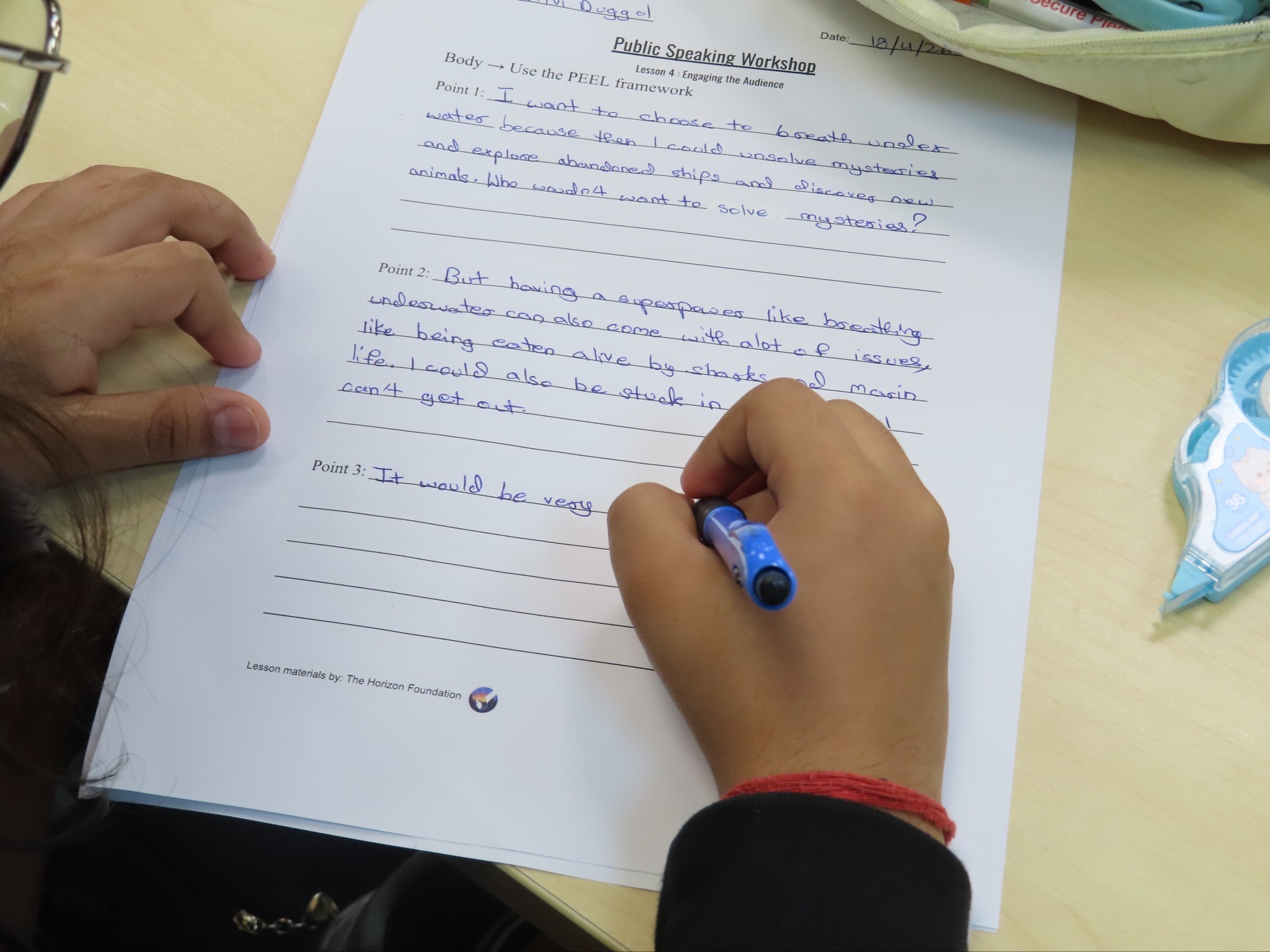
The theme of the day’s lesson was on utilising different techniques to engage your audience. Firstly, the volunteers presented on ‘Rhetorical Questions’, then encouraged the children to come up with their own examples for such questions and note them down on their worksheets. Next to them, a volunteer guided them through the process.
The second method to engage an audience was through ‘Humour’. And when the volunteers shared examples of some jokes, they added playfully, “No 6-7 jokes allowed!”
Immediately, many of the children burst into laughter, sputtering “6 7”, gesturing wildly with their hands between fits of giggles. As the volunteers gently hushed them and redirected their attention back to the screen, the classroom gradually settled. Yet, small smiles still lingered on the faces of both parties alike.
Certainly, teaching these children was not always easy. A girl asked what PEEL (Point, Explanation, Example, Link—a paragraph writing approach) was a mere 30 minutes after it had just been recapped. One boy got up halfway during the lesson to fiddle with the chairs at the back of the classroom.
But in the midst of this, more children had begun raising their hands to share their answers. Scribbling responses on their worksheets no longer needed as much guidance as before.
Throughout all this, it was clear that the children seemed more carefree and more relaxed, as compared to the first session. They were expressing themselves more confidently, participating more actively. Growth, though slow, was nonetheless present.
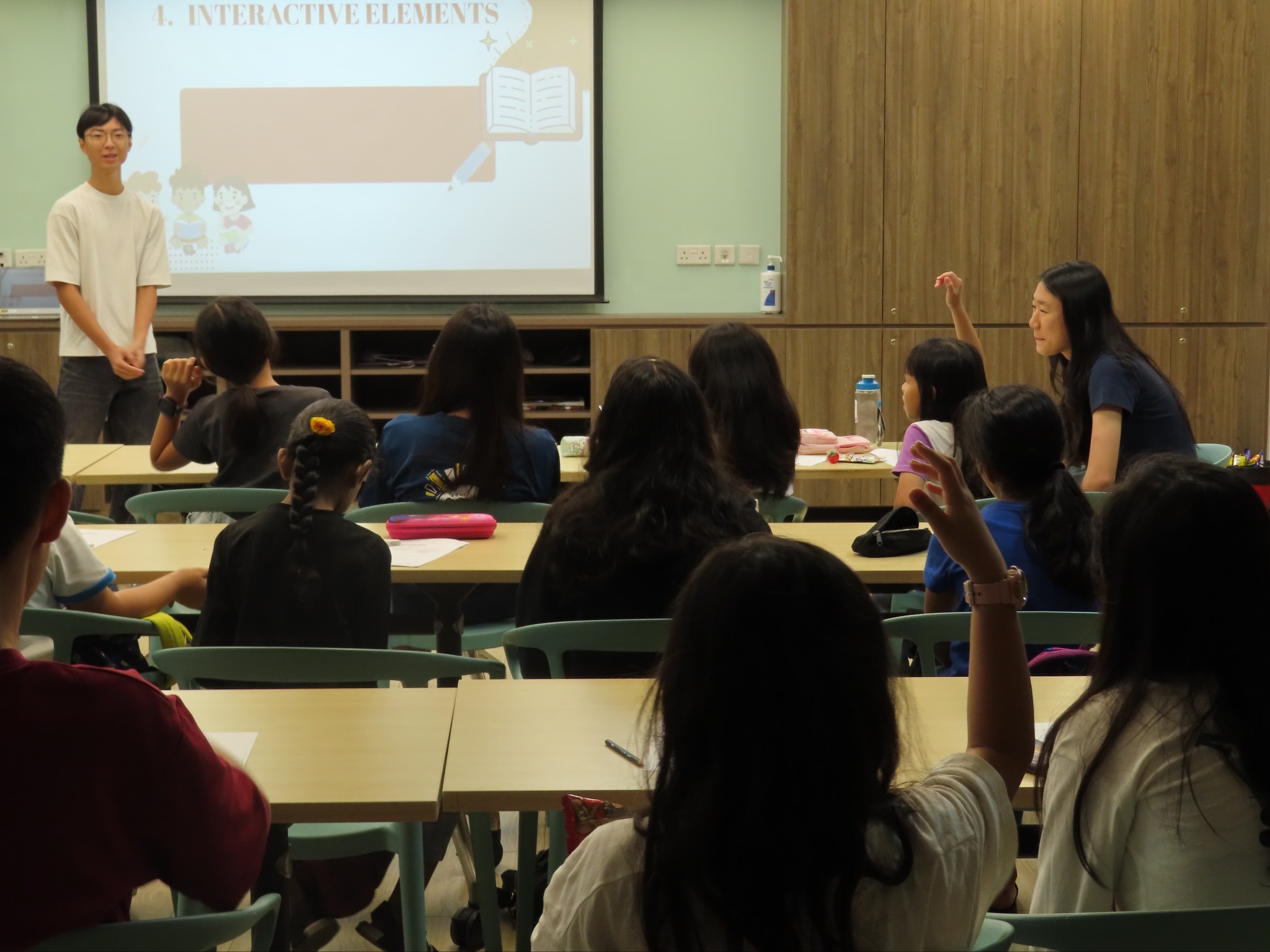
The third method to engage an audience was through ‘Personal Stories’. To demonstrate this skill, the volunteers displayed a speech by Jack Ma, in which he detailed his failures and efforts before finally attaining success.
“Success does not come immediately; you will fail many times,” he shared. Perhaps particularly resonant with the children, that regardless of one’s starting point, growth and perseverance can eventually lead to triumph, many jotted down his words.
All too soon, it was time for a break. Brian (26S06D), a Year 6 volunteer, began engaging some of the children in a simple game of tossing a ping pong ball back and forth—a light-hearted outlet for expression that allowed them to relax and interact more freely.
Excited shouts of joy soon filled the classroom. Meanwhile, Rosaline (26S06A) spent time speaking with the quieter children, gently drawing them into conversation, creating space for confident expression in a more comfortable setting.
The sense of familiarity between the volunteers and the children was evident. It was reflected in the ease with which they interacted and laughed together, without much hesitation. The children had begun sharing about their experiences in school and how they had applied their learnings. On the other hand, the volunteers were active listeners, interjecting with proud praise and follow-up questions.
Of course, as Brian reminds us, incentivising the children to pay attention to the task at hand is not easy. The kids, all within the age range of 9-12, are full of childish energy and joy, probing the volunteers to innovate ways to get their focus back.

“When dealing with kids at this age, you have to understand what they prioritise most; simple logic or reasoning may not always work.”
Brian Sim (26S06D)
A few moments later, we saw this very principle play out. As they attempted to get some of the students to write their paragraphs, the volunteers (to some avail) began to devise tactics like the classic “Let’s play a game called ‘Who can write the fastest’”.
When this failed with some of the more rebellious kids, Brian pivoted to us, suggesting that the student’s photograph was needed because of his “handsome face”, on the condition that it was a picture of him writing. The ruse, transparent as it may have been, drew laughter from him and somehow ended up working.
However, on occasion, the volunteers do come across some students who are incredibly receptive to the workshops. Walking around, we noticed a few kids who had completed the exercises given before the stipulated time, some even taking out their copies of Harry Potter to read while they waited for the rest of their classmates to finish work.

Speaking with students, we learned that these workshops were so much more than English lessons. They’ve enabled the kids to step out of their comfort zone and become more confident in their public speaking ability.
One of the children we talked to recounted that she used to be “extremely shy”. And yet, she noticed that she always gets allocated the role of presenter during group projects because of her confidence in public speaking, which she attributes to sessions like these.
The sessions also help the children inch closer to their own aspirations, offering them skills that are immediately relevant to the futures they are beginning to imagine for themselves.
As we asked one of the students what her ‘dream job’ is, she replied without hesitation, “I want to be an author or a CEO!” When asked whether the sessions were of any help to her, she noted that the practices they’d been doing were already helping her correct her grammar and construct better paragraphs—skills, of course, pertinent to being an author.
The gap Project Horizon seeks To address
As the EXCO mentioned, while we attend the occasional public speaking workshop, very few of this kind of holistic workshops are offered to those of lower socio-economic status, disadvantaging them more than we’d think.
Although Singapore’s meritocratic culture seems overly focused on intellectual capabilities and test-taking abilities, holistic skills we may take for granted are being increasingly valued as ‘human’ in an era of rapid digitalisation. Apart from providing the students with the means to express themselves more persuasively, skills such as public speaking abilities do result in tangible outcomes for those who are provided the opportunity to hone them.
“I mostly get awards for being the presenter. Our group always wins.”
Student X, attending sessions at Project Horizon
What underlies much of this, though it often goes unnamed, is the question of cultural capital. This encompasses the behaviours and sensibilities beyond grades and qualifications that allow individuals to navigate social and professional environments—for example, the ability to articulate oneself clearly in an interview, or to present their ideas with confidence.
For children from lower socioeconomic backgrounds, this form of capital is usually out of reach due to a lack of exposure. It is, by nature, inherited and passed down through environments where such skills are modelled, practised, and reinforced from an early age.

This is the gap that sessions like those run by Project Horizon seek to address. In teaching children these skills, the project offers something that extends beyond the classroom—equipping these students with the unspoken fluencies that their more privileged peers may have long taken for granted.
We already see this in both the student who leads her group presentations and the aspiring author, learning how best to refine her writing.
Singapore’s meritocracy promises equal opportunity, but opportunity is rarely as evenly distributed as the ideal suggests. Project Horizon does not seek to dismantle this system; it instead seeks to ensure that more children are equipped to participate in it. And in doing so, it reminds us that the most meaningful investments in a child’s future are often not the most visible ones.


