Walking into City of Others, City of Migrants: Art in Paris, 1920-1940s at our National Gallery feels less like entering the closed doors of a museum, and more like stepping into the hidden alleys of history, a world of intricacies of its own. The exhibition, which was held from April to August, turned our gaze toward the quiet sufferings faced by Asian immigrants as they explored the city of love—a city sadly not their own. Their stories reflected here are fragments of their memory: faded photographs, sculptures and landscapes, like whispered recollections of their lives. To walk through City of Others, City of Migrants: Art in Paris, 1920-1940s is to be confronted with the idea of remembering Paris through the eyes of Asian migrant artists.
“The speakers will examine how artistic consciousness shifts when Asian artists encounter a new city and culture while rediscovering the cultures of their origins.”
National Gallery Singapore
Fragments of their Memory
The Sisters
Lê Phổ, “Harmony in Green: The Two Sisters”, ink and gouache on silk
Combining Western techniques with local Vietnamese materials such as silk and lacquer, Lê Phổ’s painting harmonises the contrasting ideas of distance and closeness in a familial relationship, embodying the paradox of opposites, entwined within the same canvas. The two sisters sit side by side, hands held comfortably, framed in the lush embrace of rich green tones. Yet their gazes, their body language, and even their inner worlds seem to drift apart. The quiet emotional distance between the sisters subtly surfaces, in stark contrast to the serenity and tranquility of the painting’s flowy strokes.
The Paradox of Intimacy suggests that you can be attached to someone, in one way or another—by family, by love or otherwise, and still feel an unsettling distance between your inner world and theirs. Yet, in Lê Phổ’s composition, that very distance doesn’t break the harmony. Instead, it becomes part of it, creating balance. The Two Sisters is a reminder about sharing space with another, while finding beauty in the coexistence of your separate selves.
The Self
Georgette Chen, “Self Portrait”, oil on canvas
Georgette Chen’s Self Portrait is not merely a resemblance of a woman, but a quiet assertion of Georgette’s individuality. It is a harmony of various tones—identity, dignity, and embracing The Duality of Human Nature.
With a watchful gaze, a neat bun, coupled with the adornment of a black top that reminds viewers of her widowhood, she creates a tense atmosphere with her aloof composure. She captures the spirit of independence, with an awareness of her worth and her sense of purpose as a widow, and a determined Asian artist indulging in the steadfast pursuit of beauty and the arts, trying to make a name for herself in the art scene of Paris.
At first glance, she seems strong, cold, and maybe even anti-social. Yet soft rays of sunlight gently illuminate her coloured cheekbones, and her lips are delicate and pink. The deliberate brushstrokes reflect her youthfulness, serenity, and even a tranquility that transcends time—her inner self. The portrait unveils the truth beneath the cold, strong exterior of Chen. Despite having endured the loss of her husband, navigated cultural boundaries, historical upheavals, and the hardships of her artistic journey, beneath the surface lingers a young lady, innocent and graceful.
The Woman
Vũ Cao Đàm, “Femme Annamite”, Plaster
Vũ Cao Đàm’s Femme Annamite (translated as Annamite Woman) is a serene and contemplative sculpture that captures the quiet dignity and the grace of a Vietnamese woman. The figure, carved in smooth, pale plaster, is shown seated on a geometric block, her body lightly hunched in a pose of reflection. With clean lines, soft planes, closed eyes and an absence of decorative details, the figure conveys a timeless sense of quiet humanity, embodying the spirit, Solace amidst Solitude. She is grounded to some physical, solid entity, while floating in her deep thoughts.
Various artists
Sight-seeing in France
French architecture between the late 19th and early 20th century was experiencing a rather rapid identity crisis, with the rigid elegance of Haussmannian Paris, where wide boulevards were sandwiched between between orderly rows of cream-coloured buildings with their wrought-iron balconies, morphing into Art Nouveau’s organic shapes and floral motifs before settling into the simple functionality of Modern Architecture.
Life in the city was changing too. The Seine was now a hub for leisure and romance whilst steam-powered engines connected the city like never before, letting it bustle with trade, innovation and work. To these artists that crossed the globe, Paris was magnificent. And the Eiffel Tower, massive and looming, reaffirmed it all.
Through their eyes, we are offered a unique glimpse into the fascinating streetscapes and people they encountered.
Riichiro Kwashima, “View of the Seine”, oil on canvas
Chen Jen Hao, “Winter Street Scene in France”, oil on canvas
Liu Kang, “View of Sacré-Cœur”, gouache on paper
The city had also long been a melting pot of the Avant-Garde. In the mid-1800s, when Western Art began unshackling itself from Realism to enter the next revolutionary chapter of Impressionism, it was Paris that found itself at the frontlines of this transformation.
Many of these Asian artists embraced this spirit of experimentation, allowing their sojourn in the city to inform their new era of work.
“The district of Montpasse was a popular area for artists to congregate, with studios, art schools, and cafés. This bohemian environment fostered a climate of artistic freedom.”
National Gallery Singapore, Studio and Street
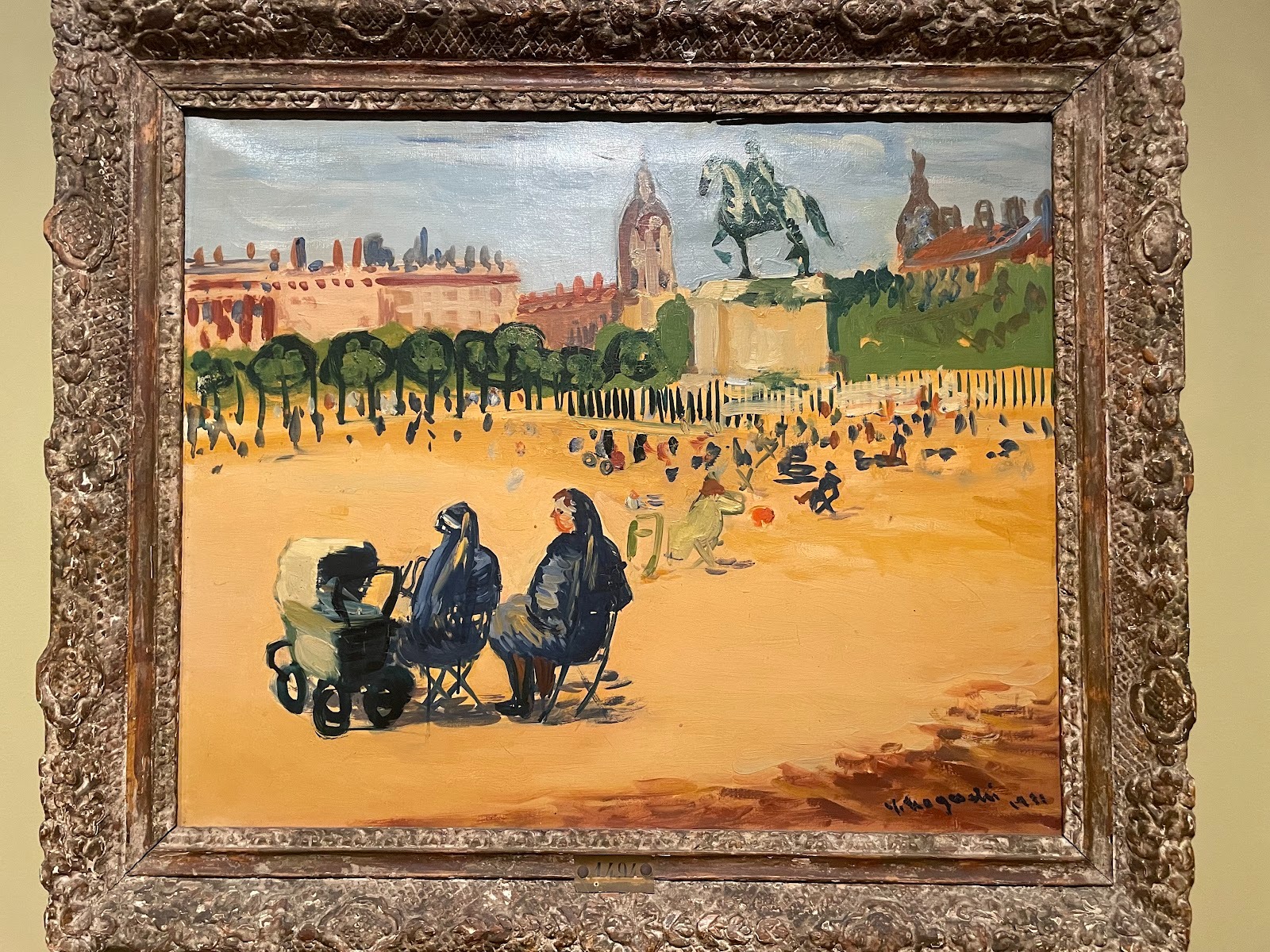
Noguchi Yatara, “Bellecour Place”, oil on canvas
For Noguchi Yatara, detail is deliberately shirked off as Fauvism, a style branching off the rebellious Post-Impressionist movement, bleeds into his work, with the city square’s vibrancy captured through spontaneous strokes and vivid shards of brilliant, saturated colours. In Bellecour Place, King Louis XIV’s bronze, horse-mounted statue stands tall amongst the French urbanites that (literally) dot the page, rising above even the buildings on the horizon, just as he did in real life—the divine “Sun King”.
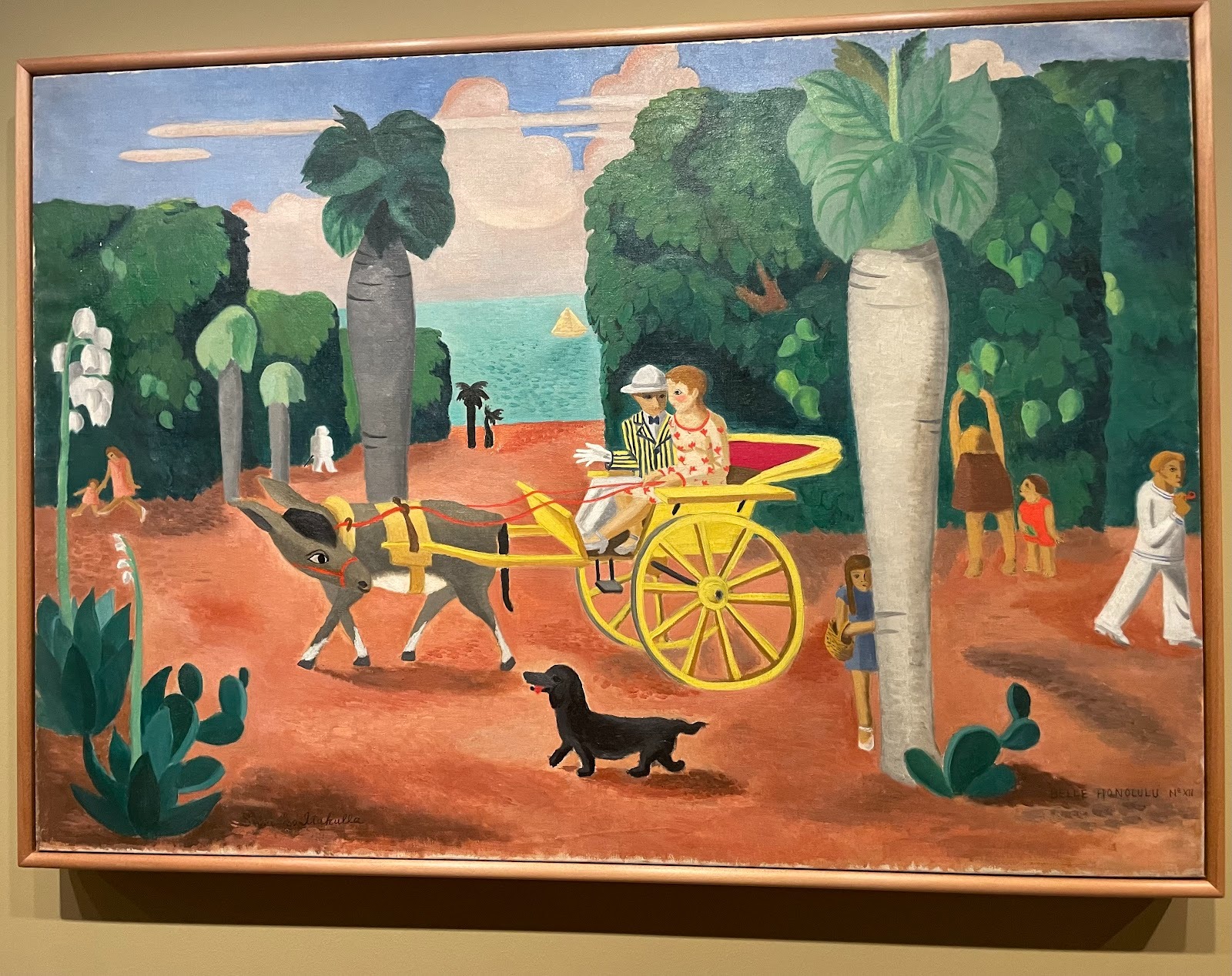
Itakulla Sumiko, “Afternoon, Belle Honolulu 12”, oil on canvas
Meanwhile, Naïveté—a style popularised by French artists like the self-taught Henri Rousseau—actively sought simplistic, disproportional anatomy in playful, 2D perspectives. In Itakulla Sumiko’s work, we are whizzed into a child’s imagination, with her bright colours adorning the flat, toy-like figures in a bizarre composition.
But with traditional Japanese ukiyo-e prints already forfeiting depth in pursuit of a flat aesthetic, perhaps she fit in swimmingly.
Oka Shikanosuke, “Bridge”, oil on canvas—another showcase of Naïveté
Various Artists
Applied Art
Subscription cards distributed by the French Communist Party and anti-colonial activists
Hồ Chí Minh, various cartoons, ink on paper
Art has always been political.
For some, Paris may have been just a city to tour and study in, but for others, it was a battleground for freedom. As the colonial masters of Indochina, swathes of Africa, and more, the French Third Republic did all they could to promote colonialism through state propaganda, whilst anti-colonial activists allied with the French Communist Party to distribute satirical cartoons and leaflets, with even Hồ Chí Minh himself pitching in his fair share.
Advertisement for the 1931 International Colonial Exposition which glorified French colonialism
Pan Yuliang, “A Black Man”, oil on canvas
Other migrant artists empathised with the plight of the colonists too. Painted in 1948 in the aftermath of Nazi occupation, Pan Yuliang’s A Black Man humanises the marginalised, delivering a raw portrayal of exhaustion as the man kneels down, naked and chained. Whilst not exactly applied art, it showed solidarity for the war refugees the city was rife with—many were African colonists who had fought for Free France—and also rejected European racial hierarchies which Pan, increasingly alienated by both the Chinese and French art scenes for being “too Western” and “too Asian”, would have known all too well. She never returned to China after departing in 1937, remaining in Paris till death.
Pang Xunqin, advertisements and book covers, etc., watercolour on paper
Beyond pushing ideologies, art was also used simply as a business tool. Art Déco was a new style championing modernity and glamour, mixing the ornate beauty of Art Nouveau with modernism’s minimalism, lending well to snappy advertisements that appealed to consumers in the Machine Age. Georges Lepape’s pochoir was a new, painstaking technique of hand-coloured stenciling used to mass-distribute fashion designs influenced by Art Déco and East Asian exoticism, whilst Pang Xunqin directly infused Art Déco into his work back home.
Georges Lepape, “Dogaresse–Robe du soir de Jenny”, pochoir
Georges Lepape, “Belle Impéria”, pochoir
Still Life
These migrant artists give a gander into their residencies in Paris, sharing an intimate view of “home”.
Various Artists
Decor
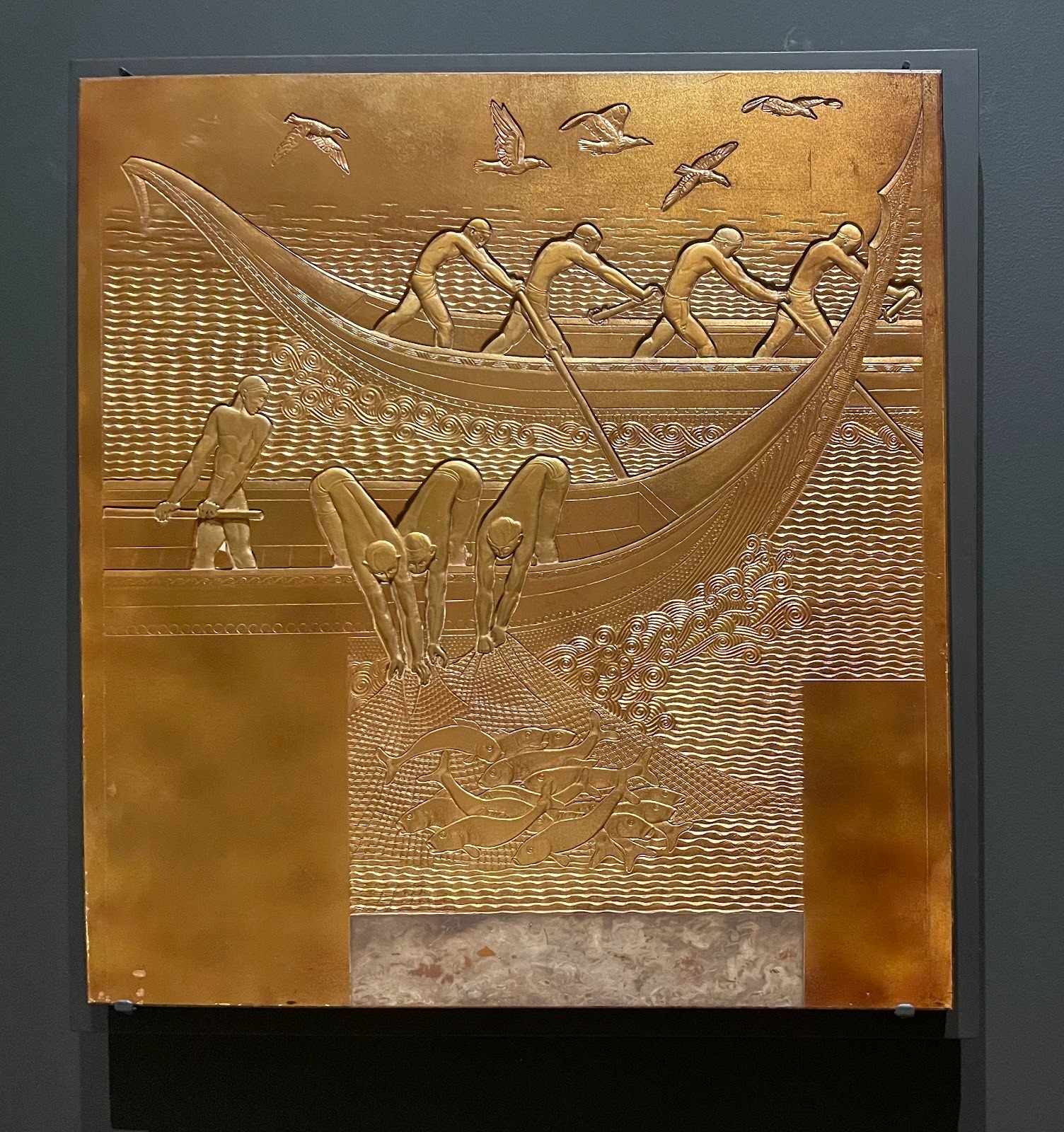
Jean Dunand, “Le Pêche (Fishing)”, engraved gold lacquer on “sabi”-moulded stucco
Asian migrant artists and French artists such as Jean Dunand also dabbled in decorative arts from ceramics to lacquer pieces, blending Western design sensibilities like Art Déco with lacquer and pottery techniques exported from China and Japan.
Various Artists
Final Thoughts
In a modern world where the West dominates in music, architecture, politics, consumer culture, and technology, City of Others, City of Migrants: Art in Paris, 1920-1940s reminds us of our ancestors who understood the importance of staying true to their roots whilst contributing to new, foreign trends. Kpop, Bollywood and Anime have all been great twists on Western blueprints to reinvigorate local expression, but the question is: what will Singapore’s be?
Pai Un-soung, “Returning Home”, oil on canvas
5896290cookie-checkThe City Of Others: Asian Artists in Parisno