

By Nithilan Balachander (26A01C)
As the Marvel Cinematic Universe enters its 18th year, begins its sixth phase, and releases its 54th project, The Fantastic Four has a lot riding on it. With superhero fatigue taking hold, the MCU is desperate for something fresh to break free from its string of stale box office disappointments. Who better for the job than Marvel’s first family?
The Fantastic Four is ambitious—with a 1960s-inspired sci-fi setting, a world-eating Galactus as antagonist, and a storyline spanning time and space, the film is clear in its desire to deviate from the 37 MCU films that came before it and its poorly reviewed and regarded F4 predecessors.
Yet, despite all its spectacle, grandeur, and ambition, the film fails at being much more than formulaic and forgettable.
Spot the difference!
Where credit is deserved, The Fantastic Four’s strength is in its visuals. Coming off of 2021’s WandaVision, which made similar use of period-inspired visual styles, director Matt Shakman does worldbuilding unlike anything seen before in superhero movies.
Set in a utopia that is as retro as it is futuristic, politics and society in this world seem to be centred entirely around the Fantastic Four. Taking inspiration from the Space Race as well as the science fiction of that era, The Fantastic Four are presented (without much of an origin story) as humanity’s foremost explorers and only saviour, in a break from the crowded-ness of the MCU.
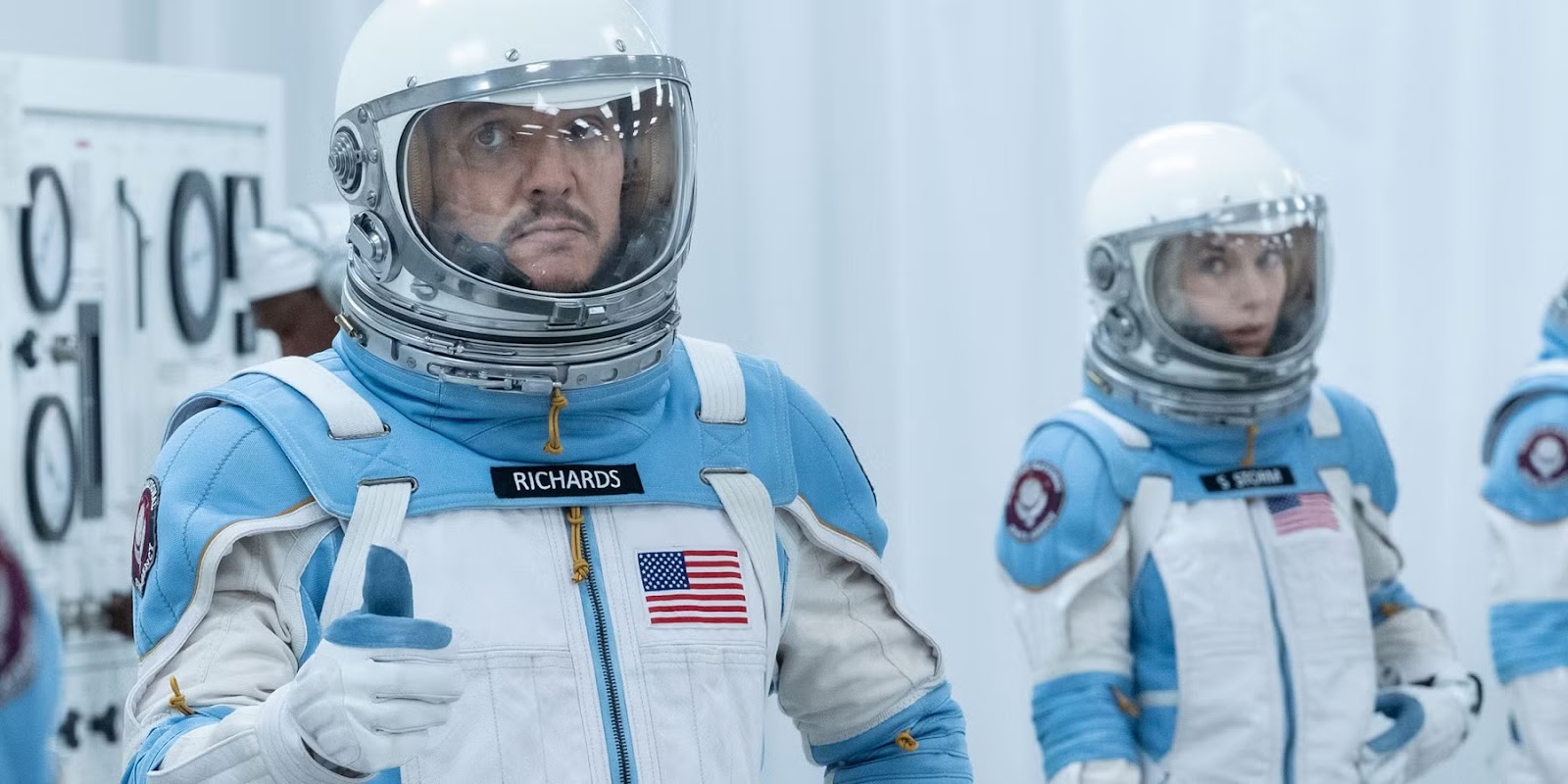
After an unexpected visit from a silver-coloured surfer announcing the imminent consumption of the planet by a mysterious “Galactus” (yes, he literally wants to eat the planet), our four fearless heroes are forced to traverse time and space in order to prevent their world from being finished off.
Throughout this adventure, one can observe how beautiful the MCU could be if the entire technical team well and truly locks in. For one, the Four are aided in their quest to save the world by various technological contraptions, mostly the brainchildren of the impossibly genius Reed Richards—each designed with detail and creativity and supported by impressive visual effects throughout.


The costuming, too, seeks to emulate superhero comics of the 60s. Perhaps most impressive is that, while still effectively creating a retro look, the costumes never feel cheap or tacky—a quality that superhero films in general often lack and one The Fantastic Four excels in.
Yet, despite excellence and originality in its music, visual effects, and other technical aspects, the film still is very much a MCU film in the most frustrating of ways—its writing is just dull.
Hype moments + aura
The Fantastic Four’s most persistent problem is that it seems more concerned with aura farming rather than giving us interesting dialogue and writing. While it most definitely does succeed in the former, it leaves the latter neglected, resulting in a film that looks fantastic but is ultimately forgettable.

For one, the character development is iffy at best. With the first act introducing Sue Storm as pregnant, the super-stretchy Mr Fantastic and super-transparent Invisible Woman are forced to deal with an incoming baby while trying to save their planet from extinction. Aided by the compelling performances of Pedro Pascal and Vanessa Kirby, the film does succeed in imbuing some humanity and creating some emotional stakes. However, this ends up being the only meaningful piece of character development in the entire film.

The other two out of the Four, Johnny Storm/Human Torch and Ben Grimm/The Thing are played respectively by Joseph Quinn and Ebon Moss-Bachrach. Both deliver performances with little to criticise; yet, the script offers too little for them to actually showcase their range.
Johnny Storm is a flat, one-dimensional character who is largely relegated to delivering quips and is only made relevant when he is wedged in as a plot device. And any narrative threads seeking to explore Ben Grimm’s emotional depth—such as a briefly introduced love interest—are left unexplored and unfinished.
With the world’s smartest individual as protagonist and a world-eating entity as antagonist, the plot—especially in the third act—seems unsure of how to handle either. The Fantastic Four’s climax and resolution try to merge both the ingenuity of Richards in trying to defeat Galactus while still retaining a good ol’ superhero climax fight, but end up not being too good at either. A flat and formulaic end to an otherwise fantastic-looking film…

The Marvel Microwave
For a film which expressly aims to set itself apart from the MCU—and perhaps the entire superhero genre—what it demonstrates, ironically, is the MCU’s enduring commitment to never break free from the superhero movie formula that it helped pioneer.
The application of this formula can surely be observed in The Fantastic Four, through its flat characters, the third-act CGI fight, and use of the film as a setup for other films. But, this formula has worked numerous times to great success for Marvel. Why not now?
Maybe, the CGI fights that once inspired awe, after so many iterations, now inspire nothing. Maybe, the humour characteristic of the MCU, after being overused for so long, now just isn’t funny. And maybe, setting up future films does not count for much if the audience is losing interest in the present.

It’s not revolutionary to say that the decline in audience interest for superhero films—or “superhero fatigue”—can be attributed to films recycling the same concepts, narratives and ideas over and over again. Consequently, The Fantastic Four seems to be suffering, through its lacklustre performance at the box office, despite its 86% Rotten Tomatoes rating.
It seems, perhaps, that despite all its efforts in trying to be different, The Fantastic Four hasn’t tried hard enough.


Reheated cheese and beans
Reed Richard’s also