Month: May 2014

Notes from the Underground: Managing Stress and Expectations

Reading Time: 9 minutes

By Marcus Tan (15A01A), Katrina Jacinto (15A13A) and Celine Liu (15A01E)

This is the third instalment in a termly series featuring advice from the team of counsellors at the Raffles Guidance Centre. This time, we bring to you FAQs on stress management in Raffles, especially relevant now with academic assessments are just around the corner. Our next instalment will centre around the theme of dating and relationships in Raffles, so stay tuned! Click to read part one and part two.

Continue reading “Notes from the Underground: Managing Stress and Expectations”

A Final Letter: Looking Back to Stride Forward

Reading Time: 4 minutes

By Lee Chin Wee (14A01B)

img_8792-copy

For the first time in more than twelve months, a Raffles Press article appeared on Word of Mouth without my direct oversight. I found my cursor reaching reflexively for the ‘share’ button, my fingers ready to type out a Facebook message instructing my team to re-post the article. I catch myself. Moments later, the article is publicized by new people, with different names and profile pictures which I have yet to firmly associate with Raffles Press. Perhaps this is what Bertha Henson means when she writes on her blog – “This morning, May 10, my newspapers didn’t arrive at my door step. (It) has finally dawned on me that I am officially an ex-journalist and no longer entitled to free newspapers – which I have had for 26 years.” While my year in charge of Raffles Press pales in comparison to her storied career as a journalist and editor for the Singapore Press Holdings, I could immediately identify with her sentiments. It is an unsettlingly foreign, yet cathartic experience to find myself missing the daily mundanities of editing sports or arts reviews throughout the night, the chagrin of making a bad editorial decision, or the joy of seeing a well-written article go viral for all the right reasons.

Continue reading “A Final Letter: Looking Back to Stride Forward”

Guitar Ensemble strikes a chord with Esperanza: The Light of Hope

Reading Time: 5 minutes

By Tan Su (15S07A), Amanda Chang (15A03A), Qiu Jia Hui (15S03B)
Photos by Yang Yang (15S06P), Amanda Chang (15A03A) of Raffles Photographic Society

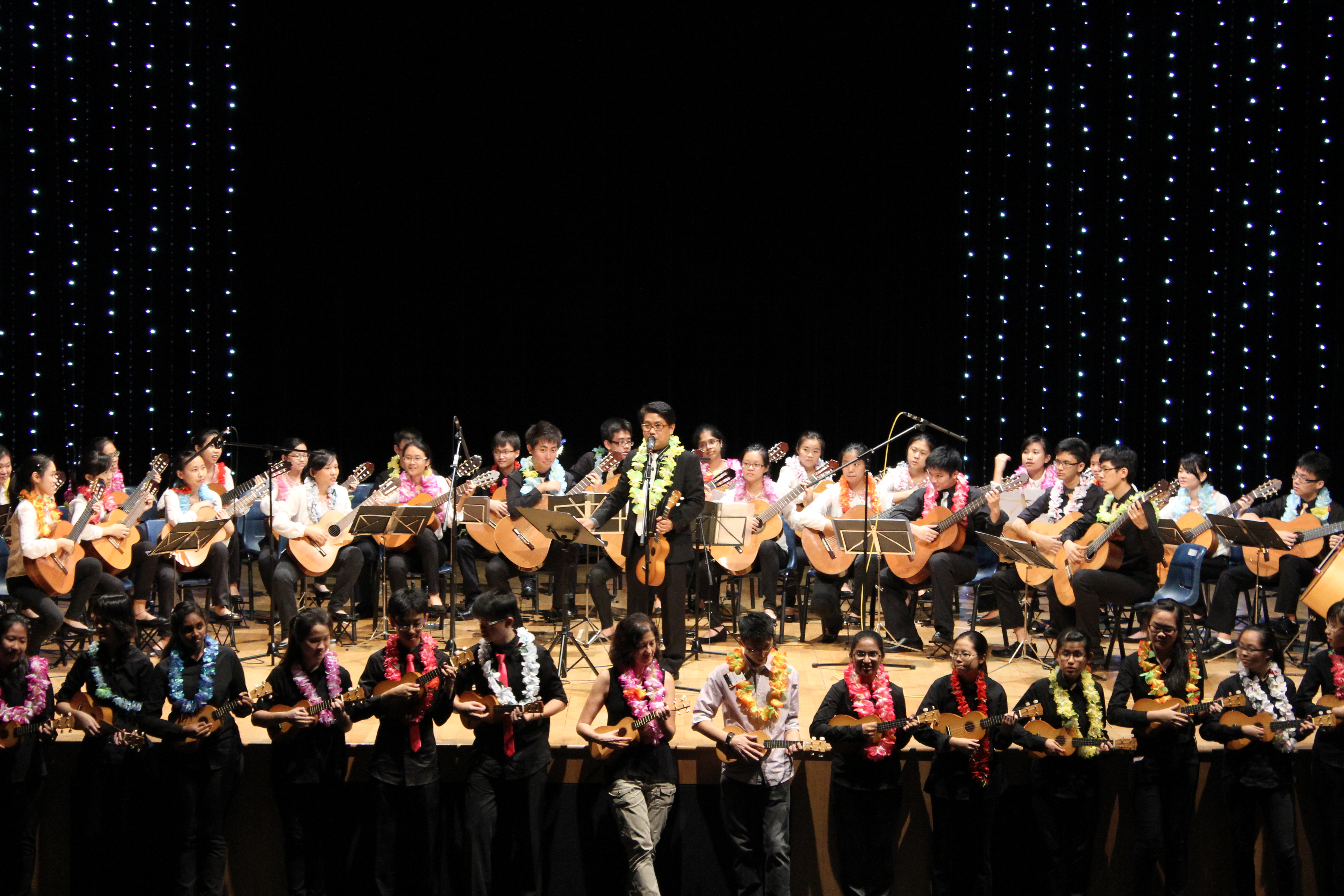
As the curtains parted, “Esperanza” itself was quite literally seen from the strings of fairy lights that illuminated the entire stage, giving rise to an almost magical atmosphere. This theme represented the hope that Raffles Guitar Ensemble (RJGE) wished to bring to the audience with their music, and we can assuredly say that they achieved what they set out to do.

guitar1

The concert kicked off with the main ensemble performing a selection of lilting tunes such as “Summers Wind” and “Coup de Couer – Les Reves du Matin”. “Summers Wind” was an uplifting and pleasant piece, which occasionally inherited mysterious undertones at times, but edged the audience into a spirit of light-hearted nostalgia with pizzicato plucking in the main melody. “Coup de Couer – Les Reves du Matin”, on the other hand, was a piece that commenced deceptively cheerfully but took its audience on a rollercoaster of emotional highs and lows. Halfway through the performance, the peaceful tones smoothly transitioned into a wistful melody with a series of deep, resonant notes, as the ensemble employed a few pregnant pauses to allow a dark and melancholic mood to settle in. This heavy mood then swelled as rapid and slightly disconcerting riffs crescendoed until the ensemble eventually burst into an abruptly ecstatic melody. The overwhelming enthusiasm in the piece was quickly tempered, as the ensemble gently brought across the final cadences of the piece. This performance truly kept the audience on the edge of their seats, engaging the dynamics of music to accentuate its mystifying nature.

All pieces by the RJGE main ensemble, including two other pieces of Ai No Kurashi and Scherzino Mexicano, were conducted by Mr Michael Gaspar, a graduate of LaSalle College of the Arts with a Diploma in Music who has picked up numerous awards in his professional career as a guitarist such as the Grand Prix awards in the Singapore Guitar Festival.

guitar2

Following the Main Ensemble, the Junior Ensemble put on a wonderful performance, made all the more impressive by the fact that it was their first time on stage. According to Mr Gaspar, the confidence level of the Year 5 batch was remarkable, seeing that the time they had to learn the pieces was very limited. Classical guitar pieces including “Calypso” and “English Country Garden” allowed the audience to unwind with their spirit-lifting and cheerful tunes. Backed up by the Year 5 batch on guitar, the impressive rendition of OneRepublic’s “Counting Stars” also put vocalists Alina Sng, Alyssa Chua, Sarah Chooi and Jaron Chong in the limelight. They took turns to display their vocal prowess to the audience, and their solid harmonies certainly did not fail to enrapture and entertain, seeing that some members of the audience were bobbing their heads along to the catchy tune. However, it was unfortunate that their vocals, perhaps a tad too powerful, drowned out the ensemble’s accompaniment. The performance, though already outstanding, could have been improved with better sound balance.

guitar3

The concert could not have been complete without guest performers from the Raffles Girls Guitar Ensemble (RGGE). Decked in elegant, flowy gowns, the ensemble worked harmoniously, greeting the audience with lively tunes such as Howl’s Moving Castle Theme – “Promise of the World”, and “Tango” which got the audience’s feet tapping. It was clear from their fluid performance that they had had months of practice under their belt and were truly passionate about their music. Their enthusiasm truly rubbed off on the audience, who thoroughly enjoyed their pieces. A highlight of the RGGE’s time on stage was “Duet” performed by Lim Jiahui and Joelle Ocampo. The two had near-perfect coordination, fingers skipping over the frets deftly with only eye contact as communication between them. The connection between the two performers in their unspoken understanding, provided the audience brief glimpses of the chemistry that guitarists share. What was even more admirable and impressive was that the pair did not have, or rather need, to refer to score sheets. What a testament to their skill and the effort that they put into the performance!

The chemistry between performers was also demonstrated through smaller group items as performed by the different sections of the RJGE; sections took turns to charm the audience with themed, often colourful costumes, showing off their wide repertoire of songs. Examples included recent hit “Let Her Go” by Alto 1, while Prime section performed “Itsumo Nando Demo” from the movie “Spirited Away” by the widely acclaimed musical composer Joe Hisaishi. “Childhood Memories” by Alto 2 was a vivid performance featuring familiar tunes which ignited fervent chatter amongst audience members each time someone managed to identify a song. Incorporating melodies like the theme song of Doraemon allowed each member of audience to reconnect with his or her cherished childhood memories. “I Believe”, the theme song of hit Korean drama “My Sassy Girl” performed by Bass section, certainly enlivened some K-pop fans in the audience.

guitar4

Other performances included “Air On A G String” by the Executive Committee of RJGE and “One” by Yu Chen and Zong Tai. “Little Talks” by Anabelle, Wei Sheng, Alysia and Nicholas even ventured into other instruments such as conga drums, which infused a clear sense of rhythm. This definitely demonstrated the sheer versatility and talent present within the RJGE community. Watching the sections and groups perform individually also allowed the audience to engage themselves in the unique camaraderie that each performing group had developed over hours of practising together. While the pieces may not have been perfect, it was clear that the sections had given it their all. This was sufficient for those in the audience that day, and the overall atmosphere of the concert was in general a joyful one.

At 9.30pm, the curtain was brought down after a final item by the main ensemble: “Tanquillo de Cadiz”, a particularly rhythmic piece incorporating powerful strumming and strong bass tones to create a warm and lively mood- the perfect recipe for an impressive finale.

However, the concert wasn’t over just yet. As the emcees took the stage, the audience quickly caught on to the emcees’ hints at more to come, cheering the guitarists on with cries of ‘Encore!’ True enough, the guitar ensemble was ready with what was considered by most to be the highlight of the evening. After an introduction to the encore piece by Mr Gaspar and a brief prelude by the main ensemble, the rest of the ensemble drew laughter and applause when they entered decked out with ukuleles and brightly-coloured leis to line the front of the stage. The two teachers-in-charge, Mdm Low Chor Huang and Mr Winston Cheong were not spared the Hawaiian treatment either!

guitar5

With that, the ensemble began “Aloha Oe” (Farewell to Thee), a folk song by a Hawaiian princess that was adapted into English by Elvis Presley in the movie “Blue Hawaii”. “I liked how different styles of music were played on different instruments. It was a quirky but heartwarming ending,” said Xu Yanling of 15S03C. Truly, the mellow, cheerful chords of the ukulele complemented the main ensemble’s smooth harmonies, and light-hearted “Aloha!”s from the entire ensemble ended off the concert on a brilliant note.

Going in Blind: Dine in the Dark 2014

Reading Time: 5 minutes

By Valerie Chee (15S07B), Michelle Zhu (15A01B), and Celine Liu (15A01E)

interact
Raffles Interact at Dine in the Dark 2014

Have you ever marvelled at how the occasional blind man or woman moved expertly through the motions of daily life with seeming ease? In all honesty, the problems faced by the visually handicapped are not usually on our minds on a regular basis. For the vast majority of us, it is a little hard to empathize with them when we are so used to taking the privilege of sight for granted, but we must remember that there exist members of our society who are consumed by a world of darkness- with difficulties and pains we may never experience.

In response to the common negligence of the visually handicapped community, Dine in the Dark 2014 sought to lend to the public a firsthand perspective on being blind, albeit for a small window of time, by challenging participants to consume an entire meal immersed in utter darkness.  As a member of the organizing team stated, the event was ‘to raise awareness for the Singapore Association for the Visually Handicapped (SAVH), because the visually handicapped is a part of society that is often neglected.’ And what better way is there to empathise with the blind than to immerse yourself in their world entirely?

Regrettably, the experiences had at lunch and dinner were inconsistent because of the windows that could not be covered up in the Evelyn Norris Hall– during lunch hours, sunlight leaked in through glass panels near the ceiling, making the dim lighting more of a strain on the eyes than an obstacle to vision. The organizing team later explained that it was quite a challenge to prepare the place because they could only look at the venue in morning, and had no time to patch it up in advance. Dinner on the other hand was touted by participants as a sui generis experience of eating in the darkness.

After the screening of a video that introduced us to the difficulties faced by the blind, the event began in earnest with a game that involved drawing a face and a house in the darkness. Being unaccustomed to the lack of vision, even the simplest things were a challenge. Passing pencils and paper around the table resulted in more fumbling than one would expect, and the cacophony of voices without the presence of visual cues was bewildering as we struggled to pick out the voice of our facilitator. Eventually, someone discovered that the key to this activity was not lifting the pencil from the paper, but not before the rest of us floundered our way through drawing disproportionate faces and misshapen houses. When our ‘masterpieces’ were returned to us at the end of the event, it was evident that any semblance of aesthetic ability we may possess had been severely hindered by the experience of visual impairment. In one sense, this became a source of hilarity, but from a more subdued perspective, the activity allowed us to acknowledge that the disability to perform even simple, everyday tasks is just one of the major difficulties faced by the visually handicapped.

strings
System of strings that were used by the servers to find their way

And with that, appetizer was served– potato salad that came in a handy little box. The servers delivered the food to participants using a simple system of tapping the shoulder of one individual at the table, and then requesting participants to pass on the dishes till everybody had their food. Later, we found that the servers were able to find their ways to each table by the use of strings suspended slightly above head level in a grid over the hall. Tags were strategically attached on the parts of the strings next to each table so that servers used their sense of touch to determine when they had reached their assigned tables.

For the participants, eating posed little significant challenge on its own, but as we quickly got accustomed to the feeling of only tasting- and not seeing- our food, the emcees introduced the bands who would be providing the background music for the meal. Much of the following two hours was filled with seamless transitions from ballad pieces to upbeat tracks, as members from Raffles Rock and various bands set the atmosphere for a relaxing and enjoyable dining experience, removing the tension from having to function in complete darkness. At the very least, it was a unique and novel experience of ‘watching’ live performances without actually seeing the performers. The rest of the meal went smoothly, as we were served with a main course of tomato-based pasta, followed by chocolate mousse dessert.

Needless to say, taking notes in the dark was no easy task. Besides having to come up with innovative ways of making sure my lines didn’t overlap, I caught the darkness lulling me in, making me forget what I’d committed to paper. By this point, we’d grown accustomed to the dark, many of us choosing simply to close our eyes in favour of the constant straining. The second game was a fairly easy one, with a variety of objects such as lemons and coins being passed around, teaching us to make use of our other senses instead of relying on sight alone.

blackness
The only type of photos that could be taken through most of the event

Having been in darkness for nearly two hours, there was a collective gasp as the lights came back on, the return to normalcy stinging painfully. Gradually, laughter and voices filled the hall as we reoriented ourselves to the light. For most participants, the event was a worthwhile one, with everyone interviewed saying that they would come for Dine in the Dark again. According to one participant, eating in the dark was “strange but fun”, although “not so much if you do that every day– [it] makes everything a lot messier and harder”. At the end of the day, while most participants enjoyed the unique experience that is Dine in the Dark, the takeaway from was certainly far more meaningful than just another night out with friends. As organizing team member Hannah Goh said, “We just hope that they are able to empathize more with the visually handicapped that they see around them, and be able to provide more help and support for these people.”