Chinese, Again?

Reading Time: 3 minutes

By Kimberley Yeo (13S05B)

H1MT, Accelerated H1CL, retaking Higher Mother Tongue O’s?! Just as you thought you had seen the last of Mother Tongue, you are now overwhelmed by several options. We are sure Ms Chen, our friendly Dean of Systems, has briefed you extensively on statistical matters like the probability of a marked improvement in your O-level grade by retaking. Here, we look into each option and interview the seniors who have “been there, done that” for their personal experience.

Retaking O’s
This option is solely for those who have a strong and stable foundation in Mother Tongue and their O-level grade a widely recognised fluke. Usually, one would have expected an A grade but may have unfortunately 离题, or wrote out of point. Yao Xin Meng (13S06P) took this option after mysteriously scoring lower than expected. Throughout the year, he could be found reading Chinese classics and eventually managed to improve his grade. There are instances of grades jumping from C5 to A1 and other cases of miraculous galactic leaps of grades. With no lessons, you are free to study (or not) as you wish. This can also be taken as a “just try” option for those who want a second chance without the heavy sacrifice of time. Just note that any improvement relies heavily on the individual’s discipline and intrinsic motivation and that it will most likely be during your PW Oral Presentation week. (The Oral Presentation component constitutes 40% of your PW grade.)

H1MT
For those on the other end of the spectrum, you will have to spend four blocks a week holed up in lessons while the rest of your batchmates have the time to themselves. It is a fair amount of time and can be taxing when the two-block lessons are held in the late afternoon after a full day of lessons. The other two one-block lessons may also be scheduled at the end of the day. Students who have gone through it may tell you it is a miserable waste of time but ultimately, it is tolerable when you are blessed with a fun class and incredibly nice teachers as it was for Jessie Lim (13S05B). Even though she could have opted not to take Chinese again, she did so anyway as she knew she could have done better. Also, Chinese lessons are not very intense and serious when most of your classmates also share in your linguistic struggles. Dominic Teo (13A01D) even said that “Chinese was the most exciting part of my life”. Grade prospects are not dire either, with the large majority improving at the very least. There are even D7 to A cases!

Accelerated H1CL
Open only to those who scored a B3 in Chinese, the four-block-a-week lessons are now halved. On the account of having managed a B3 in Higher Chinese, students are expected to have a respectable standard of Chinese already. This means condensed lessons with the same amount of practice papers as those taking the normal H1CL. As the format of the A-level H1CL paper is shorter and less demanding than the HCL paper, albeit with Listening Comprehension and Orals, these two hours every week may not be that great of a sacrifice for the A grade.

Other things you should know
Firstly, if you have an A2 there is no reason for you to go through the O-level paper again for an A1. Ms Chen told us the story of how the A level top scorer of 2010 was a River Valley student as RI(JC)’s top scorers had gotten an A2 instead of A1. And in light of that, some A2 students have actually taken the retest in the hopes of an A1.

The H1CL format differs from the HCL format slightly with Listening Comprehension and Orals components held in July/August. There is no more 公函 (gonghan/letter writing) or 报章报道 (baozhang baodao/newspaper article reflections) in Paper 1, instead there are four different essay formats to choose from, the most popular choice of which is the scenario-based narrative. Paper 2 also has its own set of differences, but rest assured you have not seen the last of the 综合填空 (cloze passage).

Also, a D7 translates to a Sub-pass grade for the A-level grading system, which is technically a fail grade. Still, this meets the minimum requirement for entering local universities. However, for the Raffles Diploma, our own version of CCA records and more, this falls short of the basic Cognitive requirements. This means you will have to continue studying Mother Tongue for the next year. There is the possibility of waiving the RD of course. If you strongly feel that there is no need for you to retake Chinese at the expense of the RD certificate, then go on ahead.

For easy reference, we have crafted a flowchart for Chinese-taking students still mulling over their choices. We hope that this has helped you better understand your options and may you pick what is best suited for you.

chinese

CCA Preview ’13: Runway

Reading Time: 3 minutes

Raffles Runway is a community of passionate students who enjoy reading, creating and experiencing fashion. The club came into being several years back when it started out as a student initiated group, but gradually garnered attention for the outfits shown during the fashion shows, then held on a smaller scale in RJC’s Multi-Purpose Hall. Since 2008, Raffles Runway has become an official CCA, and year after year, we are ever so proud to present to the school the culmination of our efforts during our annual fashion show, R Project.

Getting ready at R Project

However, Runway is definitely not all about the glitz and glamour, but also the experience of being around and working with like-minded people who have a common passion for fashion. As designers, we come up with fashion sketches according to themes, go fabric shopping together and sew together in the runway room. Every Monday, we meet for two hours to have sewing lessons, design consultations with our seamstress, and sometimes even have the privilege of getting expert advice from people working in the fashion industry!

R Project 2012
R Project 2012

R Project is the heart of Raffles Runway. Held every May, it is the pride of Runway members to say that it is entirely initiated and run by students, and is what every member has put their sweat and soul into preparing for. From deciding the themes of the show to creating the outfits itself, every runway member has a stake in the show. Apart from the clothes, we also undertake the roles as photographers and hair and makeup artists for our student models. Even though the show usually lasts over an hour, the process of preparing for R Project begins months before. In many senses, R Project is the fruit of every member’s labour as an individual, but also as a batch, because every year’s R Project is unique to the graduating Year 6s. Seeing your outfit modelled by a fellow student on the runway is the dream of many designers, and Raffles Runway gives designers an opportunity to experience being a fashion designer. On top of that, how often do students get the chance to pull together a fashion show, all by themselves?

Runway aims to nurture members not only in fashion design and construction, but also influence the community with our creativity and bring fashion to the masses. This is why in recent years, R Project has attracted media attention, and seen a rise in student attendance. R Project 2012 – Memento Mori, featured a Gala Night which had full attendance, where 35 Raffles Runway students 70 designs to an audience consisting of Principals, teachers, fellow batch mates, and the media. The show also featured UK fashion brand FCUK, and was graced by guests who included internationally-acclaimed fashion designer, Wykidd Song, Audi Fashion Festival Director, Tjin Lee, ELLE Singapore Editor-in-Chief, Sharon Lim and Fashion Stylist, Jumius Wong.

Members of Runway
Members of Runway

So, have you ever wanted to design and sew your very own outfit? Then don’t be afraid to show us your skills and sketches, because we are looking for passionate, fashion-conscious students who desire to delve into the world of fashion design and construction. With that, signing off with a quote from Karl Lagerfeld: Fashion designers are dictators of taste.

CCA Preview ’13: Raffles Entrepreneurs’ Network

Reading Time: 3 minutes

By Kim Min Seok (13A03B)

Running a business shouldn’t come as a challenge for any member of the Raffles Entrepreneurs’ Network (REN). The club’s members are regularly exposed to various vicarious and unmediated business situations that train them for the real world.

Still, for Shurvin Ho, “REN is so much more than just running businesses. It’s about learning how to mature as a person, a leader and a Rafflesian.” “By being part of REN, members can not only pick up practical skills about running a business, but they can also enter competitions to pilot their ideas,” enthused Zera Ong, Vice-Chair of the club. “It is really a fulfilling and rewarding experience, my competition team had a turnover of a few thousand dollars last year!”

Members of REN, which was founded in 2003, participate in various national and international level competitions, including the prestigious Students for the Global Advancement of Entrepreneurship and Start-up@Singapore.

Conference with Professor Yunus, founder of the Grameen Bank

“We are a really tightly-knit community. Ideas just come together when we discuss things. It’s like an intersection of truly unique perspectives,” said Kim Min Seok, Public Relations Director at REN. “Our obligations as students do not fetter our ambitions. We really want to experience what it really is like to be an entrepreneur,” he explained.
The club holds weekly 3-hour general meetings (GMs), during which members share various industry insights and perspectives. “I really gained so much from these sessions, I even compiled a list of memorable business ideas and entrepreneurs!” said member Isabel Chew.

Various industry experts and start-up founders are also invited to their GMs to discuss their experiences. Social enterprise pioneers such as Sourabh Sharma, founder of Milaap, have also been invited. In 2010, the club invited Muhammad Yunus, a Nobel Peace Prize recipient and founder of the Grameen Bank in Bangladesh.

Talk with Saybons and Chewy Junior Founders

“Social enterprise is something we really hold dear to our hearts,” said Chairman Annabel Tay. “We don’t just try to make money, but we also consider the social impacts and consequences behind what we do. That’s why social enterprise is so crucial in both our club and the enterprise world today.”

New members are selected through interviews, and will be challenged to delve into their entrepreneurial selves. “We aren’t looking for the ‘perfect businessmen’ – that would be unfair for those who are genuinely interested but lack experience,” explained Ms Ong. “We want members who are truly passionate, dedicated and love entrepreneurship.”

Batch of 2013
Batch of 2013

Recruits will have to go through an induction camp. The camp, which involves a ‘Mini Business Pitch Competition’ to give new members a taste of what the club has to offer, takes place annually in March. “The camp was really enjoyable and allowed me to genuinely explore entrepreneurship,” mused member Chong Yong Xing. “The camp is certainly tiring, but it was so fun!” Mr Chong added with a grin. Given the club’s reputation, the interviews are known to be highly competitive. In 2012, only 25 fortunate recruits could join the club, out of the 150 students who applied.

CCA Preview ’13: Bridge Club

Reading Time: 3 minutes

By Marcus Chia (13SO3H) and Li Shaowu (13SO6G)

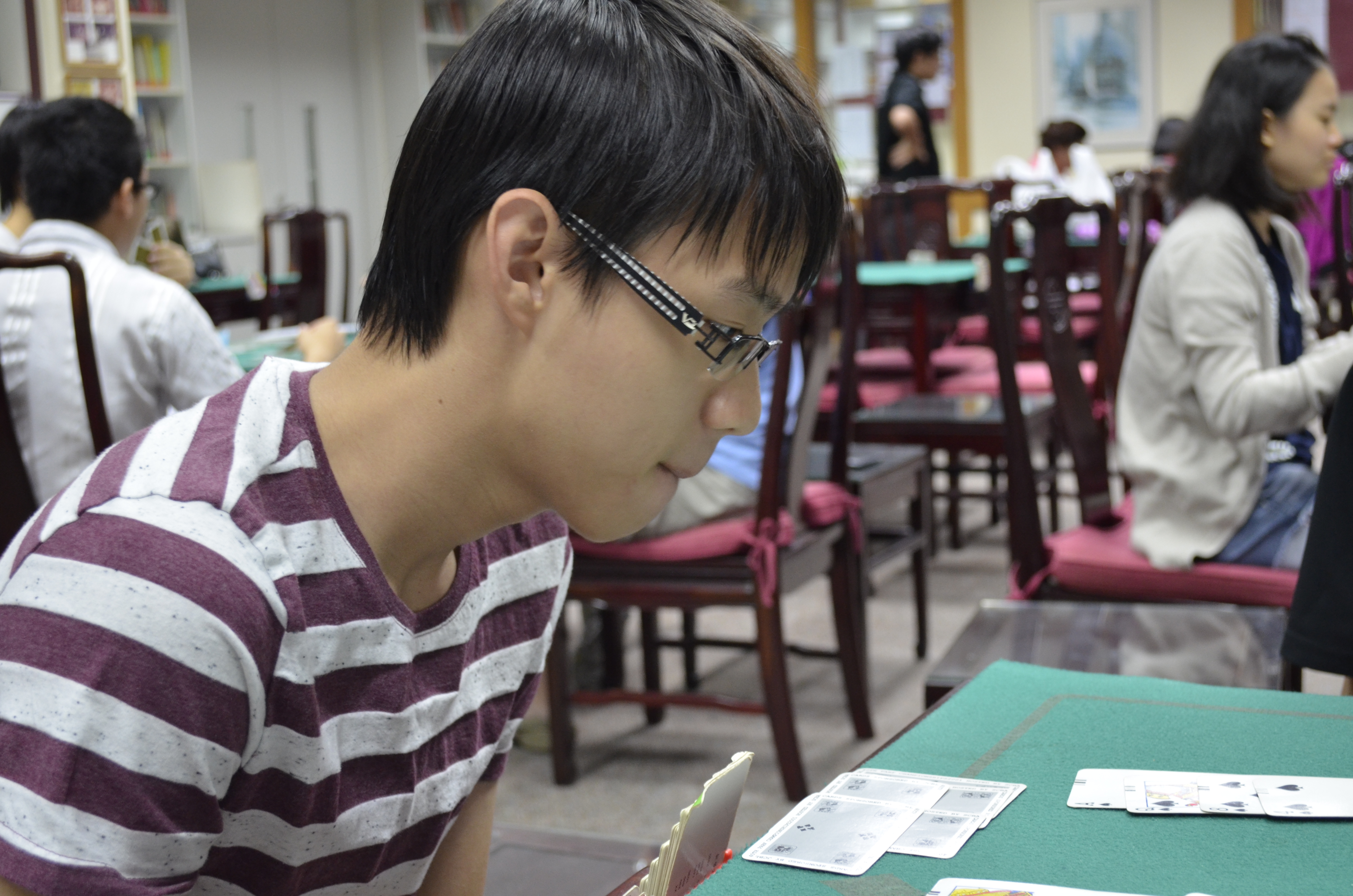
Not allowed to play card games in school? Well, the Raffles Institution Bridge Club gives you an opportunity to do just that! Established in 2004, the club continues to grow rapidly, in terms of membership and the quality of players. Just last year, the club set its place in the local Bridge scene, clinching 4 out of 5 championship trophies across the major interschool competitions. Members have also started to participate in international competitions, such as the ASEAN Bridge Club Championship held in Bali last December, with a 3rd place finish.

564966_10150805472321509_958451354_n

To improve the skills of members, the club conducts its trainings every Wednesdays and Fridays. During trainings, there are usually pair matches and team matches (different Bridge competition formats) to prepare members for all competition types.

Bridge Club is looking for students with an interest for games of mental strength, intelligence, wit, creativity and flair. Members are dedicated to spending time learning about Bridge and picking it up as a hobby, with much passion for improving their skills.

_DSC0151

While some might think that joining Bridge may not add a lot to your curriculum vitae, as scholarship boards will view Bridge as merely a card game, this is far from true. Seniors who have graduated and clinched scholarships have remarked that their interviewers were looking for people with a hobby they were committed to pursuing.

Furthermore, Bridge itself is a highly engaging and interesting game. Unlike many other card games, it is not based on luck but on skill. Your results depend not on your cards, but how you play them. Each hand thus presents a new and interesting problem. Bridge can be said to be a game of strategy, much like chess. One’s tactical decisions at the table often decide the outcome of the game. However, where chess can be said to be likened to a war, where one needs greater experience and overall tactical insight to achieve victory, Bridge is much more like a small skirmish. In Bridge, one must be able to leverage the small advantages available and have a full understanding of the situation, supplemented by tactical knowledge. This is not to say that bridge is a game purely for “intellectuals” or a game where more experienced players always win. Almost every new member of the club is new to the game as well. Hence, new members can learn to enjoy and explore this truly amazing game in a friendly environment at Bridge Club.

_DSC0153

Interestingly, research has shown that Bridge can help in the development of mental capabilities and enhance the social aspects of students’ lives. It also builds teamwork and understanding among students. Tay Min, a member, has this to say on the game: “A winner listens to his partner’s point of view, while a loser just waits until it’s time to express his own.”

As a Bridge veteran once said: “Every hand is an adventure”, so join Bridge to start your adventure!

CCA Preview ’13: Touch Rugby

Reading Time: 3 minutes

by Chan Lee Chin (13S03C0, Louisa Ng (13S03L0) and Amanda Lee (13S07C)

394681_434186759965631_90490696_n 412405_10151046745622999_1569594944_o 556573_3772415503138_1268497247_n

When will “making a touch” determine who wins? When can you play rugby without having to tackle?

With 6 people per team working equally hard on the field and only 20 minutes to make it count, Touch Rugby is a sport that requires an amalgamation of stamina, speed, strength and soul.

Getting well-toned legs, staying fit and healthy and having a chance to chalk up points for the Raffles Diploma (Sports & Health Domain) may be a few perks you associate with this CCA. However, putting the tangible aside, joining Touch Rugby is a unique experience that will benefit you and turn you into an all-rounded individual. Besides honing your mental strength, discipline and composure, you will realize how powerful team spirit and ‘telepathy’ can be. As emphasized by our coach, Mephine Ong, the team believes in having a driven attitude on the playing field. This takes a combination of excellent ball skills , as well as the ability to ‘burn’ your opponent (i.e. run through to score). Touch Rugby is very much a game of strategy and thinking on your feet.

Trials to enter the CCA test one’s physical capabilities – including acceleration, ball handling and execution of basic moves, as well as mental capacities like situation awareness Training sessions, which are held twice a week, mainly focus on picking up different moves, learning to apply them in the game and practicing these strategies. These come into play when the Junior College League kicks off annually from April to June, with many other smaller competitions along the way. However, the passion for the sport does not stop when you graduate, as alumni do go on to join clubs and come back to train the current team.

Coming in as strangers to the sport, everyone starts from the same page, only to achieve exponential progress as the number of training sessions increases. Apart from training, would you fancy roti prata or Island Creamery for supper? Besides monthly birthday celebrations and an annual Christmas event, lunches and suppers help the team turn from strangers to friends to a circle of trust. Having to shower to clean off the mud and wash your boots after training, especially after the rain or morning dew, creates memories and shared experiences within the team, holding everyone together in an even tighter bond.

Expect it to get sweaty. Expect it to get muddy. Expect yourself, along with your comrades, to be aggressive, and driven towards a goal like never before.

That’s Raffles Touch Rugby for you – we dare to try*.

(*try- term for scoring in touch rugby)