R-Rated: Exploring the music tastes of Rafflesians (Part 2)

Reading Time: 5 minutes

By Lim Shaomin (14S03K)
Additional reporting by Jayne Chan (14S03D)

Raffles Press is back with the second portion of the two-part feature, R-Rated! Previously, we explored and analysed the popularity of Pop and Rock, the predominant genres of music many Rafflesians enjoy. This time round, we explore the popularity of two genres that have received recognition only in recent years, namely Indie and Acoustic. The two genres performed exceedingly well in the polls conducted, tying for third place. Here’s what we think about the acclaim of the two genres. We’ve continued with the creation of genre-specific playlists for your enjoyment as well.

Indie Music

Tying for third place with acoustic music, the popularity of indie music among Rafflesians is indeed growing. However, it is admittedly hard to define Indie music. On one hand, you have a “sound”: an eclectic mix of synthesizers, guitar strings, and out-of-the-box lyrics sung in an unconventional fashion. On the other hand, you have a “style”: a combination of various styles that are too lyrically intimate, too soft, too dreamy, too angular.

One or two years ago, if you picked out a random stranger on the streets and asked him or her ‘What is your favourite Indie band of all time?’ or something along those lines, you would probably be met with a furrowing of brows and a flurry of ‘Umm…’s and ‘Uhhhh…’s. Fast forward to 2013 – Indie has almost become a norm in today’s music scene. You see indie bands such as fun. holding full-house showcases here in Singapore, while in August, the much-anticipated indie band The xx will be making their way to our sunny shores for a concert. The popularity of indie music could also be largely credited to the Internet, where websites like Spotify allow singers and bands from independent and major record labels alike to share their music with millions of account users.

Back in the day, indie music merely meant music produced independently, that is, not released by big-name record labels like Sony. Through the years, Indie music has evolved into a philosophy advocating the ‘importance’ of retaining musical integrity, leading ardent fans to term indie music as “true music”. Today, it is a foil to mainstream music (and naturally, pop music comes to mind). More and more young upstarts are dipping their toes into indie waters, hoping to immerse themselves in a world where freedom of creativity is celebrated. So much so, that sometimes, it might seem that the weirder the music, the better it is. An anonymous respondent on our survey commented, “Indie artists are more experimental with their songs, which makes listening to them more interesting.” Another respondent also added, “ Florence and the Machine, Iron and Wine, Turning Page, The Smiths’ song lyrics are more literature-based; their songs are unconventional and beautiful compared to mainstream songs on radio.”

However, indie music is not without its critics. Loyal followers of indie music websites such as Pitchfork believe in obscurity. This goes back to the rising trend of ‘hipsterism’ among youths nowadays: in order to level up against other hipsters, you have to discover new indie artists (albeit, extremely obscure ones) before they become popular. This, of course, raises questions about whether ‘fans’ of indie music are merely trying to outdo each other by listening to bands which are more and more obscure, or are actually enjoying the music they are listening to. To take it a step further, obscure bands are termed ‘obscure’ for a reason.

Another major piece of criticism would be the “mainstream vs. indie” comparison. Indie fans argue that not belonging to a major label makes the music more genuine and sincere. Is that really the case? Sure, pop music is veering towards superficiality and not making much sense, but does that mean there aren’t any good pop songs being produced? Go-to artists for meaningful songs include Michael Jackson (R.I.P.), The Script, and Linkin Park (pre-Living Things).

Lastly, indie music has also been slammed for laziness, resulting in the passing off of ‘boring’ music as ‘credible’ music. You know the kind of song: the one where it all ends strangely, almost as if it were unfinished? Well, the artist would probably argue that finishing a song is ‘just too mainstream’.

Indie music does have a unique blend of melodies and rhythms, and should ultimately be considered an acquired taste. Personally, I started out hating indie music, having been accustomed to cheerful, up-tempo pop beats for far too long. However, it was The Weeknd that first got me hooked. Its sensual melodies and blatant discussion of controversial topics made it a fascinating listen. However, if you’re a little more reserved, a good place to start would be by giving bands such as Angus & Julia Stone (e.g. “The Devil’s Tears) or Passion Pit (e.g. “Take A Walk”) a listen. Who knows, you might just learn to appreciate it!

Acoustic Music

It may be strange to some – how this particular genre of music has seemingly captured the hearts of so many of the Rafflesians who participated in the polls. Though, if you think about it, the expeditious rate at which acoustic music has become one of the most popular music genres among us is hardly surprising. With the inception of YouTube in 2005, many budding singers and music producers took to the video-sharing website to showcase their vocal and instrumental prowess, increasing the exposure of today’s teenagers to acoustic music.

Acoustic and indie music might overlap, but acoustic music is more narrowly defined. It involves the use of non-electronic instruments such as guitars and pianos, as opposed to electric guitars and synthesizers. It is conventionally produced in two forms: through acoustic artists, or oftentimes, through cover artists on YouTube.

The term ‘acoustic artists’ is contestable, since artists with popular ‘electronic’ songs do make acoustic versions of them. However, there are strictly acoustic artists, such as Ben Howard. His more popular songs include “Only Love” and “The Fear”. The other form of acoustic music is through popular Youtube artists such as Kurt Hugo Schneider, Tyler Ward, Boyce Avenue and Conor Maynard (before he was signed to a record label). They rose to fame primarily because people enjoyed their version of popular songs. In fact, Conor Maynard’s cover of Chris Brown’s “Next To You” has received more than 11 million views to date.

However, acoustic music without vocal input also enjoys its fair share of popularity. The Piano Guys, a five-member American musical group, perform and produce their own instrumental arrangements from popular songs, ranging from One Direction’s What Makes You Beautiful to The Hobbit theme song. The millions of views generated on YouTube show that viewers are becoming increasingly receptive to classical instrumental music. It also helps that The Piano Guys are constantly coming up with quirky and innovative ways to bring acoustic music to life, proving that acoustic music can be flexible and fun.

The only downside to acoustic music that we could imagine would be if the cover sounds worse than the original song (the horror!), or if it is dull. For the former, the outrage is understandable. For the latter, it really depends on the artistic direction of the artist.

Overall, acoustic music is a good option as ‘study music’ as it does not include the thumping (and oftentimes, distracting) beats of the original songs, and it has a pleasing, soothing quality to it. This view is reinforced by an anonymous respondent who said, “Acoustic. Perfect study songs and soothes the mind”, when asked to name a favourite genre.


Descent Into Prison Hell – A Former Drug Addict Speaks (Part 2)

Reading Time: 9 minutes

by Bryan Chua (14A01A)
Photos by: Aidan Mock and Mr Harold Tan

Yesterday, we shared with you the story of Mr Harold Tan, a former Rafflesian who fell victim to drug addiction. Today, we continue with Part 2, featuring Mr Tan’s recount of his prison experience, and the things he wants Rafflesians to know, understand and learn from.

If you missed part 1, you can view it here: wp.me/p2mmzG-VH 

****

_DSC1835 (1)

Mr Tan remembered many sleepless nights in prison.  Some inmates had been there a long time and suffered from mental conditions such as suicidal tendencies and depression. They were given anti-depressants in the day but the medication usually would wear out by 3am or 4 am in the morning. Some would then wail, scream or chant loudly and incessantly like mad men. They disturbed the sleep of inmates in neighbouring cells who would yell back at these men with a stream of obscenities, turning the place into a dog pound. It left him wondering – “Where’s the humanity in all of this?” Stuck in the corner of his cell, he awoke to a rough world every morning, a world with people behaving like dogs “barking”; not thinking anymore, just reacting like animals out of the frustration of being caged up.

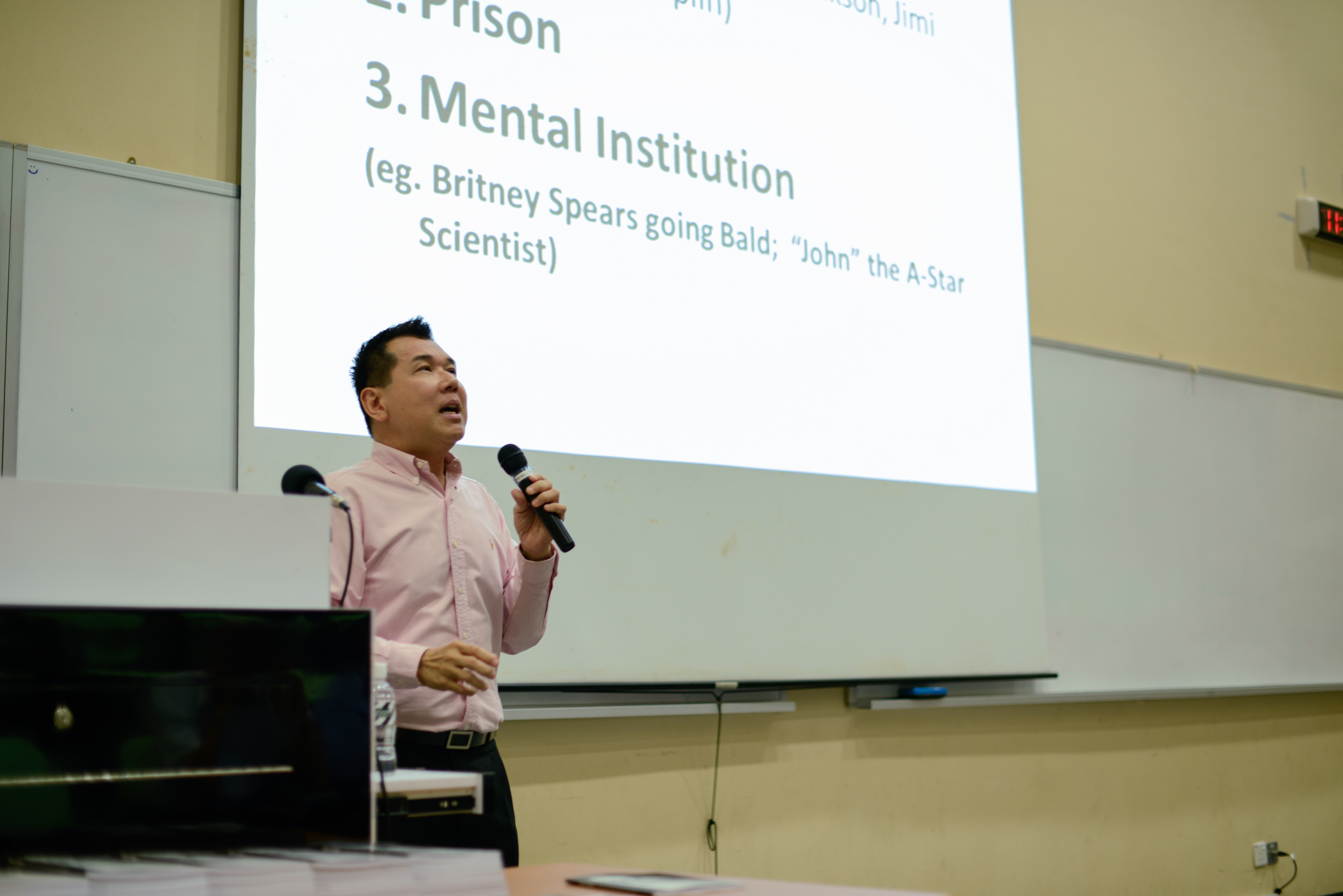
He presented to us the grim reality of the drug life – how it all begins, how it all grows, how it all ends. Yet he uses his experience to remind us of these realities – and how we can avoid them. Mr Tan tells us how he now avoids people using drugs at parties for recreation, and how we will become the most at risk, the growing trend of major recreational drug users being among the young and professional class (the PMETs: Professionals, Managers, Executives and Technicians). He reminds us of things we’ve already read about, but tend to gloss over and forget about – dismissing it as irrelevant to us. “Drugs bring about only 3 outcomes,” he says.

The first is death. Mr Tan cited examples of Whitney Houston, Michael Jackson, Jimi Hendrix, Janis Joplin, just to name a few. He tells us of rubber plantations in Malaysia with makeshift factories producing drugs, and how many more drug labs are creating dangerous drugs targeted at us (young people), synthetic drugs that put us at a greater risk of addiction, and its most grievous side effect – death.

The second outcome being prison – the path Mr Tan went down.

Finally, the third outcome Mr Tan mentioned is being admitted to mental institutions. He cites Britney Spears’ major drug breakdown (when she shaved her head bald in front of paparazzi) as a popular example of how drugs can drive you insane.

_DSC1832

Mr Tan is still grateful for the entire experience, despite all the suffering he had to endure. He met far less privileged people, some without any formal education. He met people who dealt in drugs because they had no other reason to survive – and these are the people you don’t normally meet, he says.

****

He recalls his cell-mate John (whose name has been changed to protect his identity).

John was 34-years old when he shared the same prison cell with Mr Tan. He was an A-star scholar, and made it as a top-grade microbiologist doing cutting edge stem cell research – and evidently knew every effect of every drug on the market. Yet he was suffering from drug addiction to the point he could smoke up to 1g of crystal meth – or S$400 worth – everyday. John was using so much crystal meth, he couldn’t stop – because the more your body gets used to it, the more you need to get high. And he could not sleep for days.

One night as John was playing games on his computer he noticed his computer speed go down. Most of us would think, maybe it’s time to stop, and to check it out tomorrow instead. Mr Tan recalls the story John told, of feeling so high he became paranoid – he started hearing voices in his head. He was 100% convinced that his neighbour was hacking into his computer, despite the fact that his neighbour was a 72-year old retiree. Clearly, the likelihood of a 72-year old man knowing how to break into your Internet system past midnight is incredibly slim – yet John didn’t realise that. This led to John going over to his neighbour’s house, smashing a window and screaming profanities at the neighbour until the surrounding residents called the police. Even his mother couldn’t calm him down; in fact, in her efforts to restrain him, he slapped her. The police brought him to IMH (Institute of Mental Health), where he was given injections to calm him down. After 2 weeks, John was transferred into Mr Tan’s prison cell – yet even after entering the cell, John did not appear normal – his reactions were slow, his hands were trembling and his face was twitching – the after-effects of using too much crystal meth (“ice”).

6 weeks later, Mr Tan recalls John starting to pick a fight with one of his cellmates.

John had suffered a mental breakdown.

****

Mr Tan reflects on his former cellmate as someone who was academically brilliant, but whose personality and mental state was “damaged”.  John was never totally normal even though he had stopped taking the drugs.  John would say repeatedly that he heard voices, an idea Mr Tan finds scary – how would one be able to work when he keeps hearing these voices in his head? How would one be able to maintain relationships?

Having lived with and observed someone like John, Mr Tan is thankful that he did not suffer any brain damage or chemical psychosis.  He is grateful that although he was caught, he was stopped from using drugs before it was too late to turn back or permanent brain damage had set in. Recalling John’s story, Mr Tan realised it could easily have been him suffering from the paranoia, the voices, the mental breakdowns. After all, he says, “I was leading a secret life that nobody knew or could stop.  I shudder to think what might have happened if I was not caught and continued using for years.”

“Would I have become like John?”

****

Despite his past, Mr Tan is now confident of getting back on his feet again. He attends regular Narcotics Anonymous support groups styled like those of Alcoholics Anonymous, and regularly seeks help from counsellors when he needs assistance. He knows this part of his life will remain with him and may leave a mark – but he refuses to let it stop him from moving on and becoming a better man.

“I am not defined by the past or what has happened to me. I am defined by how I live my life now, and how I treat other people. Each of us has a past, some good, some bad… what is important is when you know better, you do better.”
 – Oprah Winfrey

This quote is Mr Tan’s motivation. He looks to stories of people who’ve suffered from drug addictions, or mistakes in their past that could have haunted them for the rest of their lives – but never did. He strives to make amends for his mistakes and wishes to grow stronger for them, to become a better person. He believes standing up and being able to talk about it is the first step to help him move forward with his life.

He acknowledges that because of his actions, he will face many struggles and challenges. Mr Tan recalls his prison counsellor telling him, “Once an addict, always an addict.” Perhaps a pessimistic view – but also a realistic one. Mr Tan tells us he occasionally still has cravings, but is engaged in a 12-step program to help him deal with it, and sees a counsellor to cope. Mr Tan now stays focused on his work, which helps him avoid thoughts of using drugs.

Each time he suffers from these cravings, he reminds himself of how tough life was in prison, and all the people he had hurt and caused severe inconveniences to, as a reminder of the consequences of his actions. “Drug addiction is like a vampire movie,” Mr Tan says. “Once you’ve been bitten, you’re no longer the same.” When you think of the drugs, you can’t resist it because the craving for the drug (like vampires drawn to blood) never leaves you. All we can do then, he says, is learn how to control it and manage our behaviors and choices.

Beyond that, he also acknowledges there will forever be a social stigma attached to him, of being a former addict. Initially, he admits he was totally ashamed and humiliated of the mistakes he had made – and despite being released in 2011, he still couldn’t work, write or even speak with any confidence through most of 2012.

Mr Tan eventually realised that he had to accept the mistake he made, and move on.  He knows he cannot change what has happened, but he cannot continue to be addicted to sadness and failure. It is this realisation, he says, that helped him to move on and save him from himself. “It’s not easy though,” he adds, commenting that it took him awhile to acquire this wisdom so that he can put his life back on track again.

Relationships were a key part of his talk – when asked about the differences in his relationships before and after his incarceration, Mr Tan noted that in the process of trying to get back on his feet again, he discovered his true relationships – the real friends who reached out to him and contacted him after he was released, and continued to care for him and help him through his recovery process. Today, he hopes to continue to be there for his family through the good times and the bad.  He makes time for the people he knows who really love him. He adds, “I will never forget the kindness of my friends who gave me a chance to restart my life. My real friends stand by me. My false friends have abandoned me – but that’s okay. My life is happier and lighter without the users who only hang around me when times are good.”

“I’m better off without them.”

_DSC1837Mr Tan reminded us the importance of keeping such loved ones close, remarking that “as we climb the corporate ladder, it is easy to forget (our relationships).” Looking back, he tells us, “I am no longer just a go-getter, an over-achiever because that didn’t get me anywhere.” He adds, “I’ve never met somebody who said ‘Darn, I wish I spent more time at work.’” He admits, however, this is not easy in our achievement-oriented Singaporean society. Yet he holds true to his belief that we need to place a priority on our relationships, adding:

“When you die, all the images you see will be the people you’ve loved and people you’ve spent meaningful moments with.” He asks the question, “on your deathbed, do you want to regret not spending enough time with the people who’ve cared about you through thick and thin?”

The experience, Mr Tan believes, has humbled him as well.  He is no longer as quick to judge the uneducated gangsters he sees or reads about. He hopes we will discover this virtue for ourselves, this realisation that ex-addicts like himself are still human, that they have feelings and have a heart, the realisation that criticising them merely brings them down further.

“If society continues to be judgmental and unforgiving, what chance do they have to improve their lives?  If we condemn and ostracize them, they may give up trying to do good and revert back to taking drugs because of all the rejections and doors closed on them,” he commented.

He sums up his view in that while it is good to achieve, to work hard, to get the “A”s, we must never lose our hearts because this is what makes us human. He believes it is our heart and the relationships we forge that will help us to recover when we fall down.  Without it the likelihood of us slipping again, and perhaps falling further down, is even greater – and it is hard to disagree with him.

“Life is meaningless without love.”

****

Mr Tan hopes that his words and his story will encourage us to think about the things we take for granted.  To think about the things we say we will never do. His experience tells us that we are all vulnerable – and he hopes what he has shared will open our eyes to the world around us, and the dangers we may face; that we should now begin to be aware of the company we mix with, and the things we do – because no matter what we say, nobody is safe. He also reminds us that we should never be afraid to seek help, that there’s no shame in admitting you have a problem and wanting to fix it.

“Don’t let your own ego hamper yourself.”

His final words to the members of the audience last Wednesday, and his message to all who may read this article: “Do your best, work hard, never give up. When you fall, pick yourself up – and finish the race well.”

“I hold dear to our school motto: Auspicium Melioris Aevi – The Hope for a Better Age, therefore, I look forward to better days ahead,” Mr Tan says, before triumphantly declaring,

“My life has not ended.”

****

Mr Tan has been taking the steps to put his life back on track – he was recently in Manila to teach managers in an Executive Program in Real Estate, and in Kuala Lumpur to make a presentation on other projects he is currently working on. We wish him the best of luck in his endeavours – and fully believe that he will return better and stronger than ever, having put this harrowing experience behind him.

Descent Into Prison Hell – A Former Drug Addict Speaks (Part 1)

Reading Time: 9 minutes

by: Bryan Chua (14A01A)
Photos by: Aidan Mock and Mr Harold Tan

In our previous article on “Sense of a Beginning”, we featured a book written by 5 Rafflesians as a means of spreading awareness for the dangers of drug abuse. The team conducted interviews with those whom have suffered from and are recovering from drug abuse, creating original stories based on these transcripts.

During the launch last Wednesday, Singapore Anti-Narcotics Association (SANA) President Mr. Poh Geok Ek invited, Mr. Harold Tan, a former drug addict, to share his experiences with the audience. Mr Tan shocked and moved the audience with his honesty.

With his permission, Raffles Press has the privilege of sharing the tale of his descent into drug abuse, serving as a stark reminder of how vulnerable we are to this danger. In the first of this two part series, we will examine his descent into the world of drug addiction, and the lead-up to Mr. Harold Tan’s arrest.

———————

Many think of drug addicts as gangsters or low-lifers, people at the bottom of the social structure scouring the dark alleys for a quick hit, people who spend beyond their means and people who are generally labeled as failures in life. We read about drug addicts and drug traffickers in the papers everyday, and we dismiss what happens to them quickly. “It won’t happen to us”, we tell ourselves. “I won’t ever do drugs.”

Yet as Mr Tan recounts, you never know. Sometimes you think, maybe once is okay; “I’ll just try it once, I’ll stop after”. He continued, “I told myself, just once would not hurt. I will try it just once for the fun of it. After that, I will not touch it again.”

He was wrong.

“Not even once!” warns Mr Tan, on hindsight.  “I now know for sure that all drugs are extremely strong chemicals that can get a person hooked without him even knowing that addiction has set in,” he said.

harold tan 1

Mr Tan (above) hardly looks the picture of a man who suffered from drug addiction and was incarcerated. You might be tempted to think – “oh, prison probably changed him, he constructed a new identity and became this person.”

You would be mistaken.

Mr Tan is a former Rafflesian.  In his years at Raffles from 1971 to 1976, he was a scout, a debater, a member of Raffles Players, a prefect and was even teased by his classmates for being a ‘‘teacher’s pet”.

Harold-JLLHe graduated with a PSC Local Merit scholarship and a Jurong Town Corporation Overseas Merit scholarship, and went on to build a reputation for himself as an Associate Professor in Real Estate at NUS, after spending more than 25 years in senior management positions in top organizations.  Beyond his qualifications on paper, his friends saw him as a loyal friend, always willing to help them when they were in need; his family saw him as a caring brother, being the sole breadwinner to support his sister’s university education and a filial son, caring for his mother when she slipped into senile dementia.

Hardly the image of a drug addict.

Yet this is the reality of his situation – behind his successful career and teaching excellence, Mr Tan was tempted to try recreational drugs around 2008.  He was immediately “hooked”.  He then began a “Jekyll and Hyde” existence, leading a secret double life as a drug addict while still performing his role as a professor.

Even more surprising was how he got into drugs in the first place.

“No, not in a back alley like you might see in movies,” he says, but rather via mixing around within his social circle of professional acquaintances.  At parties or clubs, these people who would bring with them recreational drugs – drugs that he believes many of them still use today to lead double lives.  He says he has met corporate executives, engineers, accountants, doctors, lawyers and teachers at these parties and clubs.

Mr Tan first came into contact with drugs at an elegant wine and cheese party. It was a banker who passed a bong around, rather than some shady drug dealer in a dark alley.  The banker said “hey, try this.” Mr Tan thought, “it’s a nice elegant setting with friendly people, so why not?”

Once he started, he couldn’t stop. He was in love with the ‘high’ he got from the drugs, the chemicals providing what he described as euphoria and a sense of extreme alertness or “aliveness”.  The drugs allowed him to hallucinate and experience an “alternate reality” akin to the incredible visual images and sounds that can be see in the movie “Inception” where people can float or fly, and buildings and furniture can morph into different shapes, colours and objects.

“I experienced floating out of my body while lying on a sofa.  Music that I was listening to seemed to burst into a galaxy of colours and patterns floating with me in space like a colourful computer screen saver.  I can imagine and dream whatever I wanted, even though I knew I was semi-awake,” he said.  He remembers entering a fantasy world in hues of blue and green, as if he was in the movie “Avatar”. On another occasion, he recalls floating on a cloud of pastel flowers, or flying like an eagle into a night filled with stars, while he was actually lying motionless in bed.  “The images and feelings were so fantastic and vivid that it was hard to distinguish between what was real and what was not.  Am I dreaming or am I in reality?  I couldn’t tell when I was intoxicated with a cocktail of drugs,” he revealed.

He told us of how various professional people continue to engage in drugs as a method of coping with stress, or situations they find painful.  The drugs quickly became a means of escape, of forgetting or coping with emotional pain or disappointments. He goes on to add, “At every party, I would love to have some (drugs).

“That’s how it starts.  It seemed so harmless.  I thought I was smart enough to be in control of my drug usage. I totally misjudged how potent and addictive they are.”

Mr Tan revealed that he was highly organized in maintaining his professional image while dabbling with enjoying recreational drugs; treating the latter as a “pastime” and an escapade.  When the drugs wore off, he would return to work and could function normally, so no one – not even his family or closest friends – had any inkling that he was abusing drugs. He was truly leading a double-life.

A photograph of Mr. Harold Tan working out in the gym; this was taken prior to his arrest

****

His life crashed when he was arrested in a drug dragnet by CNB (Central Narcotics Bureau) on 16th Dec 2010 for consumption and possession of drugs, including crystal meth (otherwise known as “ice”), and sentenced to rehabilitation in the DRC (Drug Rehabilitation Centre). The moment the news broke, the shock his friends and relatives received was beyond measure. To make matters worse, he was vilified by the press and was lambasted as a “Black Sheep” in articles and blogs.

An article published online, labelling Mr Tan as a 'black sheep'.
An article published online, labelling Mr Tan as a ‘black sheep’.

“Don’t be naive and think of the DRC as those comfortable-looking centres celebrities like Britney Spears or Lindsay Lohan would go to”, he says. His drug rehabilitation centre turned out to be Singapore Changi Prison.

“When I was arrested, I didn’t think I was addicted.”

****

When the news broke in February 2011, Mr Tan had already been imprisoned for a month. As he was being transferred to prison, he was bound at the ankles and at his wrists – as if he was a hardened criminal. Yet only when the prison gates opened did the enormity of his actions hit him.

“A very rough wake-up call,” he called it.

He wasn’t the only one nabbed in the drug bust – yet his story dominated the headlines. He believes that he was singled out by the authorities to serve as a warning to other other professional people to lay off drugs because of Singapore’s “zero tolerance” policy towards drug abuse.

When the arresting officers took his details, he remembers their reaction when they discovered that he was a professor –

“What the hell are you doing using drugs?”

They had never arrested anyone with such high educational qualifications before.

****

He looks back on the experience of being labelled as “Singapore education’s black sheep” as a very hurtful time. It dawned on him then, as a former Rafflesian, he used to make judgments on other people, reading the news of other drug addicts saying, “that will never be me.”

“I was wrong.”

“In fact, sharing the same prison cell with former gangsters, repeat drug addicts and drug traffickers made me realise that I am no better than they are. Many of them led a hard life of poverty, or lacked education.” The drugs provided escape from an intolerably difficult and impoverished life, many suffering from broken families, violence and a sheer need to survive on the streets.

“When I was sharing the same cell with them, they took care of me when I was sick, showed me kindness and encouraged me to serve out my sentence.  I learned that no matter what our education, status or position in life, we all essentially long for love, friendship, comfort, security and shelter.  It was so very wrong of me to look down on drug addicts … I had become one of them.”

He’s walked away from the negative publicity now knowing what it’s like to be under the glare of the media spotlight.  He tells us, “It [the whole experience] humbles you – it makes you realise that you’re no better than anyone else, that you’re wrong when you think can control it (using drugs).”

_DSC1826

Mr Tan tells us how all addictions are the same – cigarettes, computer games, saying that you’re only smoking 5 cigarettes a day, or playing video games for 2 hours every day, or taking just one more drink. Yet it grows: 5 becomes 10, 2 hours becomes 4, one drink soon becomes 10. He says many smoking addicts he has met look at the pictures of cancer on the cigarette packs and say – “that’s them, not me. I go the gym, I exercise.” Yet at the end, Mr Tan reflects, you will face the truth of what addiction does to you – it ruins your life.  Your life becomes “out of control”.

****

Mr Tan remembers that his prison cell was roughly 400 square feet cell (about the size of an average hotel room) – a room which he had to share with 7 other people, and was forced to learn to sleep, eat and use the toilet in the same enclosed space. There were no windows, apart from a small hole in the wall covered over with a perforated grill (to prevent inmates from hanging themselves), covered to the point that very little sunlight – if any at all – would enter the cell.  When the ceiling lights were switched off to conserve electricity in the daytime, it was just dark. Mr Tan calls living in the cell the equivalent of being trapped in a cage; all the heavy steel doors are computerised, and every time the cell door closed, it slammed shut like a heavy vault door closing.

After being incarcerated in prison for 6 months, he was released for good behaviour, but was put on home arrest for another six months.  While at home, he had recurrent nightmares of being trapped in prison, unable to get out and whenever he heard a door slamming, it reminded him of the steel doors in prison. When he consulted a psychiatrist, he was diagnosed as suffering from PTSD (Post-Traumatic Stress Disorder).

****

Mr Tan regrets taking drugs beyond just the personal trauma he suffered. He regrets the grief and pain caused to his family, and the shock to his friends and associates as he witnessed the career he built up over the years come crashing down. Despite being released, he found himself being avoided by some people whom he had worked with.  The prison experience left him broken, lacking severely in confidence, which caused him to spiral into a depression. He recalls becoming reclusive, feeling utterly ashamed and humiliated.

He remembers the days in prison where he would think, “After all my achievements as a scholar and a Rafflesian, has my life come to this, spending my senior years in prison? I accept that I have done wrong and should be punished; all I ask is please do not punish me so hard till you break me. For if I am broken, how can I restart my life and be a useful member of society again?”

“Isn’t rehabilitation supposed to help us reintegrate back into society?”

 ****

Mr Tan’s story doesn’t end here – we continue this with Mr Tan recounting more of his prison experiences, and the lessons he learnt from the harrowing ordeal. Do check back for part 2!

A Handover, and a Quiet Farewell

Reading Time: 4 minutes

By Jeremy Khoo, Lee Chin Wee and Angelica Chong (14A01B)

“There was once where we wanted to surprise Anty for his birthday, but we didn’t know he had a class camp briefing in the Hodge Lodge. The whole council ended up standing outside really awkwardly holding the cake, so we eventually sang the birthday song extra loud and just ran off!” Ashlynna Ng sheepishly admits that the incident earned her a reprimand from her teacher-in-charge. “But I think it was worth it because Anty was so touched.”

It may be the end of her tenure as President of the Students’ Council, but Ashlynna is not the kind to look back wistfully on anything. She may no longer be the President, but the distinctly Ashlynna look and style contained in her close-cropped hair, affable manner and down-to-earth personality that was at the forefront of her public persona as President has not gone anywhere.

Ashlynna at the 33rd Students' Council Investiture, looking cheerful as always
Ashlynna at the 33rd Students’ Council Investiture, looking cheerful as always

She tells us that she wanted to be the Prime Minister when she was ten. Arms crossed, she gazes into the distance when reflecting on her childhood, talking animatedly. She doesn’t just talk, either; memorably, Ashlynna was one of the few girls to shave during Hair for Hope last year [http://rafflespress.com/2012/07/22/your-son-ah/]. Her short hair is a lingering mark of her decision —  before she shaved, she used to wear her hair in a ponytail with a hairband.

“It was to get rid of the notion that for girls, appearances are very important.” she says. “Even for the women leaders in our world today, like Hillary Clinton – even when the media talks about her, the first thing they say is that she’s wearing a very nice pantsuit and I’m like, what has that got to do with anything?”

Ashlynna at last year's 32nd Students' Council Investiture, with her hair tied back in a ponytail
Ashlynna at last year’s 32nd Students’ Council Investiture, with her hair tied back in a ponytail

It is this sincerity that has marked her term in office, leading her to launch initiatives like the Smile Challenge, an attempt to get people in school to smile more at each other. To Ashlynna, school should be much more than just a glorified gateway to university. In her words, the school culture needs warmth — it can’t just be a place where people only focus on getting their own stuff done.

“The smile is a symbol of people connecting with each other in school …it’s important for us to look outside our own little bubbles and try to connect with people.”

She acknowledges that people may not actively be thinking about the Smile Challenge anymore but she still holds out hope regardless. “If we can get the councillors to continue doing it, it may over time become a more natural part of school life,” she comments optimistically. “Just because (the RI Year 5-6 side) is a bigger place doesn’t mean we shouldn’t make that effort to connect with the people around us.”

It was this personal touch and focus on building a school community which Ashlynna feels distinguished her time in charge from her predecessors’. “Our vision was ‘Family, Connection’. ‘Family’ was to do with things internally — because our batch is relatively large with 79 people, it is a big group of people to get to know and be comfortable working with,” she shares. “Externally it’s also about the personal touch, reaching out and being service-orientated, really trying to think of the people.”

Ash 3Despite her earnest belief that the Students’ Council plays an integral role in enriching school life in RI, Ashlynna is acutely aware of how the Council may be perceived by some segments of the school population. “We’re not like the Discipline Board, where the first and foremost priority is to be a role model for their peers,” she argues. Ashlynna goes on to explain, “For our batch especially, we focused on a lot of leadership training, in the sense that we highlighted how their actions have larger repercussions on the school and how they themselves are role models.”

The fact that Council is an elected body does give them a popular mandate, but it is easy to overlook Council’s administrative responsibilities. “We strive as much as possible to hit that pinnacle of leadership but the thing is, the nature of the job scope we’re already given is very organizational,” she admits. “I would like to say that we try to make sure that all councillors are role models, but leadership is quite ambiguous, and we all have different notions of what leadership is.”

Her idealist credentials are certainly burnished: she is buoyed by Barack Obama’s charismatic leadership and cites Hillary Clinton as an inspiration for her personable leadership. Thus far, it seems that leadership has treated her well: her experience has only reinforced her convictions. She is no Quixote — she is aware that at some point, the knife blade of the Here and Now will puncture the garment of her Reality – but she holds cynicism at bay. The success or futility of her effort will remain to be seen.

“I think people should participate more. I feel everyone has a stake in what’s going on, and no one should give up that ownership. Everyone can make a difference. This is my idealism, which has yet to be crushed by the cruel world.”

Still, all things must come to an end. With Ashlynna, Antariksh and Arjun’s farewell speech at assembly last Tuesday, the tenure of the 32nd Student’s Council, and its President, has officially ended. (Ashlynna marches onward, looking to the A-Levels and hoping to conquer Math for the last time.)

If she’s not a Councillor anymore, we ask, will she choose to take off the Councillor’s badge? “Some people choose to take it off, to move on,” she says, “but I plan to continue wearing the badge — even though our term may be over. I still think that we have a duty to continue striving to be a positive influence on the school culture even after we step down. I think the journey of leadership never ends.”