School Life

Judo Team Clinches Silver for Girls and Championship Title for Boys

Reading Time: 5 minutes

By William Hoo (15A01E)

A few weeks back, RI’s Judo A Division team headed down to Hougang Seconday school for the National Schools Judo Championship. After defeating Nanyang Junior College in the semi-finals, our Judo boys and girls were set to face off against one of our fiercest rivals, Hwa Chong Institution (HCI) in the team finals. Despite having faced HCI in previous years of the competition, the team was well-prepared and confident for this encounter in the finals, having trained extensively in the months leading up to the National Schools Championship. This year’s team finals indeed showed that the Gentle Way did not necessarily mean a gentle fight.

The atmosphere as both schools got ready for the team final was tense and fierce, with both judo teams performing their club cheers with pride. The format of the team event consists of five bouts played between opponents, with one member from each weight category. Each bouts lasts for three minutes, during which players aim to score an ippon. The victor of the event is determined by winning three out of five bouts. This did indeed set the stage for a suspenseful and exciting match for both the A Div boys and girls teams.

GIRLS

The first match was between the A Division girls of RI and HCI.

The line-up for RI’s A Division girls by weight category consisted of Cheong Hui Shyuan (-48kg), Amanda Chia (-52kg), Tania Forichon (-57kg), Joey low (-63kg) and Joyce lee (+63kg).

The opening match was easily won by Huishyuan, catching her opponent off guard while they were fighting for control over each other and ending the bout with several nicely-timed foot sweeps.

The second bout witnessed Amanda fighting valiantly, with her best effort. Both players were locked down gripping each other, but her opponent attempted a throw and managed to bring Amanda down to the floor. Her opponent pinned her down, and in spite of her best efforts at trying to bridge her opponent over, Amanda lost the second bout through groundwork.

With the current score even at 1-1, the third bout started with both Tania and her opponent playing aggressively, vying for a hold on each other. While there were a few close calls where Tania was almost thrown by her opponent, or pinned down after being brought to the floor, she remained composed and was able to parry each attempt. After a stalemate in groundwork, the referee resumed the bout anew at the centre of the arena. Tania seized the opportunity as her opponent went into defensive play, and threw her swiftly with a back throw, winning the bout for the team.

The fourth bout saw Joey putting up a strong fight against her opponent, with plenty of attempts by both parties to throw each other. Scores were awarded to both of them as the bout progressed. However, as the bout dragged on, Joey and her opponent engaged in a lot of intensive groundwork, each trying to pin down the other. Despite some considerable effort and spirit on her part, Joey narrowly lost to her opponent by points at the end of the bout.

The last bout of the A Div girls team event was a nail-biting one as it was the last deciding bout for both schools in order to clinch the championship. Supporters from both Judo clubs rallied in support of their judokas.

The match started in a flurry of aggression, with both Joyce and her opponent engaged in heavy groundwork – resisting each other while simultaneously seeking to pin the other down. However, Joyce was unfortunately caught off guard at a key moment, resulting in her getting pinned down by her opponent. Although Joyce tried her best to break free of the hold and bridge her opponent over, she was unable to do so and lost the bout.

IMG_20140402_164254 (1)
RI’s A-Division Judo Girls Team

Hence, with a score line of 2-3, RI’s A Div judo girls conceded victory to HCI for the team finals, coming in second and winning the Silver title for the school. Regardless, their effort was no less laudable and their team spirit really showed through with the immense support their batchmates provided throughout all their trainings together.

BOYS

The next match for the day was the A Division boys’ team finals, which showcased a spectacular display of skill from both schools.

The line-up for RI’s A DIv boys by weight category consisted of Davis Yep Swee Kiat (-60kg), Ong Jia Xiang (-66kg), Julius Sander Nugroho (-73kg), Henry Neo Jin Hong (-81kg) and Wei Yong Ji (+81kg).

The first bout for the A Div boys saw Davis being pitted against his counterpart in the Feather weight category. Catching his opponent off guard, Davis managed to counter his opponent and was awarded a score. His opponent eventually went on to concede two fouls through defensive play. Davis won his bout by points at the end of three minutes.

Jia Xiang played the second bout, with both players fighting each other for dominion over the other and grappling to throw each other. Unfortunately, while Jia Xiang played really well, he was brought down to the ground and subsequently pinned down, losing the bout.

With the score at an equal 1-1, Julius entered the third bout, facing up against HCI’s captain. The first point was awarded to Julius as his opponent conceded a foul for overly-defensive play. However, Julius was penalised shortly after for the same reason. The next point of the bout was awarded to Julius for a small throw, but the score was quickly equalised when his opponent threw him for the same score later on in the bout. With time running out, Julius caught his opponent off guard with a massive throw, scoring a major point. The bout was thought to have been won by Julius when in the final five seconds of the bout, HCI’s captain threw Julius for a major point that sealed a win for HCI.

The fourth bout featured RI’s Judo team captain, Henry who took an early lead with a foot sweep early on in the bout. He then went on to secure a win for the team by throwing his opponent, getting a full ippon.

Once again, the A DIv boys’ team finals proved to be exciting and nerve-wracking as well, with the score being equalised at 2-2 for both RI and HCI. The last bout would again be the deciding factor for the championship.

The last bout of the A Div boys’ team finals was nail biting from start to finish, as supporters from both RI and HCI yelled words of encouragement to both players. The early start of the bout saw Yongji conceding a small point. This was slightly demoralizing, but Yongji rose to the occasion, turning the bout around by throwing his opponent and following up with a pin. The hall of Hougang Secondary School was filled by cheers all around as Yongji secured the win and the championship title.

IMG_20140402_164724 (1)
RI’s A-Division Judo Boys Team

Hence, with a score line of 3-2, and after an intense showing by both RI and HCI, our A Divison judo boys brought home the championship title for RI.

IMG_20140402_165644
The Raffles Judo family

The good showing of RI’s Judo A Div team was the result of months of training and encouragement from their coaches, Mr Tan and Mr Low, as well as the teachers, Mr Kok, Mr Eng and others.

Raffles Press would like to congratulate the A Div boys and girls judo team for their stellar performance in the National Schools Judo Championships. Here’s wishing all sports CCAs the best of luck in the upcoming 2014 season.

Shooting to Win: Of Guns and Grit

Reading Time: 3 minutes

Raffles Press would like to express our appreciation to Shooting, for giving us the opportunity to experience a day in the life of a competitive shooter. If you would like to have your CCA featured on our student newspaper, do drop us an email at press.raffles@gmail.com.

By Radiya Jamari (14A03B)

Tucked away in a quiet corner of the school campus, adjacent to the basketball court, lies the shooting range. I, along with a few friends, was recently given the opportunity to experience the training that our school’s shooters have to go through every week. Perhaps some of us have preconceived notions about the sport, and may question the physical intensity of the shooters’ training. Stand, aim, fire – what can be so difficult about standing still and using only a finger to pull the trigger, right? I assure you that there is more to shooting than meets the (bulls)eye.

Shooting is no child's play.
Shooting is no child’s play.

Shooting is categorised into two events: the air pistol and the air rifle. Both are fired, using pellets, from a distance of ten metres. The air pistol has to be controlled using only one hand, in a standing position perpendicular to the target. For better balance and stability, my air pistol mentor instructed me to put my free hand in my pocket. I asked her for a demonstration on how to hold and fire the air pistol – and it looked easy enough. So I got into position, composed myself, aligned my pistol to the target, and fired a shot. It missed the target. Looks can be deceiving: while my mentor had a good grip and control of the pistol because she had been trained, I, on the other hand, had great difficulty stabilising my hand. Being the inexperienced shooter and naturally clumsy person I was, my hands were trembling quite a fair bit due to the weight of the pistol. I believe many of us may underestimate the physical endurance and stamina it takes to simply stay put and control our actions. In a sense, shooting is a sport that is unique from others because it does not involve the same motor skills; however, it requires the same amount of physical strength and exertion, and even greater hand-eye coordination.

I ended up having to sit down and hold the pistol with both hands first, before eventually having the confidence and stability to stand and fire single-handedly. Next, I moved on to the air rifle. Naturally, due to its size and weight, it is handled using both hands. The standing position was trickier to get used to: feet apart, the base of the rifle resting on my left knuckle, and my left elbow resting on my hip, such that my left forearm, hip, and left leg would form a vertical frame to support the rifle. Sounds tough? In the Olympics, the male competitors have to fire 60 shots within 105 minutes; for females, 40 shots have to be fired within 75 minutes. I could barely maintain my position for two minutes.

Yet what struck me was how my air rifle mentor stressed the importance of relaxing myself and gaining composure before taking a shot (he even taught me a few breathing exercises). While physical strength was also necessary to carry and support the air rifle, what was even more essential was the mental strength it took to maintain that position, and to concentrate instead on the aim and accuracy of the shot. I believe this was the first time that I had taken part in a sport where I was not gasping for breath, but I was instead learning to control my breath to gain stability, composure, and focus.

Like any other sport, shooting also involves a risk of injury. Shooters wear specialised clothing and gear to improve stability and prevent chronic back injuries.

Beyond the muscular strength and almost superhuman balance needed to be a shooter, what really struck me were the psychological demands of the sport. It was truly a game of marginal fractions and slim percentages – as much as I celebrated every successful shot, I grew to appreciate the unerringly mechanical precision required of competitive shooters.  While we are often confronted by tragic stories of mass shootings that seem to take place far too frequently, I think many of us forget that what matters is ultimately the will of the person behind the trigger. In the hands of a trained athlete, elegance comes from the barrel of a gun.

Exitus acta probat: Explaining No Shoes Day

Reading Time: 5 minutes
This letter was written by the Heartware 2014 Organizing Team in response to an opinion-editorial piece contributed by one of our readers. You can read the original piece (Acta Non Verba: One Day Without Shoes) here.
Kenya shoes

No Shoes Day is just around the corner (Thursday, 17 April).  An annual initiative by the Raffles Community Advocates, this event aims to raise awareness about the issue of poverty in developing nations. The act of taking off one’s shoes for a day has become a key feature of CA’s advocacy efforts, and will hopefully become a lasting tradition. However, we are aware that concerns have been raised about the usefulness of the project, and would like to take this opportunity to answer any questions or doubts that you may have.

A key concern raised in the recently posted article is that the influx of donated foreign-made shoes will destroy local cottage industries, causing local shoemakers to lose their jobs, resulting in the local community becoming over-dependent on foreign shoes. Based on our own research as well as discussions with our partner organization, the Tana River Life Foundation (TRLF), we are glad to share that the upcoming shoe donation drive will not threaten the livelihood of local communities.

Most importantly, the part of Africa the shoes are being sent to does not have a significant shoe-making industry. The shoes are going to the Tana River County, specifically the village of Isdowe. This village relies almost exclusively on agriculture, with the majority of villagers being farmers – it does not have a local cottage industry to make shoes. When villagers do buy shoes, the shoes are likely to come from larger manufacturing businesses located in larger cities in Kenya such as Mombasa and Nairobi. These manufacturing businesses, being much larger, are less threatened by donations of shoes. In particular, the limited number of shoes we donate every year (a few hundred) will not cripple local industries. Rather, the real problem is with large multi-national corporations, such as TOMS, which routinely and unscrupulously dump enormous numbers of shoes, along with a massive influx of cheap Chinese imports. This larger problem of Chinese imports will only be solved through economic policy, such as by the imposition of higher tariffs, or with World Trade Organization agreements. The number of shoes, as well as the breakdown of local industries, needs to be taken into context in examining this project; in particular, one needs to balance whether the shoes donated will do more harm or good. As elaborated upon below, the small number of shoes donated through the TRLF do significantly benefit local villagers.

Rather than simply introducing a free handout that encourages a dependency on foreign imports, the shoes serve to encourage entrepreneurship and create business in the local industry. The Mitumba project serves more as a microfinance scheme, providing capital for local entrepreneurs as well as providing the training and business skills they need to succeed. This is because, instead of just handing out the shoes, the shoes are sold to local villagers who pay $0.50 for each pair of shoes. They then receive entrepreneurship training, learning how to sell and market the shoes. The villagers, who then sell the shoes at $2.50 per pair, can then go on to use these skills to run businesses in the future. Without entrepreneurial skills, many local businesses in fact fail due to poor management. The TRLF views this as a way to help villagers in a sustainable way that respects their dignity and self-sufficiency. The payment for the shoes is treated much like a bank loan, which must be paid back; indeed, all beneficiaries last year had excellent credit discipline with no bad debts, and they submitted receipts to prove that the supplementary income was used to send their children to school. The 56 beneficiaries of the project were in fact women whose main profession is farming – without the skills provided them to run a business on the side, they would not have had enough additional money for education.

Moreover, the shoe donations to TRLF benefit the local community there in many long-term ways, going beyond the immediate donation of shoes. The Tana River Life Foundation has many other projects to benefit the local community, of which this project is only one. Out of the shoes donated, the shoes which are broken, old, or cannot be used, are first sold to the garang guni or sold in jumble sales in Singapore. Last year, sales made to the garang guni made S$1457, and the jumble sales raised S$5569. TRLF in fact places much more focus on this money raised as opposed to providing the villagers with shoes. Rather than this money simply being a handout, the Foundation invests this money in the local infrastructure, building schools, providing mobile libraries and improving classrooms, and rebuilding farms that were destroyed in floods. An example of how they improve local education would be by setting up the Delta Mustard Seed Academy, which educates 115 children of the Tana Delta river tribes. The entrepreneurship scheme is not only extended to the women who sell the shoes; training is also given to local youths to set up and run small businesses, learning trades such as mobile phone repairing. As the author of “Acta non verba” rightly pointed out, the correct way to help poor economies is through the introduction of capital, training, and infrastructure, which creates jobs and an independent economy. Most importantly, it gives the villagers dignity, and a way to break out of the cycle themselves.

No Shoes Day can indeed be seen as “slacktivism”, as it is true that taking off one’s shoes may just be a “feel good” gesture, that does not directly benefit the Kenyan locals. However, we hope that through this publicity gesture, we will generate greater meaningful debate about helping developing countries, and the ways in which one can help. Those participating can contribute by explaining the project and donating shoes. Hopefully, the participants will find it meaningful enough to be inspired to find more direct ways to help.

“What have I been taking for granted? What do I have to share?”

We hope that everyone who participates in No Shoes Day and in Heartware 2014 can better appreciate the little things we have around us.

We appreciate alternative viewpoints on this project, as well as on the wider event of Heartware 2014. Thank you for generating debate and giving us a chance to explain No Shoes Day, and we look forward to more discussion on the concerns raised. Excita acta probat: we hope that the outcomes of our work will speak for us.

For more information about the Mitumba Project please proceed to the following link: tinyurl.com/mitumbaproject14

Mr Gabriel Teo the founder of Tana River Life Foundation will be coming down to RI on Wednesday, 16th April 2014 (tomorrow) to give a talk about the foundation and what projects they are currently embarking on. Accompanying him will be three Kenyan youths. Please drop by LT6 (Block J)  from 2.30-3.30pm if you are free!

Water Polo Girls Maintain Gold with 10-1 Victory over TJC

Reading Time: 4 minutes

By Yeo Jia Qi (15S03H) and Teo Kai Wen (15S03H)

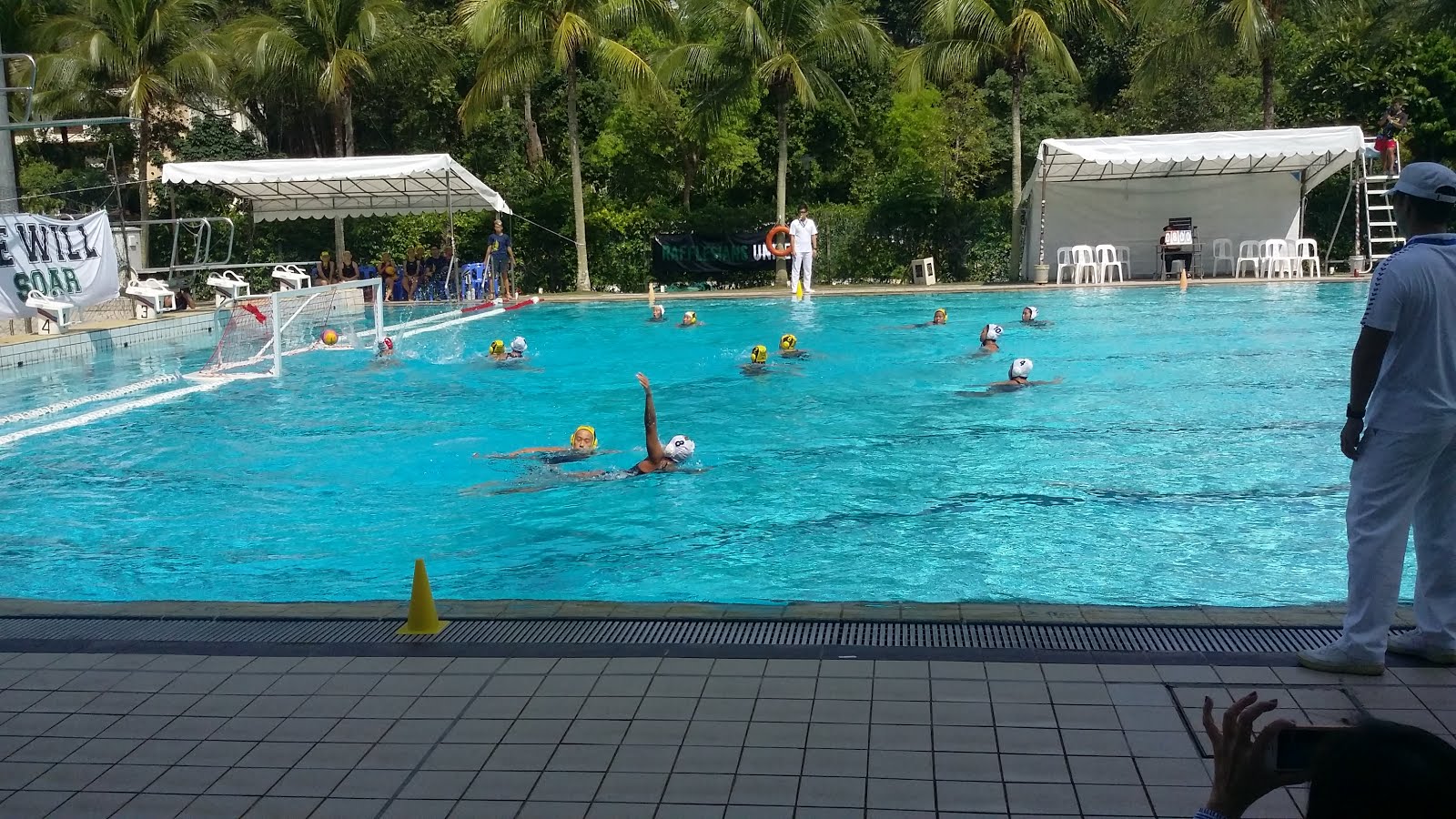
Having defeated Temasek Junior College (TJC) 7-2 in the preliminary stage of competition, RI’s A Div water polo girls no doubt entered Thursday’s final against the very same opponents with some degree of confidence.

Back-and-forth cheering between the TJC supporters and RI councillors, as well as some prospective Council nominees, preceded the start of the match at MOE Co-Curricular Activities Branch. While the TJC supporters came armed with plastic clappers, the banners hung at the RI end of the pool and the drum brought along by CCAD for coordinating cheers ensured that our supporters were not outclassed.

RI Councillors putting up support banners before the match

The match started somewhat slowly, with both goalkeepers saving long shots across the pool, but soon gained speed. After a disallowed goal, RI managed to keep the ball in TJC’s half for a full minute, and the pressure produced results when Richelle Ang (#8) finally managed to send the ball past the goalkeeper. This energised the RI team, which continued to dominate possession and keep the ball in the Temasek half. The second goal came two minutes later in dramatic fashion when a shot on target hit the top of the Temasek cage, bounced back and was palmed past the TJC goalkeeper by Clarinda Tan (#6), triggering cheers of “Raffles Dynamite” from the councillors. Later, RI coach Mr Lim Yao Xiang would remark that the girls displayed such confidence that all that remained for him was to “take a back seat and let them play their own game”.

10.12.50.jpg
The second goal

In the second quarter, RI seized possession and made it 3-0 20 seconds in. This time round, TJC put up a more resolute defence and the fourth goal only came 3 minutes later from a remarkable shot over the entire Temasek defence line. Despite a stout defence, Temasek still could not get the ball out of their half. More drama ensued after a RI was awarded a penalty shot, which unfortunately sailed over the cage. Moments later, RI substituted four players, increasing the speed of the game, and Rachel Lee (#12), one of the four new players, immediately found her mark as she scored a shot over three Temasek defenders.

Incredible defending by goalkeepers Joanna Chue (#1) and Stephanie Sim (#13), as well as two lightning shots by Neo Serhan (#7) in rapid succession, ensured RI led by a margin of 7-0 at halftime, giving the councillors good reason to put up an intimidating display of “Rafblood” and “Ichiban” cheers.

In the second half, Temasek ramped up the pressure but failed to capitalise on the RI defence, being repeatedly frustrated by the time limit of 30 seconds they had to attack the opposing goal. The TJC goalkeeper, repeatedly shouting a ten-second countdown across the pool to encourage her team members, made quite a few excellent saves, and the pace of scoring slowed. Nethania Low (#10) and Rachel Lee (#12) nonetheless managed to score one more goal each, making it 9-0 before the final quarter.

10.44.17.jpg
RI scores their 9th goal against TJC

The final quarter commenced with a spate of fouls and determined marking of RI players by their Temasek opponents. Determined to stop conceding goals, TJC further intensified the pressure on RI forwards, with 3 defenders challenging one RI player holding the ball on more than one occasion. Rising to the occasion, RI mounted a comprehensive attack on the Temasek defence, resorting to long passes with unerring accuracy over TJC players, and Clarinda Tan (#6) of the RI team finally made it 10-0 before Richelle Ang (#8) found her shot saved twice. In the nerve-wracking last minute of the game, Temasek finally found the RI cage with a long shot from the halfway line, but subsequent attempts on goal were stymied and the final ended with raucous cheering from the RI supporters.

waterpolo
RI supporters and the team sing the Institution Anthem after the match

After the match, coach Mr Lim Yao Xiang admitted that they “didn’t expect to win by so much”, but also remarked that the girls “fully deserved” their win because “they trained really hard and even throughout last year’s promos they did not stop training on their own just to improve”. He also said that the team was one of the “most united teams [he had] coached so far” and that their “chemistry on land [was] really reflected in the pool”, which explained their fitting win.

They put in a lot of effort more than the competition. Every holiday they will ask whether they can come back to school for extra training, so I’m the one that needs to say ‘give me a rest’, so that says a lot.

On Thursday mornings they start swimming at 6am at the RI Hong Leong pool in the cold, in the dark for an hour. That’s something that no one actually knows [so] they deserve every bit of their victory.

Raffles Press would like to congratulate the A Div Girls’ water polo team on defending their National Champions title for the 8th year running, and wishes all sports CCAs well in their matches and games to come.


World Autism Awareness Week 2014

Reading Time: 3 minutes


On behalf of the Raffles Community Advocates

10173601_695196610518446_974113883_n
World Autism Awareness Week 2014. Celebrating colours in our lives.

As a typical bored student scrolling through your Facebook newsfeed on the 30th of March, you may have noticed that a number of friends suddenly set the exact same profile pictures. How exactly did this mysterious phenomenon happen?

For those curious souls out there, the 30th of March marked the start of Autism Awareness Week.

As the name might suggest,  this is a week for the spreading of awareness for autism. But before going into what Autism Awareness means, the bigger question is: why dedicate an entire week to it? Beyond vague recollections of Rainman, Forrest Gump, or that Jodie-Picoult-character-you can’t-really-remember-the-name-of,  (they were all… kind of autistic…. right? right?), nothing really comes to mind about about autism besides silly insults that are supposed to be insensitive to…. some unfortunate people you’ve never met.

And therein lies the problem – unlike the widely touted diseases of cancer and heart disease, no one really knows what autism really is.

Autism Spectrum Disorder (ASD) is a lifelong developmental disability characterized by great difficulty in forming relationships with other people and in using language and abstract concepts. Does that mean that that socially awkward guy who sits in the corner of your class is autistic? Not necessarily so. Autism is an actual diagnosable condition (which we will be telling you more about this week) however, the most important thing is that it is just a label – a label that does not define who they are. Yes, there are differences. But what is more important is that they are just like us, with big dreams, big beliefs and big aspirations. These people could be so much more, yet much of their potential is being thrown away because we tend to focus on the disability itself rather than them as people.

And that’s why we have World Autism Awareness Week. To show that children on the autism spectrum shouldn’t be viewed any differently. To lift the chains of prejudices and stereotypes that we shackle them with. To prove to the world that autism is a word, not a lifelong sentence. This WAAW, challenge yourself to look beyond. Everyone has aspirations, and everyone is a winner in their own right.

So, what can you look forward to in this WAAW?

Like and follow the Facebook page at http://www.tinyurl.com/RIWAAW2014, as members of Community Advocates bring to you facts and myths about autism. Check back daily to receive new updates and opportunities to do more to help children on the autism spectrum! We will also be featuring stories and experiences from various Rafflesians, so do check it out.

Apart from that do also look out for #riwaaw hashtags on Twitter. It would be great if you could use the hashtags and tweet about the new things you have learnt this week! CA will be displaying a live Twitter feed in the canteen during your break times alongside some videos they’ll be screening regarding autism. In the canteen, you might also find that each table has pieces of paper attached to it containing facts and short excerpts on autism that you can take the time to read and learn more about.

Last but not least, do look forward to our extremely excited and ferociously friendly CA members approaching you with their eager whiteboards at the end of WAAW and be bold in sharing what you have learnt from it and how your perception of people on the autistic spectrum has changed!

World Autism Awareness Week 2014. Celebrating colours in our lives.


If you’ve got interesting facts/quotes/personal anecdotes/videos/photos/projects/anything related to autism to share, we want to hear from you! Head over to http://www.tinyurl.com/riwaaw2014submissions and say whatever you want to say. We’re also open to questions being asked.

Have a great autism awareness week ahead, all!