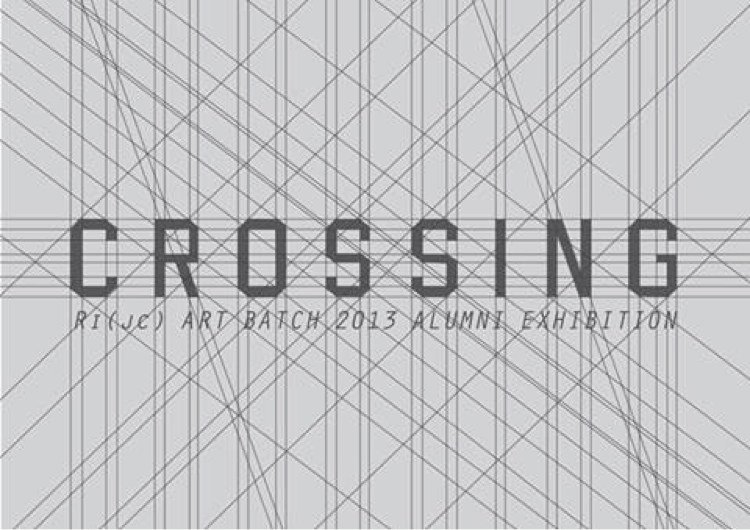
Last Friday was a night for the arts. Despite sheeting rains, throngs of Rafflesians swarmed the amphitheatre in anticipation of The Poetry of Movement, while Raffles Photography Society’s Anamorphosis and Raffles Art Club’s Up had taken over the adjacent walkways. In a corner of Block A, a warm glow unfurled from the usually disused art exhibition space. This was Crossing, a joint showcase by the most recent batch of graduated art students encapsulating their progress at a point when they are about to embark on their respective university educations.
A significant turnout for the art alumni’s collaborative exhibition
Although the space was only meant to open at 7.30pm, a steady stream of alumni and students from other schools began trickling in beginning from 6pm. Walking in, William Batara Jeremiah Samosir was seen animatedly talking to two J2 art students about his coursework boards: “That’s the good thing about art – you can never have something perfect.”
Seet Yun Teng articulated its significance thus, “For us, this showcase tracks our progress, letting us see where we are now. It’s a milestone in our lives, tracking how far we’ve come and where we’re going, which is very important especially for those of us who might not be going down an art path in future. For our batch, it’s like closure.” Of the ten students, four will be attending a fine arts education, including Yun Teng and William. Two others hope to study architecture.
Pursuing something as demanding as art demands a great deal of passion, which these alumni did not lack. Asked what her most valuable takeaway from JC art was, Yun Teng said, “What I like is that art here really opens the mind up and encourages experimentation and independent work, which you don’t really see in other schools […] Art here showed me that it is possible to do art beyond JC. There’s a perception that it’s not possible to study art at a higher level, but my time in art convinced me that this is really what I want to do for the rest of my life.” Yun Teng is currently interning at the National Arts Council.
William’s evocative installation was a heartfelt commentary on the feeling of displacement from being in a foreign country, and parental love.
Similarly, for William, art was clearly something both tied to the self and indispensable: “Art is a language in itself, you use it to express things language can’t really express. It’s like a religion and a philosophy […] a real and total reflection of your life and experience. And I think art is meant to be shared.”
A closeup of one of the hundred memories, printed on tissue paper, making up Seet Yun Teng’s coursework.Tan Yan Yong’s coursework, entitled Course, was a maze installation featuring quirky larger-than-life illustrations of the inhabitants of the gastrointestinal tract.Chia Yu Xuan’s installation drew on the properties of temples to create an immersive spiritual experience.
Share it they did. The artworks on display at the exhibition that day spanned a wide range of materials, from oil on canvas to mixed media to illustration to video to installation, and grappled with various subject matters ranging from social identity to spirituality. Since a coursework concept is developed over the span of up to a year, many of these artworks were extremely personal, offering an insight into the artists’ worldviews and what they held dear to their hearts. Yun Teng’s work, An Open Call for Memories, was a ten-month process. She collected memories from over a hundred people in pictures and text which they either wished they remembered or wanted never to forget. The images were printed on tissue paper to symbolise fragility, mounted on the interior of a Styrofoam space, backlit with small lights and the anecdotes painstakingly handwritten in gaps in the Styrofoam. The resultant immersive installation was a cosy space suffused with warmth, allowing one to literally get a glimpse of the fragile, precious memories of all contributors. Said Yun Teng: “It’s a very personal work for me, but at the same time it’s very universal because it speaks to a wider audience.”
Eugene Tan’s Die-abetic Me photoseries
In addition to their coursework, each artist also displayed samples of work they have done since graduation, which were more experimental in nature. William featured Clouds ‘n’ Thoughts, a popular ongoing instagram-based project dedicated to illustrating pithy quotes that anyone can submit here. Another student, Ahmad Nazaruddin, submitted a glass and charcoal-on-paper work addressing the prickly subject of religion. Eugene Tan, whose trompe l’oeil triptych oil painting drew considerable interest from exhibition-goers, also submitted a photoseries exploring the sinister nature of seemingly innocuous candy, aptly titled Die-abetic Me. Having been liberated from the constraints of the A Level system, each of them evidently seized the chance to explore their interests and take more risks. When comparing each artist’s past courseworks to their present experiments, one can clearly see how their skills and conceptualisation abilities have progressed since their graduation, as well as their flexibility in dealing with a diverse range of topics of interest.
Four of ten exhibiting artists, and their teachers. Left to right: Ms Amanda Poh, Miss Julie Lee, Seet Yun Teng, Ahmad Nazaruddin, Tan Yan Yong, William Batara Jeremiah Samosir.
Mr Chia Wei Hou, their teacher and mentor throughout their H2Art journey, commented on the artworks exhibited, “Overall, their coursework was very high in standard, but the works that they do now are very organic – in a way they’re more engaged and open. There’s the sense that there is no longer a need to come up with a solution [to a question]… They’re full of potential, and I hope they can use their knowledge and make a difference in whatever they do and continue the passion. This exhibition is site and context-specific, so before we take it all down, I hope that as many people can see it as possible.” Yun Teng said, “Not everyone could make it, but I’m proud we put it together.”
Written by Shikhar Gupta (15S06M) and Lorraine Fong (15A01C)
Photos by Isaac Siaw (15S03Q)
Lift, breathe, swing, release. Strike.
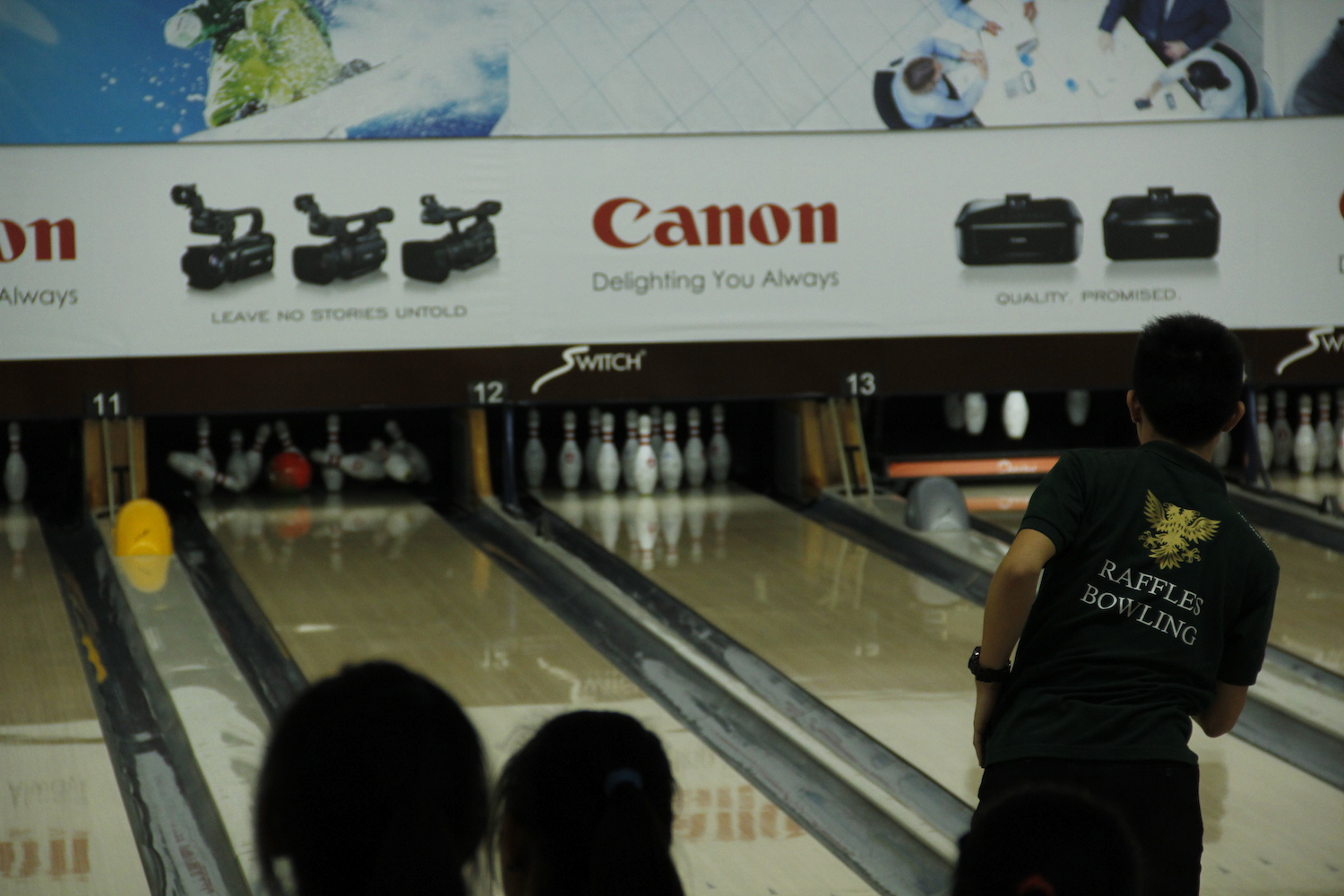
The electric atmosphere at Orchid Bowl in Orchid Country Club was unmistakable for anything but the pride of the various supporters for their schools, and there was never a moment when the cheering stopped. With the 34th Council pouring on the support, the A-Division bowlers of Raffles Institution bowled their way to strong finishes.
Boys
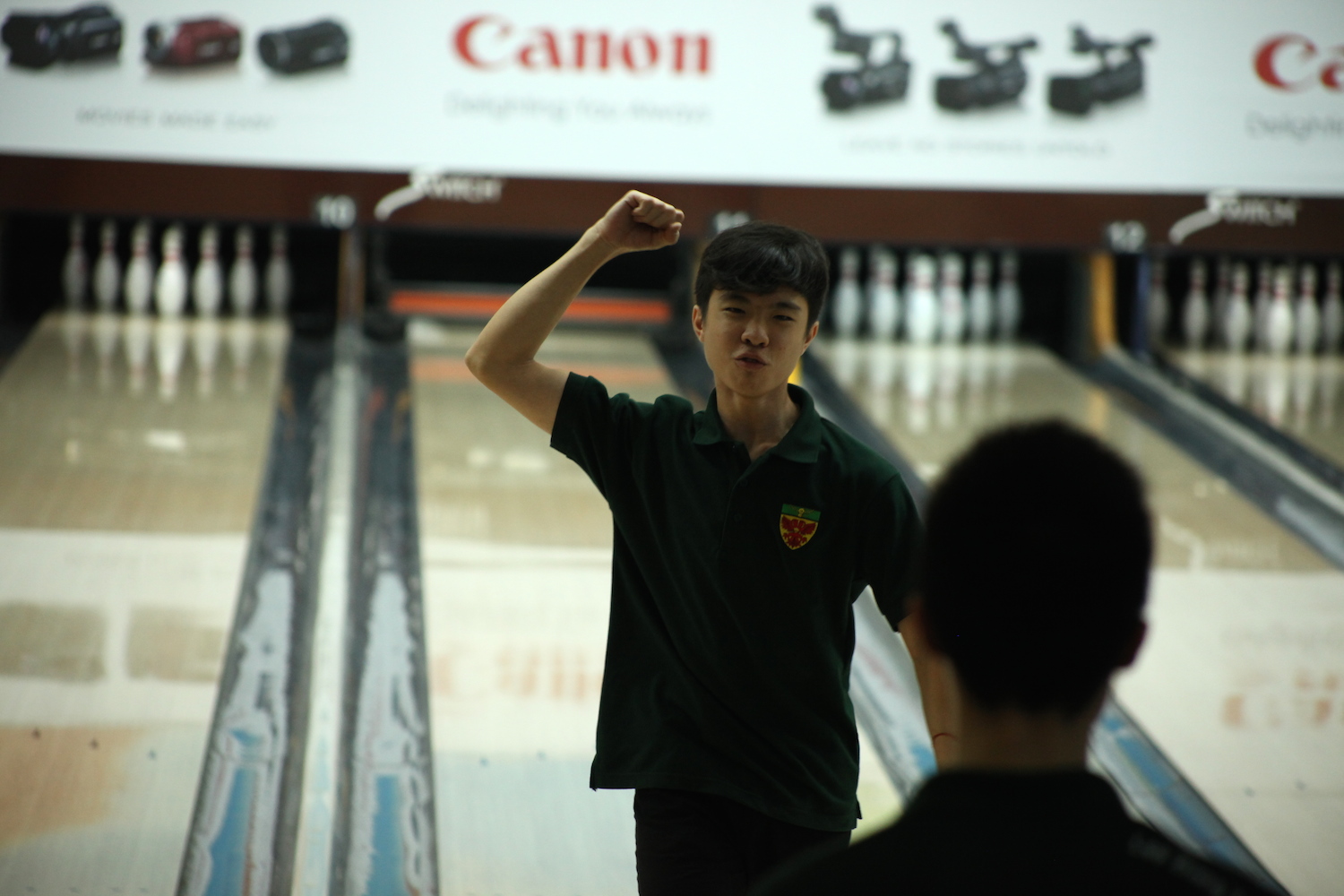
Surprisingly, the boys were not always in command, as one would surmise looking at their performance on 29th April at Orchid Bowl. They had been trailing Anglo-Chinese Junior College (ACJC) for the first two days of the tournament, but pushed hard to claim the lead on the third day. Following that they gave no quarter on the final day, and cruised to victory, claiming the overall school champions spot.
The Boys’ team takes home the overall schools’ championship title
Speaking to Press, team captain Jevarn Li said “I’m really happy and proud. We lost to ACJC last year by one point, and I am proud that we managed to win it back by a larger margin.”
Both he and his teammates were clearly elated at their success. The team comprising Marcus Seah, Ian Siow, Ng Kai Xiang and Jevarn came in first for the Team event, Jevarn and Marcus came in 2nd runner’s up for the Doubles event, and Jevarn clinched the overall all events gold with a 29 pin lead.
Girls
The girls also performed strongly, however they missed out on top spot for overall schools, losing narrowly to the ACJC girls. They had taken the lead on the first day, but after ACJC had wrested it back on the next, they were left playing catch-up.
Cheritta Low, captain of the RI female bowling squad reflected, “We trained very very hard this year, it seemed very promising, but luck wasn’t on our side. However, I am very proud of my team for persevering through trainings, and throughout the four days of the tournament and never giving up.”
Team members Jamie, Rebecca, Clarie and Limin huddle together to encourage and spur each other on during the tournament
The team of Joey Yeo, Kristin Quah, Cheritta Low and Darolyn Tan came in first for the team event, but their performance was not enough to take the overall girls’ champions position. Also a national bowler, Joey Yeo performed spectacularly. She and Jamie Lim came in first and first runner’s up for the Singles event, respectively.
In the Doubles event, the pairs of Joey and Kristin, placed first, while Darolyn and Cheritta came in second. Not only did Joey win the high game award for two separate events, scoring pinfalls of 248 and 247 during the Singles and Team event, she also clinched the overall girls gold with a 326 pin lead in what was a seemingly effortless performance.
From left to right: Darolyn, Cheritta, Joey and Kristin proudly accept their gold trophies for the team event
Clearly the star of the show, Joey Yeo felt satisfied with her performance, and thanked the team for their never ending support, camaraderie, and perseverance. The bowling teacher-in-charge, Mr Lee Chee Keong was also happy with both the boys’ and girls’ performances. When asked to sum up his feelings about the tournament, his reply was simply “Good job.”
When asked about the future of RI Bowling, Cheritta was pensive. “Seeing a lot of our juniors train for the past half a year or so, I’ve seen them improve a lot and I am very proud of them. And though we placed 2nd, there is still a chance to fight. There is no definite ‘winner’ or ‘loser’, it can only go up from here,” she said.
All five teams were also buoyed by the constant support by the Rafflesian councilors,who themselves were enjoying the action. One of the supporters even wanted in on it, saying that “everyone [wanted] to bowl, because it [was] so fun.” The bowlers never forgot the supporters even throughout the whole four hours of the final day, acknowledging their cheers constantly.
Amidst all the feelings about the game, Rebecca Wong felt wistful that her competitive days were probably over. “I’ll probably and hopefully continue [bowling] as a leisure sport, and it’s so sad as this is our last major competition,” she told Press.
Framing it up: RI Bowling poses for the camera with their awards lined up before them
The fight is not yet over for Joey, Cheritta, Jevarn and Kai Xiang, though. The four of them ride high on confidence into the Masters Finals, to be held on the 3rd of May at Orchid Bowl. The event will be starting at 8 AM, so do hop by to offer your support if you can! All of us here at Raffles Press would like to congratulate everyone, and the best of luck to those competing this Saturday.
Written by Ching Ann Hui (15S03A), Michelle Choy (15S05A), and Tan Su (15S07A)
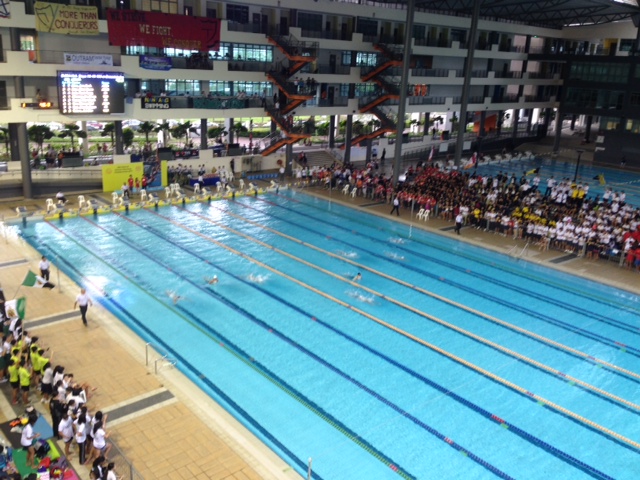
Months of intense training – including coming to school before assembly to train – boiled down to 2 days of finals for Raffles Swim. As Madeline Quek put it, the trainings were “tiring physically, but worth it”. Looking at the results now, it is clear that it was indeed worth it – with the A division girls clinching 1st overall and A division boys being awarded first runners up.
It was a close fight and tensions were rising with RI’s rival schools ACS(I) and ACJC proving to be strong competitors. The coach of RI swim Mr Lim Yao Xiang commented early on that there was no clear indication on which school would emerge victorious, and that it might even “boil down to the last relay.” Despite having “no national swimmers on the team”, the stellar achievements stood as testament to the sheer grit and hard work of our swimmers.
GIRLS
The girl’s segment of the competition began with our girls team placing in the top 3 for almost all races – a result consistent with what we have seen in previous years.
For the 50m Freestyle race, tensions rose as Song Ai Vee went neck and neck with Annis Loy from Temasek Junior College. The two eventually tied for second place after an intense fight, with Nicole Ong Ting Zhi racing in a close third just milliseconds after. Nicole Ong also bagged a bronze medal for the 50m backstroke.
Similar victories were seen in the 200m freestyle where Dayna Ang and Christiane Tan placed 1st and 2nd respectively. Richelle Ang also made a podium finish – clinching third place in the 200m individual medley. Rachel Lee put up a strong showing with two wins: 3rd in the 50m breaststroke as well as in the 100m breaststroke.
Madeline Quek was another serial medallist with her placing of 2nd in the 50m backstroke and butterfly. Over at the 200m breaststroke, Grace Tan placed 3rd and Gayle Tan placed a commendable 2nd despite facing strong competitors from ACJC.
The 400m freestyle elicited cheers from the Rafflesian crowd as Teo Jing Wen, Kimberly Yeo and Chloe Tan all placed 1st, 2nd and 3rd respectively, sweeping the awards for that category.
A breathtaking dash to the finish in the 200m breaststroke event led to Samantha Yeo setting a new competition record, clocking in at 2.34.17 – almost 3 whole seconds faster than the previous record.
Samantha again clinched first position for the Girls 100m Breaststroke, with a record breaking timing of 1:11.65, 1.06 seconds faster than the previous record. Unfortunately, the result was subsequently disqualified due to her doing a double fly kick.
Despite that, spirits soared as the much-anticipated 4x50m Freestyle Relay saw our girls relay team (Samantha Yeo, Teo, Jing Wen Shan, Madeline Quek and Song Ai Vee) bring a roaring victory to RI by coming in first with a timing of 1:50.44 9 in the 4×50 Meter Freestyle relay. The 4x50m Medley relay had a similar showing, with the girls securing the overall gold medal for our team.
BOYS
Victory was never a certain prospect with our boys team facing up against strong rivals such as ACJC, ACSI and Singapore Sports School (who had home advantage). Swim team coach Mr Lim Yao Xiang had realistic expectations of the boys team, remarking that “with no national swimmers in the team i feel that second is already a very good result.”
In the 200m freestyle race – a race primarily between RI, ACSI and ACJC, Andy Lo was able to clinch the gold medal, beating ACSI by 1.23 seconds. The other 2 RI swimmers,, Aloysius Tan and Bryan Tan came in 4th and 5th respectively. Other notable races include the 100m breaststroke where Alexander Tseng Wei Chen, Teo Cheng Quan Edmund and Lee Teck Fang Kenneth came in 2nd, 3rd and 4th respectively. Despite the stiff competition for the 100m backstroke, where a new record was set by one of our arch competitors, Andy Lo and Joshua Koh fought to clinch the 2nd and 5th respectively. Joshua Koh also took home a bronze for the 200m Backstroke.
Quan Ren Barry Koh fought hard to finish 5th in the 200m butterfly race. In the first and second laps, he was placed 6th with timings of 1:07.18, 1:44.4 respectively. However, at the last lap, after putting up a valiant fight, he finally emerged 5th, with the timing of 2 2:23.54.
The 4x50m freestyle and medley relays were both highly anticipated races. For the freestyle race, our team fought hard but ACSI took the lead and clinched gold by a narrow 3-second difference. Ultimately the Raffles Swim team came in second for both races, making the school extremely proud. The team consisted of Bradley Samual, Windley, Teo Chang Quan Edmund, Lee Teck Fang Kenneth and Tan Xuan Fu.
The fight to the finish is never easy, just as the race to the finals was tough for the Raffles Swim team. However, as A-division girls captain Kathleen Leong said: We really hope that the raffles legacy will be able to continue for many years to come and that everybody will be able to swim for pride, glory, honour – Raffles!
By Myko Philip (15A01B), Michelle Zhu (15A01B), Chew Sher Mein (15S03H), Katrina Jacinto (15A13A)
Photos by Tan Wei Xin (15A01B)
Raffles Chorale performing their opening number
This year’s edition of Raffles’ annual arts festival commenced last Wednesday with the Raffles Choirs performing at a packed Esplanade Concert Hall. In what was a spectacular kick off to Arts Season 2014, the Raffles Choirs comprising Raffles Voices (the Year 1-4 choir) and Raffles Chorale (the Year 5-6 choir) captivated audiences with their highly eclectic repertoire and deliciously sweet singing. It was an evening that saw the audience whirled around in an iridescent vortex that brought them from the solemn, high-ceilinged halls of cathedrals in continental Europe, to the deep south of America with its upbeat tunes and alleluias, all the way to Africa with its kaleidoscope of sounds inspired by animals and the surrounding landscape. This far-reaching odyssey of music all happened within the inspiring and formidable wooden halls of the Esplanade, its size lending itself in giving the choirs a slight echo and a sense of vastness.
Raffles Chorale eased us smoothly into the programme with their haunting rendition of “How Can I Keep From Singing”, arranged by their conductor, Mr Toh Ban Sheng. It was an apt song to begin the programme– a hymn which exults so greatly in the presence of God it cannot help but express itself in song. True to style, Raffles Chorale made an impressive entrance. As the lights dimmed and the scattered glow of cellphones subsided, Chorale left us in a palpable darkness for some time, before the calm and honeyed voices of Daphne Quek and Ma Yuqing cut through. Light slowly began to fall on the stage as the sweet singular voice was joined by another, and yet another, gradually forming a powerful but austere chorus reverberating around the theater. As the light grew stronger on the stage, figures could be discerned walking deliberately and purposefully to centre stage, and when they came on in full brightness, the entirety of Raffles Chorale was before us. Masterfully using a technique called chance singing, in which each singer takes a chance at their own tempo, the song was multi-layered, with different waves of sound moving against and along each other that convalesced in a glowing whole. Needless to say, the audience was entirely dazzled.
After a brief rearrangement of singers, they dove straight into their second piece, Josef Rheinberger’s “Abenlied”, a post-resurrection story about the light of Christ. If their first piece was like numerous rays of light melding together into a continuous whole, then their second piece was like waves crashing on rocks. What shone through were the deep and mellow tenors and bases, offering a rich contrast and foundation for the higher melodies that were superimposed on top of it. The song was memorable for its elegant and brilliant close: it ended on a brief but candid descent, as if down a flight of stairs, to reach a soft but solid and resounding note.
One of the night’s highlights was their third and fourth pieces. Departing from the angelic aura of the previous two songs but nevertheless keeping to a semi-religious theme, Raffles Chorale indulged us in their energetic and passionate delivery of Z. Randall Stroope’s “The Conversation of Saul”. In the Bible, Saul was someone who initially persecuted Christians but was eventually turned over and became one of Christianity’s forward and belletristic writers. Beginning with a driving, pulsing chant from the boys that was constantly returned to throughout the song, the girls slowly joined in with their own refrains that complemented but did not mimic the boys’. Immediately, we felt a tingling sensation in our spines; the music seeped into our bones. Violent but coordinated feet stamping was weaved into the song, imitating thunder. It was seemingly frenetic but beneath the apparent chaos was a very controlled and skillful execution of music. Towards the denouement, we began to hear crazy descending chromatic scales, giving the effect of something spiralling out of control. It was the most exciting piece of the evening.
From this terrifying and gripping piece, we were immediately catapulted into the realm of the stars: next on their repertoire was Audrey Snyder’s “And In The Evening”. Based on William Blake’s poetry, it was a song that promised to juxtapose the mystical nature of dreams with a wide field of stars, and it did not disappoint. Notably, the choir distributed wine glasses filled with water to varying levels during the emcee’s introduction. The song was largely amorphous and ethereal, flowing in a certain direction but seemingly flowing everywhere as well. Indeed, we were brought up and down as if a sloping mountain range and from the weirdness of dreams to the terrible vastness of a star-filled night sky. The choristers slid their fingers over the rims of the glasses, producing a discordant but spectral sound that seemed to echo around the concert theater. Shayna Yap accompanied on the piano and played solid chords that, in tandem with the contrastingly eerie sound of the water glasses, gave the song a sonorous feel. With that, Raffles Chorale concluded their first set and gave the stage to Raffles Voices.
Raffles Voices in their spirited rendition of Amani
Where Chorale was more timid and had sharper and more powerful high notes, Voices delivered their characteristic and entertaining theatrics. They were generally more lighthearted, even if they appeared more nervous when arranging their blazers and being asked to shuffle about on stage into position. Having been brought across continental Europe by Chorale, Voices took us into the heart of Africa with Audrey Snyder’s Amani, which means “peace” in Swahili. Although accompanied by slightly awkward posing and marching, the upbeat and cheerful tune along with the rhythmic beating of percussion African drums had the audience’s feet tapping to the music. We then had David Dickau’s “If Music Be The Food of Love” (a reference to Shakespeare’s ‘Twelfth Night’), a piece similar to the first in terms of its need to express its joys in music, then “J’entends Le Moulin” by Donald Patriquin, an equally mesmerizing song because of its usage of various sound onomatopoeic sound effects to conjure a colourful soundscape. Cheng Xin Yu and Guan Xin gave accompaniment on the percussion, and Gavin Jared Bala gave an astounding and instructive performance on the piano, at times even surpassing the choir. With that, they yielded the stage once again to Chorale.
Chorale gave us a taste of a different palette this time, moving away from sordid hymns and requiems to much more upbeat devotional tunes. To this end they gave us “Non Vos Relinquan Orphanos” by William Byrd, “Wade In The Water” arranged by Allen Koepke and “If I Can Help Somebody” arranged by Ray Liebau. It was a smooth and lively transition from Voices’ segment as well as an refreshing pick-me-up and contrast to their opening four songs. “Wade In The Water” in particular, a Negro hymn sung in the American south, had a throbbing pulse to it that made it akin to Adele’s “Rolling In The Deep”, albeit with more flair and colour. It got blood flowing through the audience’s veins. Tan Fong Han of 15A01B, one of the choristers, said that the song was her favourite of all any that she performed, saying that “there’s something about the song that makes it both liberating and oppressive at the same time. It’s a layered song and I think when we sang it in SATB (Soprano, Alto, Tenor, Bass) it resembles to me a progression of letting go- along with transition from bass to sop[rano]. It’s an emotional piece that is also controlled.”
Raffles Voice treated us to another two songs, “Northern Light” by Ola Gjeilo, which melancholic notes reflected the mysterious beauty of the aurora borealis, and Oscar Galian’s “Salseo”, where the swingy and rhythmic tune along with the trademark Spanish lyrics provided great entertainment. Then, the combined choir came on stage to give us the world premier of “Tui Sunt Coeli” by Vytautas Miskinis, a song that blended a whole smorgasbord of tunes to one continuous whole, as well as the iconic and easily recognized “Baba Yetu”, or the Swahili Lord’s Prayer, noted by many to be Civ-4’s theme song. The soulful and melodic piece had distinct African roots and Marc Leong and Jonathan Tan delivered riveting performances as the piece’s two solos and enthralled audiences with their mellifluous but powerful voices. Even as we sat at the back of the first floor, we could feel the vibrations from their singing. It was, as Zhang Yimin of 15S03H said , “so beautiful that it was disconcerting”.
The combined Raffles Choirs performing their finale
As the evening drew to a close, and amidst fanatic cries of “encore!”, the combined choirs departed somewhat from tradition and delivered another piece, Stephen Paulus’ “The Road Home” before performing the much more expected and customary school song. Even a parent we overheard was somewhat surprised by this encore, as were the most of us. This piece was a pleasant surprise with a much simpler arrangement than most of the complex multi-layered repertoire, yet held its own rustic charm.
The evening finished of course with the institution anthem, at which tentative Rafflesians glanced around nervously at the hall to see if they should stand up. After one or two did, however, all the students in the Esplanade stood up at attention. The choirs’ rendition of the school song is always something to look forward to, a refreshing change from the dreary and somewhat gaudy version played on not-so-adequate speakers at morning assembly. The ending, with its delayed last line, is always a delight, where the song reaches an entire octave higher than it normally would. The sound was sublime and we surrendered readily to the familiar melody. In those four stanzas, singing the school song in front of the rest of the audience, you could definitely feel proud to be a Rafflesian.
And so, encore included, the entirety of choirs’ repertoire of fourteen songs had just been performed. Raffles Chorale and Raffles Voices alike brought us a magical night of music that will be remembered fondly by the audience and choristers alike. “There were many magical moments on stage,” writes Mr Toh Ban Sheng, conductor for both choirs, and I would say it’s one of the most memorable performances in the Esplanade.” One of the issues was the Esplanade’s “unique acoustics” which were a double-edged sword. Initially a challenge to “grapple” with, it nevertheless highlighted the haunting quality of many of the religious songs. Whatever issues they had with the idiosyncrasies of their venue went unnoticed and never once hindered their performance: “once we got it settled after some time-consuming first round,” writes Mr Toh, “we were able to make music more comfortably.”
Echoing Mr Toh’s statements, Chorale chairperson I-Vivek Kai Wen added that no small measure of hard work was involved, but was glad that it all worked out in the end and went very well. To put on a show that lasted an evening, hours and hours of sheer effort were spent in school after lessons preparing, not just during official training but outside of it as well. Tan Fong Han of 15A10B recounts to us how from 2 to 3 sessions per week they gradually ramped up to 3 combined sessions in addition to 3 sectionals per week. Even mornings were not spared; in the lead up to the concert, mornings were usually devoted to “mental work [like] recall[ing] details of every song, where to crescendo, where to back out etc…It’s pretty intensive but after a while, it doesn’t become a chore so much as it becomes second nature. Outside of practices, I’m pretty sure everyone else hums [or] sings on their own.”
In fact, in class, it is not unusual to find her quietly but delightfully humming some of her favourite tunes from their repertoire. That the performance went so smoothly that the evening flew by is testament to the combined choirs’ dedication to making good music (and the implied hours that this dedication demands) and putting on a hell of a show. No mean feat considering that their pieces were scattered in terms of style and mood as well. Explaining the eclecticism and diversity of their song selections (and a possible religious undertone), Mr Toh said “the repertoire usually consists of songs that we programme for participation in international festivals we are taking part in. For Chorale, it is taking part in a Musica Sacra International Festival in Czech Republic. To fulfil the requirements of the 2 categories we taking part in and the grand prix, it resulted in a predominantly sacred music programme this year. Nonetheless, I try to find music that embodies contrasting characteristics and yet appeals to the singers. It’s always a challenging task.” He explained similarly that Raffles Voices travels in December and thus has little room to programme in something more than the competition repertoire. Hence, they performed an African song of peace, a lush modern American work, a virtuosic French folk arrangement, a modern sacred Latin piece, and an onomatopoeic Salsa piece.
Raffles Chorale charmed the audience with its ability to blend seamlessly complementing layers of music into a harmonious web; once the audience was caught, they were never let go. While Raffles Voices was not as technically brilliant as their senior counterparts, their characteristic passion more than made up for it. Their spirited and theatrical renditions of songs were infectious and kept audiences glowing long after they left the stage. Limelight 2014 was a real pleasure and set a high standard for Arts Season: both choirs put on show-stopping performances and kept audiences spellbound for the entire evening. The whirlwind ride from one region of the world to another was pulled off deftly and convincingly despite the difficulties of this monumental task. Both choirs handled the repertoire expertly and highlighted innocent nuances in their performance and, for two brief hours, sang the devils out of the details, bringing us away from the Esplanade and onto a breathtaking journey of music.
Written by Joyce Er (15A01A), Marcus Tan (15A01A), Christine Saw (15A01A) and Martin Lim (15A13A)
Additional Photos by Hugo Tay (15A01A) and Raffles Community Advocates From the 15-17th of April, Raffles Community Advocates (CA) rolled out the inaugural Heartware, in their bid to raise awareness on the serious issue of poverty in our society and around the world. Instead of merely having No Shoes Day as per tradition, this year the graduating batch of CA decided to address the issue of poverty more holistically, starting with the individual before branching out to the community and to the world. With the aim of cultivating empathy and inspiring Rafflesians to reflect on the privileged lives we take for granted, the Organising Team organised a series of events from the 15-17 of April, in the hopes that students could experience poverty for themselves.
Day 1: Try It! The $3 Challenge
Heartware 2014 commenced with Try It!: $3 Food Challenge. Participants were encouraged to limit their food spending money for the day to $3, an initiative which bore similarities to the ‘$5 challenge’ that gained popularity and attention in Singapore late last year. In the $5 challenge, Singaporeans pledged to cap their spending on food and transportation to a mere $5 a day so as to be able to better empathise with Singaporeans who face such impediments living on a $1500 income. Similarly, the $3 challenge aimed to encourage fellow Rafflesians to get a taste of the constraints and discomforts of food poverty.
The $3 Challenge pledge board featuring pictures of students holding up placards
When asked about the purpose of the challenge, Daniel Hakim (14S06F), the head of the Organising Team for Heartware 2014 remarked, “It’s not about going hungry […] it’s about appreciating the value of $3 such that you will be able to spend wisely on your food.” Students were encouraged to pledge their commitment to the challenge by writing their reasons for doing so on placards. Pictures of students holding up the placards were displayed on a board along the canteen walkway and featured in a video screened in the canteen.
One of our writers decided to take part in the challenge as well.
Many students took part in this event with enthusiasm, citing reasons such as wanting to empathise with those who regularly face financial constraints, and recognising that we should not take our food for granted. Students felt that even though the challenge was on too small a scale to really feel the experience of being impoverished, it still helped to make the student population more sensitive to the plight of the less privileged. Eugene Lee from 15S07D commented, “I think that it’s important to know that we are in a very comfortable and blessed environment, and we shouldn’t take what we have now for granted… $3 may seem small to us but in other people’s eyes, its a lot of money…I did it because I wanted to empathize with others from all around the world and to just keep in mind that we have a lot in our current age, and we shouldn’t take all these privileges for granted by being spendthrift and spending excessively.”
The challenge was labelled by many as a difficult one. While many students excitedly pledged to commit to the challenge, a number found themselves unable to complete it and eventually succumbed to the persistent growls of their stomachs. Not only did students find it tough to last the day on the significantly smaller amount of food that $3 could get them, they also faced the inconvenience of having to consider the value of food items down to the very cent.
Phionna Teo from 15A01A said, “I found it rather difficult because I’m not the type to consider the food I want to buy by its price, but more of how it would satisfy me. Putting a monetary limit to the food I could buy was thus a great stretch for me and I eventually gave in. I think the challenge is really a sacrifice that makes you take a step back and consider the plight of the less fortunate.”
However, some students refrained from taking part in the challenge entirely. Reasons for desisting included having a long day in school or failing to see the value in such an initiative. This was especially so for those who had to stay back that day and needed their money to cover the cost of more than one meal. The more common replies when interviewed were “I’m staying in school till ____/ I have CCA and I need energy” or “I’ll probably exceed it anyway”. When asked why she thought this was the case, a CA member who declined to be named replied, “I think many people don’t really take events like these seriously and simply dismiss it because they already feel that they have the sort of awareness the event aims to promote. Taking part in this challenges don’t seem to be able to improve the lives of the less fortunate in any way. But what many people fail to realise is the challenge is meant to be a starting point for fostering greater empathy which will hopefully translate into greater action taken.”
What also possibly limited the success of the event was the fact that some brought home cooked food to school in order to remain below the $3 budget, which many claimed defeated the purpose of feeling the discomfort and curtailment of $3 in the first place. On the other hand, many other students found meaning in the challenge and persisted in completing it despite the long school hours. When asked why she still participated in the challenge despite having to stay back till 5pm, Liu Lijia from 15A01A quipped, “Well, poor people don’t have a choice.”
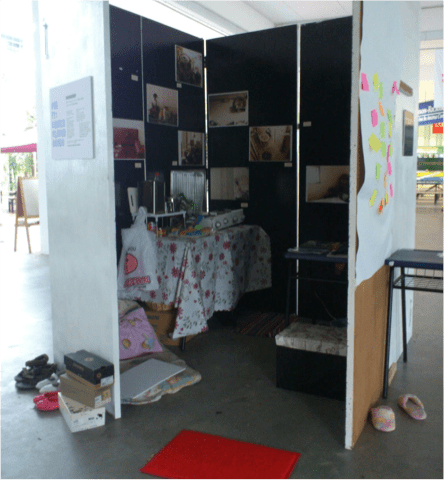
Day 2: See It! Behind Closed DoorsOne-Room-Flat Exhibition Heartware continued on the second day with “See It! Behind Closed Doors”, where a one-room flat exhibition was conspicuously set up in the canteen walkway. The intention was to bring the struggles of the poor right to our doorstep, while concurrently publicising REACH Singapore’s home refurbishment volunteer activities. Singapore’s shiny facade belies its income inequality, currently the highest amongst OEDCs, such that, as Daniel Hakim explained, “poverty in Singapore may not be obviously seen”. Although it was not to scale, the exhibition clearly demonstrated the cramped living conditions which the underprivileged have to face on a daily basis, even in a country at the pinnacle of economic prosperity.
A table displaying an assortment of cheap but unhealthy foodstuffs, which can typically be found in a one-room flat.
The not-to-scale mini-exhibition served its function by creating an illusory sense of claustrophobia even in the wide canteen walkway, which undoubtedly proved to be a novel experience for Rafflesians. A table piled with cheap foodstuffs like milo packets and biscuits took up about a third of the space. In addition to this table, the tiny space was further crammed with a study desk and a blanket meant to indicate a sleeping area.
Photos of one-room flats which CA helped to clean up were displayed on the walls to show visitors the reality of living in such flats in Singapore, and students who wished to view those on the far end of the exhibit were forced to squeeze in. The rest of the wall space was covered in infographic posters about poverty in Singapore. Students who visited the exhibition were encouraged to pen down their thoughts on Post-It notes which were then put up on a cork board inside the exhibit, as well as on its exterior.
The majority of post-its expressed approval of the exhibit, such as one that said the exhibition was “very meaningful and insightful in showing us the living conditions of our fellow Singaporeans [which] we otherwise would not know about”. Similarly, another said the exhibition “opened my eyes to the harsh reality in Singapore and inspired me again to remember to be grateful and stand up for the needy”. For such individuals, the exhibition clearly confronted them with the stark reality of poverty and inspired them to reconsider their own privilege, fulfilling CA’s intended outcomes.
At the same time, the exhibition had its detractors, with one post-it arguing that the exhibition was an “unrealistic representation of a one-room flat” and an “exaggeration”. Admittedly, the exhibition had its limitations; one could hardly expect CA to reconstruct an entire flat in the canteen, and stepping into a small space for a couple of minutes makes a mockery of the experience of the poor. However, the intention of the exhibition was not to replicate, but to simulate, and in doing so provide an opportunity to step into the shoes of someone less fortunate.
However, ‘See It’ appeared to be limited in its attempt to inspire students to sign up if they were interested in future home refurbishment activities. When we last checked on Saturday, there were only four signups expressing interest in future home refurbishment activities. When asked if she noticed the signup sheet, Sandra Faith Tan from 15S05A highlighted, “If it was on the table outside the exhibition, the table was strewn with loose papers and post-it pads,” which may have obscured the signup sheet. The exhibition had unrealised potential to engage and inspire students and perhaps there could have been better organization and more conspicuous positioning.
For an inaugural run, the one-room flat simulation appears to have been well-intentioned, but to increase its effectiveness, it could have been executed more thoroughly, with greater attention paid to detail. A Y5 who has requested to remain anonymous praised the visual component of the exhibition, but felt that ‘it could be much more improved through other senses like taste, smell and touch’ for a more comprehensive and convincing sensory experience.
Tana River Life Foundation Talk
That same day, a talk was also held to help establish the right attitude towards the final instalment of Heartware, Feel It! No Shoes Day. Over the past two years, this has been held alongside the Shoe Collection Drive that CA holds in partnership with the Tana River Life Foundation (TRLF). This is a charitable organisation situated in Kenya, which aims to provide dignified aid to marginalised locals. The talk was conducted by Rafflesian alumnus and TRLF founder, Mr Gabriel Teo, about his organisation’s schemes and the ethics he believes should underpin any acts of social service. He was accompanied by three Kenyan youth beneficiaries of TRLF’s programmes, including the Mitumba Project which the Heartware shoe collection drive is contributing towards.
Mr Gabriel Teo spoke about TRLF’s aid schemes and the principles underlying TRLF’s work.
Mr Teo began with a preamble on the principles underpinning his work. He warned against heroism and ‘creating dependency’ or a culture of slacktivism, which he characterised as ‘playing with people’s lives for your own ego’. Passionately decrying shortsighted, one-off welfare projects that fail to prioritise human lives, he said, “Community is understanding that it is not about output or numbers you generate, it’s about outcomes, and how are lives changed for the better.”
After touching on schemes geared towards subsidizing education for Delta students, Mr Teo provided detailed information about the Mitumba Project, which is behind Heartware’s Shoe Collection Drive. Mitumba, or ‘recycled goods’ in Swahili, is a microfinance scheme set up in 2004 and one of TRLF’s entrepreneurship courses. In addition to shoes, Mitumba also collects clothes and bags, which are then sorted and either sold or used for the course.
The microloan scheme, essentially a form of repackaged financial assistance, operates over 4-5 months. In the first month, 100 pieces of clothing and 20-30 pairs of shoes are loaned on good faith to interview-selected applicants, mostly women with dependents such as children studying in secondary school or with chronic disease. Participants market and sell their wares to locals for about 400-500% profit. The sale of all their shoe stock, with a pair going for approximately $4.20, can pay for about a term’s school fees. In the subsequent months, they repay their loans and purchase more stock to sell. Participants must remain accountable, presenting monthly receipts accounting for their income and expenditure.
Eddie, a Kenyan youth beneficiary of the Mitumba Project, is proof that TRLF aid can be effective.
In response to a question about the sustainability of a scheme in which TRLF still provided the shoe stock, Mr Teo clarified that Mitumba ‘is not intended to be a major source of assistance’, and practically only ‘gives them a boost’. The real intention, Mr Teo stressed, was to ‘preserve dignity as you assist, through dignified giving and dignified receiving’, as opposed to a condescending ‘beggars can’t be choosers’ attitude on this end, or a sense of passive dependence on the other.
Since the overwhelming majority of students in attendance were CA members or Councillors, the outreach for this talk was admittedly seriously limited. This was unfortunate, as the talk did have important messages to share. Especially in light of Acta Non Verba, those in attendance found the talk useful in clarifying exactly how the Mitumba project works, and understood TRLF’s guiding mindsets of aid with dignity in relation to No Shoes Day. Lum Qian Wei, a Y5 member of CA, succinctly summed up her takeaways, “I found it useful. The TRLF emphasises self-reliance and preserves the dignity of the beneficiaries as ultimately, beneficiaries have to put in their own effort to run the businesses. I think No Shoes Day serves to remind us how fortunate we are, and helps us empathise with the poor; this ties in nicely with the TRLF’s principle of treating everyone with respect regardless of his background or status, and not slipping into condescension.”
Day 3: Feel It! No Shoes Day
Heartware 2014 rounded off with Feel it!: No Shoes Day as the popular poverty awareness event returned for the third year running. Organized in collaboration with the aforementioned Tana River Life Foundation, the event aimed to raise awareness for the poor living conditions of the children in Kenya.
A sample of the 905 and counting pairs of shoes collected in this year’s Shoe Collection Drive, which have far surpassed previous years in number.
There, millions of children are forced to go barefoot across treacherous terrain and risk painful abrasions, cuts and infections with every step they take – all this because they cannot afford a pair of shoes. While walking around without shoes in a clean, safe school compound is in no way an accurate simulation of their daily ordeal, this small act of sacrifice on our parts was intended to encourage participants to empathise with less fortunate children. No Shoes Day was also meant to encourage participation in the Shoe Collection Drive so as to raise funds for these Kenyan communities through the Mitumba Project, which encouraged students to donate their pre-loved shoes to the Tana River Life Foundation.
Across the three days of advocacy, No Shoes Day appears to have sparked the most criticism of all, with students levelling the typical accusations of ineffectiveness and slacktivism at it. For instance, a Y5 student who declined to be named demurred, “No Shoes Day is rather gimmicky as it doesn’t raise awareness enough to make a difference. It’s merely a bandwagon thing and people just jump onto it without understanding why. Everyone will just forget about it in a week so I don’t see how it’s useful at all.”
Some students also pointed out the stark contrast in going barefoot in RI compared to going barefoot in Kenya, again a case of simulation becoming ineffective simplification. Participating Rafflesians had to navigate mere puddles of water and the occasional ledge, to the extent that a Y6 student said, “It was a great experience and by the end of the day I got used to it. I really enjoyed myself.”
In contrast, the children in Kenya have to negotiate much harsher terrain and the profundity of their difficulties may well be beyond our imagining. Those who willingly participated and grasped the risible contrast between conditions here and there are perhaps the ones who benefited most from the challenge. One such individual would be Natalie Chan from 15S03B, who reflected: “The grossest part was the toilets and the canteen floor, but even that is nothing compared to what the Kenyan children have to go through because they risk stepping on dangerous objects such as broken glass”. Some other students, like Ding YuChen, took the challenge several steps further by running their 2.4km item for NAPFA sans footwear.
Two J1s resolutely running their 2.4km for NAPFA without shoes.
While many people were seen walking around school barefoot or instagramming themselves with their friends that day, it can be hard to distinguish between successful advocacy and mere slacktivism, as the difference lies in the mentality behind the action. For those who participated by walking around school barefoot, their good intentions are to be commended,though it is important that they realise how much worse going shoe-less is for those in Kenya for the entire exercise to have been fruitful. As with the $3 challenge, the fact that we had a choice to participate only underscores our own privilege. Moreover, going around shoe-less for a school day was a small sacrifice to make. Indeed, No Shoes Day seemed to be a success because of the number of students who enthusiastically participated; yet, it remains to be seen how many took away the true meaning behind their dirty soles that day.
As a whole, Heartware’s thoughtfully planned, holistic experiencewas a welcome evolution from past years, where there was only ‘No Shoes Day’, and those who attempted each day’s challenges and experiences generally came away with a better appreciation of poverty. This year, however, controversy arose over the various events organised and numerous questions were raised over the kind of aid being provided and whether it would reach the very people we are trying to help. And perhaps that recognition and depth of thought is something encouraging for the Rafflesian community – after all, advocacy can only progress when we truly take ownership of it. While it is up to the reader to assess the impact of this year’s Heartware, credit has to be given to the Organizing Team, who began planning Heartware last October, for their hard work in conceptualizing and putting together the different events over the three days. For these dedicated organisers, their parting message to all participants is, “All in all we hope that everyone who participated in Heartware 2014 can better appreciate the little things we have around us and are more aware about poverty that exist both on local and global scale.” Hopefully, regardless of which side students take in the conundrum of slacktivism and spreading awareness, every student has grown at least a little more cognizant of the privileges they are fortunate to have.