

By: Choo Shuen Ming (16A01E)
This is Part One of a photo essay documenting the backstage happenings of Raffles Players’ most recent production, The Bicycle Plays. Part One casts an inward-looking eye on pre-production happenings. Part Two will pick up right where Part One leaves off, at the opening of doors and beginning of the audience members’ experience.

Production day for Players starts way before the doors open at 6.30pm. By midday, they’re already in the TSD Room, but unfortunately full dress rehearsal has been cancelled this time due to scheduling problems. At 2pm, the black box remains quiet, the sets untouched, right where last night’s run left them.

Locked and tucked away behind the black curtains, the workshop is also tranquil, filled with sets built for previous productions, and racks of tools eager to begin work on future ones.

The sets room. The familiar yellow suitcase tucked in the corner at right, Bicycle Plays posters lying on the table, a production tee draped on a chair – touches that bring a small but pleasant kind of life to the quiet space.
Fun Fact – Vasu (16S07D) designed the production tee. “I am quite an amateur,” he says, having ‘almost no experience’ in shirt design. He recounts an episode where the supplier kept asking for sharper designs and images, but he didn’t know what she wanted. “It was quite embarrassing that she had to sharpen the images herself and send the design over to us to show us what she was asking for”, he says. “But overall, it was really a good learning experience.”

The annex, where most of the players are hanging out.
The atmosphere’s rather chill as the players relax, awaiting their turn with Isaiah (in green) for makeup. Quite a contrast to the highly-strung PW OP earlier that week. Unlike OP though, Sarthak (16S05A) notes, they’d more than one run, letting them learn from their mistakes for their second run. “I guess that’s why it was chill on the second day. The first run was a lot more nerve-racking I think, especially since we had a pretty short time to rehearse.” he says, which Beatrice (16S03C) echoes: “Friday is the first day, letting someone into your space….but Saturday night you have the feel of what it’s like to have someone there, so the nerve goes down a lot more.”

The script for Heart’s Desire lies untouched on a chair, barely visible through the earphones and jumble .
Also Sarthak says, despite any nervousness, they “didn’t want to run the risk of over-rehearsing and thus lose the instinctive aspect to it.” With over-rehearsing, “you end up just reading your lines in the kind of tone that you’ve established after hundreds and hundreds of runs, so you become more desensitized to the emotions.” shares Wen Wen (16S03G). For her, it’s the “in-the-moment experience that really matters, that kind of thing you can’t anticipate until it actually happens.” “Every night is different.” Beatrice neatly sums up.

Aside from these, this relaxed mood is rather normal for them. Wen Wen notes that, “it has never been a mad rush to memorise lines, or frantic run-throughs to the last minute even in our other productions.” “It’s all pretty chill and flexible,” says Sarthak, especially apparent here with their senior Jovi (in red) freely popping in. “We’re really communal,” Jasdeep says, “if our seniors come back, we just talk to them and joke around.”“It’s a nice place too,” Rishi adds, “it’s fairly quiet, so a few seniors just came back and studied for their SATs and As”, as Jovi’s doing.

“We used this production to get to know the space. So even through the stress of production, it felt more and more like home.” – Rishi (16A01E)
And indeed, it feels homely, with that warm sense of togetherness as Sreshya describes: “times when we would just sit on the sofas in the room inside TSD and the whole community spirit — people scurrying around, Isaiah making all of us pretty one by one, all of us waiting for the time of fulldress —really made me appreciate my batch a lot better as a unit that worked together to put up this J1 production.”

In the annex is also Isaiah Lee (16A01A), who’s doing the makeup for this production, and these are his tools. (of especial note: the 84-colour palette above, and numerous brushes below)
“Brushes, sponges and my trusty old ring finger (laughs),” he says when asked about his tools. One might think this collection took years to build, but he says it took a year, as he does throw out makeup that’s been kept too long. “The only thing I keep with me since the beginning is the experience,” he says, having done makeup for about 5 years now. “I started with Youtube videos, my aunt is a makeup artist so I do get tips from her, but mainly it’s from experience and trial and error.”

Isaiah at work, featuring his palettes and brushes.
In the makeup process, Isaiah uses the numerous colours on his different palettes to help him build up to colours. This happens especially if he wants to do an ‘ombre look’, where different parts of the eye have different colours. “I would need to blend the colours seamlessly, and say I don’t have the different shades of a colour, then I build to the desired colour by mixing colours from different palettes,” he shares. “I mix, build and work with what I have.”

Isaiah holding the powder puff on his ring finger between his hand and Caitlin’s face as he does her makeup.
“Treat the face like a blank canvas.” he says. “After I’ve done the base, I wouldn’t want to mess it up with my hand when I’m applying the rest of the makeup so I use the puff.”

Valerie gets her makeup done.
On the actors’ side, the makeup process can be more than skin deep for some. “As the makeup goes on your face, you slowly get into character,” Valerie (16S07D) shared. “I feel like a different person, and I look different, and that helps me get into character.”

Celine, Aishwarya and Beatrice (left to right) erupt into laughter, while Isaiah does Wen Wen’s makeup right beside them.
“Oh good lord yes, so distracting!” laughs Isaiah about doing makeup with the rest of Players hanging out in the same room. “I do believe that the makeup process includes interacting with people so it is enjoyable too,” he says, “but when they all crowd around the makeup table at times or block passageways, I’m just like, ‘please’ (laughs)”.

At around 3pm Ko Lyn arrives, and some minor props repair gets underway in the sets room.
“I was doing the costumes so I took it upon myself to procure a superglue set” says Ko Lyn (16A01B), which proved rather handy. As Rishi shares, “the shoe is rather old, so each sole, left and right, came out at a certain point in time, and it happened like 3 times.” Thankfully though, it didn’t get in the way of rehearsals, since unlike other actors who had heels on, the flat shoes made less of a difference, and Rishi rehearsed fine barefoot.

We stay in the sets a room awhile longer, Ko Lyn putting on a 7-minute song so we’ll know when the glue’s ready. It’s still rather quiet, but now that the three of us are there, it’s got a homey feel, with the piles and jumbles of props around.
“Every year if we buy something for this production or for other productions we add it to the room,” says Rishi, “so there’s a big collection there, from previous generations too.” Reusing old props does make occasional repairs like these necessary, but it has its upsides. “It’s more economical, and environmentally friendly,” Ko Lyn points out, “and, we have more than enough … creativity to adapt old props for new uses.”

The song ends, and Ko Lyn and Rishi head back to the annex, leaving rocks in the shoe to help the glue press the sole back on.
Speaking of music, Rishi looks like he’s just watching a video, but he’s actually spending this time writing music. “It’s on my own,” he says, “ like I just do it in my spare time, because I like writing … or trying to (laughs)”. He does his writing on an app called Reflow. “It doesn’t sound very good, but it gives you a range of instruments to use so you can just get an idea.”

Sarthak on another sofa is likewise absorbed in what he’s doing – in this case, reading The Glass Palace by Amitav Ghosh.
“No I don’t usually read during preshow,” Sarthak says, “but it was kinda free and easy during that time so I just read it”.
“Also because it was about 3 weeks overdue and I hadn’t finished it.” he adds. “But,” he reflects, “I guess it kinda calmed me down and all, helped me with my focus and whatnot.”
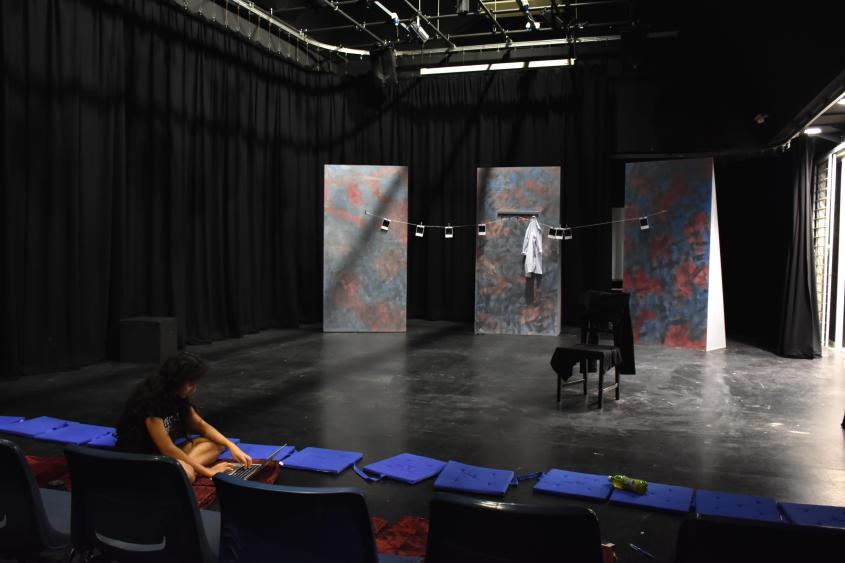
Meanwhile in the black box, Caitlin takes advantage of the quiet to get some work done on her laptop.
Fun fact: the 3 mysterious, oddly reflective flats in the background were designed by Caitlin, Sarthak, Sufyan and Aishwarya. Behind that look was a lot of work – 4 layers of it as they’ll tell you. They wanted a metallic finish, but metallic paint was too pricey, so “it was a lot of experimenting,” Sarthak says, and they eventually nailed the layering – “whitewash, layer of grey, paint red and blue, silver top” and also the exact texture – “dipped two sponges in paint, scrubbed them together and put it on the flats and randomly threw it around.”

It’s 4.30pm, and prep slowly gets underway, as Sarthak grabs a rag and starts cleaning the window which they’ll use for their intermission ‘show’ later on.

Dinner arrives, and the players shift outside as they dig into their chicken rice and chatter away.
The actors have to be careful what they eat before performing, as Rishi shares that while technically one’s voice is supposed to come from your diaphragm instead of the throat, the chicken rice chilli can make one feel uncomfortable, depending on one’s tolerance. “Guess everyone had a little bit, but generally good to stay away.” In any case, “the chilli’s packed separately anyways,” as Sufyan shares, “so if you can handle it go ahead.”

It’s 5.30pm when they finish dinner, and Kathy, Caitlin, Sarthak and Jasdeep (left to right) set up the Front of House, in anticipation of early birds on their way to pick up their pre-orders.

Meanwhile, back inside, Sufyan (in black) checks each and every seat for squeaks, (while Celine on the right races him to test out the last few seats). Aishwarya sprays air freshener on the cushions on the left, and some still drying spray patterns are visible on the blue ones at bottom right. Of the air freshener, Aishwarya (16S03S) shares that interestingly, “it was what [Sufyan and I] took the longest time to decide on when we went out to get stuff, because we couldn’t decide on the smell, so we just opened all discreetly and smelt (laughs).”
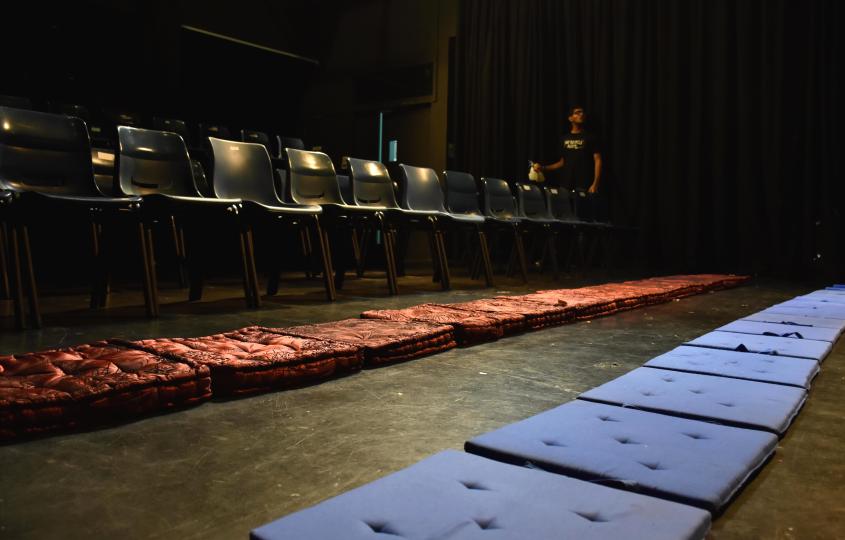
Sufyan wields his trusty air freshener. “I’ll keep on using those, even after production.”

Air freshener aside, much of Aishwarya’s and Sufyan’s effort went into creating the seating layout above. As Aishwarya shares, they planned way in advance, “[taking] measurements from day one of rehearsals” to draw up seating plans, before setting each of them up to physically try them out. “We really sat and discussed for 2 whole days to make sure everyone can see”, shares Aishwarya, even staying one night to 11pm as they revamped their plans after they discovered they had cushions. As Sufyan (16S06F) says, “it was a tedious process.”

On the performers’ end of the black box, actors, director, and senior alike all chip in to clear the flats from last night (incidentally,the reflective paintwork is much more visible here) and set up Heart’s Desire’s set.
Just as how they’re helping each other set up the set, many of the players juggle multiple roles, helping one another out in the different areas of production. From publicity to acting to sets to stage managing just to name a few, it’s common to find players who are in two or more of those. ‘It’s quite amazing,” as Kathy (16S06I) says, “how they can juggle all these without dying actually, and like they can still be so high and hype the energy up.”

Celine on the right packs the suitcase she’ll use as Susy, while Caitlin on the left helps draw out the unique chalk ‘set’.
Jasdeep (16S03N), director for Heart’s Desire, explains that the chalk, with its yellow border above separating the family and Susy, helps explore why the family’s fighting in the play. “Is it because of what’s happening within, or is it something that’s beyond it – is it Susy? Perhaps this family was broken not because of Susy, and Susy was merely an excuse, and it was this toxic environment, this toxic box that they were stuck in.”

The chalk footprints forming paths on the stage also subtly explore the artificiality of the setup, showing that there’s “some greater force that’d already planned that the bird would be walking in that direction” Jasdeep explains, referring to the yellow chicken footprints above. “That idea of reality, and what is fake, the clash between what is created and what is real, and if there’s anything real in the first place is one tension we tried to discuss.”

This chalk they used is Jasdeep’s – he really likes chalk.
“I think chalk is really cool, I watched a play about chalk before and it was in a black box, except they put up like chalkboards and drew the set. It was really really cool, and I always wanted to use chalk for a play, so I did it.”

Outside, the first attendees arrive to collect their tickets from Kathy, who’s in charge of the front of house this night.
“There were many more parents on Saturday and more RGS girls on Friday,” observes Kathy, and she also enthusiastically shares that “sales were really good!” “We oversold both nights,” Celine (16A01A) says, “and even squeezed in a few more on Friday!” Kathy adds. On Friday, some called to cancel last-minute, but the popularity of the play was such that “there were a few enthusiasts waiting outside the TSD for extra tickets so we sold it to them!” “It was pretty surprising for us,” she says, and notes that perhaps “it was also because we only had 91 tickets available”. Also, Hai Yun mentions that they tried to keep ticket prices low and affordable at $7, possibly driving up sales too.

Back in the black box, Celine and Hai Yun (left to right) write messages on the posters for their teachers-in-charge, Mr Tan and Mr Choo.
“It was a spontaneous decision,” Celine shares. Inexpensive says Hai Yun, but also meaningful. “We wanted to give the teachers something nice, but also relevant to the play” explains Celine, plus, “that’s also what some people do in plays too, so it’d be cool!”

It’s 15 minutes from doors-opening, and the players go through their final preparations: Beatrice helps Wen Wen affix the glitter with hairspray, Isaiah adds the final touches to Celine’s makeup…

…and of course, the cast and director of Heart’s Desire quickly pose for one final pre-show group photo.

In the last few minutes before the doors open, the cast gathers round to do their warm-up.
“It’s like a tradition, we do it every time,” says Val. It’s “very like family … [feeling] together, as one, preparing for the show.” And indeed, it wasn’t just the actors warming up, but the directors and crew too, everyone gathering round. As Jasdeep shares, it’s not so much one’s role, as the fact that they’re part of this community. “Whether you’re doing tickets, acting, directing, lights & sounds, this community is very important because it’s an environment where you create something together. It’s about the friendships you make, the people you meet, and I think that’s really the fun about theatre.”

“The shakedown is something we always do, and at the end you’re just supposed to ‘urgh’ one last time, and just purge, like ‘arrr’ get it out of yourself and then calm down, and get in character.” – Rishi, on the pictured ‘shakedown’ part of the warmup.
“In theatre we have this idea of energy when you’re on stage,” Jasdeep shares, “what you put into your character to move the audience”, and the shakedown is highly important for that, to getting them ready. “Aside from the practical purposes, like enunciation, making sure you can move without cramping, it’s also about more intangible ideas, like conviction and the energy.” Jasdeep stresses.

Aishwarya and Isaiah (left to right) look on and discuss the lighting effects.
As the warmups proceed, Isaiah and Aishwarya are in the lights booth testing the lights and sounds, “how the light shines on faces, the shadow, and the effects – individual lights, and a blue wash in one of the A Painless Way to Die scenes,” says Aishwarya. In the booth, Aishwarya handles lights execution, which Isaiah had programmed, and sounds execution (including announcing and even house music) is taken care of by Isaiah.

In the lights booth itself – winky lights and cool monitors
Aishwarya explains that the orange lights and sliders adjust individual lights’ intensities, and the left monitor is where they can save that lighting setup to a cue sheet. The right monitor then loads those cues, so “on the actual day we simply need to hit ‘GO’ and the lights will automatically almost magically change.” Isaiah says. ‘Almost’, because behind those cues was a lot of work. “Lights was a tedious process,” he says, especially since the lights board was new to him. “We spent hours having technical runs,” he shares, “spending time setting which light goes where, and also figuring out positionings of moving lights, if the directors wanted moving lights.”

Aishwarya’s cue sheet in the booth
The work isn’t just in the programming though. In the execution itself, they have to be very careful to hit go on the right cues. Also, “some sound and light cues have to go at the same time,” Isaiah shares, “so Aish and I have to coordinate together… so it’s not so relaxed (laughs)”. Furthermore, it’s really too dark during the play to simply refer to their cuesheets, but, as Aishwarya shares, “we hold the flashlight there for the tricky parts like continuous cues, but most is already memorised due to extensive practice.”

It’s finally 6.30pm – doors are now open, and Sufyan and Aishwarya look on as people arrive for the show.


