Arts

A Wilde Night of Puns, Laughs and Theatre: Lady Windermere’s Fan

Reading Time: 4 minutes

By Austin Zheng (14A01B), Mindy Yeo (14S03R), Lee Yun Wen (14S03R)
Photographs by Matthew Yeo

‘I love acting. It is so much more real than life.’
– Oscar Wilde, The Picture of Dorian Gray

As evening fell on the last day of the semester, a bustling crowd gradually streamed into the PAC foyer, buzzing with anticipation for Raffles Players’ annual college production. Curious newcomers and theatre aficionados alike went to support their friends and family, with even Mrs Lim Lai Cheng turning up to watch the play. An elaborate assortment of Victorian furniture and costumes had been thoughtfully set up for the restless audience as they eagerly waited for the doors to open. The décor provided a fitting backdrop to the night’s production, a rendition of Oscar Wilde’s Lady Windermere’s Fan. Reflecting the vacuous viciousness of gossip, the ambiguity of human morality, and the hypocrisy of Victorian society, the play follows the puritanical Lady Windermere as she suspects her husband of cheating on her with the seductive Mrs Erlynne, who is actually her mother.

This slideshow requires JavaScript.

It is always difficult to produce a play from a different time period, and the cast had the additional challenge of reproducing Wilde’s wit on stage. They however managed to pull it off, putting up a laudable performance that left the audience shaking with mirth. The supporting characters were the stars of the night, with Aaheli Tarafdar perfectly portraying the Duchess of Berwick as a stereotypical meddling, middle-aged matriarch, complete with a shrill, assertive voice and exaggerated expressions. Aeron Ee’s Mr Cecil Graham was the epitome of arrogance, delivering his lines with slicing wit and a haughty tone of self-importance. The other actors also displayed elegant proficiency, from Shrey Bhargava’s dangerously charismatic Lord Darlington to Bradley Yam’s bumbling Lord Augustus Lorton. Behind the scenes, the Players had spent innumerable hours honing their craft for the stage. Bradley related that it was his first time acting as an elderly man, and that it was challenging to learn the corresponding mannerisms. Publicity officer Vivien Neoh observed that the rehearsals were ‘a very tiring process. Learning to project one’s voice in an English accent puts great strain on the vocal chords.’

The cast made the play truly memorable, with play’s climax being particularly so. It was brilliantly executed, with Lady Erlynne suddenly stepping onto the stage, causing the agitated men to freeze in shock as a nearly-discovered Lady Windermere scampered away behind their backs. The speed of Lady Erlynne’s intervention, the brazenness of Lady Windermere’s flight and the hyperbolised reactions of the men made the scene side-splittingly hilarious. The audience’s uproarious laughter, which reverberated throughout the theatre long after the scene had ended, left no doubt about that.

This slideshow requires JavaScript.

Yet the most impressive aspect of the play was the Victorian outfits and props. While the foyer installations were remarkable, it soon became apparentthat they were merely a prelude to the lavish costumes and sets of the stage. Exquisite gowns and intricate furniture made for a breathtaking sight right from the outset, with each actress wearing up to three dresses over the course of the play. Judith Tan, a member of the costumes and makeup crew, recounted, ‘We had togo out every day to costume shops to get them… it was really difficult to find Victorian jewellery and costumes, especially since every item on the set was sourced.’ Shrey explained that the costume team’s professional perfectionism prompted them to research on genuine Victorian clothing styles to avoid renting inauthentic pieces, which necessitated painstaking investigation into a multitude of rental shops. The crew’s prodigious efforts have certainly paid off, with the costumes and sets superbly complementing the cast, allowing the audience to truly visualise and appreciate the play’s Victorian setting. The Victorian-styled music also heightened the audience’s experience, allowing the lengthy transitions between acts to appear natural. Even with the admirable acting, it is no exaggeration to say that the play would have been a whitewashed shadow of its current self without its costumes and props.

Nevertheless, there were inevitably areas for improvement. The actors stumbled over their lines with alarming frequency, particularly the butler, Parker. Even the lines that were delivered smoothly often seemed a beat off. An audience member, Neo Wei Sheng, noted that comic timing was of utmost importance in a comedy like Lady Windermere’s Fan, and that the imperfect pace rendered the otherwise amusing dialogue less funny than it should have been. The implications extended beyond humour: Mr Dumby, for example, was too hurried in responding to Lord Darlington’s line ‘We are all in the gutter, but some of us are looking at the stars.’ This meant that the audience could barely register the most famous line of the play. The performance also lacked energy at times, undermining the tension of several critical scenes. Another spectator, Angelica Chong, opined that Lady Windermere herself was the weak point in the play due to her insipid gestures and her grating accent and enunciation, a shortcoming shared by many female and minor characters.

This slideshow requires JavaScript.

There were also some odd directorial choices. Lord Windermere, for example, buried his face in his hands in an almost comical manner after his conflicted monologue regarding his wife’s accusations of infidelity. In another instance, Mr Cecil Graham tapped an enraged Lord Windermere on the shoulder not once, but two separate times with apparent mischief, providing a confusing touch to the play’s climax.

Ultimately, as Mr Peter Booth, a teacher-in-charge of Raffles Players and the director of the play, reflected, ‘There’s always room for improvement…with a play one always wishes that one has an extra three days  but if you get those extra three days, you wish for more.’ The strengths of the production exceeded its flaws, with the audience giving the cast and crew a rousing round of applause as the play concluded. It was a delightful finale for an eventful school term.

There was also a hint of poignancy to the play’s end, it being the Year Sixes’ last performance in Raffles. Shrey, a Year Six Player, commented, ‘I started with Year Three Dramafest, and it’s been an amazing experience so far… Raffles is a safe place, it doesn’t matter if you fail. But my next production will be my own, and it’ll be different because it won’t be here.’ Mr Booth gave a glowing account of the outgoing batch. ‘I’ll miss them when they go… it wasn’t just me guiding them; they gave me support too.’ It must have been quite a journey for the Year Sixes, but with an accomplished team of enthusiastic juniors, Raffles Players will be in good hands. It is after all apt that the Year Sixes’ final school production, Lady Windermere’s Fan, culminates with Lady Erlynne’s marriage to Lord Augustus, ending on a note of new possibilities.

Sangamam 2013 – A Celebration of The Arts

Reading Time: 5 minutes

By Vanathi Rajarajan (14S05B) and Lakshmanan Lakshmi (14S06B)
Photographs by Chelsea Ng (Photographic Society) and Niranjana Krishna

4 months of meticulous planning. 2 months of dedicated practice. 1 week of intense rehearsals.

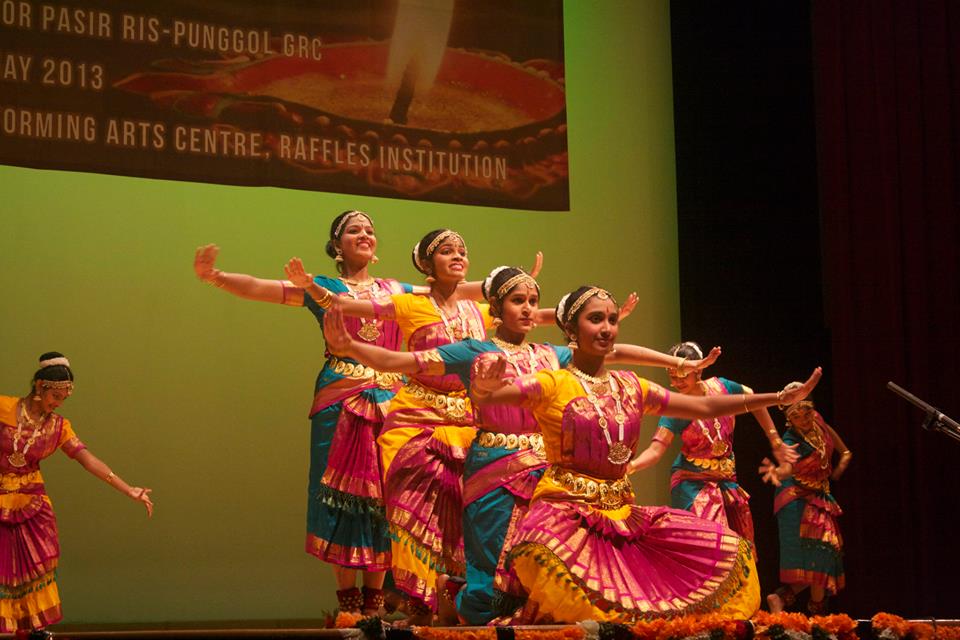
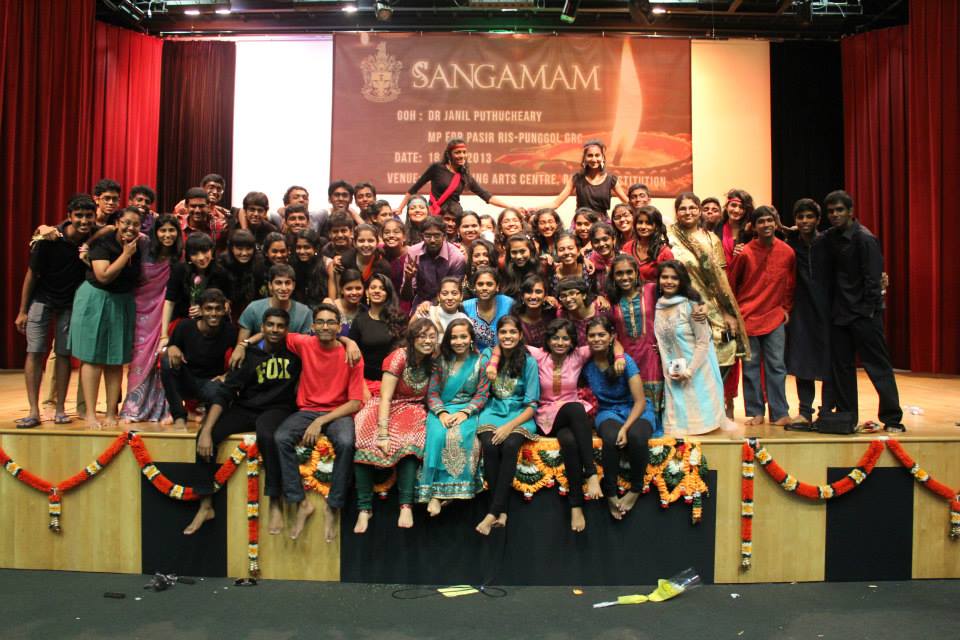
18th May 2013 marked the day that Raffles Indian Cultural Society (ICS) had been preparing for – Sangamam. Largely considered the most anticipated cultural night of the year, Sangamam brought together a close-knit community revelling in music, dance, colour and drama.

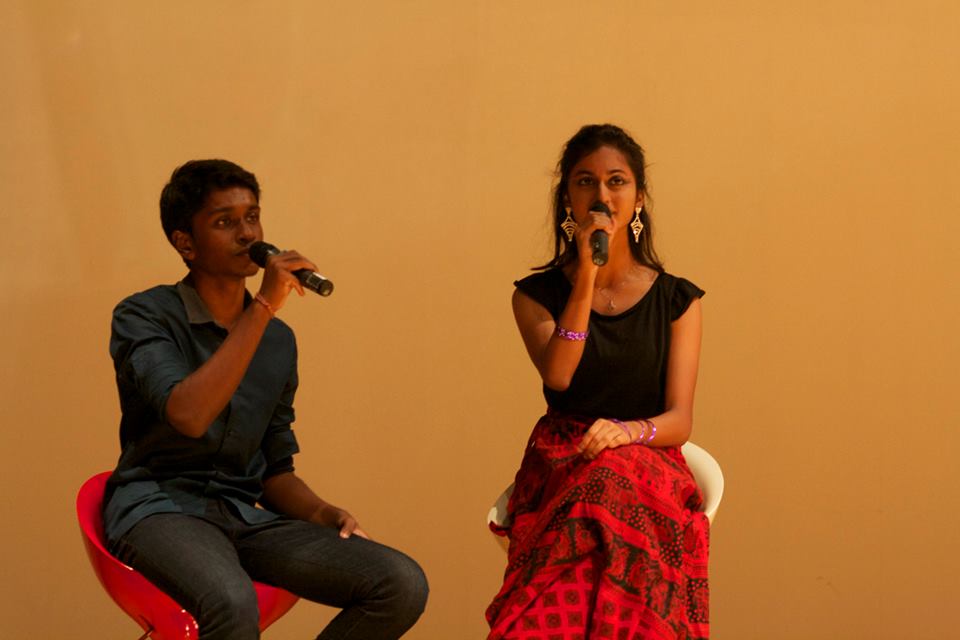
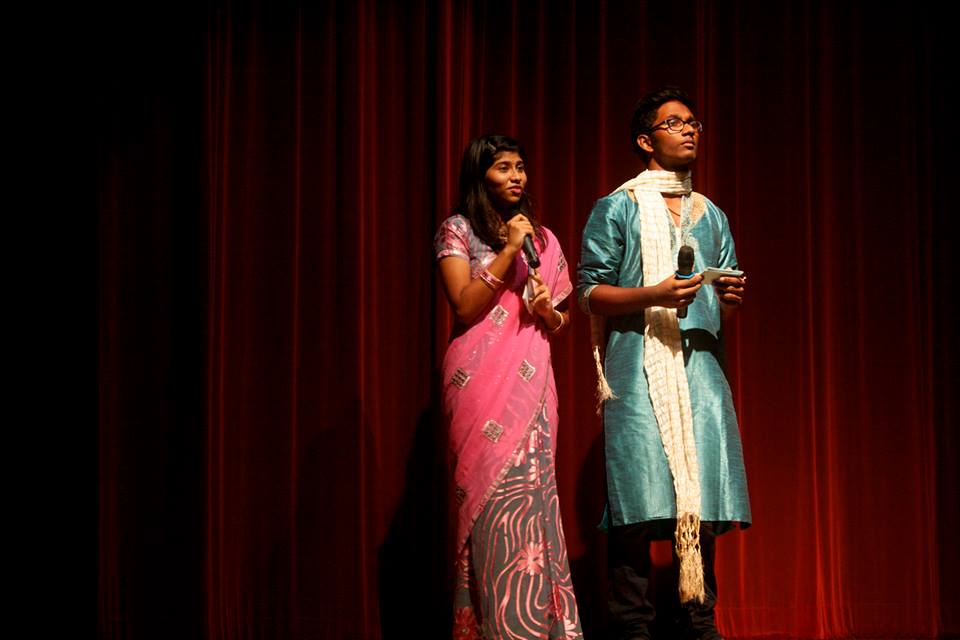
Emcees

The event started off with the song Tamil Thai Vazhthu, a song sung in praise of the tamil language and culture, an age-old custom to mark the beginning of Indian events.

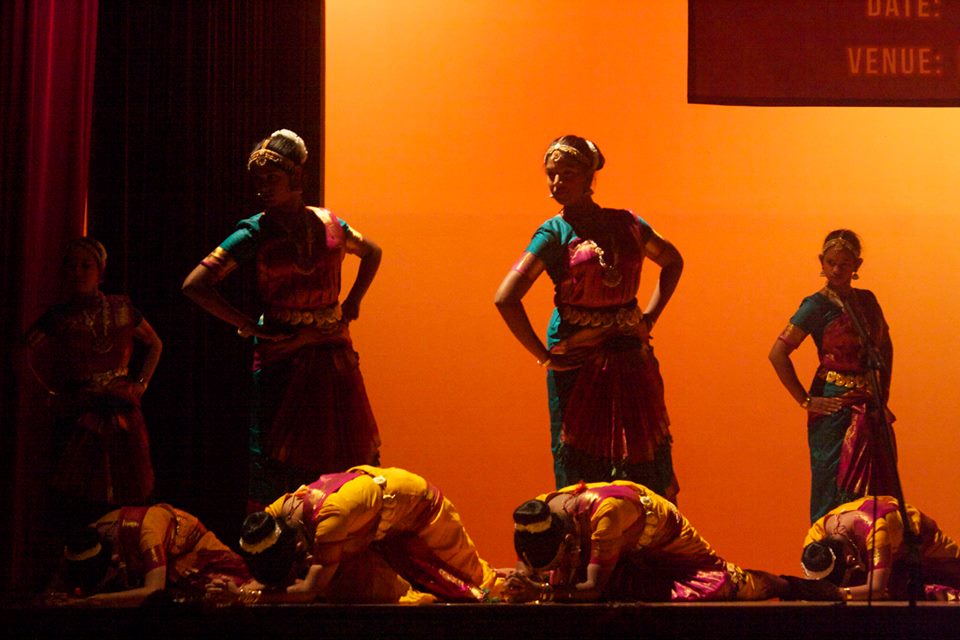
This was followed by own Raffles Indian Dance’s opening routine, Natya Shristi. It was a splendid classical piece that depicted Bhava (Expressions), Raga (Music), Tala (Rhythm) and Natya (Dramatic dance). The myriad of emotions and flavours in the piece made it a colourful and lively feast for the eyes.

Dance 1

Dance 2

This year, Sangamam was graced by Mr Janil Puthucheary, MP for Pasir Ris-Punggol GRC, and of course, our very own principal Mrs Lim. Even Mrs Lim joined in the spirit of the occasion, arriving in an elegant traditional Indian saree.

GOH
Guest-Of-Honour Mr Janil Puthucheary, MP for Pasir Ris-Punggol GRC
Mrs Lim
Principal Mrs Lim gracing the event

As the lights dimmed and the crowd cheered, the Year Fives took the stage for the first time with their batch performance. Thirteen of them put up a comical drama based on the themes of love, family and friendships. The drama followed Muthu, Aruna, Karthik and Ambhu as they ventured into a little adventure to succeed in love. Although it was their first experience acting for most of them, this did not deter them from stepping into the characters’ shoes, bringing them to life. With a well-crafted script and storyline, the drama was a full entertainment package, bringing forth peals laughter from the audience.

j1 Drama 1

j1 drama 2

After a captivating performance, the audience enjoyed a medley of songs sung by our very ICS members. The medley comprised of various soothing Tamil songs from famous movies, including Kumki and Kadal. The familiarity and exuberance of the songs got the audience singing along too! This segment definitely brought a smile to many faces.

Singing 1

singing 2

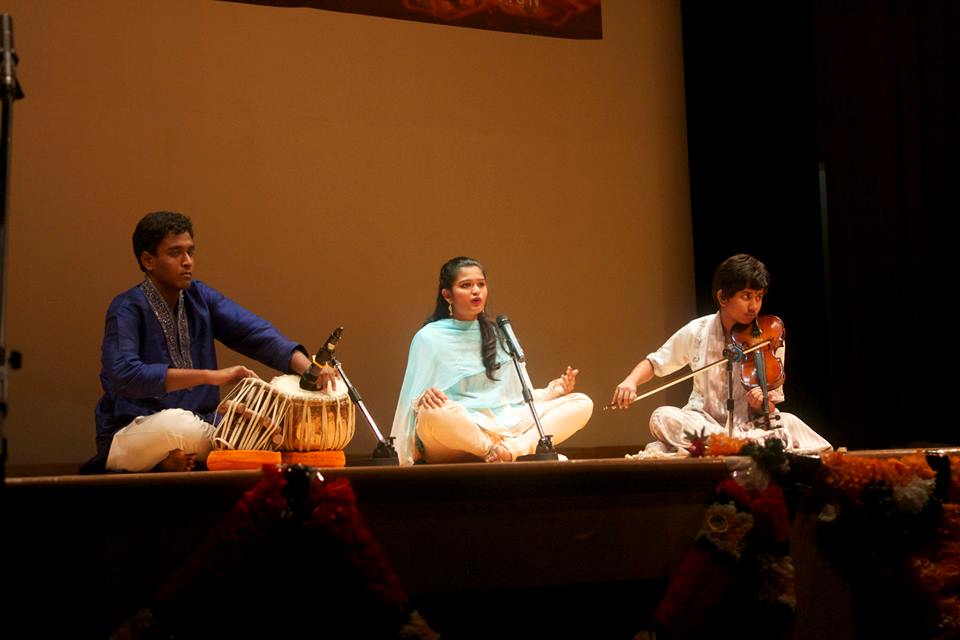
The concert proceeded shortly after, with a classical performance. With the confluence of both Carnatic and Hindustani elements, this segment featured the various facets of Indian classical music at its finest. The performance was executed in perfection, as all three performers, Govind, Swedha and Priyadarshini, were trained and had prior experience in classical music.

Classical 1

The Indian dancers took the stage by storm, and this time, it was a trendy and fun Bollywood performance. In a truly heartwarming moment, the batch of 2012, despite having graduated from the school, returned to put up a joint performance with the Year Fives, a genuine testament to the bonded community – the Raffles family.

Bollywood 1

This was followed by yet another comedic drama production by the graduating batch of Year Sixes. Steering away from the tried and tested Sangamam Drama formula of romance, comedy and happily ever afters, this drama took an original turn, making for a fresh change for audience members. In the play, the main character, Sanjay, meticulously makes countless attempts to impress his wife Maya, with the help of his family and friends, albeit in funny laughable ways. However, contrary to our expectations, Maya remained immune to his charms right till the very end! With its unusual ending, the senior batch’s bold attempt of trying something new this year definitely paid off.

j2 drama 1

j2 drama 2

The much awaited couple dance did not fail to dazzle the crowd. The five pairs did an excellent job, and unlike previous years, there was clever use of props in the dance too. The performance followed five couples as they danced their way through a fun and emotional journey from a pattikaadu (village) to the pattinam (city). A special feature of the couple dance this year was the use of glow-in-the-dark masks! It provided a truly an innovative touch to the dance which did not disappoint.

couple dance 1

The show ended with a bang, with the finale performed by the whole CCA. All the members rocked the stage as everyone rocked out to fast, upbeat songs, ending the show in a highly memorable manner.

final

When asked about the experience of organising Sangamam, overall IC Premikha (13S03A) said, “I felt that this year’s Sangamam was a great success considering the many challenges we had this year, especially as it was on the same day as two other major Indian events. To make sure that we attracted a crowd for was definitely not an easy task, but we still managed to pull it off really well – even the GOH mentioned he enjoyed the show!”

She also praised the commitment of the other members in the CCA for their effort despite various commitments, citing thanks to the teacher-in-charge Mdm Meera, Fahima the co-IC, the EXCO members and the CCA. “I learnt a lot about the talents of the other members in my CCA,” she said.

Although it was mainly a Tamil event, Sangamam did not fail to attract the non-Tamil speaking crowd. Year Five Cheryl Huang had come to support her friends. “It was a really colourful show. I could see the amount of effort put in by all the members and it was really heartening to see how their Indian community is so bonded. It was a really fun concert and it was great to see all their different talents.” Sangamam proved to be a great success, and Raffles Press wishes Raffles ICS to another great year ahead.

“Like a Boss” – All Jazzed Up

Reading Time: 5 minutes

by Alison Olivia Lewis (14S03S), with additional reporting by Muhammad Garda Ramadhito (14S05B)
Photos by: Wang Ziren and Edwin Chow (Photographic Society)

Widely regarded as one of the most prominent events on the ARTSeason Calendar, Raffles Jazz’s concert “Like A Boss” certainly lived up to the hype surrounding it. Hosting a fully packed crowd to the point many were forced to sit on the steps, Raffles Jazz opened the show with the curtains closed, a string of sweet, lone notes trailing behind them. As the curtains parted, Raffles Jazz’s first band opened the show with the upbeat “Spain”, setting a relaxed atmosphere that would last the rest of the night.

964759_4797701783803_285770693_o

After the opening song, the emcees, Andrew Chia and Victoria Yeo, stepped out to formally welcome the audience. Decked out in well-coordinated outfits, the emcees further lightened the mood with their cheerfulness and lame (and sometimes painful) puns, which only promised a chill, laid-back evening.

971732_10151613428309901_1217614236_nThe concert segment displayed the incredible talents of the Raffles Jazz members, performing passionate and expressive renditions of songs such as “I’ve Got You Under My Skin”, written by Cole Porter and became a signature Frank Sinatra song, and “The Chicken”, originally made famous by Jaco Pastorius. Most of the songs also featured solos by each instrumentalist, their abilities on stage also matching their enthusiasm. Many of the performers clearly held those sharing the stage with them in high regard – saxophonist Andrew Chia commented of how anxious he was “playing beside a great trumpeter (Quek Qian Yi)”, and how “pressurizing (it was) to play at her standard.” Despite the nerves, it was clear every performer had a unique ability that provided an added edge to each performance, with the various instruments complementing each other in perfect harmony.

However, the highlight of the show’s initial segment was its finale, a cover of “Virtual Insanity”, originally by Jamiroquai. Lead singer Brillia was, simply put, brilliant – her bright voice coupled with her cheeriness and powerful stage presence lit up the stage. The complementing instrumentals further enhanced the performance. For example, the violin and viola brought depth and character to the piece, while the keyboard added a modern touch to a song now 17 years old. Raffles Jazz’s rendition of this funky tune was well received, and was indeed a great end to the first half of the evening.

480339_10151613435654901_1693378970_n

Traditionally, Raffles Jazz has always “jazzed up” a usually standard concert format with a ‘musical’ segment featuring scripted staging and acting, and Like A Boss was no different. After a fifteen minute intermission, as Raffles Jazz returned to kick off their with a song entitled “Zoot Suit Riot”, they emerged onto the stage in masks and bearing guns, only to be “shot down” by the end, quite literally starting this segment with a bang. Featuring a witty script coupled with more cringe-worthy puns, this stray off the usual concert course proved to be a pleasant surprise, the highlight being the effeminate boss of the main character’s rival agency Hunter Skywalker, portrayed by Lin Qi, who not only stood out with his convincing display, but also brought much laughter to the crowd.

The finale piece, For Once In My Life, featured various characters getting together with their love interests from the musical, including main characters Jack and Jill Doe, who performed a short Broadway-style dance. Though clichéd, the “happily ever after” fairy tale ending never gets old and got the approval of the audience, who cheered for the rather cute (yet sadly fictional) couples.

294801_10151613431569901_257106251_n

Despite being a tradition, opting to go with a musical raised several eyebrows, including some from its own members. Lin Qi mentions, “I was uncertain of how it was going to go and how we would manage the technical challenges involved, and as much as it is a short visual show itself, the music is a large part of it – so I didn’t know how we would do it.” One of the other key challenges which came up during the rehearsal process was balancing acting and playing music. This was worked around by the organisation of the concert – Andrew tells us that “those who had major acting roles had few (1-2) songs, while those who didn’t got a few more tunes (3-4).” Beyond that, it also came down to the sheer hard work of the actors, as Lin Qi adds, “We tried hard for all the aspects of our performance. Acting a role just means that you have to put in time to learn your lines and know what to show people. We worked at it from rehearsal to rehearsal, and it’s just a bit of extra effort that you put in alongside playing music, which is the main thing.”

Not forgetting the people who worked so hard behind-the scenes, Raffles Jazz ended the evening making sure to thank everyone who played a role in their performance, most notably teacher-in-charge Ms Jina Foo. When spoken to about how she viewed the experience as a whole, she mentions how she finds working with the Jazz musicians a joy. “They are humble and willing to improve,” praised Ms. Foo, who willingly stayed back almost every day to let the musicians practise until perfection is achieved. “I look forward to work with them again for future concerts”, she declared, hopefully a sign of more to come.

After the lights dimmed, the audience clearly couldn’t get enough of the catchy jazz tunes as they chanted for an encore. After some time, Jazz members returned to the stage to perform September by Earth, Wind and Fire, while the other non-performing members danced along to a performance that summed up the sheer quality and talent on offer for the night.

922962_10151613433224901_1477874264_n

Unbelievably, some of the performers on stage that night had little experience performing on stage. Pianist Jennifer Ho admitted that she was very nervous before the concert, as this was the first time she had played music and acted in front of a live audience for quite a while. Likewise, drummer Timothy Tan found the experience incredibly rewarding, adding that while “the rehearsal process was really sapping and trying at times, I had a lot of fun preparing with my CCA mates”. Incredibly, some of the performers were playing parts outside of their comfort zone – when we spoke with her, Jennifer also humbly admitted, “I am not very classically trained like the typical pianist. I stopped attending piano lessons once I had my Grade 5 exam.” That said, any deficiency went well unnoticed, the top-notch performances still full of emotion and stunning quality.

Looking ahead, many of the performers on stage were Year 5s, and their ability to match up with their experienced seniors promises an even better show next year. On the whole, Like A Boss was a great showing from Raffles Jazz, and certainly entertained all in the audience who wished to unwind after a hectic week at school. Like A Boss was definitely worth catching, and certainly was a highlight of ARTSeason 2013 thus far.


You can watch Raffles Jazz’s performance of “Virtual Insanity” here:

Setlist:

First half:

1.     Spain
2.     I’ve Got You Under My Skin
3.     Girl from Ipanema
4.     Nature Boy
5.     Moanin’
6.     Lullaby of Birdland
7.     The Chicken
8.     Virtual Insanity

Second half:

1.     Zoot Suit Riot
2.     Close to You
3.     Cold Cold Heart
4.     Power Rangers
5.     For Once in My Life

Highly Strung 2 – A Twang of T’ang

Reading Time: 6 minutes

By Gao Wenxin (14A03A) and Nguyen Trung Huan (14S05A)
Photos by Mathew Gan (14A01C)

If one went into Highly Strung 2 expecting it to be an ordinary concert, he would have immediately dispelled that belief the moment he stepped into TheatreWorks 72-13 last Friday night. Notably hosted in an atypical stripped-down venue very different from a conventional concert hall, members of the Raffles Chamber Ensemble performed two shows with the acclaimed T’ang Quartet, which showcased emerging Rafflesian talent alongside the seasoned musicians and their protégés, both private students and students of the Yong Siew Toh Conservatory of Music.

image02
TheatreWorks 72-13: a beautifully refreshing setting

Highly Strung 2 was presented in a highly unusual setting at 72-13, a warehouse converted into a makeshift stage for the performance. A light strip demarcated the the stage area, with blocks sporting the trademark ARTS SEASON 2013 tape and sparsely scattered chairs replacing the typical concert grand stand. In fact, after overcoming their initial surprise, much of the school crowd chose to sit on the floor, themselves participating in the artistic experience by ‘interpreting the space’ as they scattered themselves in knots, selecting their preferred angle of view. All musicians were visible throughout the performance, entering and exiting with seamless informality from a visible holding area, demarcated only by more Art Season tape.

In the absence of a distant raised platform or backstage area to separate performers from audience, the arrangement offered a real sense of intimacy, which was enhanced by the smart casual pastel colours of the musicians’ untraditional performance attire. Furthering the sense of immediacy was the absence of emcees and programme notes, which kept the audience intrigued and obliged to meet the series of musical offerings on their own terms throughout. The ensemble for each piece was regularly rotated and kept small, in keeping with the intimate venue and the convention of a traditional chamber ensemble – although many offerings were subtle and innovative, at times almost atonal, and far from traditional.

The programme opened with two extracts from Carl Nielsen’s well-known Little Suite, starting slow with the Praeludium, before moving on to the Finale, where earlier themes were revisited at a higher tempo, as the piece soared to a synchronic climax.

Next came Peter Warlock’s Capriol Suite, played out of the usual order, with the second movement Pavane placed first and – a pleasant surprise – serving as a fitting introduction to the rhythmic Basse-Danse (normally the first movement). There was a sense of movement in the music throughout, and of liveliness and spirit in the Basse-Dance especially, which was quite in keeping with the origins and intentions of a dance suite.

image04
Fantasia on a phrase by Monteverdi

There followed the truly unique Fantasia on a phrase by Monteverdi. This is not a piece by the famous Claudio Monteverdi, but a contemporary work by Tomas Friberg, a wildly cinematic score, presented by a row of 8 instrumentalists. The symmetry seen on stage was juxtaposed with the almost discordant score to create a sense of discomfort. The piece seemed to bounce from one instrument to another, at times swelling in volume, at times dissolving into near silence, as the musicians subtly hovered around semitone intervals, which somehow managed to wander hypnotically and disturbingly without losing a thread of central melody.

The Fantasia served as introduction to a further series of innovative modern offerings, beginning with the bright and sprightly Le diverti se ment by Jean-Philippe Goude. The title is perhaps a pun on the French term divertissement, or a light piece of music often played for entertainment, and suggests ‘the entertainment lies’ or ‘the entertainment lies about itself’, without actually forming a properly grammatical sentence. The energy put into this piece was truly infectious, and not at all dissipated by the closing cheeky pizzicato note. It was taken up in Maurizio Bignone’s Il mistero di cossyra, the next offering, which alternated unison passages with solos in a musical car-chase of high drama.

image03
T’ang Quartet

A string of quartets followed, including Passamezzo, Arvo Pärt’s Summa, and Schnittke’s Polka. The first was a melodious treat, a series of comfortable mid-range notes embracing the audience warmly, before the Polka raised the pace and pitch. In contrast, Summa was a classic showcase of Arvo Pärt’s minimalist style, rocking between different harmonies, steady and meditative.

Gopak by Modest Mussorgsky was the finale of the night, bringing all the Raffles players onstage, playing scoreless and with zest, ending the night on a joyous and triumphant note.

Gopak
Gopak

As a whole, the concert featured a varied repertoire, not only exploring contemporary works but also giving a modern twist to the traditional close-knit affair of chamber music. Although the audience may have been initially slow to respond to the unfamiliar setting and the experimental nature of some works, the event surely turned out to be a musical education for all.

After the concert we spoke to members of the T’ang Quartet, Mr Leslie Tan (cello) and Mr Lionel Tan (viola), both alumni of RI. Lionel agreed that “the pieces are designed and programmed in an unconventional setting and with an unconventional rethinking of the concert programme flow.” But he expressed that the selection of pieces was felt to have the potential to appeal to a young target audience.

Lionel explained that Highly Strung II was part of The Ensemble Dimension Project, which aims to “harness the power of youth” and develop talented young players. It arose when the T’ang Quartet was approached by the RI Aesthetics Department to work with the Chamber Ensemble, a first for the Quartet, who had previously involved young students in Highly Strung I, but had never before undertaken a full scale collaboration with a school ensemble. T’ang actually hesitated to agree to the project at first, until after they held auditions at RI. At this point, they were duly impressed and, as Lionel put it, thought “Ok, this is the kind of talent we’re looking for!”.

curtain call
Curtain call

The final verdict? “This is our second installment of the Highly Strung concert series, and we’re very happy to have done it and hope that RI is equally happy with it. We hope the kids have really learnt something! I think the students have progressed a lot and even the most shy ones have opened up. I’m very pleased with the show.”

Mr Leslie Tan, the cellist, draws much of the concert-goer’s attention with his signature long hair and stage presence. Besides which, how can anyone fail to be impressed by an artiste who goes about with a cello stashed in the back of his means of transportation – a pastel pink vintage school-bus! One could be intimidated approaching such a figure, but we were struck with Leslie’s friendliness when he greeted us. With a light-hearted laugh, he exclaimed, “Hey, please don’t call me Sir. You’re making me feel so old!”

In our informal interview, Leslie shared his passion for Singapore’s classical music scene. The main reason for the quartet members’ decisions to return to Singapore after graduation was that they “realised that there was just too much to be done” in the local arts scene for them to be content to stay overseas and miss out on contributing. Sighed Leslie, “Over the years, I have met many talented students. But by the time they reach O-Level or A-Level, they stop practising as they decide to pursue higher earning careers like medicine or law.”

The future of classical music in Singapore, Leslie feels, will depend on a change of “mindset”. The social pressure creates too much of an overwhelming force that magnifies and exaggerates the value of “conventional dreams” and of holding high-paid office jobs. His ambition is to plant the idea of forgoing such prosaic “dreams” and encourage some to be brave enough to follow in the footsteps of T’ang’s now highly successful musical career. Leslie told us that, on hearing about T’ang’s first full scale collaboration with a school ensemble, his students from other schools such as ACSI or HCI asked, ‘Why didn’t you do this for us?” His response: “Because you never asked!”

“The Horse in Motion” – A Time of Firsts

Reading Time: 5 minutes

By Jayne Chan (14S03D) and Sushma Pai (14S03R)

image001

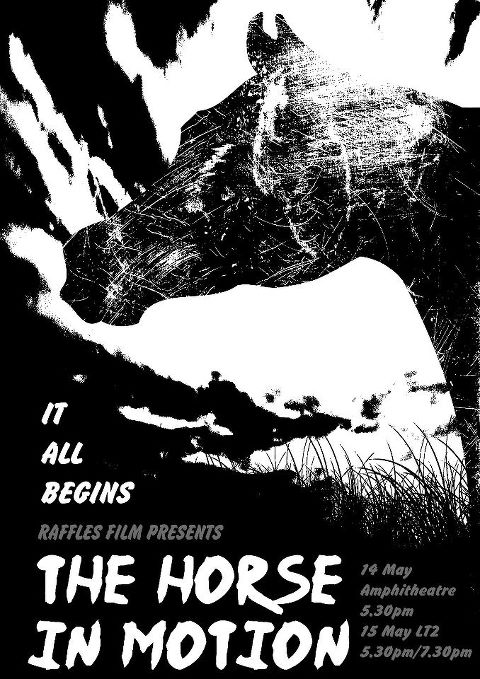
The first ever motion picture created was of a running horse. Looking back, the film industry has come a long way since then. From the insanity of Black Swan, to the heart-stopping (and sometimes, gory) action of Django Unchained, the film industry has captured millions of hearts and minds with its magical way of drawing you into a whole other world, before launching you (cruelly) back into reality. In somewhat similar fashion, Raffles Film Society documented their first forays into filmmaking in a half-hour showcase aptly named, “The Horse In Motion”.

Knock

The showcase opened with Knock, a chilling take on urban legends. Knock features a student studying late into the night, the ticking clock his soundtrack and books, his companion. Suddenly, a strange knocking interrupts his thoughts. Curious, he gets up to investigate. As he makes his way down a red-tinged hall, and opens the main door, he finds nothing. Perplexed, he resigns himself to returning to studying. However, the knocking persists and the story’s true climax comes with a shocking revelation.

The film oscillated between climaxing and sliding into a resolution… Or so we thought. It maintained a tight grip on building tension throughout, truly an excellent blend of spine-chilling music and suspense that kept us on the edge of our seats for its entire duration.

Trace

Being the only non-English short film in the entire compilation, the story was narrated by the main character himself in fluent Chinese. Trace featured a private detective taken off the side-lines and thrust into the spotlight, in an ironic role reversal. The audience was led through the main character’s thoughts, featuring a woman, later understood to be his wife. Following her discreetly, he observes her with another man from a distance. Flashbacks to his married past then culminated in him attacking the man from the back, remarking, “This will be my last assignment.”

Feng Weihan remarked, “I wanted to explore more mature themes”, when asked about why he chose to make a film on this topic. Unsurprisingly, this motion picture was indeed a reasonable exploration of more mature themes such as loss and memory. It was a breath of fresh air and was indeed pleasing to watch.

The Relationship Blocks

“People form relationships all the time, block by block… As they get closer, the tower grows.”

The film begins with a newly-formed friendship between a boy and a girl, through studying sessions. As we all know, though not impossible, ‘just friends’ is hardly ever the case between members of opposite genders. As the film progresses, the girl begins to fall in love with the boy. In fear that her confession might affect their friendship, she holds back. Yet when she finally gathers up the courage to write a confession note, the boy has already gone off with someone else – as you would probably expect. She crumples up the note, throwing it away. The film then closes with the demolition of the tower built up throughout the film as their relationship grew, only to collapse in the end.

The Anomaly Integration

The unusual title of this film caught our eye. It was directed and produced in a simple manner, telling the story of a “Mugger” being the ‘anomaly’ in his class of ‘bo-chups’ (loosely translated, a Hokkien phrase meaning “couldn’t care less”).  He was always relegated to the side-lines, partly due to his ‘80s-influenced fashion sense with the ever-popular high-waisted pant. Nevertheless, this film had a happy ending with the “Mugger” finally ‘integrating’ with his classmates due to their shared dislike towards a particularly naggy teacher. The light-heartedness and relatability of the film through its depiction of school-life made it an enjoyable watch.

Two. Point. Four.

“2.4 timing: 20 minutes.”

A boy despairs over his inability to pass his 2.4km run. He is motivated to run with a girl he likes, inspired to run faster in her presence. Eventually, our hero finishes his 2.4km in a mere ten minutes, running across the bridge towards the girl, then revealed to be a figment of his imagination. Out of the blue, the boy poses with a bottle of F&N and appears to advertise it. This was an unexpected twist in the film, possibly meant to be a parody, definitely catching the audience by surprise.

Redemption

The final short film screened was a re-hash of the usual “student-drug-addict-meets-his-end-and-wishes-to-repent” plot, and predictably, it did mirror those “1800-X-AHLONG” commercials on television for the ‘redemption’ factor. Nevertheless, its fancy cinematography compensated for it being rather forgettable. It was indeed a powerful end to the string of 6 short films we were treated to.

The scriptwriters, directors, and producers of the short films

Some of the themes covered in the short films, such as the lack of social integration and relationship building, are popular topics students are able to relate to and empathise with. Such themes were accurately portrayed in the short films. Raffles Film also branched out and touched on delicate themes, such as unfaithful relationships, drug addiction, and even horror. It was an ambitious decision to direct and film such themes, but Raffles Film did an absolutely brilliant job in capturing the audience’s hearts.

Viewers were kept engaged throughout each and every film by the carefully-selected music and entertaining dialogues. The impressive cinematography undoubtedly made the half hour worth our time, despite some of the plots being slightly clichéd. Whilst the audience turnout may have been less than ideal, the films screened were excellent first attempts and showed the tremendous hard work put in by the members to make this happen.

The production process was indeed a challenge posed to the members of Raffles Film. Year Fives were split into groups and tasked to write a script, only to swap scripts with each other after hours of fine-tuning. These films were largely completed over the span of two days – which included familiarizing themselves with new scripts, acting, and filming – and were wholly edited by Year Fives. Of course, the Year Sixes played a role in the production as well, producing films such as Trace. Under these circumstances, the showcase was indeed a commendable production.

Wu Jiamin of 14S03S commented, “the films were not made with million-dollar budgets, but they were made with ‘million-dollar hearts.’” And yes – that is certainly good enough for us, even though the transparency of the themes did cast a shadow on the creative, eye-catching cinematography. Just as the film industry has matured into the multi-million dollar industry it is today, we must never forget that it all began with a running horse. In similar fashion, Raffles Film, guided by Mr Kelvin Sng, director of the locally-acclaimed movie, “Taxi! Taxi!”, has the potential to grow, and we definitely look forward to future productions from them.

Watch their preview below.