Enrichment Programme Previews

[Please Mind The Platform Gap] Enrichment Programmes: Raffles Public Policy Programme

Reading Time: 3 minutes

By Jayne Chan (14S03D)

I can still remember the first time I stepped into the Seminar Room for an RP3 session, with its bright white lights and neat rows of desks. I remember feeling extremely nervous. I wasn’t sure what to expect. I wasn’t even sure I was in the right room despite reading and re-reading the reminder email at least ten times. However, the past year spent in the (correct) seminar room opened my eyes to a host of local issues and made being in RP3 a truly eye-opening experience.

The Raffles Public Policy Programme (or RP3, for short) is one of the many exciting enrichment programmes offered in Year 5. Sessions involve discussions about hot-button issues in Singapore, whilst delving deeper into the rationale behind policies, as well as the contributing factors leading to such decisions. Guest speakers (I had the pleasure of listening to Dr Cherian George and Dr Teo You Yenn) will be invited to give talks, and when the year-end holidays roll round, all RP3-ers will be given the privilege of interning at a ministry of their choice.

Discussions

The discussions I had the opportunity to engage in mainly revolved around inequality and meritocracy, with a side of LGBT rights, the disabled, and the necessity of tuition. We were usually treated to a brief overview of the day’s topic before gathering into groups for smaller-scale discussions. Following that, each group had to present their opinions. Everyone in RP3 is well-read, so I learnt a great deal from those I had the pleasure of interacting with. We explored the characteristics of various policies in Singapore in-depth, along with their merits and areas for improvement.

There are also quite a number of readings to do before each weekly session. Usually, these readings comprise local newspaper articles, the occasional paper and opinion pieces on similar phenomena or policies overseas (usually the US and the UK).

Year-end Internship

To me, the internship was the most memorable part of being in RP3. From my five-week experience, I gathered that policy work involves a daily barrage of emails, a substantial amount of miscellaneous work, plenty of meetings and to a certain extent, unpredictability. It was a regular desk job, but that didn’t translate to it being ‘boring’ or ‘dull’. Certain tasks involved critical thinking and evaluation skills, as well as a great deal of professionalism. Writing and IT skills were also important (I recommend familiarising yourself with Microsoft Excel). You may or may not utilise the knowledge gained during regular RP3 discussions, but the skills picked up from delving into policies do help in the work given. The discussion topics will also be brought up over lunch conversations with your colleagues.

However, at the end of the day, what I remember and appreciate most was the people that I had the fortune of working with. They entrusted me with interesting projects and went out of their way to make sure I was welcome in the office. I’m sure my fellow RP3-ers can attest to that too. Also, other perks of having a year-end internship include year-end parties and the occasional lunch treat.

The temp pass issued to us

(Just as a side-note, you may be left to your own devices at times, since it is the end of the year and people take leave).

Conclusion

Overall, I can’t say that my RP3 journey was filled with ‘ups-and-downs’, but it was a very fruitful and enriching experience for which I am truly grateful. I learnt how to navigate the office environment, and am now more aware of the public policy scene in Singapore. It is a timely programme too, given that we have to decide what paths we want to embark on in our (future) working years. If you are interested in policy-making, or simply want to find out if the public sector is for you, do consider joining RP3. It’ll be an experience you (hopefully) won’t forget!

[Please Mind The Platform Gap] Enrichment Programmes: Raffles Bicultural Programme (China)

Reading Time: 2 minutes

By Lu Jinyao (14A01D)

Mention Raffles Bicultural (China) Programme and the first thing that comes to mind is usually either the trauma of Chinese ‘O’ Levels of your rusty Chinese oral skills. However, that is definitely not the best description of Raffles Bicultural (China) Programme.

Raffles Bicultural (China) aims to inculcate into students a sense of awareness and appreciation – not of exotic Chinese vocabularies, but of the world’s second largest economy and its culture. This programme recognizes the increasing importance of bilingualism, be it for the purpose of embracing your cultural roots, or the pragmatic reason of China’s rising economic power. Essentially, Bicultural China exposes students to various aspects of the Chinese society, past and present – the history, culture, politics and modernization, through its weekly sessions held during every Monday’s protected time.

IMG-20140216-WA0015

Every year, to conclude the programme, there will be an overseas trip to China’s cities which varies year to year. In 2013, 31 students from the programme went on a 9-day long tour to Beijing and Xi’an, truly embracing one of the world’s richest continuous cultures. We visited historical sites such as the Forbidden City, and the Terrecotta Army of Emperor Qin Shi Huang’s Mausoleum. We also had the opportunity to interact with local students, some forming intricate bonds amidst the insurmountable language barrier. For me, nine otherwise mundane school vacation days were turned into an unforgettably fruitful experience, leaving me with beautiful memories and blossoming friendships.

After all, Bicultural China focuses more of dissemination than excellence. Ultimately, the programme aims to invoke within Rafflesians an embracement and appreciation of a different culture. Thus there is minimum requirement of the mastery of the Chinese language. The selection criteria are simple – a passion for the Chinese culture, a keen attitude and a decent Chinese grade. For the truly passionate, Bicultural China also offers its very own scholarship to outstanding students from the programme. As a scholar, you will undergo training to further sharpen your language skills.

IMG-20140216-WA0014

If you are interested in the world’s most populous nation, world’s second largest economy, and the world’s richest continuous culture, do consider joining Bicultural China!

[Please Mind The Platform Gap] Enrichment Programmes: Raffles Middle East Programme (RMEP)

Reading Time: 3 minutes

Arab-Spring-women-Egypt

‘The Middle East’.

The first thoughts that came to mind were words like ‘Islam’, ‘chaos’, ‘belly-dancing’. It sounded complex. It sounded exciting. It sounded like the kind of enrichment I would look forward to every Monday morning.

There were a number of particularly memorable activities that took place through the year, one of which was the belly-dancing lesson. The dance teacher did more dancing than talking (which was a plus point) since she danced fantastically; it was safe to say that we were all awed by her gracefulness and poise. Everyone had a chance to attempt some moves, and even a routine of sorts, to cool Arabian music (note the distinction, ‘Arabic’ is a noun referring to the language, while ‘Arabian’ is the adjective).

Arabic lessons were a regular part of the curriculum for the programme, about once or twice every term. These lessons were peppered with stories about the teacher’s adventures in the Middle East, and how the Arabs would be amazed at his ability to speak Arabic. For most of us, these stories livened up the lesson, since it could get dreary repeating Arabic phrases again and again. Yet it was all in good fun and at least exposed us to the language. Elements of culture are often found reflected in the language of the nation or region. How is one supposed to appreciate the culture of the Middle East if we are unable to appreciate the language? Arabic lessons were definitely part of the more appealing and stimulating sessions held throughout the programme.

Not to say that the other sessions were boring or very disappointing – the talks by the various speakers dealt with highly pertinent topics for the Middle East today. I remember distinctly the talk on Political Islam. It was rich in content, providing us with in-depth background information on the Middle East, on how much of the region was ruled by the Caliphate before being dismantled sometime after a few hundred years of Golden Age (then again, I could be wrong about the timespan). The information has proved useful for both General Paper essay questions on politics, as well as the International History syllabus on religious fundamentalism. A lot of content is offered, and speakers try to give a good overview of the topic.

What I personally found unsatisfactory about the talks was how they were broad overviews, and did not focus on specific issues such as the role of religion in the various Arab states, be it in politics or in the society. Where religion was mentioned, they only discussed the role of Islam, ignoring the conflicts that have arose due to the presence of Jewish and Christian communities.

Furthermore, the meaty bits of information were only covered during the question-and-answer session held after the talk. Sometimes, the overviews covered information that we already knew, and it would be easy to tune out, especially if the speaker that day was merely reading off the slides.

In retrospect, I admit I was not the most proactive student. I did my regular reading up each week on the topic for the next, but I never did ask questions even if I had them. It was the same students each week that contributed to the question-and-answer segment at the end of each talk. It probably is the same few students who have an innate thirst for learning, who already have a burning interest for the Middle East. And I believe they came away each week, achieving their aims, having their questions answered, and gaining a few bits of knowledge that might come in useful for their General Paper. I simply was not one of those students. I went for the programme because I expected to be engaged, and not to engage.

Thing is, the Raffles Middle East Programme is not for students who wish to be engaged by the speakers. The talks are generally comprehensive in nature, and similar to the usual academic lectures, the speakers do not care if you pay attention. In the end, you have to take ownership over your own learning. How much you are willing to give, determines how much you take away from the programme.

Ultimately, the Raffles Middle East Programme welcomes students who already have deep interests in the Middle East, and who are willing to find out more on their own, to take charge of their own learning and be proactive about achieving their learning aims. The rewards it offers come only with diligence and a willingness to think critically and challenge the speaker with provocative questions. Be willing to step out of your comfort zone, because the programme is not for the timid or the lazy.

[Please Mind The Platform Gap] Enrichment Programmes: Adventure Leadership Programmes (ALPS)

Reading Time: 3 minutes

By Law May Ning (14S03O)

As part of our feature on Year Five enrichment programmes, our reporter speaks to Clarie Ng (14S03B) and Jeremiah Choo (14S06D), members of the 2013 Adventure Leadership Programmes (ALPS), who shared their experiences in ALPS in the last year.

IMG_11695146757185

Q. So what is ALPS about?

Jeremiah: ALPS stands for the Adventure Leadership Programme, and if I remember correctly the actual byline is  “self discovery through experiential learning” – a line that’s really is quite apt, given that it’s all about learning to push yourself out of your comfort zone.

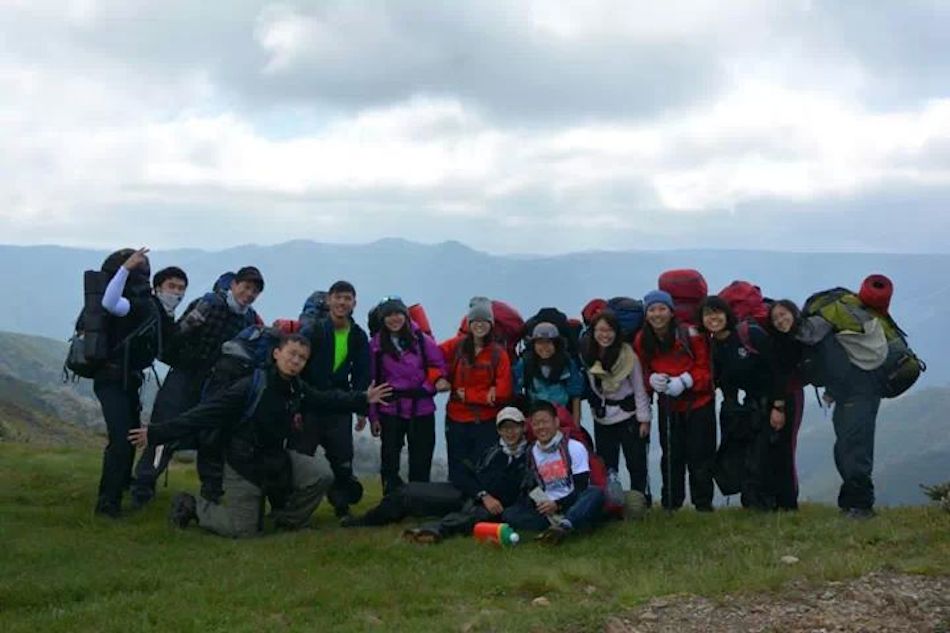
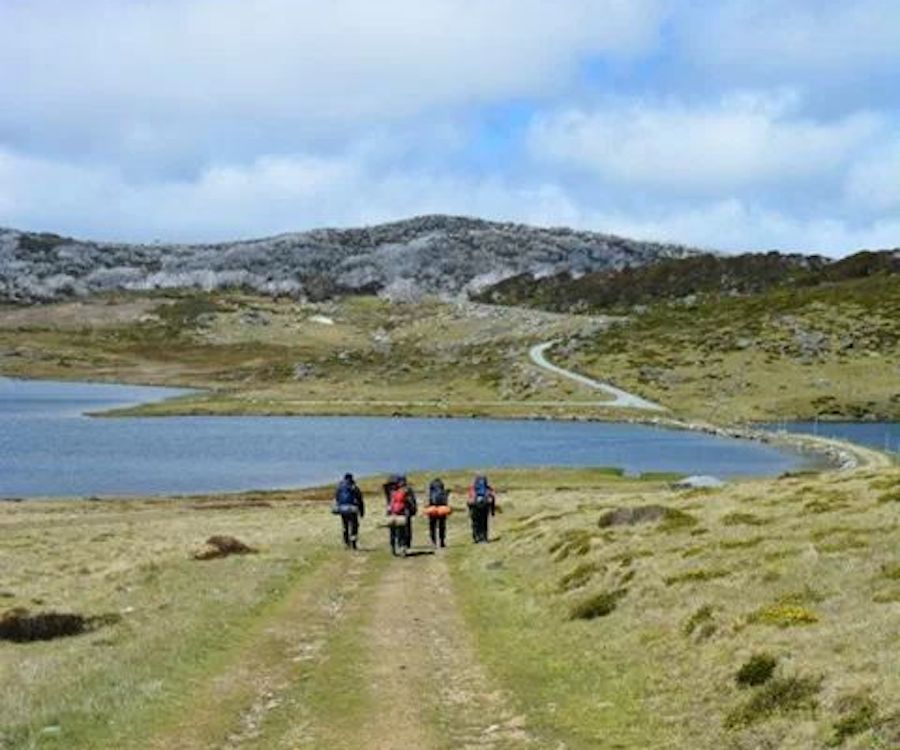
Clarie: The programme leads up to an end year, two week long hike at the Australian Alpine National Park. We have to plan our own route, bring and carry our own food so it’s really quite an adventure.

Q. What would a member of ALPS do, besides go on the end year trip?

Jeremiah: In our weekly Monday morning sessions, we had leadership training and learnt other skills to mentally prepare ourselves for the trip.

Clarie: We had physical training sessions too – on some Saturdays we went to Bukit Timah to train our fitness by climbing the stairs there!

IMG_11720081650877

Q. Does that mean I have to be fit to apply to ALPS?

Clarie: No, that’s not necessarily true – to get into ALPS we will only have an interview. It doesn’t mean we’re going to make sure you’re fit enough to climb stairs or you can’t join us! You may not be fit enough to climb the stairs at first, but that’s the whole point of the programme, to train ourselves – climbing stairs will definitely make you fit to climb the mountain. We’re just looking for people with a positive attitude.

Jeremiah: A lot of people come into the interview just because they want an enrichment programme, or they want some sort of points on their resume. We want people who are genuinely interested in the experience and want to improve themselves and grow as a person.

IMG_11666957932954

Q. So how was the trip itself? What was your experience like?

Clarie: The days of preparation were not enough to mentally prepare for the trip – a mountain is much more steep than stairs, and the terrain was quite rough and hard to travel across especially when we were carrying heavy bags with all the supplies. There was even hail! It was an interesting experience to see hail, it hurt a little then we put on waterproof attire but we could still feel the hail against us.

Jeremiah: In the daytime the temperatures were about 10ºC and above! It was quite comfortable, rather like an airconditioned room in Singapore, though there were rather strong winds. But at night, it reached sub zero temperatures and we couldn’t start fires since we were using gas canisters! It was difficult to sleep even with our special thermal sleeping bags, so people who joined ALPS do have to be mentally prepared for an exacting experience.

Q. What was the most memorable experience in the trip for you?

Clarie: For me, the one experience I will remember most are the people I met through the trip and the shared experiences we had – the cooking, waking up, attempting to eat. We had a lot of fun together and I’m glad I went through it.

Jeremiah: What I remember most was trying to cook mac and cheese up on the mountains! It was so funny – what I can say is, cooking mac and cheese on a mountain is definitely a bad idea. At high altitudes, it’s difficult to cook anything, so we ended up with mac and cheese that was half burnt, yet half uncooked! It was a terrible sight,  but definitely memorable.

Q. Do you think it was a worthwhile experience?

Clarie: Yes, it was. Then again, the experience is really different for everyone – a lot depends on who is in your team, and what you do while you’re on that hike. But, if you want a challenge for yourself, perhaps this is the programme for you.

IMG_11784438472800

[Please Mind The Platform Gap] Enrichment Programmes: Raffles Reflects

Reading Time: 3 minutes

By Jeremy Khoo (14A01B)

bj_pagebat

There are many misconceptions about the study of philosophy. It is not intellectual masturbation, completely irrelevant to the real world (its only mostly irrelevant, a distinction insisted upon by most eminent philosophers) or the devil’s work, though if you believed any of the above Reflects is probably not for you.

The issue of the relevance of philosophy is actually a hotly-contested one. Ludwig Wittgenstein, perhaps the preeminent philosopher of the 20th century, had many things to say about the academic philosophy of his time overreaching itself to arrive at conclusions philosophers had no epistemic right to because they were confused by their own use of language, thus creating philosophical castles in the air. Today, whenever a debate over the importance of philosophy erupts, philosophy is always defended by someone who points to philosophy of science and political theory (in other words, the obviously useful stuff) and who seems willing to jettison quite a lot of present academic philosophy. I am personally dubious about how knowing whether the A or B Theory of Time is true would really change my life. (That doesn’t mean I wouldn’t be intellectually interested in knowing the answer.)

Anyway, if you’re a philosophically-minded person in this context, you might wonder if studying philosophy is a viable option. Well, no philosophy lesson or course is going to be able to answer that question, but Raffles Reflects will give you some idea of what you might be getting into and whether you feel its worth the comfortable life you might have had as a successful white-collar worker. As you know, a career in philosophy involves living in hovels with six other fellow hovel-ees, all of whom have more advanced philosophy degrees than you, and subsisting on a diet of pure thought and the occasional packet of crackers.

Raffles Reflects is more or less intended to allow students to explore the most important philosophical issues at an introductory (i.e. first-year undergraduate) level. It is, of course, just a taste of what one might experience reading philosophy at university, but does involve more in-depth study than the RP Philosophy course. Four main areas of philosophy are covered in the year’s work — ethics, politics, epistemology and the philosophy of mind.

In each area, the course aims to broadly sketch out the most influential ideas of the last few hundred years. For example, in the Ethics module, the three major theories of normative ethics — deontology, consequentialism and virtue ethics — are given focus. At the end of the year, each student writes an extended essay on either a set topic or (if they so choose) a topic of their own devising of 1500 words or more.

Readings for each lesson are given out the week before. In order to follow the lesson, it is more or less necessary to do this work diligently. The work is not usually dumbed down, which is a plus point because you will be engaging with actual philosophy rather than ‘introductory texts’ most of the time. The tutors will then spend the session working through the article and facilitating discussion on the key points.

On the whole, Reflects will probably be a suitable introduction to the basics of academic philosophy for any philosophically-minded person. As opposed to Knowledge and Inquiry (KI), which is about ‘the nature and construction of knowledge’ (maybe the most-repeated phrase in the SEAB syllabus) and engages with specifically epistemic concerns in both philosophical and non-philosophical fields, Reflects focuses more on the central areas of interest to modern academic philosophers. Students already taking KI should not find that the content overlaps, while students interested in philosophy who elected not to take KI may consider this a (nongraded) substitute. Its also worth noting that a background in philosophy can serve as good grounding for any career where critical thinking skills are important. Studying philosophy to improve your critical thinking without any actual interest in philosophical issues is probably not the best of ideas, though.

The selection process is fairly simple: you will have to write a 1000-word response to a question on a basic philosophical issue, most likely a comment on an influential philosophical analogy / thought experiment or an important bit of theory. No philosophical background is presumed and citations are both unnecessary and impossible to submit through the online enrichment registration portal.

For the reference of anyone interested, links to online versions of several articles covered last year are included below.

Rosalind Hursthouse, “Virtue Theory and Abortion”

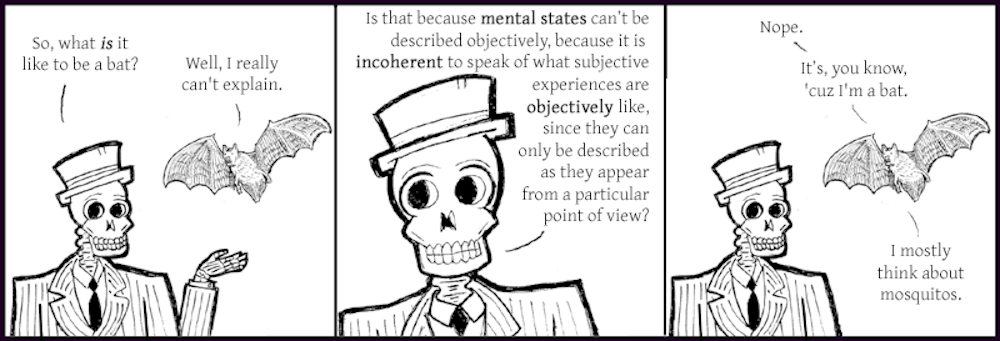
Thomas Nagel, “What Is It Like To Be A Bat?”

Edmund Gettier, “Is Justified True Belief Knowledge?”

Cover Image from http://23ae.com/wp-content/uploads/2010/03/bj_pagebat.png.