Commentary

[Please Mind The Platform Gap] Enrichment Programmes: Raffles Ecological Literacy Programme

Reading Time: 3 minutes

By Tyronne Toh (14A01A)

Does “Ecological Literacy” sound a little dry to you? Well, you’re horribly mistaken. With a multitude of field trips to places ranging from Bishan Park to the offshore Cyrene Reef (yes, there is a coral reef in Singaporean waters), you’re bound to get your feet wet.

Cyrene Reef, earlier in the year. See what I mean?

With a strong emphasis placed on hands-on activities and experiential learning, Ecological Literacy (or Eco-lit in short) consistently brings us out of the conventional classroom to experience nature in all its glory. Our first trip of 2013 was to Bishan Park, then Macritchie Reservoir, but we soon progressed to places such as St. John’s Island, Ubin and Cyrene Reef, with an additional trip to Tioman in June. And although not all the trips may be to exotic destinations, such as Cyrene Reef –not many people get to visit Cyrene, and even fewer know of its existence, for the matter-, every trip is nonetheless an eye-opener; life and beauty are truly ubiquitous in nature- one simply has to take a closer look to realize this.

Hey, it’s Patrick!
Hey, it’s Patrick!

Do consider joining if you enjoy being close to nature and spending quality time with the great outdoors. For nature-lovers, it would be a dream come true; Eco-lit gifts you with numerous opportunities to get intimate with nature. For the curious skeptics, you’d likely learn to love and respect nature for all its fabulous flora and fauna. Each Eco-lit student is required to keep a journal in which sketches of encountered flora and fauna are taken down. Information regarding the animal, plant or location would later be added in. Journaling certainly makes for a great hobby too. Some of us have even taken this journal as a personal project of sorts, putting in entries from extra-curricular outings or encounters.

Of course, there are also in-house activities. Discussions on topics pertaining to the conservation of nature or pressing issues also take place, with students encouraged to voice opinions and ideas to these. Earlier in the year, we even had a guest speaker come down to share her experiences with the group. Also, we also had story-telling sessions where every member brought his or her own children’s picture book and read it to the others. Why? You’ll find out soon enough. More recently, Mr Tan Si Jie, our teacher-mentor, led the group in setting up a mini garden in the cozy backyard area of the RLI office. Herbs such as mint, chili padi, citronella and lemongrass were amongst the lot, and the garden even features its very own butterfly cabinet, which was constructed by Eco-lit students under Mr Tan’s guidance.

Despite the seemingly scientific nature of this enrichment program, there aren’t any subject pre-requisites to joining this program. Personally, I’m taking a full Arts subject combination, and have never felt left behind in this program. You might have to take down the occasional scientific name, but my lack of hard scientific background has never been an obstacle for me.

Ever thought of publishing your own book? Well, Eco-lit gives you that chance, too. Every student is encouraged to write a children’s book pertaining to nature, complete with illustrations. The book-writing process would usually take place from December to next year’s June, culminating in a book launch and possibly a story-telling session to kids- that’s where the story-telling experience comes in handy.

All in all, Eco-lit has been a ride. There are few things in the world that can ever surpass great company in the great outdoors. Hopefully, this article has cleared up some of your doubts with regards to Eco-lit; and do consider signing up for it!

101 Crowdsourced Ideas for Valentine’s Day

Reading Time: 6 minutes

By Allison Choong (14S05B), Arintha Adelina (14S05B), Law May Ning (14S03O), Seraphine Chanentia (14S06N)

Q. What would you expect a girlfriend/boyfriend to do for you on Valentine’s Day?
A. Kiss me.

– Female respondent, currently single

How did you spend Friendship Appreciation Day?

Did you know that Valentine’s Day was originally a religious celebration of a Christian saint named Valentinus? The original festival had nothing to do with roses or chocolates – the only semblance of sentimentality was that the said saint carried out secret marriages for soldiers otherwise forbidden to marry.

What then does the arbitrary retailers’ dream day mean today, beyond making most American men $150 poorer? And in particular, what does it mean to the average Rafflesian?

In an attempt to demystify the unspokenly exciting day that might spice up an otherwise dull school life, Raffles Press presents to you an online survey of 120 respondents on boyfriends, girlfriends, expectations and reservations. Of the 120 people we surveyed, about 56% were girls and only around 26% were in relationships.

genderrelationship

Expectations

Q. What would you expect a girlfriend/boyfriend to do for you on Valentine’s Day?
A. Buy me chocolates! And spend time together with me.

– Male respondent, currently single

Fexp

The first of our questions was ‘What would you expect your girlfriend/boyfriend (or hypothetical one) to do for you on Valentine’s Day?’. Girls are commonly stereotyped to expect more gifts and romantic gestures, and some may feel weighed down by perceived expectations from the day. But is this actually true?

Q. What would you expect a girlfriend/boyfriend to do for you on Valentine’s Day?
A. Not get heat stroke at Take 5.

– Female respondent, currently single

At first glance, it might appear that flowers, chocolates, and handmade gifts like cards and letters can commonly be found among the girls’ responses. Some wanted “personalised gifts”, others “self-composed songs”, while one slightly vague response hinted at the desire for “a romantic event”. Some girls seem to be more imaginative than others, providing us with more detailed descriptions of their ideal Valentine’s Day. One female respondent detailed that her ideal date would be to “go on a walk in some quiet nature place, like a reservoir, beach, garden or park and stone with me somewhere quiet and with no one, just looking at the scenery with a cup of tea~”.  However, the generalisation of demanding girlfriends is definitely false, with even some of those in relationships not even expecting gifts. “I just expect him to spend time with me. No gifts needed”, said one. Out of 67 girls, the majority of 31 expected to spend some time with their would-be significant other on the special day, 27 expected some sort of gift if a small one, and the remaining minority didn’t expect anything at all.

Q. What would you expect a girlfriend/boyfriend to do for you on Valentine’s Day?
A. Wish me Happy Valentine’s?

– Female respondent, in a relationship

Mexp

As for the guys, it would seem that some still hold the mindset that they’re not supposed to be on the receiving end. About ⅓ expected nothing at all, with one respondent even remarking, “I’m the guy. I should be the one doing something special for her.” However, contrary to popular belief, some guys did expect some sort of presents – one commented, “Write me a card at very least.” The majority of male respondents simply wanted to spend time together or hang out. As clichéd as it might sound, it seems that the best present is our loved one’s presence, regardless of gender.

People in a relationship:

“Give me a surprise!” – Male
“Make me feel happy.” – Female

People not in a relationship:

Spend a quiet day with me reading books. – Male
“A handmade card perhaps? I’d love a necklace, or flowers or chocolate are fine too. :) A simple picnic would be amazing.” – Female
“Be there.” – Male
“I wish she existed…” – Male

Attractive Traits in a Partner

top3

female

males

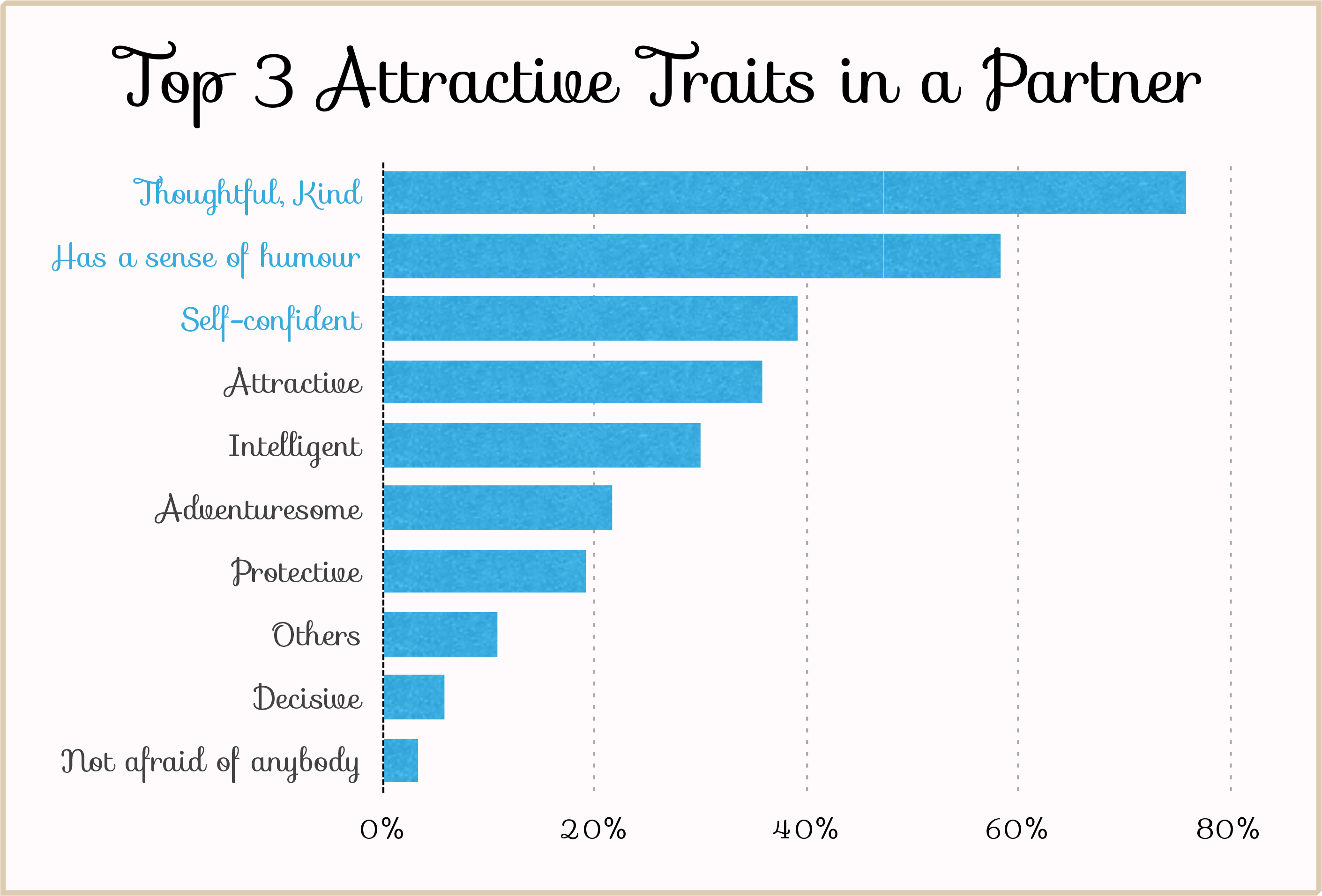
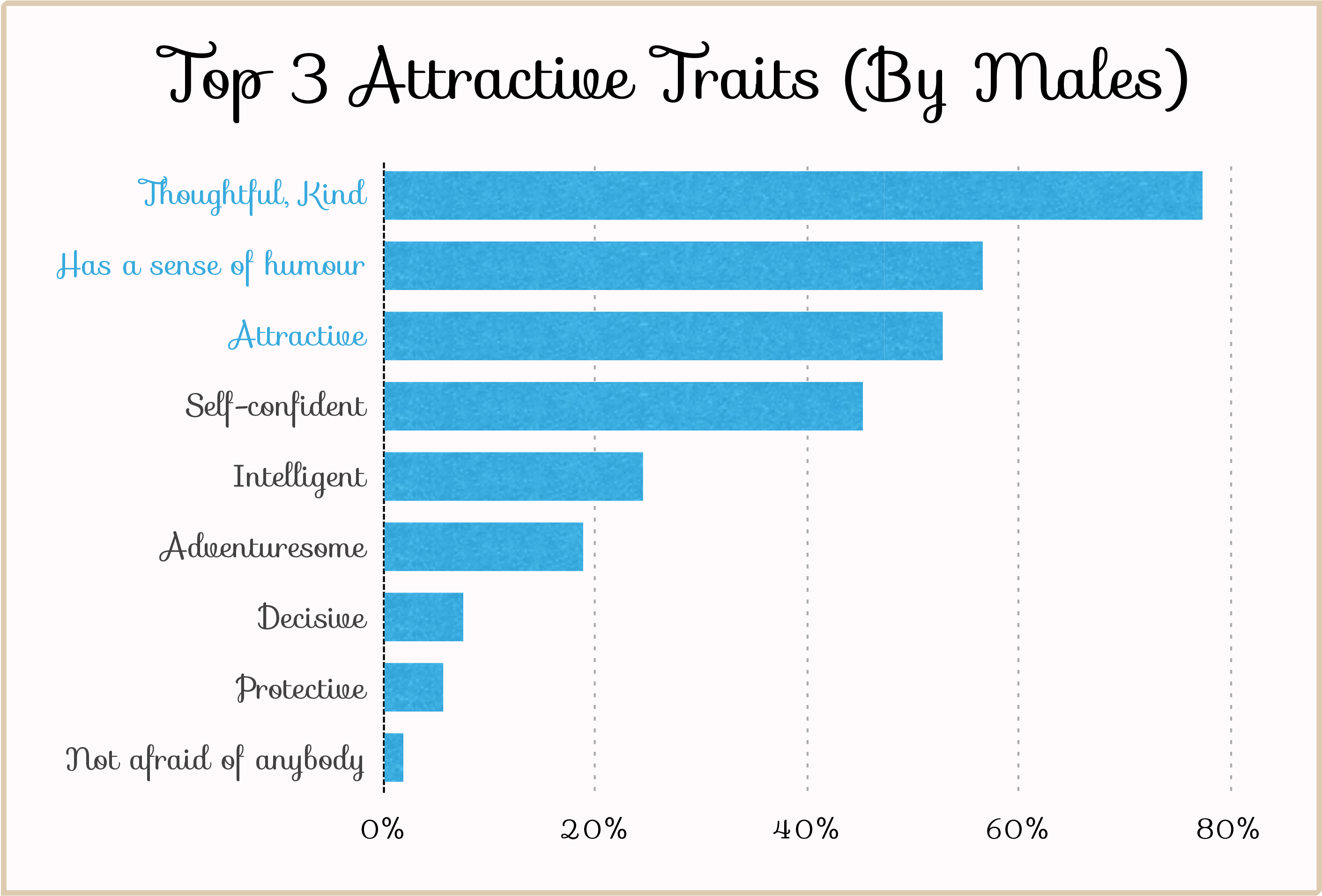
What our respondents could agree on, however, was that the most attractive trait was – thoughtfulness! It topped the charts for both girls and guys, with almost 80% of responses. It was followed by sense of humour, which again ranked second unanimously by both genders. Following these two traits though, disparities between guys and girls’ preferences start to occur. Attractiveness apparently plays a more important role in choosing a potential partner for guys as compared to girls. Attractiveness ranked third in the guys’ preferences, while it’s close to the bottom in the girls’ preferences. It does seem, however, that girls still prefer guys to be their knight in shining armour – protectiveness ranked relatively high in for the girls! It could also be assumed that Rafflesians are most interested in well-read and charismatic individuals, considering how both self-confidence and intelligence made it to the top five of the guys’ and girls’ rankings.

Dealing with a Relationship

1mistake

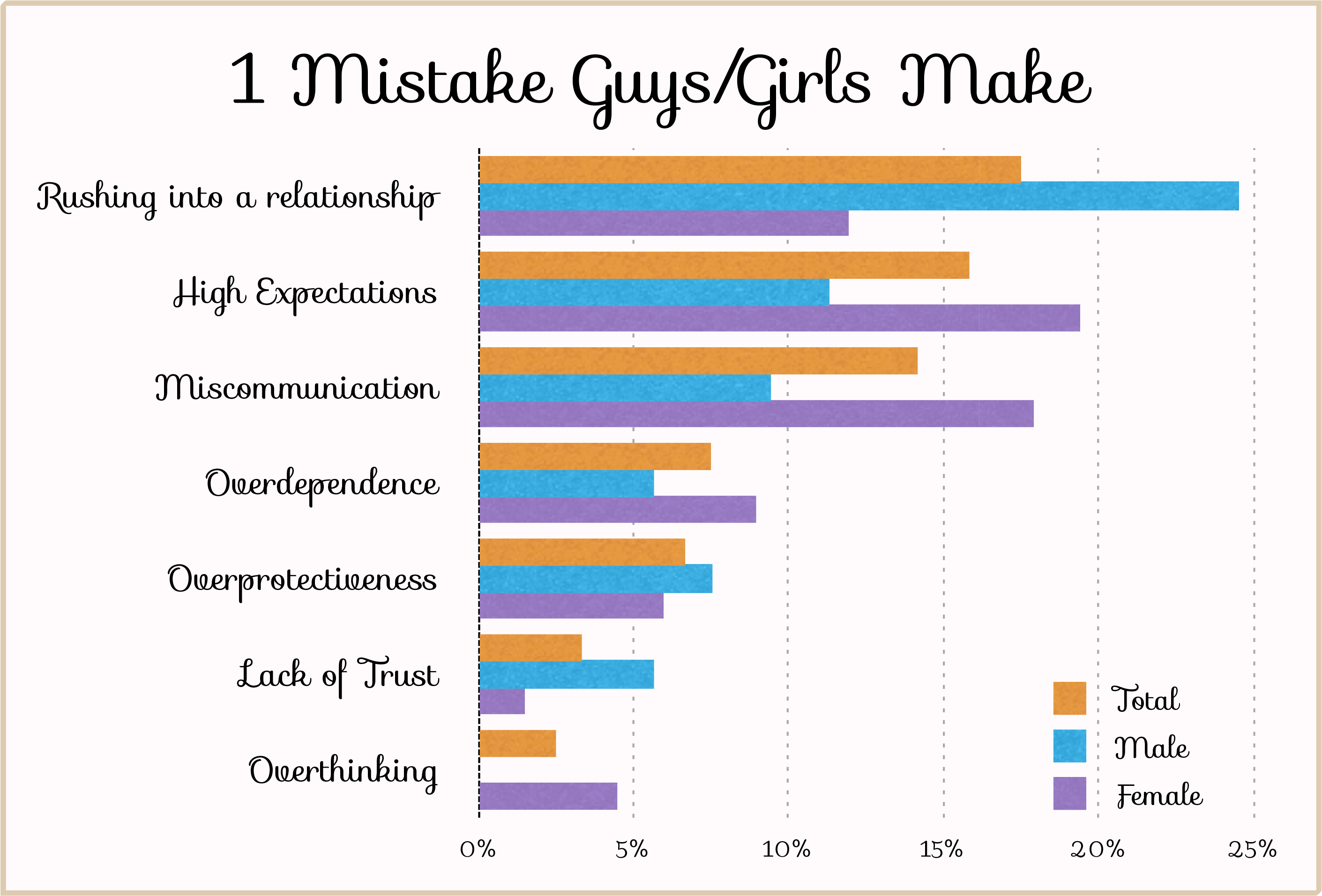
We also asked the respondents about the one mistake they felt that guys/girls tend to make in a relationship. Majority of the female respondents responded something to the effect of “expecting a fairytale-like relationship” as the most common mistake, subsequently facing disappointment when things go sour, leading to an unhappy relationship.

Contrastingly, the responses we received from the guys were rather surprising. While we often hear that guys like to rush into a relationship, it seems that Rafflesian guys like to take things slow. One male commented, “People often go in too early without really knowing their feelings and end up breaking the other’s heart.”

The one key mistake that both genders wholeheartedly agreed on was the issue of miscommunication. Supposedly, our respondents felt that overthinking and making assumptions about the other’s feelings were key causes of conflicts and break-ups. It seems emphasising the importance of communication doesn’t only apply in workplace, but in relationships as well.

As anyone would be curious to know, we asked our respondents to talk about the one key piece of advice he/she would provide for their potential partners. Responses ranged from serious advice (honesty is the best and talk things out, even if you’re not one to talk or share concerns easily – after all, a relationship should have no secrets) to amusing ones like ‘get me a cat!’ and ‘please exist’.

On this romantic eve of Valentine’s Day, Raffles Press would like to wish all the couples out there a memorable Valentine’s Day. We would like to point out that, as one of the respondents cleverly put, “One shouldn’t celebrate their relationship specially just on one day. Every day that you’re together is a gift to be cherished (:” As for everyone else, we wish you a happy Friendship Appreciation Day! Look on the bright side – you’ll be able to get all those chocolates you’ve been eyeing in the supermarket on sale within the next few days!

In Remembrance: Aunty Haw

Reading Time: 4 minutes

By Tan Jun Xiang (14S06C)

Raffles Press recently received the sad news that the owner of the Haw’s Kitchen canteen stall passed away on the 27th of January, after a prolonged struggle against breast cancer. From the accounts of those who knew her, Mrs. Haw Geek Nai was a diligent worker and a wonderful cook who was close to many students and staff.

Mrs. Haw first joined the school around 2009, when she started up Haw’s Kitchen. She had previously been running a similar canteen stall over at Ngee Ann Polytechnic, but shifted over to RI when she heard there was an opening.

Mrs. Haw with her family

It didn’t take long for Haw’s Kitchen to become one of our canteen’s most frequented stalls – serving up piping hot Tom Yam soup and fish soup to hungry students. Among the students and staff Raffles Press spoke with, several mentioned that she would dole out extra portions or even free food to students from needy families. Raffles Press also spoke with her two sisters currently running the stall, who recalled how it was in 2012 when Mrs. Haw first began complaining of back aches and nose-bleeds. During a routine check-up with a doctor, she was unexpectedly diagnosed with Stage 3 breast cancer.

She immediately underwent treatment, going for surgery and chemotherapy in a bid to keep the cancer from spreading. And for a while, she got better. For a brief period of time, she was even well enough to return and help out at the stall. She couldn’t be as active as she once was, but her husband, son and daughter assisted by helping to purchase food ingredients every morning. At one point, her sisters recounted, a student who was a regular at the stall even made it a point to buy an egg for her from the drinks stall every day, after seeing how skinny she had become.

Yet, even after her return, it swiftly became clear that she had not fully recovered. Following further complaints of bone aches, she returned to the hospital for a full body scan. The prognosis was poor. Despite treatment, the cancer had metastasized to her bones and her chances of recovery were slim.

She was hospitalized just last year (some of you may recall that Haw’s Kitchen closed intermittently for a period of time last year) and frequently received visitors from staff and students who knew of her condition. Although she remained positive about her condition, she grew progressively weaker and passed shortly before Chinese New Year.

IMG_7710
Mrs. Haw receiving visits from ex-students

We contacted Hu Weijie – a Rafflesian graduate who visited her regularly in hospital – who kindly shared his experiences with and memories of Mrs. Haw:

I was really lucky and blessed to have gotten closer to her during my JC life such that we even kept in contact after I graduated. About 2 years back when i visited her in school during my army days I received the news from her that she was diagnosed with stage 3 breast cancer. Despite the news, she remained optimistic and strong.

She went for an operation and the doctor said she was recovering well back then. The students could tell as well as she still insisted on coming back to work here and then in her headdress, although she often had to rest as chemotherapy has its toll on patients.

As I got more involved in army I had less time for her so I only managed to visit her after I ORD, which was at the start of December 2013. I couldn’t contact or find her then and I was pretty upset about it. Then a week later her daughter texted me that she was in the hospital, and her condition has worsened and it was stage 4 terminal cancer now and whenever I went to visit her she got weaker and weaker.

Though she is a very happy person with a strong will to live, her condition still got the better of her and she passed away last Monday [27th January]. Before she passed away I posted a photo of me and her on Facebook and a description of what happened to her, as I knew that many people were concerned about her well-being. Many many kind souls shared the post, private messaged me encouraging notes and several went down to visit her as well. This includes students teachers and the staff of the school as well.

You can ask anyone who has interacted with her personally and you will know how beautiful a person she is, both on the inside and the outside. She’s selfless and always cared for the people around her before herself. Even during her last days, she would apologise to people who visited her for taking time off just to see her. In school, she’d make sure her students had enough food and are well fed. She would also take the time to have a good chat with students who came by the stall.

She appreciates the support and concern the school students have given her as well and to quote her ‘to have such loving students, teachers and customers who are so concerned about my well-being, in this life I am truly blessed’. She would also often give students extra or free food. So one day, I asked her: how exactly does she make money this way? 

She then replied, ‘How much money can anyone earn in their life? It’s an endless pursuit. I would rather see my students well-fed, satisfied and happy, that’s enough.’

Erratum: The article initially mentioned that Haw’s Kitchen opened in 2011. Our thanks to our sharp eyed alumni readers who noted that the stall opened in 2009. We apologize for the error.

The Five Dollar Question

Reading Time: 7 minutes

By Gao Wenxin (14A03A)

What can you get for SGD$5?

IMAG0700_mh1391315161615

Last December, I had been dared by my dear friend Chin Wee to take on the $5 Challenge. Challenge accepted, I thought, Barney Stinson-style. The premise of this activity seemed simple enough: go about your daily life with only $5 a day, including food and transport. It was a novelty initiative started by the website Singaporeans Against Poverty, to encourage people to experience the daily budget of some 387,000 Singaporeans with a household income of less than $1,500. Chin Wee had argued that since I was doing an internship in the CBD at that time, I was practically the perfect living model of a working adult. Perfect, if only it wasn’t also one of the most expensive places to work on this island.

Perhaps I should preface this by saying that my family had actually lived in similar circumstances when I was younger. Here I borrow the words of Alice Munro, when her character Edie had started work in a wealthy house: “I thought it was still a lot easier, living the way we lived at home, to picture something like this, the painted flamingos and the warmth and the soft mat, than it was anybody knowing only things like this to picture how it was the other way.” My family’s situation has improved vastly since then, but I know a number of my schoolmates who probably cannot imagine poverty and think it a far-flung third-world concept. But even if you do not find homeless beggars starving on the streets, many Singaporeans face relative poverty, when their income falls below what is needed to pay for living necessities. Poverty is not a distant concept at all.

So while everyone was stocking up on chocolate santas, I was bracing myself for this period of self-enforced austerity. And I braced myself again. And again. I could not take the plunge because it just seemed too difficult. My round-trip commute from Toa Payoh to Clarke Quay will have cost $2.42 already, if I was a paying adult. The Starbucks peppermint mocha ($7.20) I had yesterday would have busted an entire day’s budget all by itself, and the cheapest thing I could find in the CBD food market was fishball noodles ($3.30). The first thing I realised before even starting the challenge was that small daily costs add up to become expensive, and it takes someone with pinched pockets to feel the sting.

Given the odds, I figured that if I was in it to win it, I might as well take one for the team. I managed to work out a plan to take advantage of the free MRT rides in the mornings before 7.45am, and also save 10 cents in the evening by taking the MRT from City Hall (1km walk from my workplace) instead of Clarke Quay (650m). That left me with $3.89 to spend on my three meals, and I set out to the supermarket, hopeful that I will solve my personal bread-and-butter issues.

IMAG0497_mh1391271113700

But it was depressing. Especially because the Spirit of Christmas was beckoning me with its goodies and unaffordable price-tags.

Turns out, there was little I could buy with $3.89 except maybe, bread and butter. For those of us who take Economics, you can definitely see Engel’s Law (i.e. when income decreases, the proportion of income spent on food rises) at work here in real life. Food is expensive for the low-income. Making a decision at the shopping aisle no longer involves grabbing whatever strikes your fancy, but a complicated game of mental sums. Do I buy the $2.20 loaf of average Gardenia bread, or the awful $1.70 house brand loaf with twice the amount of slices? Should I spend $0.65 on a cheap cereal bar which will fill me for breakfast, or an apple to compensate for a balanced meal but will leave me hungry? What about butter? Could I do without it? Isn’t margarine, like, the same thing?

With a limited shopping budget, taste and nutrition often gets thrown out of the window. It’s hard to think about the food pyramid when you are wondering whether you should spend the $1.70 on a celery stick, or a loaf that will give your whole family the energy to start the day. This is because supermarkets often sell items like bread below costs of production to draw customers to the store, in order to persuade them to buy mid-to-high range products with a higher profit margin. The poorer lose out because they will be falling for discounts on poor quality or unhealthy processed food, since there is almost never an offer on the celery stick. [1]

So, here’s the hard truth: $5 in Singapore really isn’t worth much. I left the supermarket with only four purchases to last me for the day: bread ($1.70 for 18 slices), canned soup ($1.50, but I will only need half a can for dinner, so $0.75), tom yam cup noodles ($0.80), and an apple ($0.65). The tally was $3.90, and unfortunately I have still exceeded the remaining budget by 1 cent. Unbelievable. Disastrous as it is, I decided that I will simply make it up as I go along, and went to bed.

“Wake up, Wenxin! Aren’t you supposed to be poor today, or something?” said a voice as I rolled back to sleep. No, wait. I looked at the clock. 7.07am. I was supposed to be washed, dressed, and out of the City Hall gantry in 38 minutes. No way. I dashed out of my house and on my way, but time ticked by. At 7.44am the train was just pulling into Dhoby Ghaut. A terrible idea begin forming in my head. I made a last ditch effort to salvage the situation and sprinted out of the station.

The good news was that I made the 7.45am cut. The bad news was that I was also 1.4km away from my workplace, with no money to take other forms of transport, and separated by the Fort Canning Hill.

pt2014_02_02_00_13_05_mh1391271275888

I did not have a data plan to check my location, or any sort of plan really, and it must have been so strange to see a girl in a dress sweating it out on the steps of Fort Canning while parading a giant loaf of bread. I also got desperately lost. In fact, I made it past three museums and the treasury building before finding my way past this former graveyard, but fortunately got to the office unscathed after the longest 30 minutes of my life.

Putting away my things at the cubicle, I went to heat up my breakfast, which was essentially just 2 pieces of plain bread and free workplace coffee. Nothing to get excited about, really. It unfortunately didn’t take 2 slices for me to get sick of the sour and yeasty taste, so I stopped eating, but this decision cost me. I was hungry for the rest of the morning, unable to get out of an important meeting.

IMAG0511_mh1391271812536IMAG0512_mh1391271895580

After 4 hours with a queasy stomach, however, I am ashamed to admit that I failed the challenge many times over the course of the day as my resolve wavered. We had served refreshments to some guests at the meeting, and as an intern I obviously felt it my duty to clear the leftover Swissbake pastries (into my stomach). After which we had our lunch (small restaurant, nothing remotely under $5) paid for by our colleagues because it was our last day of work, and I could not possibly refuse. I did somehow wrestle my conscience into walking to City Hall for my trip back home, but when I returned I found the dinner table set for my place because my grandfather had predicted that I would fail. I had lost the challenge, and disgracefully so.

Feeling that it was too soon for me to give up just yet, I decided to set aside the next day to repeat the feat. And I actually passably succeeded, by spending less than the allotted amount. The only questionable move I made was to avoid a rehearsal in school to save on transport (shh), but in real life unexpected costs are sometimes unavoidable. No amount of planning can prepare for uncertain illness or injury, a sudden appointment at an inconvenient location, or your classmates deciding to go for a spontaneous meal that you cannot really afford.

IMAG0570_mh1391271613884 IMAG0577_mh1391271710473

And here exists the real five-dollar question I should be asking: What have I learned? Beyond the challenge’s gamification of suffering underlies a message that poverty is cruel and humiliating, and that food poverty is particularly inhumane and a real public health issue. As a developed country with one of the highest rates of income inequality, we could do much better as a country to help the needy.

Harper Lee once said that “you never really understand a person until you consider things from his point of view… Until you climb inside of his skin and walk around in it.” If there is a lesson to be learned from this challenge, perhaps you should try it for yourself. But then again, the fact that we can choose to partake in this challenge and give up whenever we wish reveals the privilege that we enjoy. Have I truly experienced poverty? No. It was a sanitised version of reality, an experiment with controlled variables. Sure, I may have gained some superficial understanding by stepping into their shoes for a day. For the 387,000 Singaporeans facing this daily reality however, there is no stepping out.

_____________________________________________________________________________________

[1] http://www.theguardian.com/commentisfree/2013/oct/01/dont-worry-david-cameron-price-bread

Prepare to get thrown: Raffles Jiujitsu

Reading Time: 2 minutes

JJ1

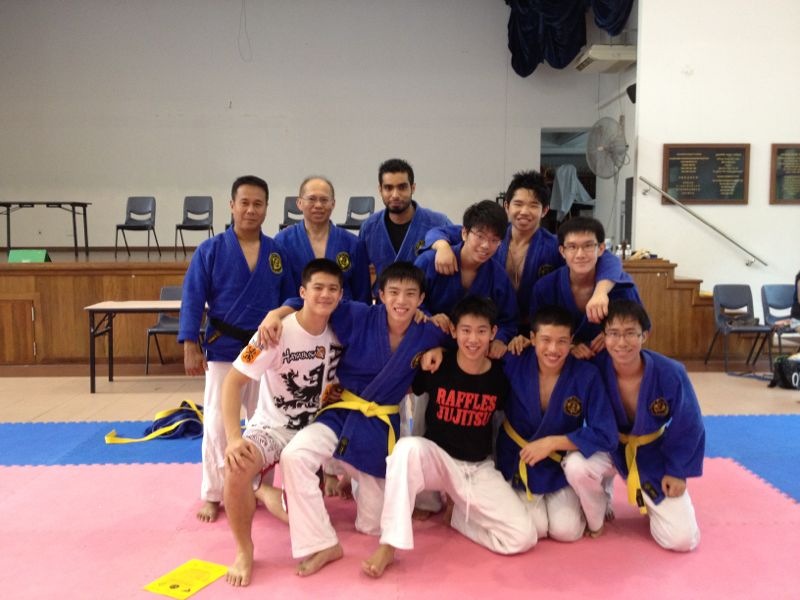
Ever watched an MMA match and wanted to be able to defend yourself and fight like one of the pros? Raffles Jujitsu is an external activity that offers an opportunity for you to do so in a safe environment.

You may have heard of Karate, Judo and Aikido but perhaps not Jujitsu. Jujitsu was the martial art of the Samurai in ancient Japan. Taught in a modern context, Jujitsu is both a grappling and striking martial art, comprising a wide variety of techniques that include punching, kicking, throwing, takedowns, joint locks, chokes and use of small weapons.

While this may sound dangerous and risky, be assured that it is safe as you will be under supervision of trained professionals! It’s like a safer version of MMA training. Not only will you learn skills, you will also get fit and have lots of fun!

While Jujitsu is not a school CCA, there is an active group of Rafflesians practicing the art, making it a comfortable environment to learn. You will also get recognition from MOE as well as the Jujitsu Association of Singapore.

Our trainings are held weekly at Tanglin CC, which can be reached by taking a direct bus from school. There are also 3 public classes held on Monday, Wednesday and Friday at night which you will be more than welcome to attend. Trainings include conditioning, drills as well as learning of new striking, throwing, and grappling techniques.

Go beyond compulsory CCAs and try something new and exciting! It will be an enjoyable and fulfilling experience.

JJ2