Commentary

[Please Mind The Platform Gap] Enrichment Programmes: Raffles Middle East Programme (RMEP)

Reading Time: 3 minutes

Arab-Spring-women-Egypt

‘The Middle East’.

The first thoughts that came to mind were words like ‘Islam’, ‘chaos’, ‘belly-dancing’. It sounded complex. It sounded exciting. It sounded like the kind of enrichment I would look forward to every Monday morning.

There were a number of particularly memorable activities that took place through the year, one of which was the belly-dancing lesson. The dance teacher did more dancing than talking (which was a plus point) since she danced fantastically; it was safe to say that we were all awed by her gracefulness and poise. Everyone had a chance to attempt some moves, and even a routine of sorts, to cool Arabian music (note the distinction, ‘Arabic’ is a noun referring to the language, while ‘Arabian’ is the adjective).

Arabic lessons were a regular part of the curriculum for the programme, about once or twice every term. These lessons were peppered with stories about the teacher’s adventures in the Middle East, and how the Arabs would be amazed at his ability to speak Arabic. For most of us, these stories livened up the lesson, since it could get dreary repeating Arabic phrases again and again. Yet it was all in good fun and at least exposed us to the language. Elements of culture are often found reflected in the language of the nation or region. How is one supposed to appreciate the culture of the Middle East if we are unable to appreciate the language? Arabic lessons were definitely part of the more appealing and stimulating sessions held throughout the programme.

Not to say that the other sessions were boring or very disappointing – the talks by the various speakers dealt with highly pertinent topics for the Middle East today. I remember distinctly the talk on Political Islam. It was rich in content, providing us with in-depth background information on the Middle East, on how much of the region was ruled by the Caliphate before being dismantled sometime after a few hundred years of Golden Age (then again, I could be wrong about the timespan). The information has proved useful for both General Paper essay questions on politics, as well as the International History syllabus on religious fundamentalism. A lot of content is offered, and speakers try to give a good overview of the topic.

What I personally found unsatisfactory about the talks was how they were broad overviews, and did not focus on specific issues such as the role of religion in the various Arab states, be it in politics or in the society. Where religion was mentioned, they only discussed the role of Islam, ignoring the conflicts that have arose due to the presence of Jewish and Christian communities.

Furthermore, the meaty bits of information were only covered during the question-and-answer session held after the talk. Sometimes, the overviews covered information that we already knew, and it would be easy to tune out, especially if the speaker that day was merely reading off the slides.

In retrospect, I admit I was not the most proactive student. I did my regular reading up each week on the topic for the next, but I never did ask questions even if I had them. It was the same students each week that contributed to the question-and-answer segment at the end of each talk. It probably is the same few students who have an innate thirst for learning, who already have a burning interest for the Middle East. And I believe they came away each week, achieving their aims, having their questions answered, and gaining a few bits of knowledge that might come in useful for their General Paper. I simply was not one of those students. I went for the programme because I expected to be engaged, and not to engage.

Thing is, the Raffles Middle East Programme is not for students who wish to be engaged by the speakers. The talks are generally comprehensive in nature, and similar to the usual academic lectures, the speakers do not care if you pay attention. In the end, you have to take ownership over your own learning. How much you are willing to give, determines how much you take away from the programme.

Ultimately, the Raffles Middle East Programme welcomes students who already have deep interests in the Middle East, and who are willing to find out more on their own, to take charge of their own learning and be proactive about achieving their learning aims. The rewards it offers come only with diligence and a willingness to think critically and challenge the speaker with provocative questions. Be willing to step out of your comfort zone, because the programme is not for the timid or the lazy.

[Please Mind The Platform Gap] Enrichment Programmes: Adventure Leadership Programmes (ALPS)

Reading Time: 3 minutes

By Law May Ning (14S03O)

As part of our feature on Year Five enrichment programmes, our reporter speaks to Clarie Ng (14S03B) and Jeremiah Choo (14S06D), members of the 2013 Adventure Leadership Programmes (ALPS), who shared their experiences in ALPS in the last year.

IMG_11695146757185

Q. So what is ALPS about?

Jeremiah: ALPS stands for the Adventure Leadership Programme, and if I remember correctly the actual byline is  “self discovery through experiential learning” – a line that’s really is quite apt, given that it’s all about learning to push yourself out of your comfort zone.

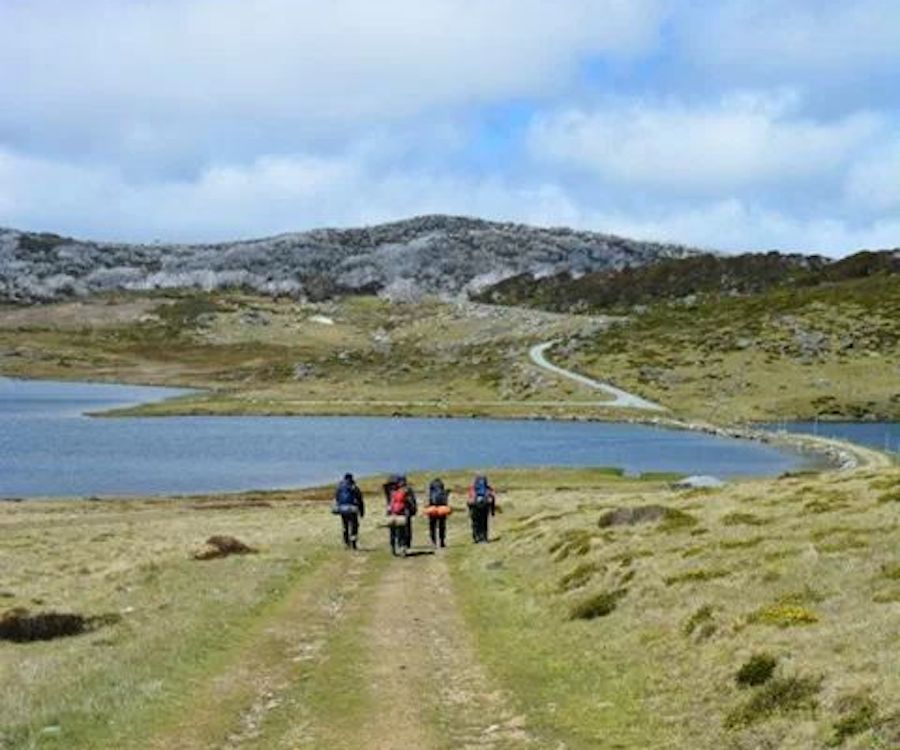
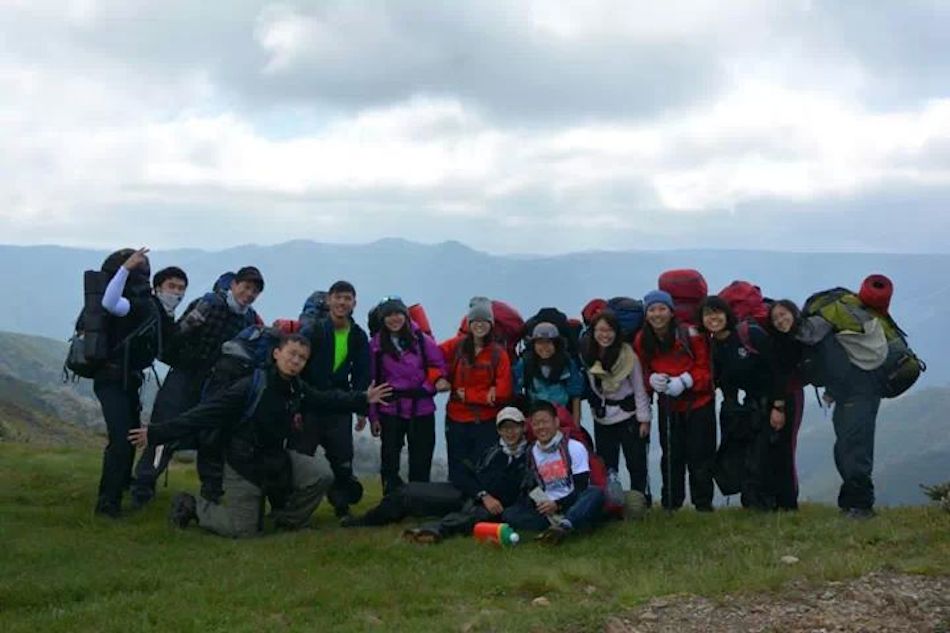
Clarie: The programme leads up to an end year, two week long hike at the Australian Alpine National Park. We have to plan our own route, bring and carry our own food so it’s really quite an adventure.

Q. What would a member of ALPS do, besides go on the end year trip?

Jeremiah: In our weekly Monday morning sessions, we had leadership training and learnt other skills to mentally prepare ourselves for the trip.

Clarie: We had physical training sessions too – on some Saturdays we went to Bukit Timah to train our fitness by climbing the stairs there!

IMG_11720081650877

Q. Does that mean I have to be fit to apply to ALPS?

Clarie: No, that’s not necessarily true – to get into ALPS we will only have an interview. It doesn’t mean we’re going to make sure you’re fit enough to climb stairs or you can’t join us! You may not be fit enough to climb the stairs at first, but that’s the whole point of the programme, to train ourselves – climbing stairs will definitely make you fit to climb the mountain. We’re just looking for people with a positive attitude.

Jeremiah: A lot of people come into the interview just because they want an enrichment programme, or they want some sort of points on their resume. We want people who are genuinely interested in the experience and want to improve themselves and grow as a person.

IMG_11666957932954

Q. So how was the trip itself? What was your experience like?

Clarie: The days of preparation were not enough to mentally prepare for the trip – a mountain is much more steep than stairs, and the terrain was quite rough and hard to travel across especially when we were carrying heavy bags with all the supplies. There was even hail! It was an interesting experience to see hail, it hurt a little then we put on waterproof attire but we could still feel the hail against us.

Jeremiah: In the daytime the temperatures were about 10ºC and above! It was quite comfortable, rather like an airconditioned room in Singapore, though there were rather strong winds. But at night, it reached sub zero temperatures and we couldn’t start fires since we were using gas canisters! It was difficult to sleep even with our special thermal sleeping bags, so people who joined ALPS do have to be mentally prepared for an exacting experience.

Q. What was the most memorable experience in the trip for you?

Clarie: For me, the one experience I will remember most are the people I met through the trip and the shared experiences we had – the cooking, waking up, attempting to eat. We had a lot of fun together and I’m glad I went through it.

Jeremiah: What I remember most was trying to cook mac and cheese up on the mountains! It was so funny – what I can say is, cooking mac and cheese on a mountain is definitely a bad idea. At high altitudes, it’s difficult to cook anything, so we ended up with mac and cheese that was half burnt, yet half uncooked! It was a terrible sight,  but definitely memorable.

Q. Do you think it was a worthwhile experience?

Clarie: Yes, it was. Then again, the experience is really different for everyone – a lot depends on who is in your team, and what you do while you’re on that hike. But, if you want a challenge for yourself, perhaps this is the programme for you.

IMG_11784438472800

[Please Mind The Platform Gap] Enrichment Programmes: Raffles Reflects

Reading Time: 3 minutes

By Jeremy Khoo (14A01B)

bj_pagebat

There are many misconceptions about the study of philosophy. It is not intellectual masturbation, completely irrelevant to the real world (its only mostly irrelevant, a distinction insisted upon by most eminent philosophers) or the devil’s work, though if you believed any of the above Reflects is probably not for you.

The issue of the relevance of philosophy is actually a hotly-contested one. Ludwig Wittgenstein, perhaps the preeminent philosopher of the 20th century, had many things to say about the academic philosophy of his time overreaching itself to arrive at conclusions philosophers had no epistemic right to because they were confused by their own use of language, thus creating philosophical castles in the air. Today, whenever a debate over the importance of philosophy erupts, philosophy is always defended by someone who points to philosophy of science and political theory (in other words, the obviously useful stuff) and who seems willing to jettison quite a lot of present academic philosophy. I am personally dubious about how knowing whether the A or B Theory of Time is true would really change my life. (That doesn’t mean I wouldn’t be intellectually interested in knowing the answer.)

Anyway, if you’re a philosophically-minded person in this context, you might wonder if studying philosophy is a viable option. Well, no philosophy lesson or course is going to be able to answer that question, but Raffles Reflects will give you some idea of what you might be getting into and whether you feel its worth the comfortable life you might have had as a successful white-collar worker. As you know, a career in philosophy involves living in hovels with six other fellow hovel-ees, all of whom have more advanced philosophy degrees than you, and subsisting on a diet of pure thought and the occasional packet of crackers.

Raffles Reflects is more or less intended to allow students to explore the most important philosophical issues at an introductory (i.e. first-year undergraduate) level. It is, of course, just a taste of what one might experience reading philosophy at university, but does involve more in-depth study than the RP Philosophy course. Four main areas of philosophy are covered in the year’s work — ethics, politics, epistemology and the philosophy of mind.

In each area, the course aims to broadly sketch out the most influential ideas of the last few hundred years. For example, in the Ethics module, the three major theories of normative ethics — deontology, consequentialism and virtue ethics — are given focus. At the end of the year, each student writes an extended essay on either a set topic or (if they so choose) a topic of their own devising of 1500 words or more.

Readings for each lesson are given out the week before. In order to follow the lesson, it is more or less necessary to do this work diligently. The work is not usually dumbed down, which is a plus point because you will be engaging with actual philosophy rather than ‘introductory texts’ most of the time. The tutors will then spend the session working through the article and facilitating discussion on the key points.

On the whole, Reflects will probably be a suitable introduction to the basics of academic philosophy for any philosophically-minded person. As opposed to Knowledge and Inquiry (KI), which is about ‘the nature and construction of knowledge’ (maybe the most-repeated phrase in the SEAB syllabus) and engages with specifically epistemic concerns in both philosophical and non-philosophical fields, Reflects focuses more on the central areas of interest to modern academic philosophers. Students already taking KI should not find that the content overlaps, while students interested in philosophy who elected not to take KI may consider this a (nongraded) substitute. Its also worth noting that a background in philosophy can serve as good grounding for any career where critical thinking skills are important. Studying philosophy to improve your critical thinking without any actual interest in philosophical issues is probably not the best of ideas, though.

The selection process is fairly simple: you will have to write a 1000-word response to a question on a basic philosophical issue, most likely a comment on an influential philosophical analogy / thought experiment or an important bit of theory. No philosophical background is presumed and citations are both unnecessary and impossible to submit through the online enrichment registration portal.

For the reference of anyone interested, links to online versions of several articles covered last year are included below.

Rosalind Hursthouse, “Virtue Theory and Abortion”

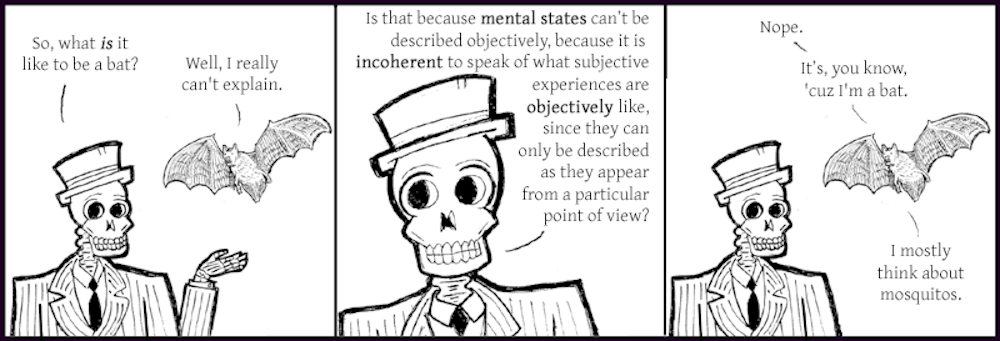
Thomas Nagel, “What Is It Like To Be A Bat?”

Edmund Gettier, “Is Justified True Belief Knowledge?”

Cover Image from http://23ae.com/wp-content/uploads/2010/03/bj_pagebat.png.

[Please Mind The Platform Gap] Enrichment Programmes: Raffles Ecological Literacy Programme

Reading Time: 3 minutes

By Tyronne Toh (14A01A)

Does “Ecological Literacy” sound a little dry to you? Well, you’re horribly mistaken. With a multitude of field trips to places ranging from Bishan Park to the offshore Cyrene Reef (yes, there is a coral reef in Singaporean waters), you’re bound to get your feet wet.

Cyrene Reef, earlier in the year. See what I mean?

With a strong emphasis placed on hands-on activities and experiential learning, Ecological Literacy (or Eco-lit in short) consistently brings us out of the conventional classroom to experience nature in all its glory. Our first trip of 2013 was to Bishan Park, then Macritchie Reservoir, but we soon progressed to places such as St. John’s Island, Ubin and Cyrene Reef, with an additional trip to Tioman in June. And although not all the trips may be to exotic destinations, such as Cyrene Reef –not many people get to visit Cyrene, and even fewer know of its existence, for the matter-, every trip is nonetheless an eye-opener; life and beauty are truly ubiquitous in nature- one simply has to take a closer look to realize this.

Hey, it’s Patrick!
Hey, it’s Patrick!

Do consider joining if you enjoy being close to nature and spending quality time with the great outdoors. For nature-lovers, it would be a dream come true; Eco-lit gifts you with numerous opportunities to get intimate with nature. For the curious skeptics, you’d likely learn to love and respect nature for all its fabulous flora and fauna. Each Eco-lit student is required to keep a journal in which sketches of encountered flora and fauna are taken down. Information regarding the animal, plant or location would later be added in. Journaling certainly makes for a great hobby too. Some of us have even taken this journal as a personal project of sorts, putting in entries from extra-curricular outings or encounters.

Of course, there are also in-house activities. Discussions on topics pertaining to the conservation of nature or pressing issues also take place, with students encouraged to voice opinions and ideas to these. Earlier in the year, we even had a guest speaker come down to share her experiences with the group. Also, we also had story-telling sessions where every member brought his or her own children’s picture book and read it to the others. Why? You’ll find out soon enough. More recently, Mr Tan Si Jie, our teacher-mentor, led the group in setting up a mini garden in the cozy backyard area of the RLI office. Herbs such as mint, chili padi, citronella and lemongrass were amongst the lot, and the garden even features its very own butterfly cabinet, which was constructed by Eco-lit students under Mr Tan’s guidance.

Despite the seemingly scientific nature of this enrichment program, there aren’t any subject pre-requisites to joining this program. Personally, I’m taking a full Arts subject combination, and have never felt left behind in this program. You might have to take down the occasional scientific name, but my lack of hard scientific background has never been an obstacle for me.

Ever thought of publishing your own book? Well, Eco-lit gives you that chance, too. Every student is encouraged to write a children’s book pertaining to nature, complete with illustrations. The book-writing process would usually take place from December to next year’s June, culminating in a book launch and possibly a story-telling session to kids- that’s where the story-telling experience comes in handy.

All in all, Eco-lit has been a ride. There are few things in the world that can ever surpass great company in the great outdoors. Hopefully, this article has cleared up some of your doubts with regards to Eco-lit; and do consider signing up for it!

101 Crowdsourced Ideas for Valentine’s Day

Reading Time: 6 minutes

By Allison Choong (14S05B), Arintha Adelina (14S05B), Law May Ning (14S03O), Seraphine Chanentia (14S06N)

Q. What would you expect a girlfriend/boyfriend to do for you on Valentine’s Day?
A. Kiss me.

– Female respondent, currently single

How did you spend Friendship Appreciation Day?

Did you know that Valentine’s Day was originally a religious celebration of a Christian saint named Valentinus? The original festival had nothing to do with roses or chocolates – the only semblance of sentimentality was that the said saint carried out secret marriages for soldiers otherwise forbidden to marry.

What then does the arbitrary retailers’ dream day mean today, beyond making most American men $150 poorer? And in particular, what does it mean to the average Rafflesian?

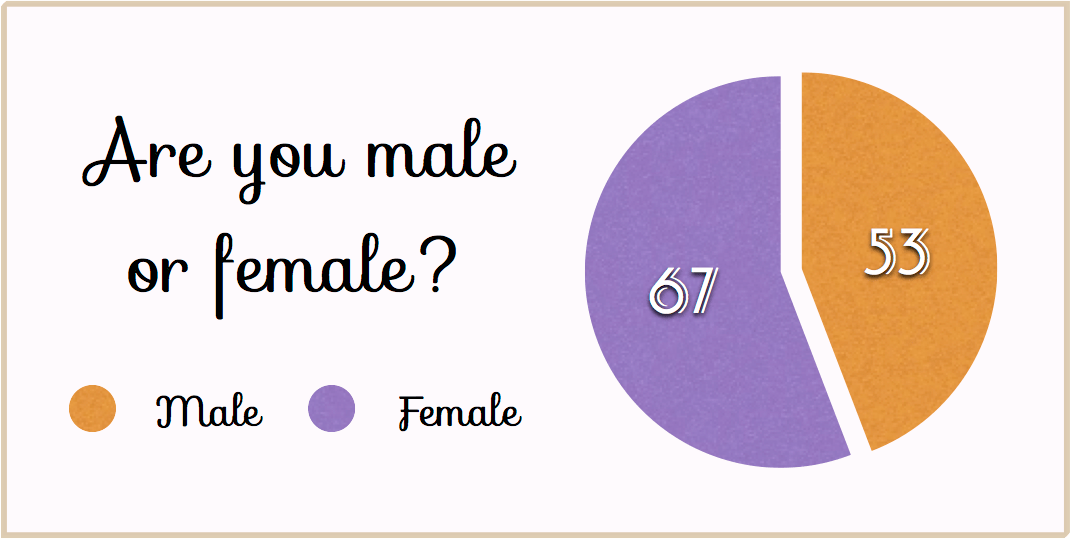
In an attempt to demystify the unspokenly exciting day that might spice up an otherwise dull school life, Raffles Press presents to you an online survey of 120 respondents on boyfriends, girlfriends, expectations and reservations. Of the 120 people we surveyed, about 56% were girls and only around 26% were in relationships.

genderrelationship

Expectations

Q. What would you expect a girlfriend/boyfriend to do for you on Valentine’s Day?
A. Buy me chocolates! And spend time together with me.

– Male respondent, currently single

Fexp

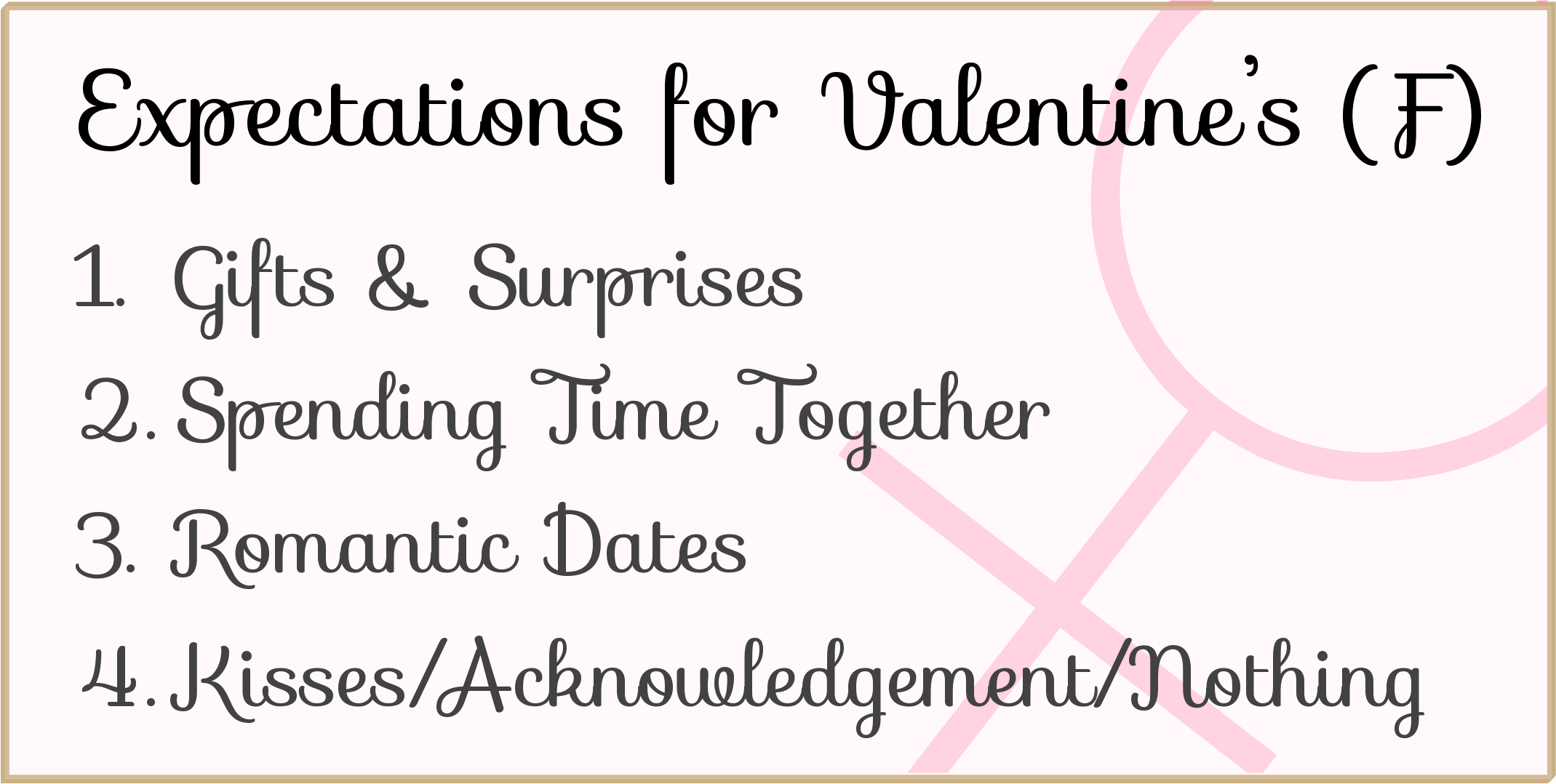
The first of our questions was ‘What would you expect your girlfriend/boyfriend (or hypothetical one) to do for you on Valentine’s Day?’. Girls are commonly stereotyped to expect more gifts and romantic gestures, and some may feel weighed down by perceived expectations from the day. But is this actually true?

Q. What would you expect a girlfriend/boyfriend to do for you on Valentine’s Day?
A. Not get heat stroke at Take 5.

– Female respondent, currently single

At first glance, it might appear that flowers, chocolates, and handmade gifts like cards and letters can commonly be found among the girls’ responses. Some wanted “personalised gifts”, others “self-composed songs”, while one slightly vague response hinted at the desire for “a romantic event”. Some girls seem to be more imaginative than others, providing us with more detailed descriptions of their ideal Valentine’s Day. One female respondent detailed that her ideal date would be to “go on a walk in some quiet nature place, like a reservoir, beach, garden or park and stone with me somewhere quiet and with no one, just looking at the scenery with a cup of tea~”.  However, the generalisation of demanding girlfriends is definitely false, with even some of those in relationships not even expecting gifts. “I just expect him to spend time with me. No gifts needed”, said one. Out of 67 girls, the majority of 31 expected to spend some time with their would-be significant other on the special day, 27 expected some sort of gift if a small one, and the remaining minority didn’t expect anything at all.

Q. What would you expect a girlfriend/boyfriend to do for you on Valentine’s Day?
A. Wish me Happy Valentine’s?

– Female respondent, in a relationship

Mexp

As for the guys, it would seem that some still hold the mindset that they’re not supposed to be on the receiving end. About ⅓ expected nothing at all, with one respondent even remarking, “I’m the guy. I should be the one doing something special for her.” However, contrary to popular belief, some guys did expect some sort of presents – one commented, “Write me a card at very least.” The majority of male respondents simply wanted to spend time together or hang out. As clichéd as it might sound, it seems that the best present is our loved one’s presence, regardless of gender.

People in a relationship:

“Give me a surprise!” – Male
“Make me feel happy.” – Female

People not in a relationship:

Spend a quiet day with me reading books. – Male
“A handmade card perhaps? I’d love a necklace, or flowers or chocolate are fine too. :) A simple picnic would be amazing.” – Female
“Be there.” – Male
“I wish she existed…” – Male

Attractive Traits in a Partner

top3

female

males

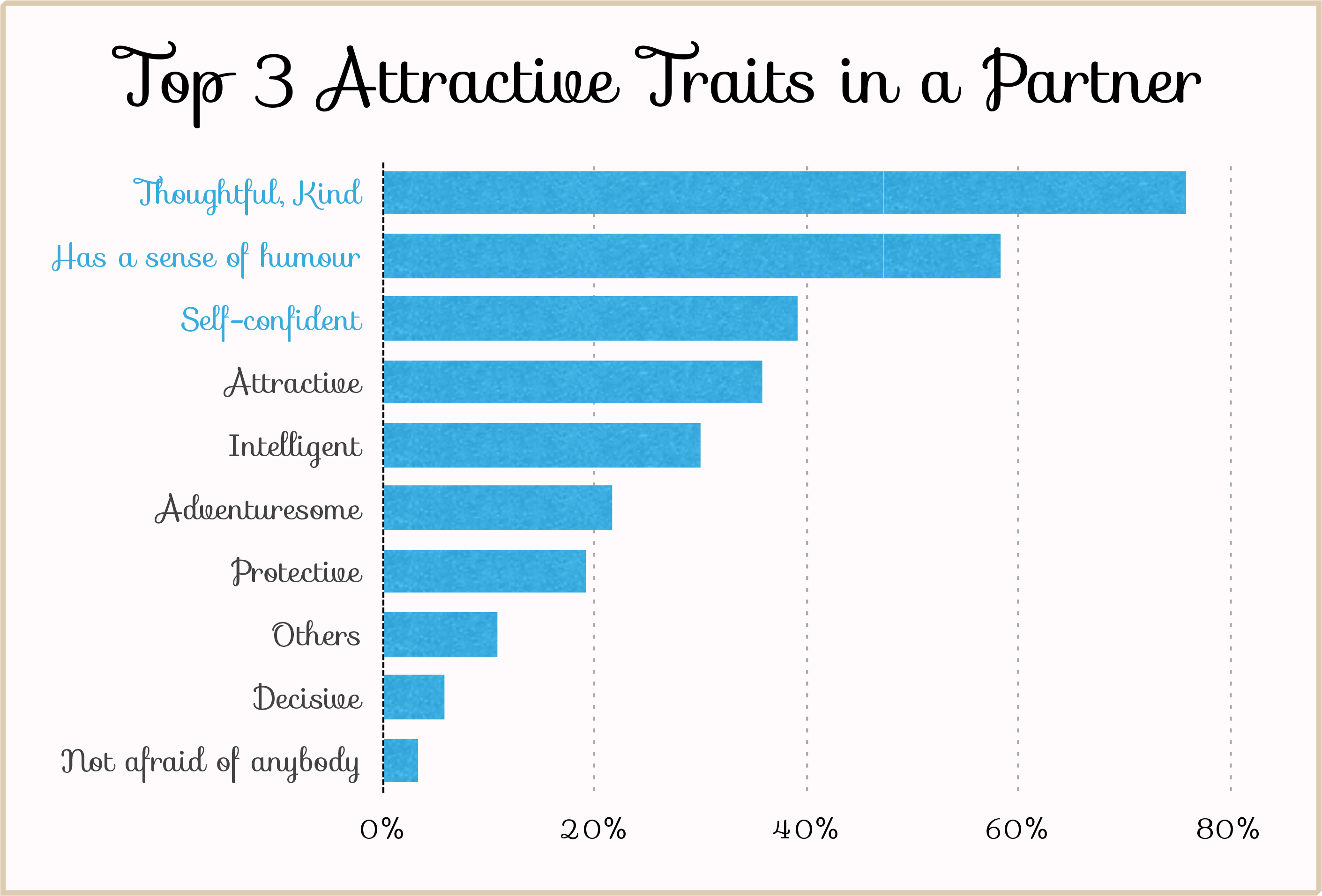
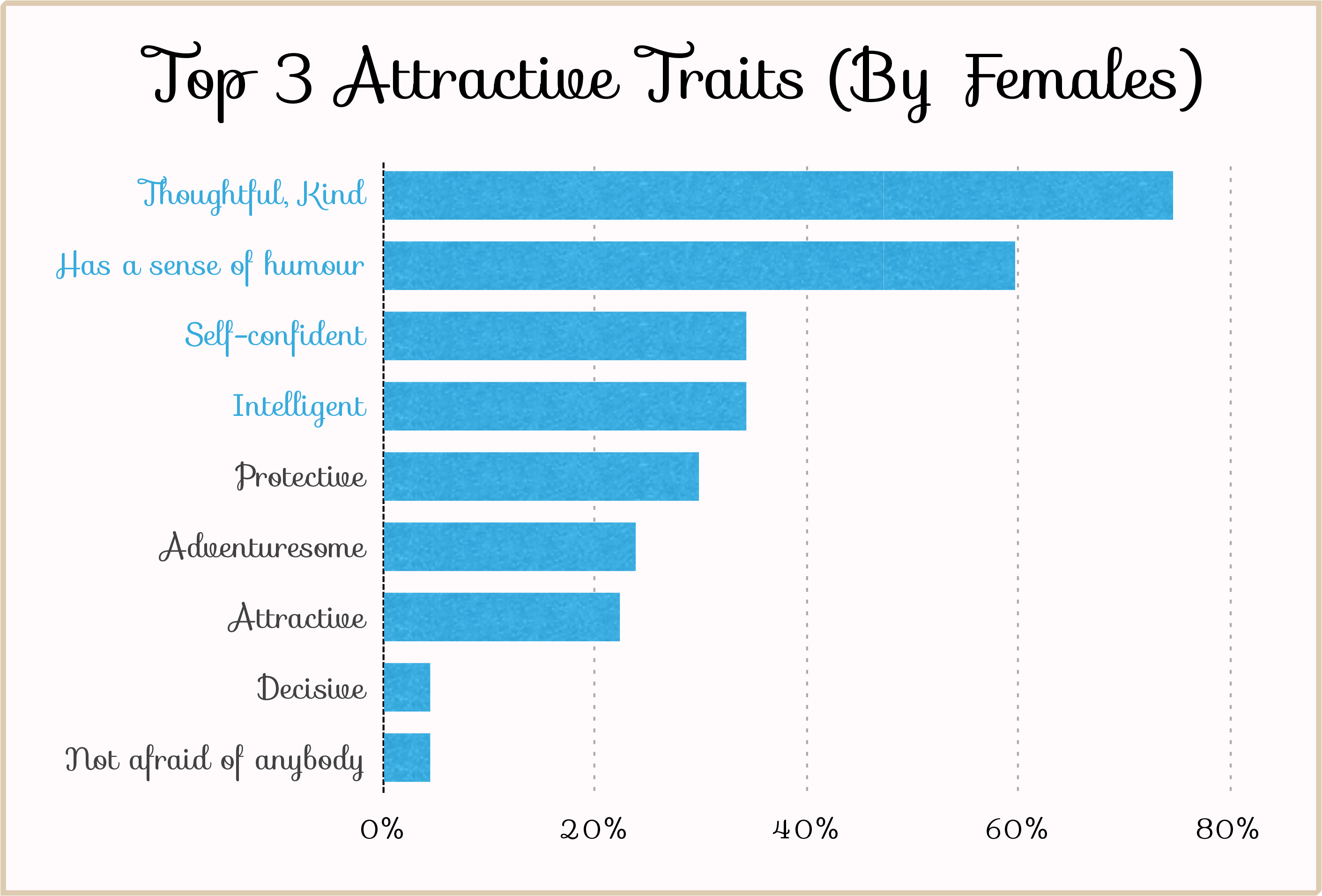
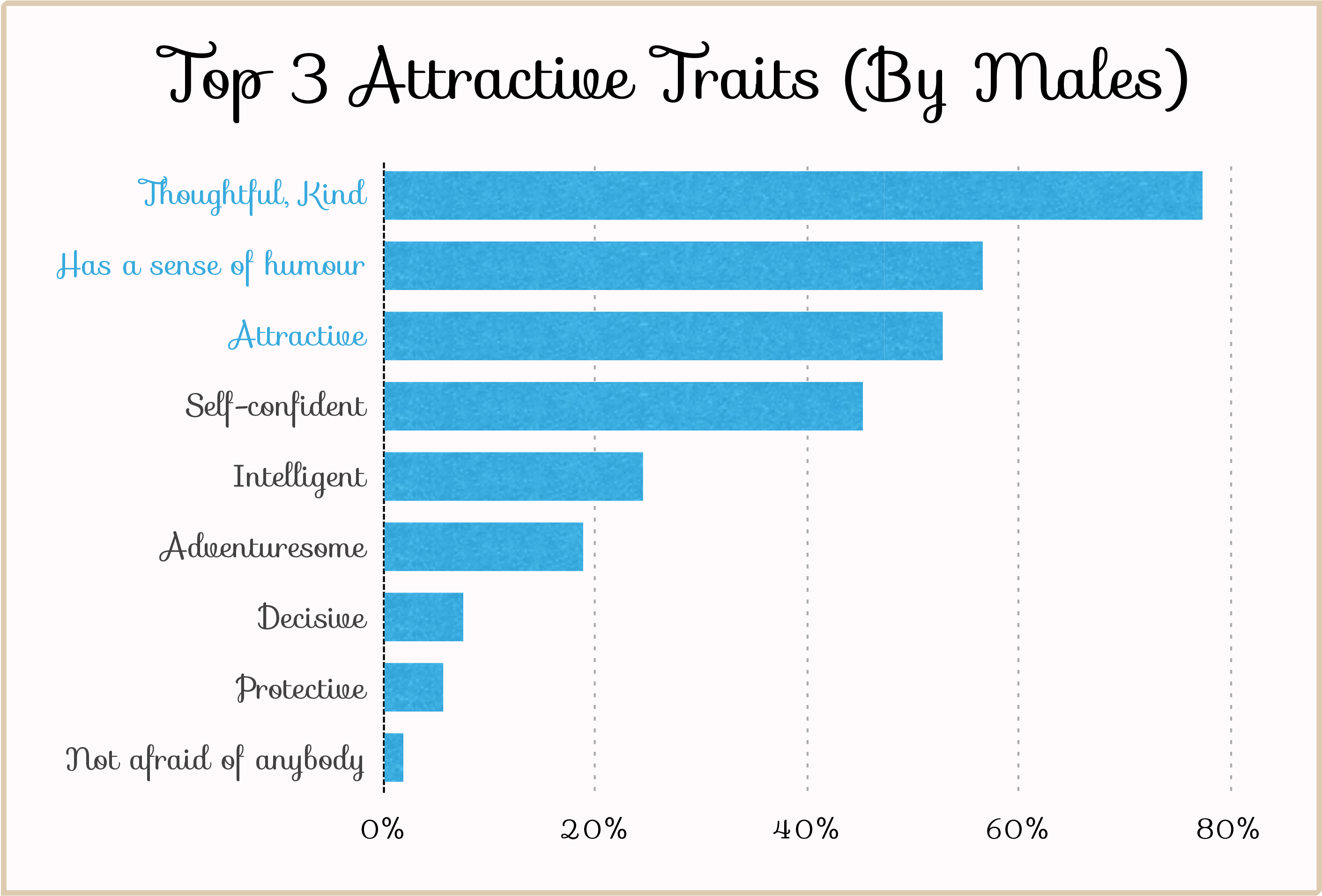
What our respondents could agree on, however, was that the most attractive trait was – thoughtfulness! It topped the charts for both girls and guys, with almost 80% of responses. It was followed by sense of humour, which again ranked second unanimously by both genders. Following these two traits though, disparities between guys and girls’ preferences start to occur. Attractiveness apparently plays a more important role in choosing a potential partner for guys as compared to girls. Attractiveness ranked third in the guys’ preferences, while it’s close to the bottom in the girls’ preferences. It does seem, however, that girls still prefer guys to be their knight in shining armour – protectiveness ranked relatively high in for the girls! It could also be assumed that Rafflesians are most interested in well-read and charismatic individuals, considering how both self-confidence and intelligence made it to the top five of the guys’ and girls’ rankings.

Dealing with a Relationship

1mistake

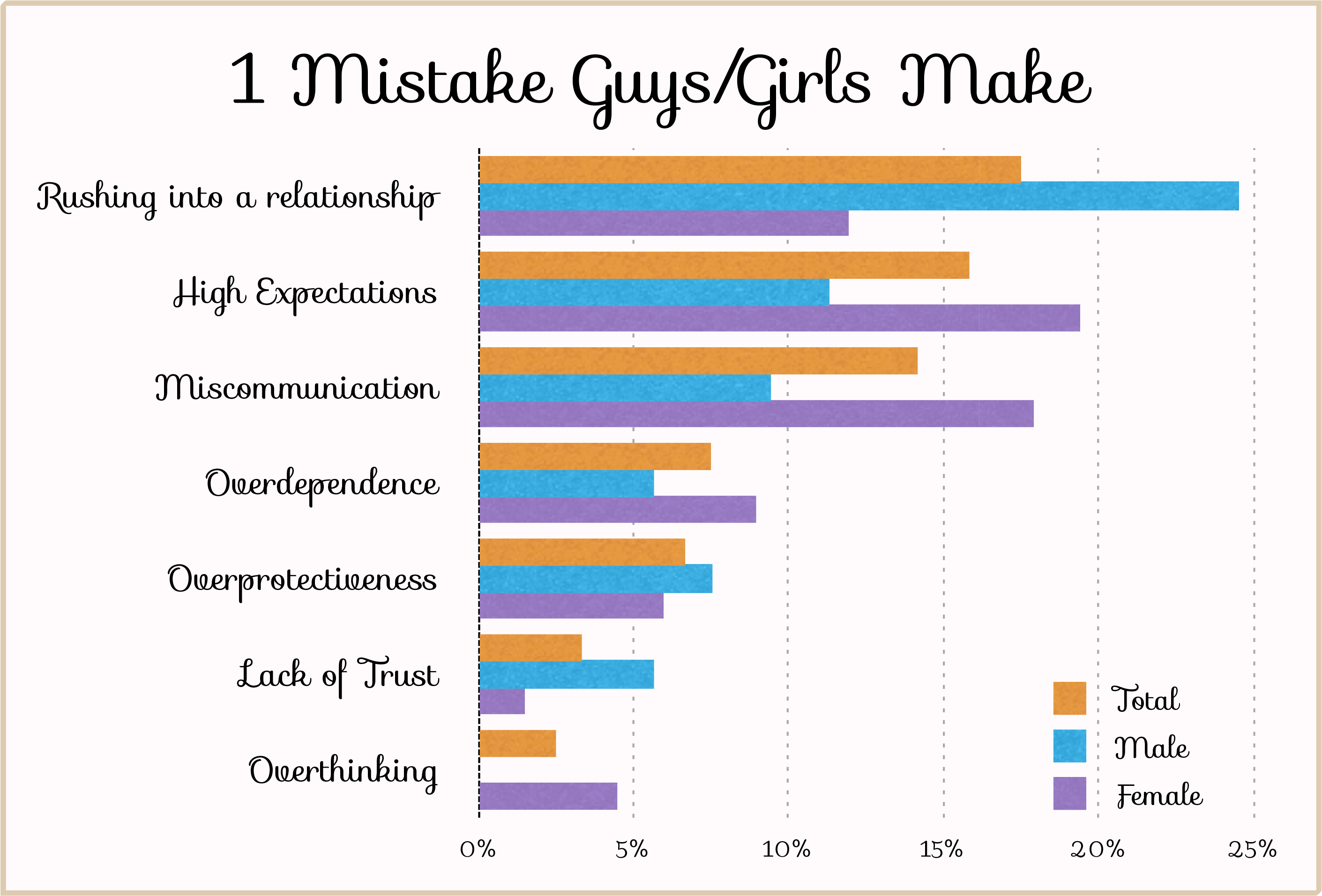
We also asked the respondents about the one mistake they felt that guys/girls tend to make in a relationship. Majority of the female respondents responded something to the effect of “expecting a fairytale-like relationship” as the most common mistake, subsequently facing disappointment when things go sour, leading to an unhappy relationship.

Contrastingly, the responses we received from the guys were rather surprising. While we often hear that guys like to rush into a relationship, it seems that Rafflesian guys like to take things slow. One male commented, “People often go in too early without really knowing their feelings and end up breaking the other’s heart.”

The one key mistake that both genders wholeheartedly agreed on was the issue of miscommunication. Supposedly, our respondents felt that overthinking and making assumptions about the other’s feelings were key causes of conflicts and break-ups. It seems emphasising the importance of communication doesn’t only apply in workplace, but in relationships as well.

As anyone would be curious to know, we asked our respondents to talk about the one key piece of advice he/she would provide for their potential partners. Responses ranged from serious advice (honesty is the best and talk things out, even if you’re not one to talk or share concerns easily – after all, a relationship should have no secrets) to amusing ones like ‘get me a cat!’ and ‘please exist’.

On this romantic eve of Valentine’s Day, Raffles Press would like to wish all the couples out there a memorable Valentine’s Day. We would like to point out that, as one of the respondents cleverly put, “One shouldn’t celebrate their relationship specially just on one day. Every day that you’re together is a gift to be cherished (:” As for everyone else, we wish you a happy Friendship Appreciation Day! Look on the bright side – you’ll be able to get all those chocolates you’ve been eyeing in the supermarket on sale within the next few days!