Arts

Modern Dance SYF 2015: Undercurrent

Reading Time: 4 minutes

By Liew Ai Xin (16A01A) and Collin Teo Jun Kai (16S06Q)

Moddance 1

It all starts with a whisper.

In the spotlight, a single dancer wearing red stretches her hands heavenwards. The rest of the dancers – clad in black – stand as one mute entity in the back, before an unseen cue from the soloist ripples them into action. Together, the group inches forward and moves backwards, all whilst the sibilant whispers of many overlying voices continue over the speakers.

The tension created is almost palpable, as if someone is waiting and watching –– as the audience is held in suspended disbelief at the improbability of dancers dancing to something without a rhythm. After a good two minutes, a steady beat finally appears, and soon a dark melody strung by a cello comes into play.

The soloist in red continues to move amongst those clad in black, who constantly sift together as several interchanging groups. Near the end of the piece, the whispers return, leading the dancers perform a remarkable act of synchronization. This time, with their back towards the audience, they reform the mass of black from the beginning of the piece, to watch the soloist again in her increasingly frantic movements to escape the undercurrent.

After the performance, audible murmurs of “that was so good!” were heard from the stunned crowd, who applauded the dancers enthusiastically after the lights dimmed. However, there were also questions being asked, namely: “What did the piece mean?” and “How did they manage to dance to music without rhythm?”

Indeed, one thing that contrasted “Undercurrent” with the other schools was the lack of a definitive explanation of their theme and title, which allowed for more diverse interpretations amongst the audience. This is a very characteristic move of their resident choreographer and coach, Ms. Low Mei Yoke. When interviewed before the performance, she laughed and said, “I just thought about the phrase, ‘Ambush from ten sides’ (十面埋伏).” Dressed in black, with a simple woven jacket, she looked relaxed compared to the tense faces of the dancers she trains. “The dancers are still young, still students,” she mused, “But I feel that they can understand it.”

Moddance 2

Ms. Low, whose works explore issues in society that she observes, often eschews elaborate costumes and formations for favour of a more direct approach. Another conscious decision by her was to create a simple but distinct colour scheme, with one soloist dressed in red and the others dressed in black. Compared to the long, flowing and intricately designed costumes worn by other schools, their costumes looked simple and commonplace. Yet, in a stage as large as that with such understated lighting, the red stood out as a single drop of colour that instantly caught the audience’s eye. Like she said, ““I didn’t want it to be overly “dramatic”, just something with foreboding tension.” In the interplay between the mass of black and that one red soloist, a message about the self was created that did not need to be overtly explained to the audience.

As for the dancers, many were jittery with post-performance nerves. Although the responsibilities of rehearsals and practice had been lifted off their backs, some still cited areas they thought they could have been better in. Perhaps it is true that performers are often the most critical of their own work. Isabella Lee (15S03N), the dancer wearing red, said, “We did okay … It was our best given how we only got to practice with the stage for fifty minutes.” Later, she added, “It was a good run, but not as good as our morning rehearsal.”  This, coming from the person who had shouldered most of the solo work, was akin to Beethoven saying “Thank God, there is less lack of imagination than ever before.” Granted, there were slight slips in synchronicity and moments when the soloist felt swallowed by the rest. However, one has to consider that large sections of their music had no discernible rhythm, making silent communication a paramount part of their performance. Their costumes also included socks, which made running around the stage a more slippery task than the other performers dancing barefoot.

When asked what the dance represented to them, Choong Kai Xin (15S06B) said, “It represents our hard work for the last half of a year, and the dancers’ commitment to this CCA.” Hard work was certainly evident in the detail and execution of the work. Although every dancer had a slightly different journey, all agreed that they have learned something other than moves and formations from those four-hour practices, three days a week. One dancer, Tan Yu Bin (16S03O), said “We’ve learnt a lot through this experience, not just in the technique department, but also a lot about ourselves –– in terms of how our bodies move, and how to connect with the audiences.”

“We hope the effort pays off,” Andrea Low (16S03I) finishes.

Modern Dance poses for a group shot with their coach, Teacher I/C and alumni.

Well, their efforts have definitely paid off, for Modern Dance has received a Distinction for their stellar performance! Raffles Press is proud of their achievement, and hopes that they will continue to create stunning, thought-provoking performances.

Iridescence Illuminates and Impresses

Reading Time: 7 minutes

By Naomi Koh (16A13A), Justin Lim (16A01B), Tasha Palani (16S03P) and Sean Lim (16A13A)

Photos by Carla Mosqueda (16A03A) and Li-Ann Hoong (16A03A)

iridescence1

The queue forming outside the PAC on the 10th was the first sign that Iridescence 2015 would surpass expectations. Although the unexpectedly large turnout delayed the start of the concert, the audience’s willingness to see it to the end was a testament to the quality of the performances Iridescence offered.

Organized by Year 5s from The Humanz Initiative (THI), Iridescence 2015 was a fundraising concert to aid the elderly at Toa Payoh Care Corner; all proceeds from the concert went to them. Some beneficiaries of Toa Payoh Care Corner had front-row seats for the concert, which also opened with a speech by a representative of the organization. In fact, an Organizing Team member who declined to be named noted that she chose to be involved with Iridescence as it was “a way to contribute to a worthy cause”.

Another defining feature of Iridescence was the sheer variety of acts, with both Rafflesians and non-Rafflesians taking the stage. From energetic rock songs to heart-warming poetry slams, the concert certainly did its best to cater to the tastes of every audience member. Despite each performance’s distinct style and content, it was extremely commendable that the concert still ran smoothly from each act to the next without a hitch.

Clockwise, from top left:  String Theory tugs at heartstrings; Craig upsteps with the up pedal; men in suits, Jon & Jon

Starting off the concert was Jon and Jon, an act comprising Jonathan Chua (16S03B) as the lead pianist, and Jonathan Tan (16S06K) as their lead vocalist. They first performed two hauntingly beautiful piano solo of All I Ask of You and Point of No Return from the musical Phantom of the Opera, followed by Snow Flower. The duo ended their performance by swapping roles momentarily for their final song – Les Miserables’ On My Own – a brave act that truly displayed their admirable team dynamics and diverse range of talents.

Following them was Craig Chua of ACSI, who gave a spirited rendition of Sail by AWOLNATION and No Scrubs by TLC. His performance was remarkable for its use of the distinctive step pedal, a device that allowed him to loop audio clips, creating an audio backtrack that complemented his evocative rendition of Sail. This left many audience members extremely impressed: Dylan Goh (16S06C) commented on how the performance “with the step pedal was pretty cool”, further listing it as his favourite act of the night.

Craig was succeeded by String Theory, a band from ACSI comprising Kristi Lim, Jordan Yoong and Joel Ong. Despite vocalist Joel Ong’s sore throat, the group didn’t disappoint with their sweet, soothing renditions of ballads such as Jeff Buckley’s acclaimed cover of Leonard Cohen’s Hallelujah, Great Big World’s Say Something, and One Republic’s Secrets. Outside of their heart-wrenching and laudable vocal performance, the group’s charming outfits and futuristic-looking instruments– such as their electric violin– left a nothing short of a good impression on the audience.

Rishi, Neha and Pranamika making words come alive

Up next was the first half of the poetry slam instalments for the night. To provide some context, poetry slam in its simplest form is performed or spoken poetry. The first three slammers were Rishi Vadrevu (16A01E), Neha, and Pranamika, the latter two being students from Anderson Junior College who had volunteered for the event out of ‘interest in exposing students to the power of spoken word’ and ‘to use [their] passions to help a worthy cause’. Rishi opened the performance with a riveting and emotional reading of an original untitled poem that poignantly represented the internal conflicts of a teenage boy, and this was followed by Neha’s reading of fellow Rafflesian Khairillah Irwan’s (16A01B) poem: Critical Assignment. The segment ended with Pranamika delivering her two self-written poems about the contrasting experiences of being in healthy and unhealthy relationships that resonated deeply with many members of the audience.

Clockwise, from top left: Is that a Drum Set? in action; Raffles Chorale's melodious medley; Searching finds their groove; Austere from Raffles Rock takes a bow
Clockwise, from top left: Is that a Drum Set? in action; Raffles Chorale’s melodious medley; Searching finds their groove; Austere from Raffles Rock takes a bow

Following the poetry slam was Is That a Drum Set?, comprising students from Raffles Jazz that did indeed have a drummer amidst their talented pool of musicians. Fronted by the exuberant Stefanus Phan (15A01A), the quirkily-named group performed Sunday Morning by Maroon 5 and Left Hand Free by British indie act alt-j. The audience was blown away with the mellow yet thoroughly captivating performances laced with catchy guitar riffs and a surprisingly enthralling laid-back vibe.

Rounding off the first half of the night was Austere from Raffles Rock. The group daringly started their performance with their cover of No-Diggity by Blackstreet, and followed through with a powerful rendition of That’s What You Get  by Paramore. Lead vocalist Jemi Lu (16S07B) told us that “it hasn’t been an easy journey, but I feel very blessed to be embarking on it with this group of passionate and fun-loving friends.” Indeed, their efforts did not go to waste as they received a rousing round of applause at the end of their dynamic performance.

iridescence6
Austere ending the first act on a high note

After the break, Iridescence quickly regained momentum with acapella performances by Raffles Chorale, which covered three songs- a mash-up of Thinking Out Loud by Ed Sheeran and I’m Not The Only One by Sam Smith, followed by Rather Be, by Clean Bandit. They ended off their performance with another mash-up, this time of Treasure by Bruno Mars and Suit and Tie by Justin Timberlake. Considering that Treasure was one of the many songs of the Year 5 batch dance, the song likely aroused irreplaceable, sentimental memories of orientation amongst the J1s in the audience. Additionally, the unexpected yet impressive application of beat-boxing across all songs was astounding and carried out well by the spirited performers. At any rate, the Chorale singers injected vibrancy into the PAC post-intermission with their upbeat voices colourful ensemble.

Chorale was followed by Searching, who stole the stage with lead vocalist Kelsie Tan’s (16S07C) impressive vocal range accompanied by Alexander Leung (16A01A) and Deo Teo (16S03S) on their guitars. The trio managed to successfully play on the heartstrings of many within the audience. The group’s mix of songs, American Boy by Estelle and Lost Stars by Adam Levine, was light and peppy. Together with their simple stage design that left the stage largely bare, an intimate atmosphere was immediately fostered as audience members felt an immediate closeness to the performers. Kelsie, in particular, was swaying about animatedly to the songs and capturing the audience’s attention with her infectious stage presence.

The promised second segment of poetry slamming did not disappoint, first kicking off with Isaiah Lee (16A01A) enthralling and captivating the audience with his vivid and stirring words, all through a resolute and emphatic reading. Next up, Karen Cuison (16A01D) joined Isaiah to present their duet, completely winning over the audience with a refreshing performance reminiscent of popular spoken word duo Phil Kaye and Sarah Kay. As a potential contender for crowd-favourite, their poem was a charming and relatable piece speaking of the star-crossed paths of two unlikely students from the arts and science streams, which had the audience enamoured. Subsequently, Neha made a light-hearted entrance onto the stage for the second time that night. This time around the talented student from Anderson Junior College presented her own work, Bleach, an insightful and mellow piece on racial identities that many identified with.

Clockwise, from top left: The impassioned gazes of Tofu Bloc; Karen, Isaiah and the distance in between; Nicole Sim () interacting with the audience; The Diversion taking a final bow after an electrifying stage

Following that, Tofu Bloc, who took a special trip down from Dover Road, made their highly anticipated entrance. From their eclectic aesthetic to their enrapturing performance, Tofu Bloc truly impressed that night with their clever array of song mash-ups. They made their mark as versatile musicians who were able to combine the various genres of music into their mash-up, presenting an exhilarating performance that undoubtedly added an exceptional twist to the line-up for the night.

Aptly named, The Diversion of Raffles Rock took the stage for the last performance of the night, ending off the concert with a bang. Their high-spirited rendition of cult favourite I Don’t Care by Fall Out Boy re-energised the crowd even at 11pm, with people bounding over to the front of the stage to join in on the action. The enthusiastic crowd’s cheers spurred on these talented, charismatic musicians to go on to give their best in their first ever live performance.

With high-intensity, unique performances as well as humanitarian goals, Iridescence was without question a concert worth going to. The organizing team, performers, and audience members expressed little regret in choosing to spend their time with Iridescence. Dylan had nothing but praise for the night’s performances, enthusing that “the music was amazingly good” and he “believe[d] that it was all worth it”, citing the efforts of the Organizing Team. The Organizing Team for Iridescence also expressed their profuse thanks to their teacher in charge, Ms Lye Su Lin, all performers, stage-hands, and audience members, for coming together to make this charitable concert a success.

To see more from the The Humanz Initiative, do look out for more upcoming events such as For Sale by One Chair Plays on 3rd May at the Esplanade! Book your tickets now at tinyurl.com/onechairplays.

FOR SALE: One Chair Plays Preview

Reading Time: 3 minutes

Did you know human trafficking exists in Singapore?

“Huh?” Many people say when asked this question. But it does, and on a scale far larger than what you would expect. More women are enslaved in Asia than anywhere else today, and Singapore – contrary to popular belief – is one of the biggest destinations for trafficking victims today. It’s precisely because of our booming economy and international reputation as a clean and safe place that makes trafficking victims particularly susceptible to falling prey in sunny Singapore.

Continue reading “FOR SALE: One Chair Plays Preview”

On Strawberries and Death: Dramafeste 2015

Reading Time: 12 minutes

By Karen Cuison (16A01D), Ching Ann Hui (15S03A), Michelle Zhu (15A01B)
Photos by Vanessa Gan (15S06C) and Nigel Gomes (15S06R)

Dramafeste 2015 was, for many, two weeks of rehearsals and set painting late into the night that eventually came together on the 25th and 26th of February. The popularity of the event was undiminished this year, with tickets for the Thursday show selling out rapidly, and many theatregoers arriving early at the PAC foyer to get the best seats.

Strawberry
Moor-Tarbet

df_1

Synopsis:

Bernie seems okay, but really, he isn’t. His waking hours are spent arguing with Helen, his ex-wife, over what might have been, while his dreams are preoccupied with Carol, his absent daughter. He has not been able to find closure over an initially unidentified incident, later skillfully and subtly revealed as Bernie’s failure to buy Carol a Strawberry ice-cream cone prompting her to cross the road – only to be tragically killed by a speeding car.

‘And the worst part is, in front of everyone, you have to be okay… well I… try to be.’ -Bernie

Strawberry will be remembered for its poignance with which it addressed mental anguish. From the lone handheld spotlight Bernie used in both his entrance and exit to highlight his desolation, to the building blocks that formed a house that reinforced Bernie’s lack of a loving home, MT’s play featured various little touches that added atmosphere and depth to the conflicts portrayed. A motif that worked particularly well in Strawberry was Bernie’s beginning monologue. Its repetitions in the middle and at the end of the play sent chills up the spines of many.

df_2

MT’s lineup of actors worked well with each other, clinching a deserved Best Cast award. As Bernie, whether Rishi Vadrevu was oscillating between fatherly warmth and fierce wrath,or delivering an impassioned monologue by the light of his handheld spotlight, he carried the play with gusto. Ericka Mantaring portrayed a realistic Carol, while Lam Wei Yi as ex-wife Helen surfaced love and hurt sensitively, sometimes at the same time. Last but not least, the ensemble (Maisarah, Nabilah and Sreshya) that acted as both conscience and mocking commentary, credibly translated the various aspects of Bernie’s turmoil from self to stage, enriching and enhancing Strawberry.

MT’s ambitions, however, were not wholly realized. With a full set, fully utilized stage, and diverse cast, it was easy for some things to be drowned out by others. Nonetheless, the effort put in by the scriptwriters and directors is commendable. As an unnamed audience member put it, Strawberry‘s strength lay in ‘how it was emotional, and how it was something we could all relate to.’

Two Berries, a Cherry and a Boy: The Life and Death of a Traffic Light
Morrison-Richardson

df_3

Synopsis:

Strawberry falls in love with Blueberry, who falls in love with lovable girl-next-door Cherry, who falls in love with easy-going goof Mark. Strawberry and Blueberry share a literary streak. While Blueberry angstily compares his unrequited love for Cherry to a pedestrian’s inability to love a traffic light, Strawberry desperately tries to attract his attention by rewriting his stories. Eventually, Blueberry realizes the futility of his pursuit. At the same time, he is touched by Strawberry’s affectations, and accepts them. He makes a final request – to break the glass that divides their world and Cherry’s. The play ends with Mark giving Cherry two goldfish to replace her deceased ones, Blueberry and Strawberry.

“What mountain did Albert Einstein climb? Mount Cleverest!” -Mark

Strawberry (played by Shannon Phuah) and Blueberry (played by Vasu Namdeo) made for a compelling lead couple. The Best Actress and Actor respectively displayed remarkable and consistent chemistry.

MR’s production was defined by its simplicity. This was reflected most clearly in its bare set. It was visually unique, and facilitated the smooth movement of actors. At the same time, it made full use of the stage without distracting from the actors. On top of it all, the set even retained an element of surprise in the triangular blocks, which were overturned in the closing scene to make a path for Cherry and Mark to walk to each other.

df_4

Two Berries, a Cherry and a Boy was defined not by a standout moment, but by the unity and smooth flow at every moment. There did not seem to be a key moment per se in this play – the central story that made absolutely no sense at the beginning, but makes the audience go ‘ohhhh’ once revealed. As the plot unravelled, the connections of some ideas nebulous to some audience members. Nonetheless, with the help of the traffic light and goldfish motifs, the concept of loving from a distance was articulated uniquely and well. Many enjoyed the numerous traffic light puns woven skillfully into the play that brought many light moments into an otherwise intense play, whether it was “he felt that that all the light had gone out of his life”, or “he thought that had been sending very clear signals”. The ending scene too was hauntingly beautiful – prisms toppling in succession just to let Cherry and Mark walk on to meet each other. Unfortunately, Blueberry did not have have that fortune.

This production was not without its critics – one audience member remarked ‘it was slightly anti-climatic, while other audience members finding the main character’s exchanges too ‘shouty’. Even then, MR went on to sweep the Best Play, Best Script, Best Actress and Best Actor awards. As a first-time lead actress, Shannon shared that the greatest challenge for her was “showing depth and variety to (her) emotional responses”. This was especially since the play “relied heavily on emotion to carry the plot, but it escalated so quickly that it was difficult at times to catch on. It took lots of re-looking at and unpacking the lines to fine tune the level of energy.”

Ultimately, MR’s production stood out for its professionalism. As judge Eugenia Tang shared with us after the event, each different play had really good moments but MR’s victory was because it was the only play out of the five that the judges could see as being successful in a professional theatre setting, whilst the rest were still distinctly distinguishable as student productions.

Yesterday was Saturday
Buckle-Buckley

df_5

Synopsis:

Auntie Ling hosts a group of childhood friends for what seems like a conventionally cheerful childhood-friend get-together. However, it is soon revealed that these old friends have convened to break the bad news of John’s death to Auntie Ling, his mentally impaired mother. Auntie Ling blames his ex-girlfriend, Julia, for the death, refusing to believe that her son drunkenly grabbed the steering wheel from her as he veered towards his own death. Amidst John’s tragedy and the rekindling and rejection of an old flame, Auntie Ling and friends learn their own lessons about loss.

“You think it’s really made in Germany meh? China la! Everything is made in China!”  – Auntie Ling

Yesterday was Saturday began with a sprightly Auntie Ling (played by Tan Ai) excitedly inviting everyone to her home. As the stage filled up with characters, conflicts including the pain of having to break the news of death to Auntie Ling, became correspondingly clearer. Tan Ai, in particular, fleshed out Auntie Ling’s character memorably and effectively, whether she was being a welcoming host or a hysterical, devastated mother. Strengthening the production were little hints of symbolism planted thoughtfully throughout the set and play itself. These included rows of beer bottles, and a set of curtains – John’s favourite childhood hiding place – that were left open, and drawn only at the play’s close.

In trying to tie the diverse cast and set together, the play sometimes lost sight of its main plot and message. This proved to be a stumbling block, especially when the play tended towards rambling and somewhat blunt dialogue. In particular, there were mixed opinions about the side plot of Madeline (Jesslyn) and Darryl’s (Sarthal) love story – while some found that it strengthened the theme of loss and letting go, others felt that it made the stage feel crowded and detracted from the main plot. Moreover, the ending seemed abrupt and convenient, and gave off the feeling of a melodramatic Korean soap.

df_6

However, to the play’s credit, these did not detract from the play’s promising concept, and its most memorable moments. One such moment was the near the end of the play, where bathed in dreamy blue stage lights, Julia (played by Eunice Png) delivered a heart-rending monologue about John (Daniel). John entered in a white tuxedo and both interacted with the set, seemingly thinking of each other but never making eye contact. The symbols used throughout the play were also useful in bringing out the message, in particular the pocket watches bought in the friends’ youth. This writer was particularly impressed by the subtle change of the roses in the wine bottles from white at the beginning to red at the end.

All in all, Buckle-Buckley put up a play that was conceptually impressive and heart-wrenching in its best moments. Though the execution could certainly have been improved, it was nevertheless an entertaining play that ambitiously tackled such universal issues of loss and letting go of the past.

Kampong Recipes
Hadley-Hullett

df_7

Synopsis:

It takes a kampong to find a missing child. Or class monitor. Mabel and Ian are determined to get to the bottom of the mystery, all the while balancing school and battling iron-laden parental grips. They find out that there is more than meets the eye to  witch’s signature delicacy, banzhang (Chinese for class monitor, and similar in sound to Bak Zhang, the chinese delicacy it represents ).

“But why are we still scared?”

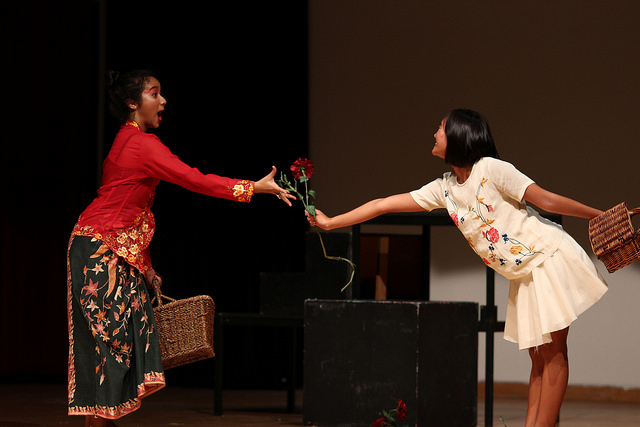
We will admit – we were skeptical. Kampong Recipes initially reminded us a lot more of a cooking show on Channel 5, than the fascinating play with, in the words of the judges ‘two narratives – one of a story of murder on the surface, but another of cannibalising the children in conservative Asian society’ that wound up wowing us. The aesthetic of Kampong Recipes was a dream from start to finish. The costumes of the cast was authentically kampong and especially for the witch (Caitlin O’Hara), who was clad in an elaborate red Peranakan outfit, with matching red eyeshadow to boot. Kampong Recipes’s look was buoyed by its sets. Simple as they were, the colourful stage greatly enhanced the storybook-like setting of the kampong, believably and tastefully. At one point, even two seemingly insignificant potted plants placed beside a painting of a kampong somehow bridged the gaps between the flatness of the painting and the physicality of the actors, while demarcating the homes of Mabel (Celine Ng) and Ian (Mohammad Sufyan). The best component was definitely the box ,which served as Auntie’s hiding spot, with vines menacingly hanging. It is remarkable how Kampong Recipes’s sets found sweet spots between tastefulness and tackiness, and minimalism and maximalism, while never sacrificing functionality. It was therefore not surprising when HH won the Best Sets.

Most would agree that the most impactful scene would be the climactic one when Mabel and Ian are cowering in the jungle with witch standing over them and the light turned green, casting a menacing figure of the (otherwise slightly comic) Auntie, reminiscent of the famous scene in “Wicked” when Elphaba defies gravity.
df_8

The unabashed hilarity of Kampong Recipes quite possibly made it the most light-hearted and easily digested play of the Feste. Arguably, it was the most ‘complete’ play – there was no unexpected, abrupt change of events, no sudden surprises. From dark, dark humour that made ban zhang (‘class monitor’ in Chinese) sound like a Chinese delicacy (hence hinting at cannibalism), to Mabel’s and Ian’s adorable friendship, Kampong Humour’s jibe-filled, script was deliciously subtle. The play was also conceptually impressive – what stood out in particular was how it effortlessly managed to bring out the parallels between a nameless “monster” in the jungle and the arguably overly harsh ways of the typical “Asian parent”.

The stagehands too did a wonderful job – with the judges even commenting ‘that was the best stagehanding (they) have ever witnessed’. The play involved a lot of set changes, making the stagehands especially important for the success of HH. HH stagehand Alex Tan shares his experience in practicing moving the bulky box set: “At first we took about 15 seconds for each scene change, which satisfied our director Celeste. But one of our crew members Jia Cheng refused to stop practising until we hit below 10 seconds!” What drove the crew to continue practicing despite rehearsals being held late into the night was the energy that persisted, heartening them despite the tight schedules.

While MR and BW’s plays were outstanding because of their simplicity, HH’s play impressed the audience because of its uncanny ability to fit so many characters on the stage without coming across as being too crowded, whether in terms of each character’s function in the plot or staging. The play was certainly not perfect, but multiple elements of the play that stood out individually managed to come together to produce a play that was both visually and conceptually stunning.

The Adventures of Zachary and Fiona
Bayley-Waddle

df_9

Synopsis:

Zachary’s world is turned upside down when his elder sister, Fiona, is diagnosed with cancer. As her cancer progresses, sibling roles are reversed: instead of Fiona looking after Zachary, Zachary has to look after Fiona. Both siblings display selflessness and love in the face of Fiona’s impending death.

‘I’m gonna explode!’ – Fiona

The first thing that struck most audience members about The Adventures of Zachary and Fiona was its minimalism – and in turn, the play’s ability to convey a lot with a little. Adventures only had two actors – Zachary (played by Abdul Lateef) and Fiona (played by Cai Hai Yun). Yet, it seemed that two actors was all that was needed for Bayley-Waddle to put up a performance that was captivating. Indeed, despite being 17, the actors were able to realistically bring out the childlike demeanour of their characters – optimistic, yet cautiously realistic – to accurately capture the hurt, fear and joy colouring the journey of a child cancer patient.

The scene where Zachary pretended to be a doctor finding all sorts of treatment for Fiona stood out. The familiar childhood game of playing doctor is given new meaning in this context, showing not only the youthful trust between the siblings, but also how children deal with cancer – in the only way they know, by turning it into a game. This scene was one of many where BW managed to combine emotional intensity and significance with comic relief. Another scene that stood out was the shadow scene, where Fiona attempted to live out her dream of being a pilot in the face of her problems – symbolised by crashing waves always seem larger than what she can manage. The shadow play had many audience members gushing for its beauty and unexpectedness, as well as for how it highlighted the delicate, unpredictable and constantly changing nature of the siblings’ journey with Fiona’s cancer.

df_10

BW’s play was distinguished by its subtlety. Notably, immediately after Zachary finished shouting about Fiona not waking up, all lights went down except for a spot on his sister’s fragile breathing form. BW’s production was different because its force came less from what it presented and more from the reactions it triggered in the audience, beautifully exposing the struggles that childhood cancer patients and their families face. While some in the audience found the play too ambitious, it was nevertheless successful in its attempt to address such a serious issue. The only possible downside to Adventures was the ending, which came across as anti-climactic after the skillful execution of the rest of the play. Perhaps the scriptwriters and directors were trying to tell us that the ending in this case does not matter as much, but that was not true for the audience, who were, after all watching for the ending.

BW winning Best Direction came as no surprise given the complexity of directing this deceptively simple. Houses like  BB and HH easily filled the stage with their numerous characters. Although BW did not have the luxury of a sizeable cast, Zachary and Fiona left deep impressions with their stage presence. The coordination of the shadow show was another challenge the directors had to overcome, and overcomed flawlessly.

df_11

As per tradition, the Raffles Players EXCO put up a spoof that linked all the plays together just before the results release. Consisting of Rafi Kamsani, Rachel Koh, Brian Yen, Joel Seow, Darshini Ravichandran and Katrina Jacinto, this year’s players EXCO linked notable lines together from the various plays to form a hilarious spoof, even borrowing parts of the characters’ costumes – BW’s pilot hats, HH’s peranakan outfit, drawing uproarious laughter from the audience and ending the night on a great note.

Dramafeste 2015 was an impressive production for all five houses, especially given the tight timeline that they had to work with. Literature teacher and Players teacher I/C Mr Ian Tan noted that the common thread that linked the houses’ plays this year was the theme of coping – with loss, with love, or with extenuating circumstances. Many in the audience marvelled at the amount of work that went on behind the scenes for every play, and we at Raffles Press echo the sentiment. the sheer amount of time and energy participants have put in to the show is perhaps the most remarkable part of a very entertaining production. We’d like to salute the passion and energy each house went into Dramafeste with, which eventually culminated in a thrilling night for all of us in the audience.

Results

Best script: Two Berries, a Cherry and a Boy (MR)
Best sets: Kampong Recipes (HH)
Best cast: Strawberry (MT)
Best actor: Vasu Namdeo as Blueberry (MR)
Best actress: Shannon Phuah as Strawberry (MR)
Best direction: The Adventures of Zachary and Fiona (BW)
Best play: Two Berries, a Cherry and a Boy (MR)

Rock On!: Musicfest 2015

Reading Time: 7 minutes

By Chew Cheng Yu (16S06L), Michelle Choy (15S05A) and Tan Su (15S07A)
Photos by Deng Yimin (15S03M)

Musicfest: the product of three weeks of practices late into the night and unyielding perseverance by the skilled musicians of every house. This year’s Musicfest had unprecedented popularity amongst the students, which saw the LT packed to the brim by eager students, and latecomers settling for standing at the entrance; it was quite a contrast to last year’s, during which there were enough unfilled seats to have the performers be able to sit down. It was indeed quite the crowd, as our bubbly emcees Lin Sheng Jun (15S05A) and Ryan Chan (15S03I) pointed out. With songs from worldwide stars and bands being featured, all of Raffles was pumped up for this much desired break from the stress of school life, where they could just let their hair down, show their house spirit and rave to the brilliant performances put up.

IMG_9561
Emcees Ryan Chan and Lin Shengjun hyping the crowd up before BB took the stage.

While Chamber Ensemble was responsible for last year’s Musicfest, this year’s competition was organised by Raffles Rock, and the bar was also raised. Teams had to perform songs from a given artist, a part of which had to be in a given style, with a special requirement, all chosen at random. According to a member of the organising committee, it was initially thought of as a way to generate interest in Musicfest amongst the students, but it also lent a very interesting dynamic to the performance, which truly allowed each house to showcase their creativity and finesse. Restrictions were deliberately flexible to allow teams freedom of interpretation, and to have fun performing on stage. In addition, there was a set minimum of three songs to perform, with an optional fourth song that could be included.

While the technical and musical skills of each house were praiseworthy, those alone were not enough to triumph the competition; audience appeal and popularity were also significant deciding factors. Win over the audience with popular, engaging songs, and you win over audience votes (hopefully enough) to vie for the first place. Judged by our own sound technician Mr. Hazli, Raffles Rock Teacher IC Dr. Lena Liu, and local pop artist turned entrepreneurs duo Jack and Rai, who often performs at various venues and are involved in several music festivals, the event started off on a high note.

mf1
BB’s extensive variety of highly skilled musicians gave them an edge over many other houses that night.

Up first was Buckle-Buckley, and their solid arrangement was performed impeccably with a unique addition of beatboxing vocals in the middle of “Bang Bang” by Jessie J, Ariana Grande and Nicki Minaj. They finished off with their challenge song, a jazz remix of “Thinking Out Loud” by Ed Sheeran, which played out smoothly down to the last note. Near the end, guitarist Alexander Leung (16A01A) successfully rallied the crowd to sing the last few verses with them; and as for the last line, house members sitting on the stage held up placards with lyrics on them for a stylish finish, earning the favour of the enthusiastic audience. The passionate House Comm of BB also showed their unending support for their house as they occupied a whole row of seats and gave standing ovations to their house members.

mf2
BW’s performers rose to their country-acapella challenge with gusto.

Bayley-Waddle took the stage next. Wowing the audience with their rendition of “Uptown Funk” by Mark Ronson ft. Bruno Mars in particular, the performers were suitably decked out, with the vocal leads dancing along to the song in sunglasses and leis. The passion exuded certainly moved the audience, bringing the excitement to a new level. Their challenge song, “Ain’t It Fun” by Paramore was performed in a capella with some beatboxing thrown in, as well as with a violin and a ukulele. Although they missed out the ‘country’ aspect of the song, it was still clear that they had excellent vocals all around.

IMG_0032
Powerhouse vocalist Esther Chan hit all the right notes.

Following after was Morrison-Richardson, performing a variety of songs. Their challenge song, which was introduced by guitarist Sun Yi (15S06G) parodying the character Lulu from popular local comedy show “The Noose” with a pink wig to boot, was a mash-up of “Thanks for the Memories” and “Light Em Up” by Fall Out Boy done in a charming oriental style with a rap battle. The musical prowess of the house was demonstrated further in their other songs; “Can’t Hold Us” had original lyrics written to suit MR, and with “Remember the Name” by Fort Minor showed off their rapping skills. The vocals for “Runaway Baby” by Bruno Mars in addition to their challenge song were provided by their talented Esther Chan (15A01D).

IMG_0090
House captain Melissa Tang charmed the audience with her brilliant singing and sparkling personality.

Hadley-Hullet charmed the audience easily with their charisma and confidence. Their challenge song, “Safe and Sound” by Taylor Swift, was played in the original key in the first part, before switching to a minor key and going Reggae style. For the difficult and odd combination of Taylor Swift and Reggae, vocalist Edward Yao (16A13A) put in a remarkable effort, sending the crowd roaring when he and his duet partner held each others hands and looked into each others eyes as they sang their hearts out. My Chemical Romance’s “Welcome to the Black Parade”, their last song, was marked by house members doing their signature cheer as the performance went on, in an amazing combination and display of house spirit and affinity coordinated by their House Captain/vocalist, Melissa Tang (15S03Q).

IMG_0284
MT put up a commendable, technically skilled performance despite lacking instruments more commonly seen at Musicfest.

Last but not least, Moor-Tarbet stepped up to meet the bar set by the other houses with their song choice and incredible vocals; Stefanus Phan (15A01A), one of the best male voice leads that night, started slow with “I See Fire” by Ed Sheeran, but followed with their quick challenge song; a mash-up of a few Maroon 5 songs including “Payphone” and “She Will Be Loved”, done in an indie style. Qiu Biqing (15S06J), their bassist, commented that ‘We decided on something more chill and laid back, yet memorable because there are a lot of Maroon 5 mash-ups out there! We are very glad to receive positive feedbacks on our final performance’ a testament of how much they wowed the crowd.”

mf3
Raffles Rock entertained the crowd while the judges deliberated.

As the last song by MT finished, votes were then opened for the audience. While voting went on, Jack and Rai went on stage to perform “Some Nights” by Fun with only acoustic guitars and drums, and their very own original “Tryin’ ”. Raffles Rock followed on with their covers of “Creep” by Radiohead, “Pompeii” by Bastille and “Monster” by Paramore, performed by their own talented members. By then, it was almost 10.00p.m., and the excited crowd was getting impatient for the results. An impromptu rap battle then begun between a BB rapper and one of the lights and sounds crew, entertaining the audience even as the air-conditioning turned off. Finally, the results were released:

1st: BB

2nd: MT

3rd: HH

4th: BW

5th: MR

According to Dr. Lena Lui, all the judges agreed that both BB and MT put up slightly better performances, due to their seamless transition of songs and overall quality of performance (i.e. vocals, effectiveness of performances etc.). The other houses were fantastic as well, but lost out by a close margin in terms of certain performances or segments being a little sluggish or messy. She quoted that: “I have to firstly say that every house did very well for Musicfest… All of the houses performed exceptionally with each having their own strengths and weaknesses, and judging was not an easy task to do…. It definitely was a tough call and all houses put up an amazing show.”

The short three-week duration that each team had from auditions to the actual event proved to be a challenge, but each house emerged and performed all their four pieces with finesse and technical skill. The performers from each house played, sang and danced passionately, engrossed in their own music, giving off a rare and exquisite appeal that rocked the audience. As the talented drummer of BB, Jonathon Pong (15S03G), commented, this new style definitely ‘appealed to different musical tastes, and different challenges,’ making it more enjoyable for everyone involved. Vice-Chairman of Raffles Rock, Mark Ho (15S06Q), said, “From Taylor Swift with Reggae to Paramore with Country, I think teams interpreted the challenge very well.”. Even the guest judges, Jack and Rai, who were thoroughly impressed with the groups, commented that ‘There is definitely no lack of talent in Raffles Institution.’

Reflecting on the organisation of Musicfest this year, Mark expressed that “Musicfeste was an event that took weeks of planning to pull off. It wasn’t easy, but it was worth it. There were problems with venues and such, of course, and I admit we weren’t able to pull it off as spectacularly as we’d hope to. But we’ll take it in our stride, to learn from this experience and do a better job next year if Rock organises it again.” Ultimately, the standings didn’t seem to matter as much as the whole school (or at least those that could squeeze into LT2) coming together and having a blast, regardless of being an onlooker, performer, or audience.