

By Nicole Lee (26S05A) and Tan Yan Qi (26S06M)
Photos courtesy of Poh Le Yang (26S03F) from RAPS
The Raffles Science Symposium (RSS) is an annual event, where Rafflesians from Raffles Girls’ School and Raffles Institution (Y16) congregate to showcase their research projects and passion for science. The symposium also acts as a lead up to the Singapore Science and Engineering Fair (SSEF), providing students with the opportunity to practice their presentation and oral skills before the competition.
This year, on 21 January 2026, RSS highlighted 238 student presenters in 105 research projects, spanning from Animal Sciences to System Software. The success of RSS is the result of the careful planning and organisation by the RSS team of teachers and laboratory staff.
In contrast to the quiet morning, the Indoor Sports Hall was bustling with life—students, not just from RI (Y56), but RI (Y14) and RGS, were gathered in their respective booths to showcase their projects. Each group was given a cardboard tri-fold board along with other materials to aid in their setting up of their research posters.
During that period, judges from various research institutes arrived at the holding area, preparing to comb through the rows of research posters and engaging the students on their research work. In half an hour, the entire venue transitioned from an empty hall to a full-blown fair.
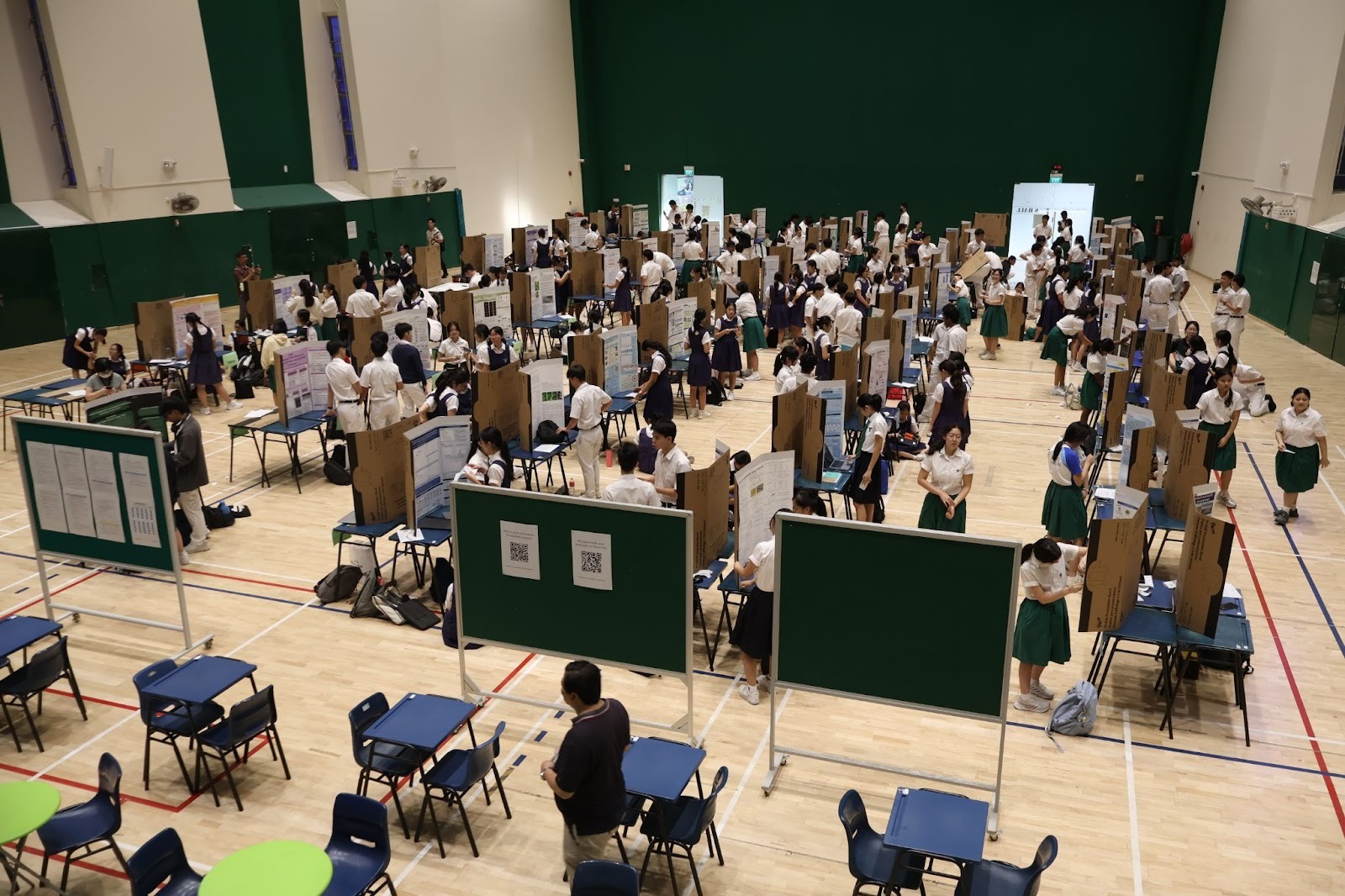
The essence of RSS, as with SSEF, lies in the rare opportunity to converse with industry experts, coming mostly from A*STAR, DSO, NUS and NTU. RI and RGS teachers also contributed meaningfully as they gave various tips which included presentation techniques, answering with confidence and voice projection.
As students, our knowledge of the world is often constrained by the academic syllabi and scientific theories with seemingly little relevance to our daily lives. However, through these valuable interactions, many get to learn more about how such research is relevant in solving authentic problems in the real world.
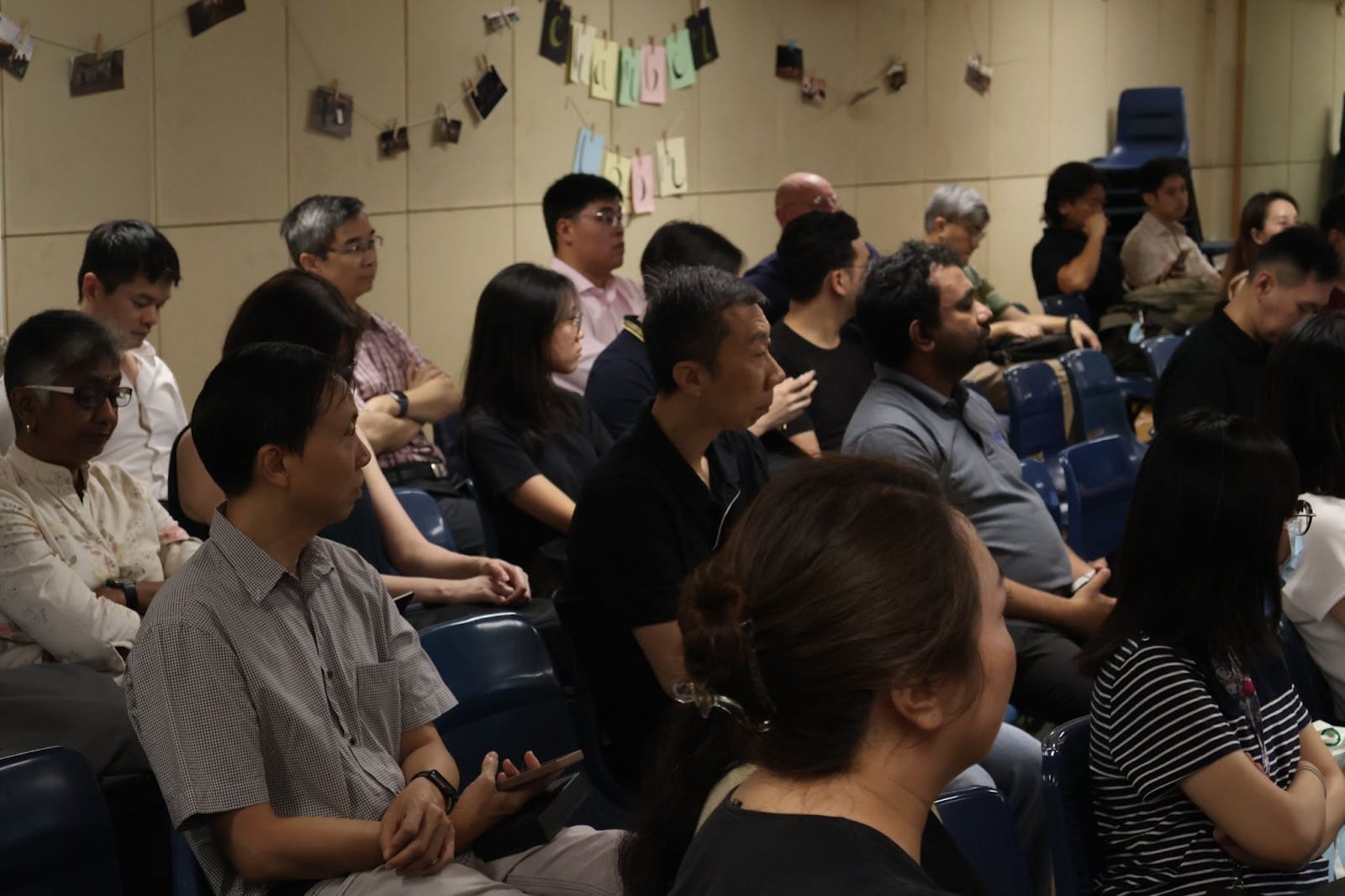
Conversing with Mr Jakub Mikula, a Senior Scientist at A*STAR IHPC and a recurring judge of SSEF, he shared that it was his first time judging for RSS.
In his words: “I’m really surprised by the quality of the projects. The posters are very nice… visuals and everything looks really great.”
A casual glance at the numerous booths tells enough about the calibre of projects this year. From samples on herbal sunscreens to a Lego model of the Kibble balance, it isn’t hard to commend the creativity and intellect of our promising young researchers.
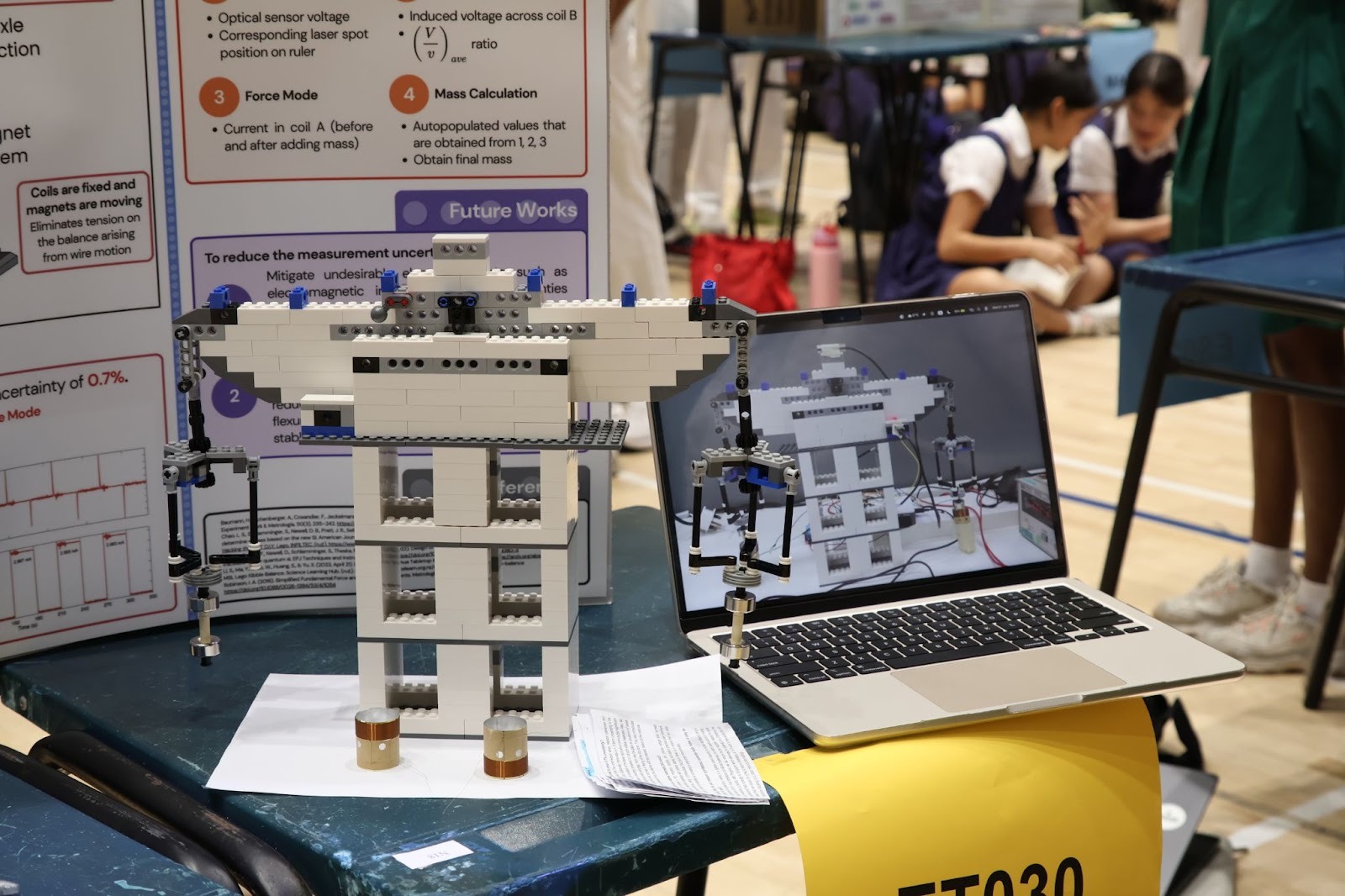
It would be nearly impossible to go through every single booth and understand each and every research project within a short amount of time. Needless to say, behind every poster, model, and display put up was months of hard work.
As we sifted through the sea of booths, we did our best to collate ground sentiments from the groups present. Here are some notable projects:
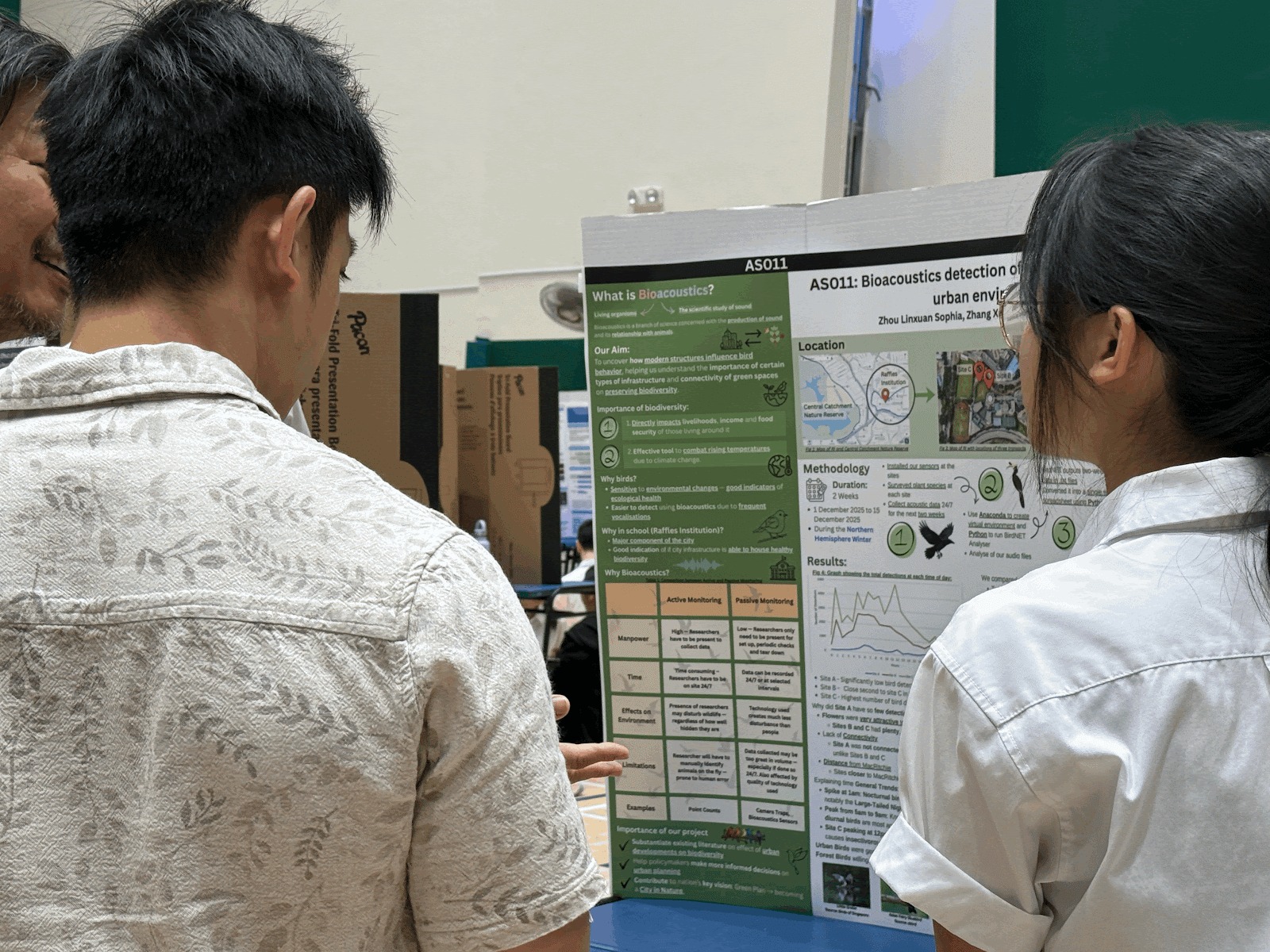
Project AS011: Bioacoustics detection of avian biodiversity in an urban environment
The project mainly focuses on finding out how different spaces in school affect bird behaviour—tapping on the birdNET model to record bird vocalisations, student researchers were able to identify the exact species with percentage confidence. This would aid in their efforts to analyse how urban structures deter birds from inhibiting isolated areas, allowing them to develop their findings.
Sophia Zhou (26S03N) shared that her project on avian biodiversity in urban environments came about as an extension of her pre-existing interest in the environment and birds.
“In Year 2, I did a similar project, although we didn’t have access to technology and [we did it through] manual labor,” she explained. “This project was different since I had to do coding and had actual equipment (bird sensors)”.
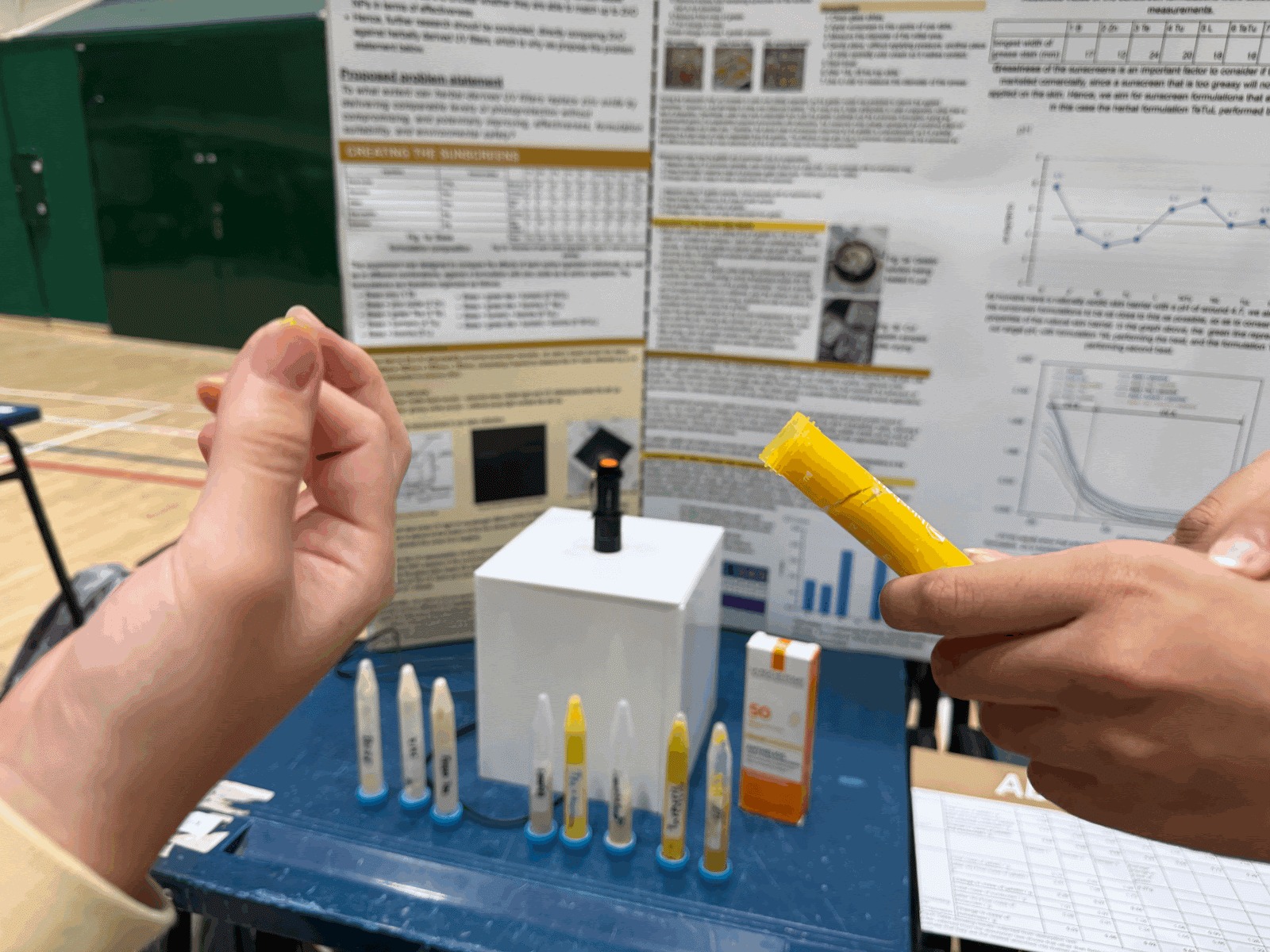
Project CH056: Formulation and evaluation of Herbal Sunscreens
Speaking with Aanya Baidya (26S03C), we learnt that the project aims to reduce marine pollution by promoting the use of herbal sunscreens.
“A lot of existing sunscreens use minerals like Zinc Oxide”, she added, “to reduce marine pollution, we aim to use herbal sunscreens–I’ve heard of sunscreens like that in the market, but they don’t really incorporate different ingredients.”
Besides coming up with a report, the group also developed a few samples of herbal sunscreens with different ingredients. The samples came in different colours and fragrances, and were freshly made in RI’s own biology labs.
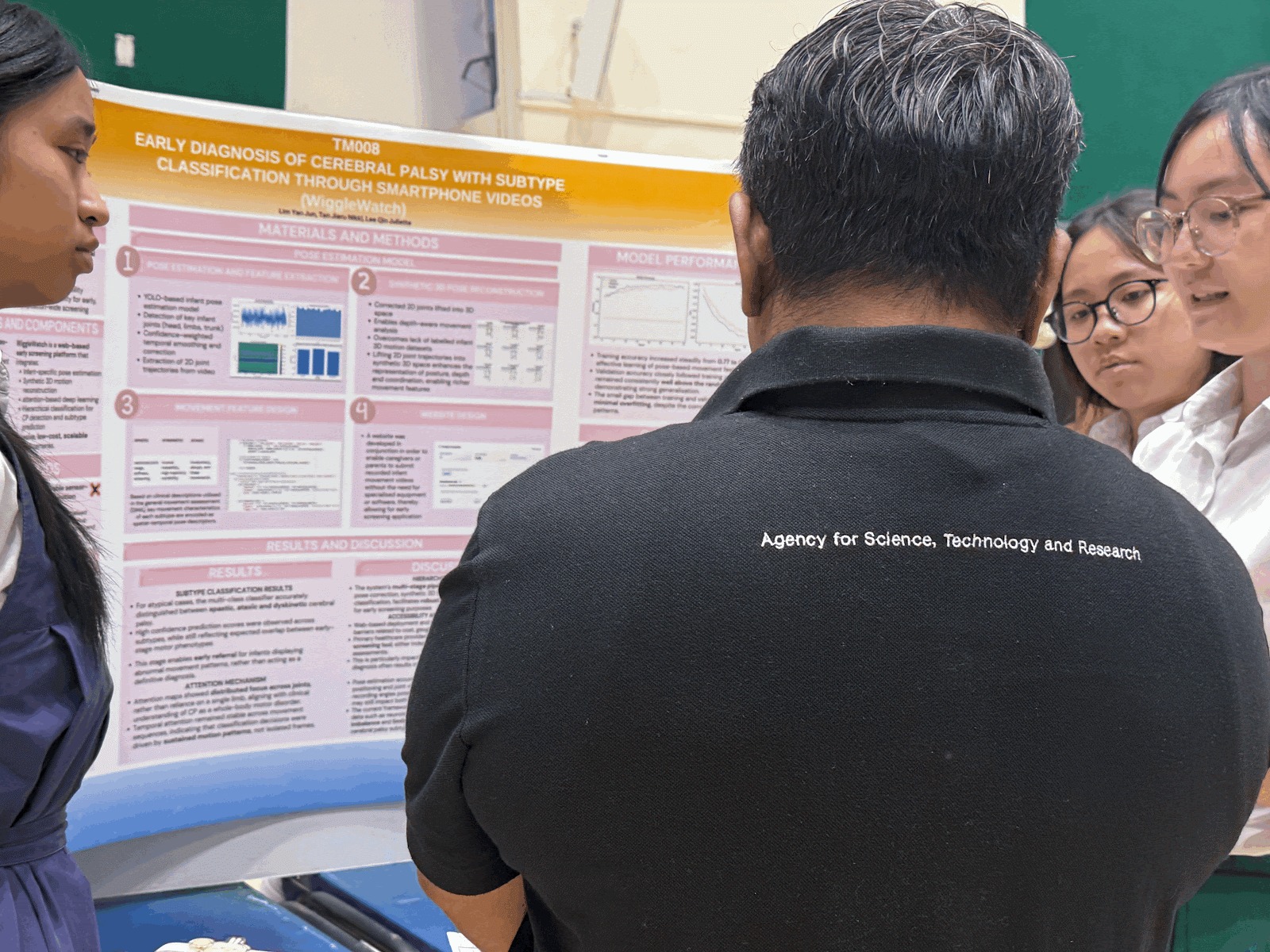
TM008: Early diagnosis of Cerebral Palsy with subtype classification through smartphone videos
The project aims to democratize access to early detection of cerebral palsy in infants with their early screening system. Presented as “Wigglewatch”, the system is able to detect atypical motor development, classify cerebral palsy into its major subtypes and provide posed-based movement analysis.
The group believes that this system could bring about equitable access in critical periods of developmental care for infants, addressing the limitations of existing technology in the field.
The importance of STEM in today’s world
RSS is part of a larger nation-wide effort to promote STEM amongst students in hopes of accelerating technological growth in Singapore. This is in line with the nation’s goal of becoming a global innovation and R&D hub.
Research can seem daunting to many, especially when the sciences may not be their strongest subjects. However, the range of projects show that you do not necessarily need to be the best in your craft to embark on one of your own. All you require is the drive to see through the research process, as well as a strong belief in the topic you chose.
“(You) must be ready for this kind of uncertainty, or be ready to fail and try again. Let’s say (you) don’t get the results…maybe think about how to evolve the research it to something else or troubleshoot. (You) have to have great determination and perseverance.”
Assistant Department Head for Enrichment, Ms Cheryl Lin
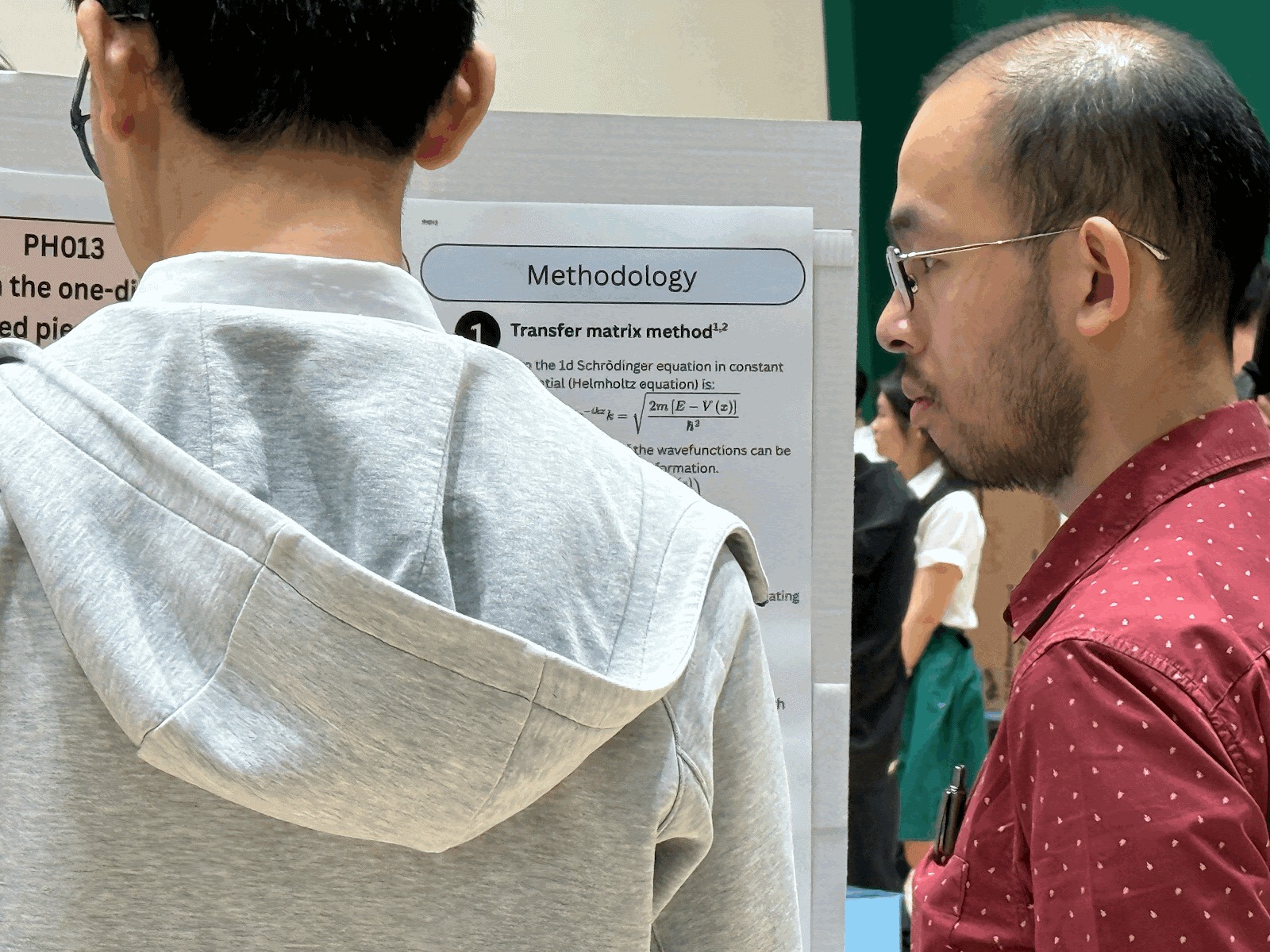
It would be a lie to say that being amongst such bright minds was not a daunting experience. But even Mr Harapan Ong (Y56 Assistant Department Head for Physics) admits that he may not be an expert in the projects he judges. “When I judge, I’m not coming in from the perspective of ‘I really know everything and I’m judging you,’” he says, “I may not understand it at first, but if they are good at what they do and they present it well to me, I will start to catch on.”
Perhaps this captures the crux of what science is all about—it is, after all, an endless pursuit to learn. It’s not about complicating things for the sake of complicating them, but instead making sense of the unknown and being able to make such knowledge accessible for all.
Ultimately, the research opportunities provided should be utilised as a chance for exploration into topics out of the academic syllabi and to further an interest in STEM.
SSEF will be held from 9 March to 11 March 2026 this year at the Singapore Expo. For interested individuals, you may cheer on your fellow schoolmates on Public Day on 11 March, and take the chance to widen your perspective on the world of STEM.
On behalf of Raffles Press, we wish all SSEF hopefuls all the best!
