

By Sophie Chong (25A01A), Yvonne Cheung (25S03S) and Yu Ning (25S07A)
The atmosphere crackled with a mix of intellectual fervour and eager anticipation. Over 300 students in crisp suits and blazers trailed into the Performing Arts Centre, representing a myriad of learning institutions, ready to put their diplomatic chops to the test in Raffles Model United Nations (RMUN) 2024. The opening ceremony of the event, meticulously planned by Raffles History and Strategic Affairs Society (HSTA), had finally begun.
The theme of the 32nd RMUN, “Vincere Adversa”, means “to triumph over adversity”. As Isabel (24A01A), the Secretary General of RMUN explained, “There is a lot of instability in the current context and current world order, thus, we wanted to make sure delegates knew how to respond to such issues.”
As a result, this year’s conference introduced a wide array of new councils, including the International Monetary Fund (IMF) and the Historical US Senate (HUSS), which discussed historical issues in the US. Held from 28th to 30th May, she hoped that RMUN will be a highlight of the delegates’ June holidays.
Opening Ceremony
The keynote address was delivered by Guest of Honour Edward Yee, founder of Givfunds and a recipient of prestigious awards such as the Rhodes scholarship. Edward, who 14 years ago sat in the same position that the delegates now do as a former RMUN participant, shared three impactful stories that have shaped his journey since.
The first story was about privilege. Edward recounted an incident in which he travelled to Dhaka, Bangladesh. While on a train, he and a group of friends were invited to sit on top of a moving train by local Bangladeshis. They were later detained by the police — yet instead of punishing the foreign perpetrators, the police beat up the local Bangladeshi that had helped them up the train. This incident made Edward realise the extent of his privilege as a Singaporean.
“I am privileged not by any merit or action that I have taken but because I was born in a tiny red dot, like many of you.”
Edward Yee
Deciding that he should use his privilege to do good, Edward founded Givfunds half a year later.
The second story focused on age. Edward shared the inspiring journey of Akash, a social entrepreneur who, at age nineteen, started a project to convert holy ash dumped into rivers into porcelain-like sculptures, providing work and purpose to local prisoners. This initiative significantly reduced recidivism rates among prisoners, proving that age is not a barrier to making meaningful change.
The third and final story highlighted triumphing over adversity. Edward spoke about Rezza, an Iranian refugee in Turkey, who despite living in a state of limbo for nine years, remained hospitable and guided new refugees around Istanbul. Rezza’s story exemplified the profound impact of policy on real lives, reinforcing the importance of the discussions and decisions made within UN rooms.
His sharings emphasised the overall takeaways he hoped the delegates would gain from RMUN: doing good for the world in whatever capacity they could. With these insights in mind, the councils were called into their first sessions.
Council Discussions
The opening ceremony concluded with a bang of the gavel, and inspiration and anticipation hung in the air as our delegates eagerly dove into the long-awaited council sessions.
Delegates were divided into nine distinct and intellectually demanding councils, ready to engage in rigorous debates and negotiations on an endless array of pressing global issues. Whether delegates were beginners, eager to explore international diplomacy, or seasoned participants, well-versed in global relations, a variety of councils allowed delegates of all proficiency levels to be fruitfully engaged.
Kicking off with our beginner councils, the ‘United Nations Environment Assembly’ (UNEA), the ‘United Nations High Commissioner for Refugees’ (UNHCR), and ‘United Nations Women’, each served as an ideal starting point for delegates just taking a dip into the world of MUN. Delegates of the UNEA navigated through the tricky world of Biofuels as well as plastic pollution, addressing the various conflicts and tensions arising in its development, proposing realistic, feasible and agreeable solutions across the council.
Meanwhile, the delegates of the UNHCR dived headfirst into re-establishing its role in global peacebuilding efforts as the increasingly turbulent political state of the world gives rise to conflict, unrest and the displacement of entire communities. Lastly, in the council of UN women, delegates worked to champion for Womens’ rights and reproductive health, as well as to understand and protect the approximately 600 million women in conflict-ridden areas. Despite these councils being many of the delegates’ first foray into MUN, they embraced the environment with ease, soon engaging in rich discussion and debate.
Stepping into the intermediate councils, these committees challenged delegates to delve deeper into increasingly complex global issues, requiring a higher level of diplomatic skill and nuanced discussions to craft refined resolutions with relevant and effective solutions. These councils included the ‘Council of the European Union’, ‘Group of Twenty’ (G20) and the newly included ‘Historical US senate’.
The delegates of the Council of the European Union had fruitful discussions over pressing issues including the looming threat of the European debt crisis on the unstable economy as well as the accession of war-torn Ukraine into the European Union. Concurrently, delegates of the G20 explored the growing tensions between US-China relations and the raging gap between the global north and south.

Delegates debating very serious topics.
Lastly, the Historical US senate took delegates back in time to 1872, where delegates explored the corruption-riddled administration and strove for civil service reforms that would have reshaped the 1872 elections. This unique council also addresses the 14th and 15th amendments of the US Constitution, traversing the complex grounds of slavery and African-Americans’ constitutional rights. Even amidst the convoluted discussions about policy and rights, delegates displayed a remarkable ability to crack jokes and tease fellow delegates.
Finally, the advance councils allowed delegates to traverse beyond their comfort zone, exploring structures beyond the conventional UN experience. Starting with the International Court of Justice (ICJ), delegates were split into the roles of judges and advocates – the former would make verdicts based on the appeals of the latter. Pushing the delegates further out of their comfort zone, the council required discussions of two very different conflicts: unpacking allegations of Syria’s use of torture and the legality of using nuclear weapons.
Similarly, the International Monetary Fund (IMF) forced delegates to engage with complex economic concepts as they discussed cryptocurrency and potential economic downturns. For delegates who had never taken economics as a subject, this would pose a significant learning curve, requiring the Head Chair of the council, Bryan Wong (24S03R), to conduct an impromptu economics lecture on the first day. Finally, the Joint Cabinet Council (JCC) plunged delegates into the 1984 Punjab Crisis in India, representing the views of various differing stakeholders in the country. Beyond that, delegates were forced to deal with new evolutions as delivered by their chairs. In spite of the complexities, each council was filled with enthusiastic delegates – placards would be raised even before chairs finished their sentences.
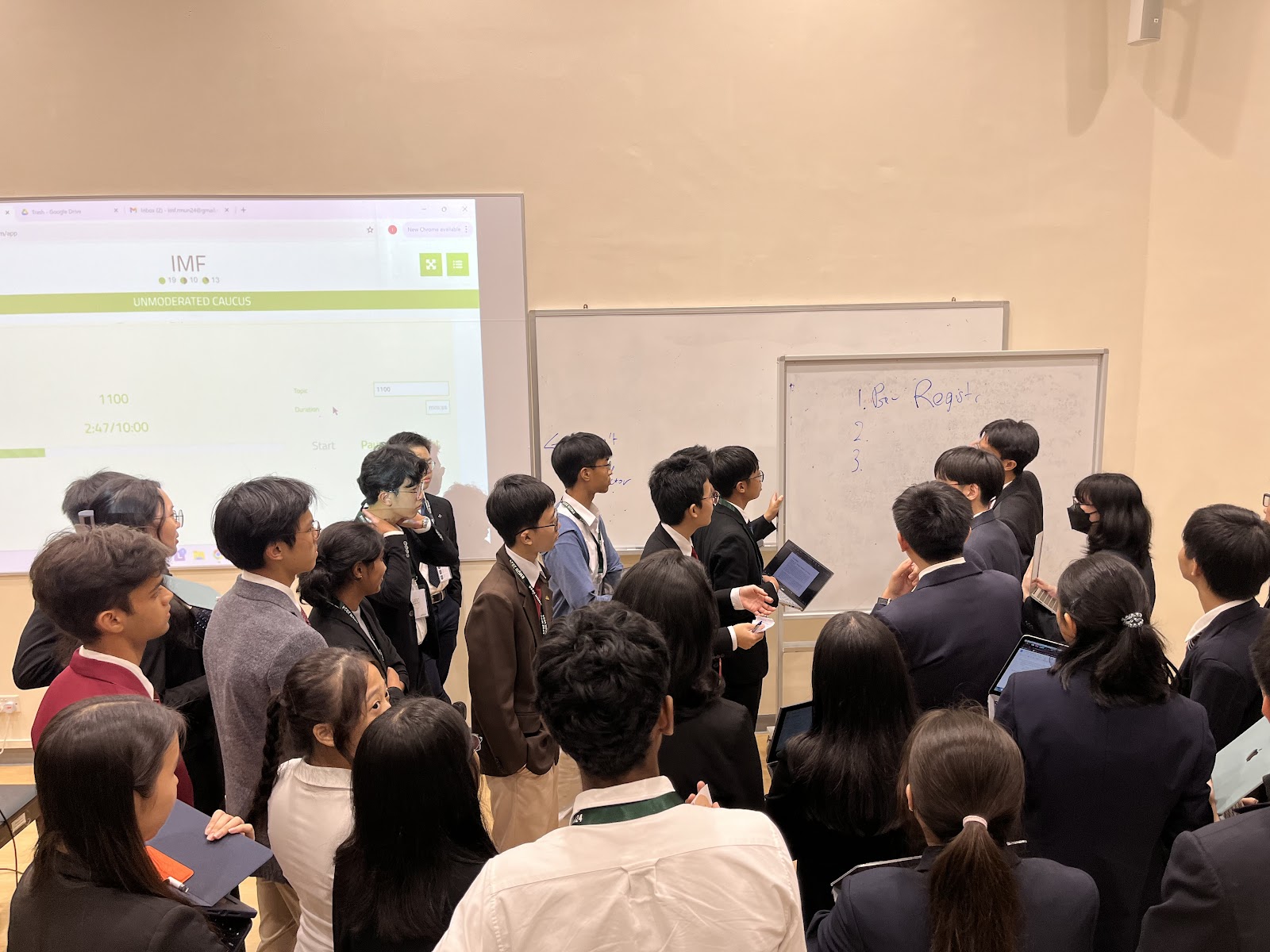
Delegates of the IMF engaged in fruitful discussion!
The Role of Chairs
Yet discussion of each council is not complete without mention of the chairs, made up of HSTA members. Working to guide and facilitate council sessions, each chair is well versed with the Standard Rules of Procedure (SROP) of MUN, from appointing a speaker onto the General Speakers’ List, also known as the GSL, to chastising delegates for referring to themselves in the first person (“I”), instead of third (“this delegate”).
Notably, not all councils share the same SROP. With the introduction of a new assortment of councils, many utilise SROPs suited to the mechanisations of the specific organisation it represents. The IMF council, for instance, shifted away from the more restrictive UN protocol in favour of relaxed policies in line with the IMF — delegates were allowed (and supposed) to refer to themselves in the first person and chairs were known as directors instead.
However, their job scopes extend far beyond the council sessions. As Liew Shan Yik (25A01A), chair of the United Nations Environmental Agency (UNEA), shared, “We spent a few months drafting study guides, which are academic documents to guide delegates through research, and have been marking delegates’ position papers over the past week as well.” These processes are fundamental to the functioning of subsequent council sessions by ensuring delegates are aware of the discussion content and their respective stances.
As the 32nd RMUN draws to a close, we are reminded of just how far the conference has come: from a one-day event in 1991 to a three-day experience accommodating over 300 delegates from across the country.


