

By Georgia Ong (26S03O), Kunchur Bharat (26A01B), Looi Ee Xin (26S03M), Tomi Peh (26S06P)
In the last term, RI has received many new guests to its school wildlife ecosystem. Small as they may be, they’ve made their presence otter-ly known; in fact, they’ve managed to create quite the spectacle whenever they show up at the ponds.
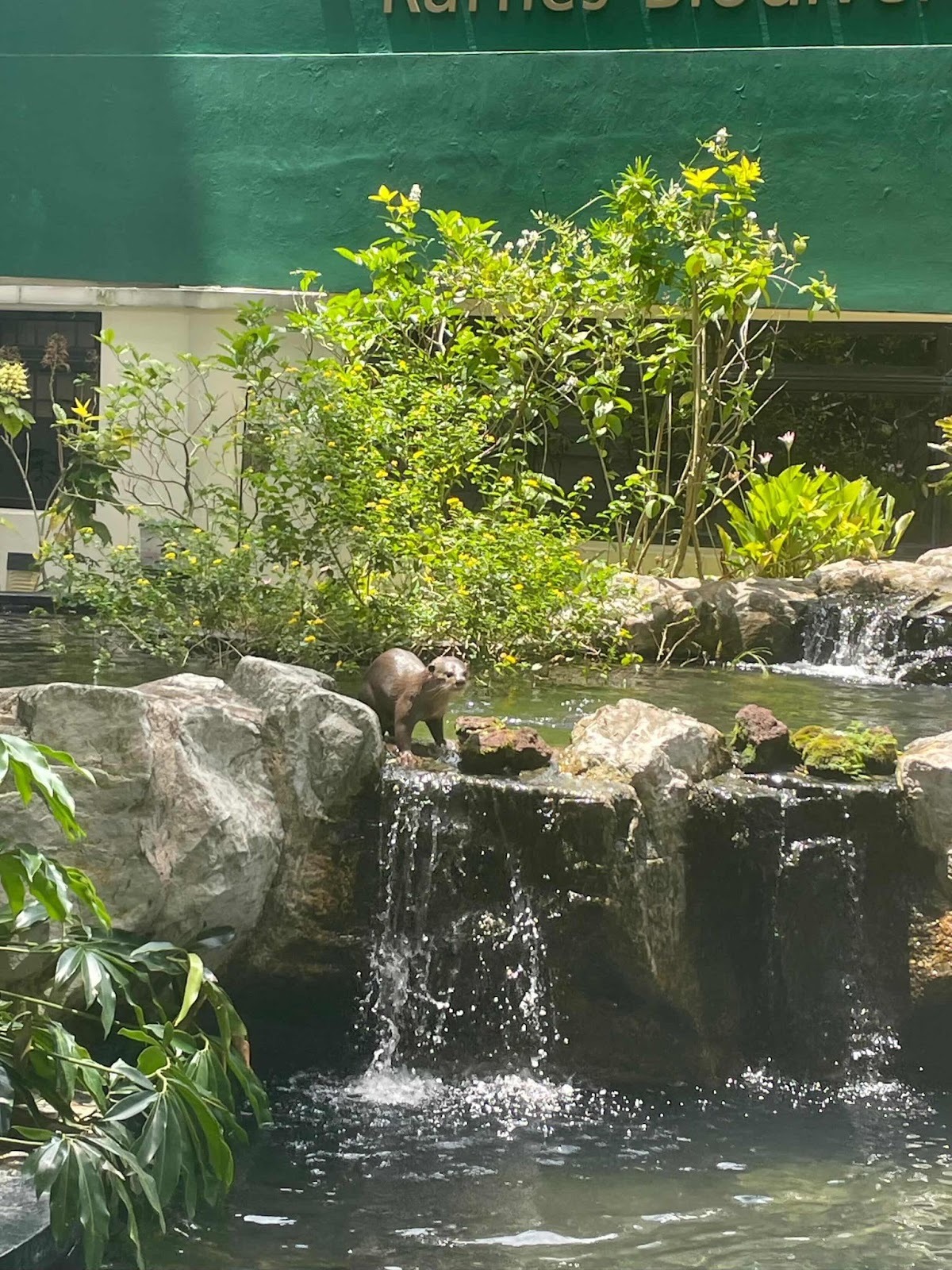
Not an uncommon sighting in Singapore, the otters have finally made their way onto the shores of Marymount and shaken up the lives of many—a joy for students to see, yet the worst nightmare for the fishes at our Biodiversity pond.
As such, four students — Filomena Litani (26S03L), Ian Poh (26A01A), Sarah Ashley Tan (26S03L) and Hannah Tang (26S03M) — put their heads together to develop Project Poisson, a school-based CE01 aimed at keeping Raffles Institution’s beloved fish population thriving in a conducive habitat.
The Project
In light of the recent diminishing numbers of fish in our school pond, their priority lies in finding companionship for the mere handful of fish left. At the same time, they also believe in sustaining the future of the Raffles’ ecosystem, protecting both fish and otters alike. This would manifest in the form of otter spotters, as well as food donation drives — benefitting the fishes’ safety while ensuring the best quality of food for the otters.
Poisson, the French term for fish, effectively merges the team’s love for fish with their deeply-rooted beliefs in French philosophies. “Art de vivre”, or “the art of living”, was what Ian Poh (26A01A), the KI-taking Vice President of the team, had in mind when he coined the project’s name.
“I hope to inspire future generations of RI students to treasure life, however small and short it may be.”
Ian Poh (26A01A), Vice President of Project Poisson
With such lofty aspirations for the project, the team wasted no time fishing for ideas. With four brains put together, the sea of potential was teeming with life. After some otter-ly devastating ideas, the freshest of plans were selected for development.
The Initiatives
- Gradual Upsizing of Piscatorial Populations for Youths (GUPPY)
The Gradual Upsizing of Piscatorial Populations for Youths (GUPPY) aims to revive the population of fish. Modelled after the 3Rs for waste management, the programme simplifies the process into a 2-step plan: Replenish and reproduce.

Firstly, replenish. This directly involves the student body in contributing their desired fish to the school pond. Fish replenishment will be done on a quarterly basis; interested applicants must fill in a form detailing information about their fish, such as size, colour and breeding seasons. The fish must be living, and they must be able to adapt to the environment of the school.
All successful applicants will be invited to attend their fish’s school inauguration ceremony. They will also earn 50 fishy points for their noble contribution to the fish’s population.
Secondly, reproduction.
In collaboration with the school’s Biology Department, the project will select 2 fish to breed bimonthly. Following a strict 5 step process, these steps were designed to ensure the optimal growth of the young, and to allow for the continuation of the existing bloodline of fishes.

This idea was inspired by Sarah Ashley Tan (26S03L)’s love for her favourite fish, Chicken. Chicken will be participating in the inaugural 1st generation breeding trials.
“I wish to see the bloodline of Chicken continue. Knowing that Chicken has little time left, I hope that his surviving offspring can continue the comfort and spirit that Chicken brought into my life”, Sarah, Publicity Head of Project Poisson recalled. It’s clear the bond between her and Chicken runs deep.
Mr Poh Wei Leong, the Assistant Department Head of Biology and Teacher IC for Project Poisson, phrased it more aptly.
“It’s a precious learning opportunity for students to learn about fish anatomy and physiology.”
Mr Poh
- Reduce Exotic Dining of Fish (RED-FISH)
The “Reduce Exotic Dining of Fish (RED-FISH)” initiative is intended to improve the otters’ eating habits. Presently, signs have been put up around the school pond to inform students that they otter avoid the creatures when sighted, but this has evidently failed to protect the school of fish in the murky waters.

To address this safety gap, the role of “Otter Spotters” has been proposed. Students may volunteer for this role, and will be rostered to keep an eye out for the otters and alert relevant school staff. Bestowed with the great responsibility of protecting the fish, these otter spotters will serve as the school’s safety ambassador to ensure the otters are kept away from the school grounds.
All interested students may fill in this form, and applications will be conducted on a rolling basis. All successful applicants are required to attend a compulsory orientation and familiarisation session, where they will undergo a stringent training programme to better understand the needs of the fish and equip themselves with the necessary skills to spot and guide otters.
Additionally, a termly food donation drive will be conducted, where students may donate crustaceans and molluscs to our school pond. While all donations are welcome, high-quality donations of lobster, crab, abalone and scallops are favoured.
Holding this donation drive was a no-brainer, Filomena Litani (26S03L), the President of Project Poisson, explains. The return of the otters is inevitable, and the team wants to be prepared for their arrival. Working with otter spotters, they hope to be able to direct them to the crustacean and mollusk tank before they sink their claws into our beloved school of fish. In line with the project’s belief in French philosophies, haute dining is what they are keen to offer in exchange for the safety of our fish.
- Poisson d’Avril (APRIL FISH)
Finally, Poisson d’Avril will be the official launch event of Project Poisson, kickstarting subsequent monthly fish festivals for the school. Each festival will see a “Fish of the Month” crowned, and April will see the beloved native French fish, the April Fish, taking the spotlight.

During this event, you can choose to adopt a fish of your choosing from our school pond, just like Hannah Tang (26S03M) did. When asked about her motivations behind adopting Gary, an Amphiprion ocellaris:
“Gary deserves a higher quality of living, and through adoption, I can make Gary’s dream a reality.”
Hannah Tang (26S03M), Admin Officer
Adopting a fish is no small task, as it requires a yearly donation of $15 dedicated to the freshest care of your fish. However, all donations are well-meaninged, and will go a long way in caring for your fish.

Additionally, by adopting a fish, you gain special access to a wealth of benefits. To name a few: an adoption e-certificate, a fish factsheet on your adopted fish and an invitation to exclusive Raffles Pond Events and Previews. And to top it all off, an acknowledgement on the Adopters Wall at our school pond!
Students interested in attending Project Poisson’s inaugural event or adopting a fish may fill in the form here: https://tinyurl.com/projpoisson. (PS: Raffles Press is proud to be the exclusive partner of Project Poisson, and you may get discounts for your fish adoption via this link!)
The debut of Project Poisson is about to cause a splash, and the team is otter-ly excited to welcome all interested students to apply and contribute to the various initiatives.
Want to devour the latest information on this fish out of the water new project, or to hear directly from the team involved? Check out our freshly-caught coverage report on Project Poisson below!


