

By Irene Eva Thomas (26A01B) and Tok Kai Xue (26A01B)
Tucked in the corners of the RI campus lies a small yet fervent group of students, who actively and willfully pursue the delights of chemistry. Raffles’ Alchemy Club spends hours each week during CCA sessions experimenting with kitchen chemistry – such as boba pearls and chocolate spaghetti, or attempting to synthesise pharmaceutical compounds.
Yet chemistry’s beauty and wonder may be far from apparent to those who do not seek it out in their own time. Slogging through hours upon hours of chemistry lectures and reading a bazillion pages of notes might not be the most appealing venture for many students. Achiral molecules, bond polarities, enthalpy changes – all an avalanche of information that seems to wrangle the throats of A-Level chemistry takers! (At least, that’s what we think – both the writers of this article, unfortunately, do not take chemistry. We can only imagine.)
However, taking a step away from the rigour of academic learning reveals a beauty in Chemistry that might not be apparent to most. Alchemy Club’s Chemistry Week offered a rare pause, inviting students of all backgrounds to reconnect with the subject in its most simple form, as well as forms a bit more advanced than the H2 curriculum.
The Booths
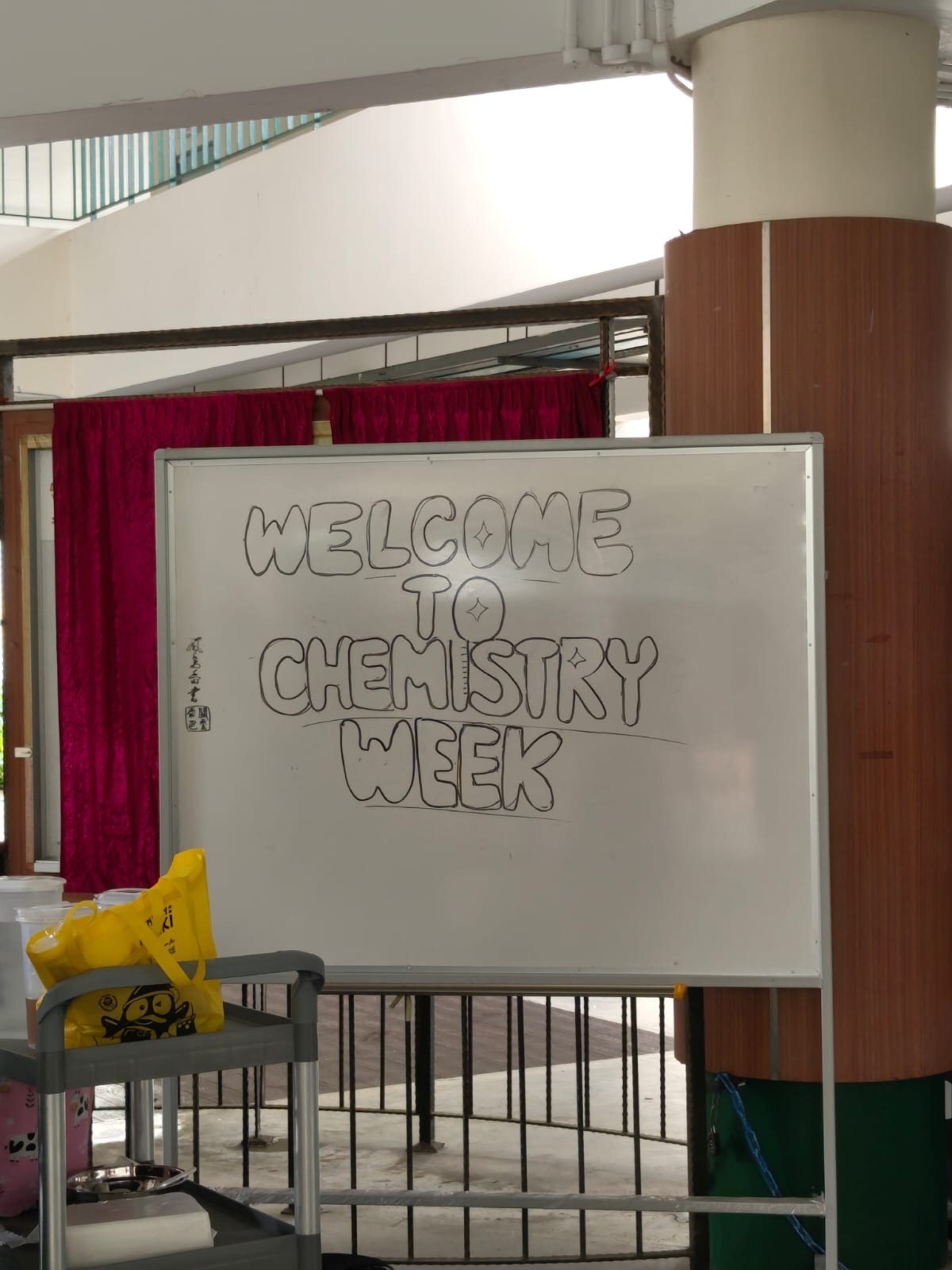
Walking into Chemistry Week as Arts students, we expected bewilderment at every turn, yet found ourselves quickly corrected. For two days, on the 9th and 10th of October, the students of Alchemy Club set up booths along the canteen walkway, each one conscientiously planned. The booths were split into three categories – game-focused booths (such as the slime and bracelet-making booths), experimental booths (traffic light and iodine carmine booths) and finally high-level technical chemistry booths (like the quantum chemistry theory booth).
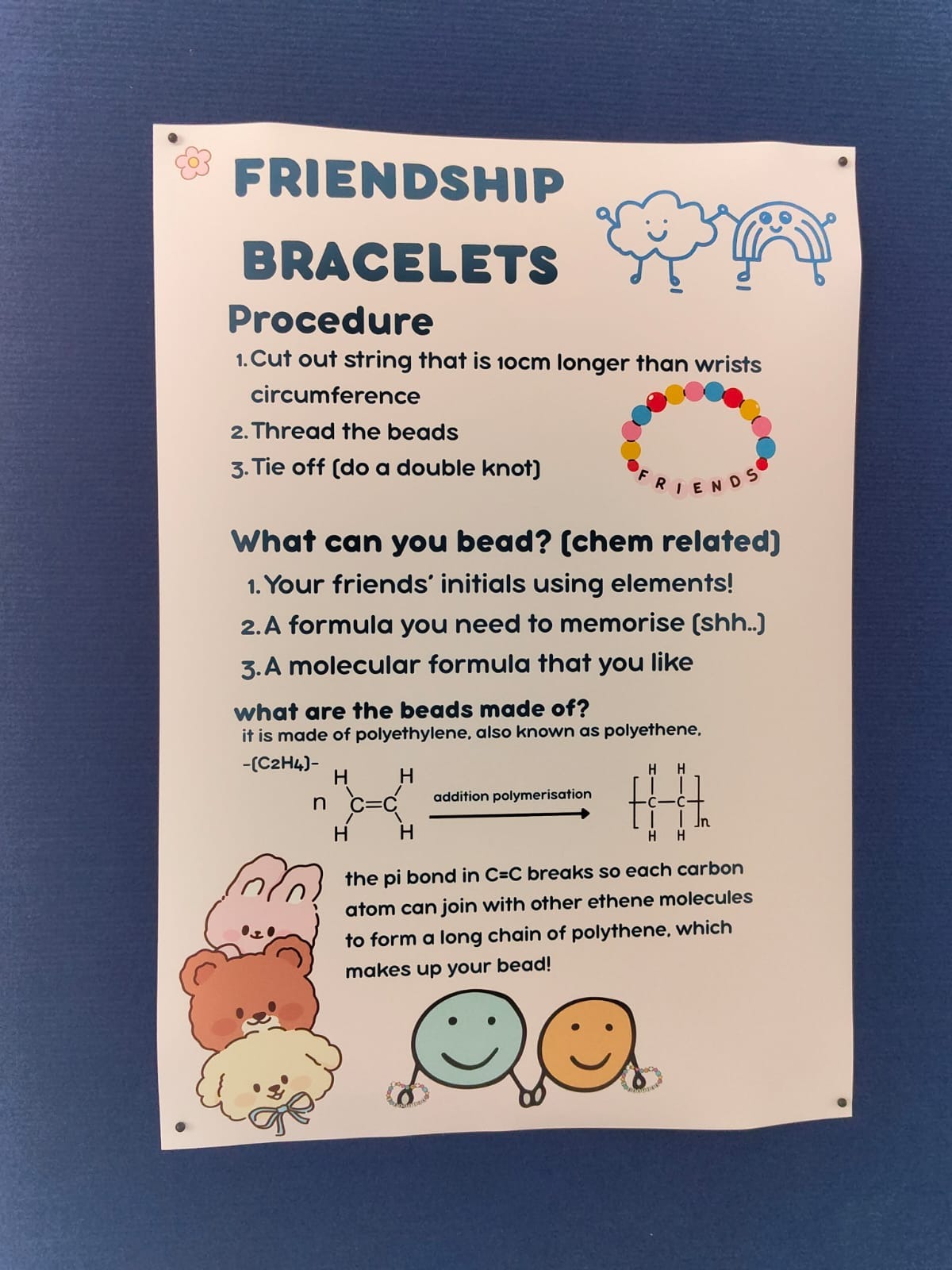
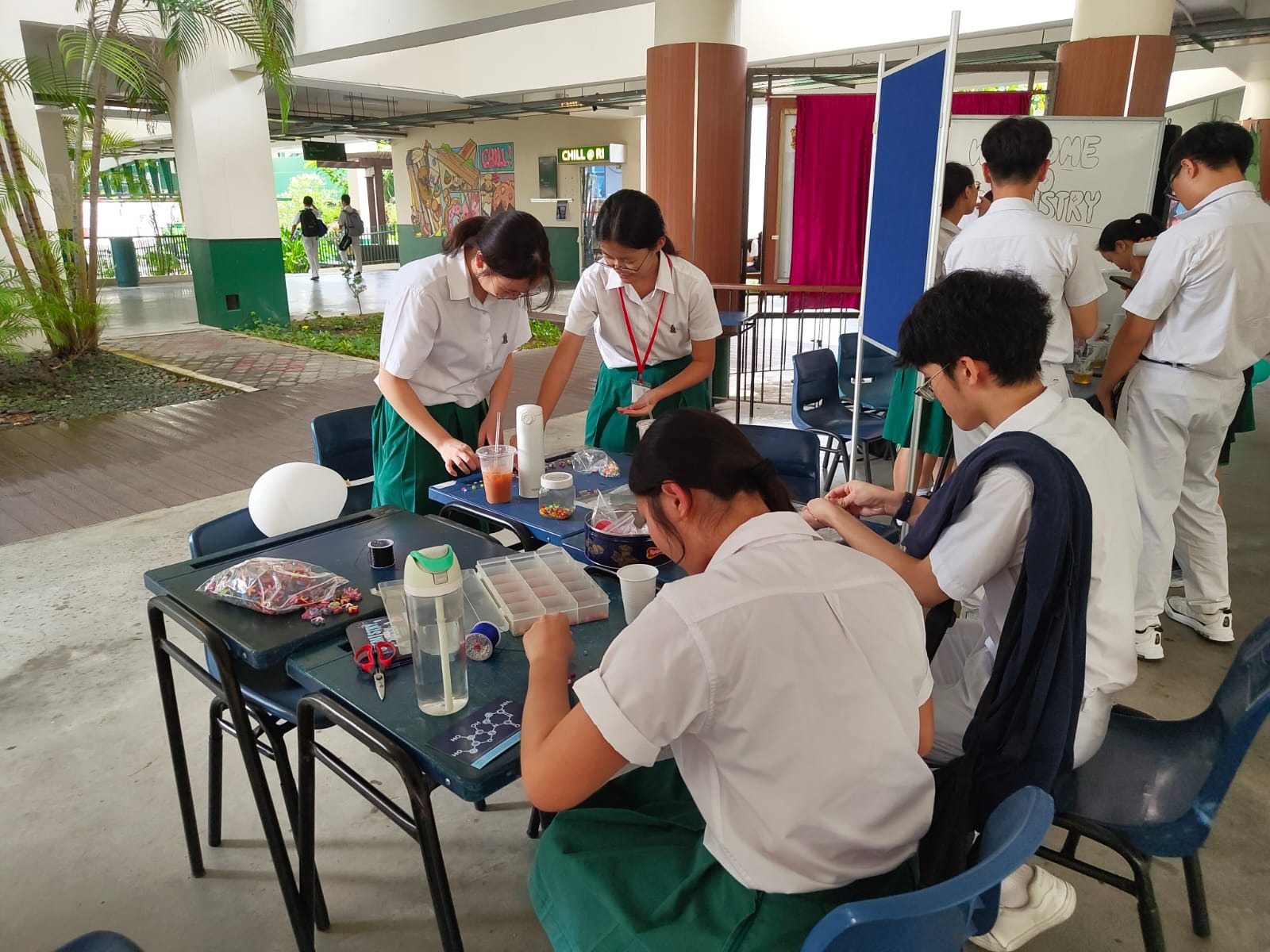
Throughout the two days, countless students stopped by – what began as curiosity soon turned into eager participation: laughter over slime that refused to form, wide-eyed fascination as the solution at the traffic light experiment continued alternating between red, yellow, and green and genuine wonder at the theory lessons offered by some of the Chemistry RA students and passionate volunteers. For a brief moment, the canteen walkway became a space where chemistry transcended the boundaries of lecture notes – alive, tangible, and, above all, shared.
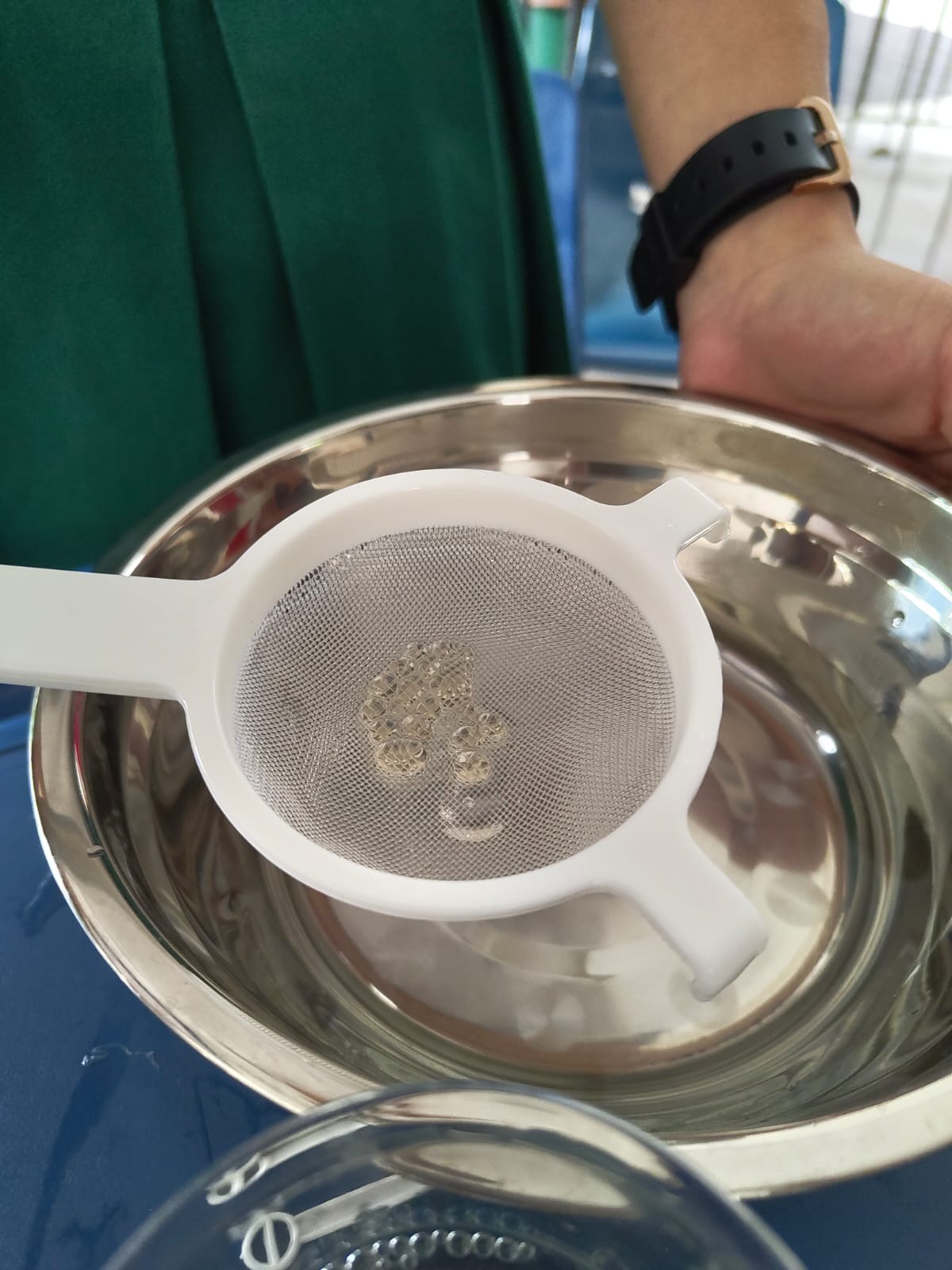
Of all the dazzling displays and activities, our personal favourites were the spherification and slime-making booths. At the spherification station, the Alchemy Club members revealed the science behind how everyone’s highly coveted popping boba,frequently enjoyed in many desserts such as smoothies and yoghurt, is made. By mixing droplets of apple juice with a little bit of sodium alginate, these liquids magically transformed into tiny spheres – ones that remained edible, no less!
At the slime-making booth, participants were given a mixture of glue, contact solution and baking soda to form the sensory delight that is slime. For those who wanted to spice it up even more, they could add food colouring into the mix for its own visual flare. Though messy and a tad strenuous (Irene’s slime took 10 years of vigorous mixing to feel just right), it was nonetheless an oddly satisfying experience.

However, all these fun-filled booths weren’t without their fair share of difficulties. Being the first Chemistry Week since 2015, the Alchemy Club members had very little to go off of during their initial stages of planning. As Alvin Chang (26S03K), the Vice-Chairperson of Alchemy Club put it, “We got lucky. This was nothing short of a miracle.”
On the day that they were supposed to set up their booths, a gust of wind blew most of their set-ups down, a “catastrophe”, as they deemed it. The list of obstacles only grows longer: as Chemistry Week was so close to A-Level practicals, the Alchemists had little access to their labs, and their timetables for post-promos activities weren’t confirmed, leading to scheduling conflicts closer to the day itself. Moreover, the experiments they chose, spherification and the iodine-carmine reaction, were notoriously difficult to execute. In particular, forming perfect spheres in the spherification experiment was considered extremely tricky. And yet, they managed to pull it off – with barely any hiccups during its execution.
The Exco, banding together with the other 8 Alchemists, worked tirelessly to bring their vision for Chemistry Week to life. Nathan, Alvin and Joon Yi, all stressed the importance of the faith they had in their CCA mates, who stepped up and took it upon themselves to ensure Chemistry Week was a success.
As Nathan Lee (26S03F), Chairperson of Alchemy Club, remarked, “Learning from TRG and implementing our takeaways into the planning of this Chemistry Week is symbolic of what we do at Alchemy Club. Chemistry has always been about continual learning, revision and perfection.”
Furthermore, due to the limited manpower from Alchemy Club – with only 13 members – they had to call for backup. Chem RA students, students with a burning passion for Chemistry, and even friends of the CCA members all showed up to helm the booths alongside the Alchemists. Surprised, they were, when they realised the Google Form they had sent out looking for volunteers came back with an overwhelming response. Without them, the Exco tells us, none of it would have been possible.
The Raffles Chemistry Challenge (RCC)
Beyond the booths, Chemistry Week also involved an exciting competition between the different houses – the Raffles Chemistry Challenge. Designed to be a fiery test of wit and skill, participants took turns to answer a variety of questions, ranging from standard H2 content to knowledge from the H3 Chemistry syllabus and olympiads.
The RCC began with the rapid-fire round, which consisted mostly of trivia questions that demanded less calculation and more quick-thinking and speed. Each house was given a buzzer which contestants raced to press as soon as the question appeared on the screen. The lecture theatre buzzed with anticipation as participants sat on the edge of their seats, ready to hit their buzzers as soon as they recognised the answer.

After the rapid-fire round, contestants were greeted with a Jeopardy Board, filled with a variety of chemistry-themed questions of varying difficulty, allocated points from 100 to 500. Each tile was labelled with a quirky phrase or line, such as “ALVIN PLEASE STOP” and “V for Victory”, which offered a peculiar hint to participants as to what the question might be testing.

Intimidated by the sheer difficulty of the questions, many of the contestants picked tiles from the 300 to 400 point range, barely touching any of the questions worth 500 points. Even so, their answers were still swept up by a gauntlet of mind-boggling diagrams and graphs that left us (and probably many of the contestants) utterly bamboozled. Yet, as the contestants furiously scribbled on the whiteboard and buzzed with their teammates, what truly shone through was everyone’s unbridled passion for chemistry.
“We hoped that they would see Chemistry from a different perspective – it is not just a discipline by itself, but it can be seen in so many other places in life.”
Lee Zhe Yu, Nathan (26S03F), Chairperson of Alchemy Club
Indeed, many of the questions in the RCC, though largely drawn from H2 content, aimed to illuminate various aspects and elements of chemistry through a unique lens. Chemistry is, after all, the language of our world. Sort of wondrous, sort of bizarre, it explains every little phenomenon we witness – whether it be the twinkling glow of fireflies or stars hundreds of light-years away from us. Most interestingly, someone even drew an Economics graph on the board – quite a surprising crossover that most of us would never have considered!
In order to make the challenge less daunting and more humorous, the Exco members injected a bit of their own characters and plotlines into the questions, turning them into mini-dramas that were quite entertaining while making the atmosphere much more light-hearted.

After 2 hours of brain-wracking challenges and intense discussion between contestants, the Raffles Chemistry Challenge drew to a close, with Morrison-Richardson emerging as champions.
And with that, 2025 Raffles Chemistry Week came to an end.
Conclusion: The Chemistry of the Raffles Spirit
It would be an understatement to describe the Alchemy Club’s Chemistry Week as a success. Despite being bogged down by numerous challenges – the lack of manpower, tight schedules, and limited dry runs – the fact that everyone managed to pull through is a remarkable feat in itself.
More importantly, Chemistry Week managed to ignite curiosity and passion for the subject beyond the classrooms – there really is so much beauty in how it shapes the world around us. Even as Arts students, we couldn’t help but reminisce about the times when we used to study Chemistry and appreciate how truly omnipresent it is in our everyday lives.
“I think it’s been a great learning experience as we worked through all the challenges we faced and grew together as a CCA.”
Teo Joon Yi (26S07B), Alchemy Club EXCO Member
Of course, none of this would have been possible if it weren’t for the commendable display of teamwork and camaraderie between not only the CCA members, but all the Rafflesians who were willing to take some time out of their day to help man the booths. As Alchemy Club’s Teacher-in-Charge, Mdm Lam, remarked, “Thank you for putting in the hard work […] I hope you guys had fun in the process as well.”
Perhaps, then, Chemistry Week was never about enthalpy changes and chemical processes, but more so a testament to the chemistry between everyone involved. (Haha…)

Cheers to everyone who took part in this year’s Chemistry Week, and here’s to hoping for more exciting chemistry events years to come!


