CCA Previews 2016

A day in the life of: A Gymnast

Reading Time: 4 minutes

This article is part of the CCA Previews for 2016.

By Callie Yap (16S06A), Rachael Lim (16S06H) and Nicole Neo (16A01C)

feature

It is 6pm, and the sun is setting. Students are leaving the school grounds, probably making their way to a good meal to end the long school day. Meanwhile, some students remain in the gymnasium. Having changed into training attire, they are warming up with some stretching. For them, this is when the day begins. This is a day in the life of a gymnast.

Gymnastic routines may look effortless at competitions, but a lot of hard work lies beneath the showy appearance. Gymnasts are only given a few minutes on the mat/trampoline, but hours, days and for some, even years have been spent on training for that short amount of time.
1

Trainings are 3 hours long, and begin with warm-ups, then physical training (PT). PT ranges from jumps and core workouts to rope skipping, and maybe even self-designed circuit training. It may be tough, but it is an essential part of helping gymnasts complete their demanding routines.

2

We then proceed to cool down with some even cooler stretching, which is done according to our individual flexibility for optimum results. The back bends and oversplits may seem daunting at first, but with personal determination and lots of motivation from batch mates, you’ll eventually achieve those feats with more ease and gain a sense of accomplishment!

3

For rhythmic gymnasts, the rest of training is spent on fundamental skills such as leg kicks, leaps, balances and pirouettes. Mastering the basics takes endless drilling and hard work, but will go a long way in helping us execute our moves with accuracy, grace and poise on the gymnastics floor!

4

This exciting buildup leads to the last (and most fulfilling and enjoyable) part of training – apparatus time! As we execute various moves with the apparatus, colourful ribbons, shimmery hoops, glitzy balls and handy clubs start to decorate the gymnastics mat. This is also the time when we get to unleash our inner creative genius as we choreograph and practise our competition routines, as well as learn new skills (that can be shared with friends and showcased on Instagram). :-)

5

As trampoline gymnasts, we spend the majority of training doing what most students are not allowed to – jumping on the trampoline! If you’re looking for a CCA that gives you an adrenaline rush every training, look no further. This is definitely a sport that challenges you both physically and mentally, but with the help of our experienced, caring, and (mostly) humorous coach, and the support and encouragement from your batchmates, your fear will instantly become excitement.

6

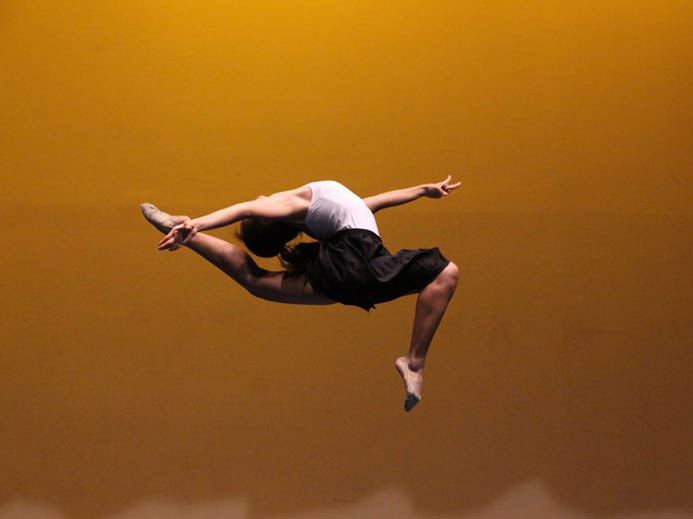
Trampolining is the closest we can possibly get to the feeling of flying; being able to flip and twist mid-air is always something we look forward to.

We begin with warm-up jumping to perfect our form and increase our jumping height, and if we’re in luck, sometimes while wearing weights!

7

The rest of training is spent working on our competition routine (the full 10 points routine for experienced gymnasts, or the 8.5 points option for beginners) from learning the basics, to mastering the individual skills, then slowly linking them together, to finally being able to perform the full routine on the trampoline.

(Fun fact!: Many of our current members had no prior experience in gymnastics at all before joining Raffles Gym, and they haven’t looked back ever since.)

If you are new to this sport and concerned about not being able to handle it, that is something you don’t have to worry about! Training might seem tough in the beginning, but with the willingness and courage to try new things, a lot of practice and the help of our amazing coaches, once you’ve mastered the basics you’ll be ready to flip and twirl with us in no time.

8

At the end of the day, we can’t promise that you will find Olympic-standard gymnasts, neither can we guarantee gold medals. Rather, what you will find in Raffles Gymnastics are gymnasts who are passionate about what they do. You will find a lot of fun and laughter even through the pain. You will find a family that is warm, encouraging, and supportive.

9

A day in the life of: A Hockey (Girls) Player

Reading Time: 3 minutes

This article is part of the CCA Previews for 2016.

By Wee Jieqi (16S03A), Captain; Sherrie Tan (16S03C), Vice-Captain; Nur Syahirah (16S03B), Vice-Captain; Kathleen Ooi (16S03N), Quarter-Mistress

feature photo
Raffles Hockey (Girls) team huddle

You walk out onto the pitch dressed in green-black-white, stick in hand, game in mind. Heart thumping in anticipation, hands clammy with perspiration. You zero in onto the ball set in the centre of the pitch as the whistle blows, and adrenaline kicks in. Game on.

Hockey is not a game for the faint-hearted; it calls for dedication and passion. Dedication that helps you pull through arduous trainings and unforgiving weather we play under, and passion for pushing your limits to be the best your team needs you to be. As a hockey player, you are a team member. Individualism is frowned upon here, and we all strongly relate to the saying, “Teamwork makes the dream work”. Sounds clichéd, but it holds true from experience.

photo_2
Phoebe Neo, captain of the hockey team, clearing the ball

A  typical training session on Tuesday or Thursday would begin with us gathering under the clock tower at the RI Year 1-4 side after school, waiting for that minute hand to strike ‘6’ on the clock face. A quick warm up around the rugby field and some stretching later, we gear up and grab our sticks, ready to take on what Coach Dahlia has in mind for us. Common drills include refining our basic skills, playing against our own teammates and learning new set pieces to be applied in a game. We continually work to improve our skills through a variety of drills, and the sounds of us cheering each other on resonate throughout the field. Though fatigue is inevitable, the sense of accomplishment you feel after a productive training session overrides everything else.

photo_3
Team photo after training

Beyond the technical details of the sport, hockey enables us to grow as individuals though the pain, sweat and tears that we leave behind on the pitch. However, our friendship extends beyond the pitch. For many of us, hockey is our family. We are more than just players coming together to achieve a common goal. Being a part of this tight-knit group includes going for batch outings or even studying together for exams. Family and camaraderie is what makes this journey so special and what pushes us on during training. Along the way, we learn to trust and depend on each other even more. As a team sport, we constantly ensure that we are there for one another and have each other’s backs. Nobody will be left behind.

Through your journey in hockey, you can expect to acquire new skills, play against various opponents, celebrate your wins and struggle through your losses together as a team. A hockey team is much more than just a group of players meeting a few times a week; the bond that forms will be evident through the constant teamwork that is displayed as you push each other on and cheer for one another through the ups and downs. Whether it is merely a practice session or a tournament, each win or loss will leave a mark on your life. Ultimately, hockey is a sport that will teach you about friendship, learning and achievement.

photo_4.jpg
The hockey girls are all smiles after winning one of their group matches this year.

Lastly, hockey is also a lifestyle, where one can stay fit and keep in shape. We are a passionate group of students that come together to continuously push ourselves forward and go beyond what we think we can achieve. So, if you are looking for a CCA where lasting friendships are forged and precious memories are created through our shared journey, come join us. Be a part of our family.

A day in the life of: A Floorballer

Reading Time: 2 minutes

This article is part of the CCA Previews for 2016.

By Floorball EXCO’16

IMG_5605
Raffles Floorball 2015.

Founded in 2006, Raffles Floorball is a relatively young CCA. Coached by Ms Jill Quek, Raffles Floorball has grown to become one of the most well-known local floorball teams.

Floorball trainings are conducted thrice a week on Mondays, Wednesdays and Fridays at the Indoor Sports Hall. Training usually starts with warm-ups, followed by court time with drills. Training then wraps up with matches. Physical training and conditioning are conducted weekly for the benefit of our players’ fitness.

Floorball trainings are never quiet. Here in Raffles Floorball, team-building is encouraged through cheering for one another, team talks and motivational talks by our coach.

Floorball will provide a variety of avenues for you to put your skills to the test. We conduct friendlies with other school teams, and take part in games such as NUS Tenses – no opportunities beneficial for the growth of our team are lost. Floorball season (National Inter-school Championships) usually takes place from March to May, and it is a very intensive period for both the guys’ and the girls’ team.

IMG_2506
Floorball girls at NUS tenses

Although Floorball is a gender-based sport, team bonding between both teams is still essential. We conduct many different activities such as batch camps, dinners and outings to bond the team and foster team spirit. Members are also encouraged to gather their friends and play in the Amphitheatre outside of training sessions. It is definitely a good way for you to de-stress and have some team fun amidst piles of schoolwork. With a bonded team, trainings truly become all the more enjoyable.

IMG_8811
Floorball Y5 2015 Day Camp

Interested in joining Floorball, but you’re not sure if you’re up for it? Well, Floorball is a sport for all – we even have members without prior sports experience. We encourage you to pick up this new sport to grow physically, mentally and emotionally while building long-lasting friendships. So come aboard and join us next year! We hope to share the joy we have with you :)

A day in the life of: A Streeter

Reading Time: 3 minutes

This article is part of the CCA Previews for 2016.

By Chua Bing Hong (16S06B), Chairperson; Grace Lee (16A01E), Vice-Chairperson; Gwendolyn Oh (16A13A), Secretary; Charm Nyi Han (16S06I), Welfare; Zhuo Yun Shan (16S06F), Treasurer

6.5 hours a week, countless sessions a year. What is it that brings Street Dance together? Why do we do what we do? The reason is simple – we love dance. Every Monday and Wednesday, we not only dance our hearts out, but do so with a family of friends. Our lessons are with our instructor, Ms Stefanie Leong, whom we call Steffi. To us, she is more than a teacher – she is a friend who helps us to become better dancers, better people.

RSD Photo 1
Raffles Street Dance 2015!

Every week, we make it a point to clean the studios so that our dancing environment remains healthy and clean. The afternoon starts with warm-ups and stretches, where it’s always funny to watch the boys attempt splits. Some days, Physical Training is also thrown in for core and strength conditioning. We then drill basic moves or refresh recent choreographies that we’ve learnt for upcoming events. When events are nearing, we usually spend more time on cleaning our choreography and building up chemistry among the dancers. In recent years, we have expanded the genres of dance from urban hip-hop to lyrical dance, old school hip-hop, contemporary dance, and even house!

RSD Photo 2
RI National Day Performance.

We are involved in a number of events annually, namely school performances such as National Day and Teacher’s Day. To round up the year for the graduating batches, we also have a showcase or concert that varies from batch to batch (that you can read about here). Internally, these events help us give back to the school community. Recently, we have also participated in an island-wide dance competition, Super 24 (you can watch this year’s performance here). The aim was not to win, but to expose ourselves to the Singaporean dance scene where we learned how big the dance world actually is. Being passionate and avid dancers, we also often engage in activities outside of CCA time. We go for open dance classes together, share choreographies with one another, and some of us often freestyle and battle one another. Whenever you visit the mirrors, you’ll be sure to see some of us just having fun dancing!

RSD Photo 3
Super 24 Competition.

Dance, to all of us, is something very emotional. During training sessions, dancers honestly feel a wide spectrum of different things, with each practice offering a completely different experience. Most of the time, the studio is transformed by the chemistry of the dancers, as we feel each other through the dance and dance as one crew. To us, dance is a form of escape – taking our minds off the troubles of the day and helping to refocus our energies. On bad days, however, mistakes do happen and there are times when we end up exhausted and drained. Nevertheless, at the end of the day, our instructor and teachers are always there for us, and so are we in supporting each other. It is through the good and bad that we truly grow as dancers, as individuals and as a family.

RSD Photo 4
RSD Showcase 2015.

With a mix of members from from different dance backgrounds, some completely new altogether, you’d expect there to be segregations in our CCA. We did indeed start out on different levels, but through the various shared experiences – from simple dinners to competitions and performances – we have worked our way to becoming a united team today.

What Street has taught us is that dance is not the be all and end all. Dance is about the important values of friendship, humility, acceptance, willingness to learn, and the determination and perseverance that is integral in life. Ultimately RSD is not just a CCA, it’s a family of dancers.

This is the life of a Streeter. If you feel this is what you want, see you at our auditions and come join our family! :)

A day in the life of: A Modern Dancer

Reading Time: 4 minutes

This article is part of the CCA Previews for 2016.

By Tan Yu Bin (16S03O), Chairperson; Tan Klynn (16A01D), Vice-chairperson; Toon Min Li (16S03J), Secretary; Samantha Rabino (16S07A) Treasurer; Cindy Chen (16S07D), Welfare/Wardrobe IC; Nicole Yap (16A01E)

A pale shaft of light falls forlornly across the floorboards. All is quiet in the mini LT. Waiting, the tables sit silently in their rows of ten. It is then that the glass doors burst forth suddenly, a sharp push revealing dancers clad in their attire, their bright peals of laughter livening up the room. A tornado of efficiency soon sweeps across the mirrored space, the dancers quickly settling into the routine of stacking the chairs and tables up and away. After all, they are dancers, and the space that they use should be respected. After doing a quick mop of the studio, the mini LT turns from a dusty day classroom into a respectable dance studio.

The dancers settle down to start on (the dreaded) physical training. Physical training? Of course! Dancing requires strength in addition to flexibility. Weekly training exercises help build up the important muscle groups needed to perform the effortless looking jumps and turns on stage. That grace does not come easily is little known; hours of strength, flexibility and endurance training behind the scenes are often overlooked. As the saying goes, 台下十年工,台上十分钟. Despite this the tight community of friendship that the dancers have formed tide them over their strenuous training, with heartening cries of “10 SECONDS MORE!” and “KEEP YOUR BACKS UP!” that push the dancers to overcome their limits time and time again.

Exercises to roll out their nimble limbs and to stretch out tight muscles are next. These standard exercises help in stretching even the trickiest muscles (that you never knew you had!), ensuring that none of them strain or snap under pressure. Dance requires quick thinking and fast reactions (think performing a piano piece backwards! That’s everything left-side and in reverse, sometimes cheekily thrown immediately after learning an exercise for the right side). Training the art of weight-shifting particularly helps protect the dancers from any sudden falls. (This is much harder than it sounds!) Dancers are intimately familiar with their bodies, knowing at once where and how to locate the area where strength is required to be channelled from. The slightest shift can drastically affect the power and alignment of a move, for example, the impressive kicks you might see on stage.

After finishing this foundational and essential training, the dancers move on to performance training by learning new choreography. There is an immense sense of camaraderie as all the dancers from different backgrounds collaborate together to form one creation, usually in preparation for a school event such as Open House, National Day or Teachers’ Day. Under the guidance of our instructor, Ms Low Mei Yoke, something conjured in the dancers’ mind slowly becomes a concrete creation that everyone is proud of and happy to dance in. However, during a SYF year, the dancers put their complete trust in the direction of Ms Low to choreograph an outstanding piece that is innovative and challenging for the dancers.

Combined SYF Image 1
CCA photo at SYF 2015.
Y5 National Day Performance Image 2
Candid shot of Year 5 dancers after their National Day performance.

Though the choreography has taken full form, the work starts when the choreography ends as the dancers need to begin cleaning up or “diao-ing” movements so that everyone moves in precise synchronisation with the same energy. This tedious but necessary process not only elevates the quality of the dance, but also gives opportunities for peer evaluation through constructive criticism given by fellow dancers. This certainly helps build a close community that builds on each others’ strengths while improving on each others’ weaknesses.

Dance encapsulates and reflects the emotions, confidence and creativity of dancers. It is an art form well-embraced by all and is not limited to the more feminine gender. We encourage males to give themselves the opportunity to explore their limits and hopefully, be infected by the joy that dance brings. Guys would definitely add a new dynamic to the CCA. Venturing through this journey with Raffles Modern Dance will not always be smooth-sailing, but we can assure you that the benefits to yourself and the team would be gratifying. We warmly welcome you to join our family!

Y5 Last prac of the year Image 3
Year 5 dancers after last practice of the year!
Y6 Farewell Image 4
Bidding farewell to our Year 6 dancers!